Week 14 - Psychology of Happiness and Flourishing – Introduction & historical perspectives
 Call Kai
 Learn
Learn Practice Test
 Spaced Repetition
 Match
Match Flashcards
 Knowt Play
1/16

There's no tags or description
Looks like no tags are added yet.
Name | Mastery | Learn | Test | Matching | Spaced | Call with Kai |
|---|
No analytics yet
Send a link to your students to track their progress
17 Terms
Why does defining Happiness matter?
- If happiness is subjective, then why try to define it?
- The lack of a unified definition of happiness can prevent meaningful scientific inquiry
- Multiple definitions lead to conceptual murkiness and confusion
- Qualities that define happiness can also be seen as predictors AND outcomes of happiness
Difference in happiness in collectivist vs individualistic cultures
C - (harmony, content, group-based happiness)
I - (well-being, joy, exuberance).
Happiness and wellbeing - a tale of 2 traditions
1 Hedonic
Eduamonoc wellbeing
Hedonic well-being - and Ancient Greek
- Well-being is closely aligned with ancient Greek Epicurean conceptions of the nature of living.
Hedonic well-being —> ‘living the good life’
- Goal in life is to maximise pleasure, minimise pain.
- Has a lot to do with our mood states, that we associate with our pleasure – they are ‘transient’ states.
- Achieving “hedonia” was key, regardless of how that pleasure was achieved.
- More subjective than eudemonic well-being.
1. Eudamonic well-being — and greek
- Also rooted in ancient Greek traditions, favouring the ethics of Aristotle.
Eudiamionia is seen as an
emergent property that arises as a result of pursuits of happiness.
Eudiamonic well-being arises when
- one pursues goals that are aligned with the authentic self, or daimon (being connected to ones self).
Eudiamonia was an objective state that is derived from……
- contemplating the best within oneself and personal excellence
Positive Psychology Definition
s a strengths-based view of human nature with a goal of understanding and finding ways to optimise human functioning and well-being, rather than focusing on human weaknesses and mental illness, which is a deficits-based approach.
Positive psychology is about…
scientifically informed perspectives on what makes life worth living. It focuses on aspects of the human condition that lead to happiness, fulfilment, and flourishing
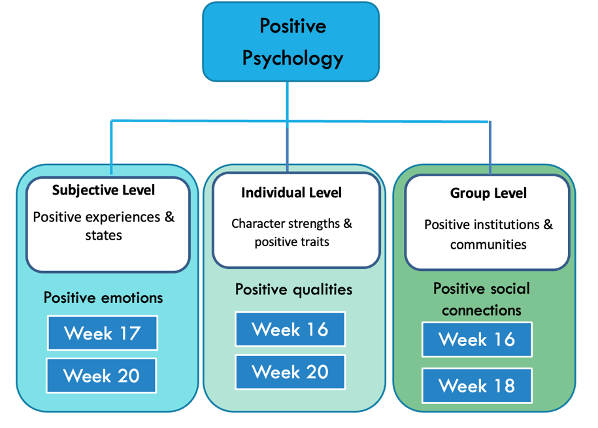
Positive psychology has 3 main concepts that span 3 different levels of human experience….
Subjective level - pos experiences and states
Induvidual level - character strengths and pos traits
Group level - pos institutions and communities
self-actualisation (Maslow) maps well onto
eduaimonic wellbeing
history of positive psychology —> Martin Seligman (Father of pos psych) —→ Recognised that psychology had largely neglected the two of its three pre-World War II missions
1. Curing mental illness
2. Helping all people to lead more productive and fulfilling lives
3. Identifying and nurturing high talent
Matin Seligman —> during his 1998 presidential address to the APA
resolved to shift the focus of psychology to be more positive.
Advocated for strengths-based rather than deficits-based approaches
Mihaly Csikszentmihalyi. → Worked alongside Martin Seligman to…..
launch initial discussions about positive psychology, why it was needed, and how the field could be developed.
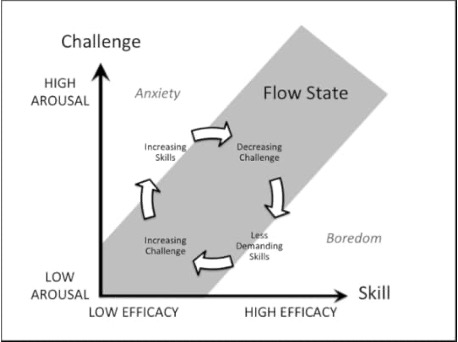
• Also developed the concept of “flow”, a form of “optimal experience”
Flow state - Mihaly Csikszentmihalyi
the state of concentration and engagement that can be achieved when completing a task that challenges a person's skills but does not exceed them.