Free Trade Agreements - BME
 Call Kai
 Learn
Learn Practice Test
 Spaced Repetition
 Match
Match Flashcards
 Knowt Play
1/10

There's no tags or description
Looks like no tags are added yet.
Name | Mastery | Learn | Test | Matching | Spaced | Call with Kai |
|---|
No analytics yet
Send a link to your students to track their progress
11 Terms
Free trade agreements
A free trade agreement (FTA) is an international treaty between two or more economies that reduces or eliminates certain barriers to trade in goods and services, as well as investment.
Australia negotiates FTAs to benefit Australian exporters, importers, producers and investors by reducing and eliminating certain barriers to international trade and investment.
Trade Agreements need to know
ASEAN-Australia-New Zealand Free Trade Agreement (AANZFTA) - ! January 2010 for eight countries; Australia, New Zealand, Brunei, Burma, Malaysia, The Philippines, Singapore and Vietnam. For Thailand: 12 March 2010. For Laos: 1 January 2011. For Cambodia: 4 January 2011. For Indo: 10 Jan 2012.
Australia-New Zealand (ANZCERTA or CER) - 1 Jan 1983
Features and role of FTAs
FTAs between countries aim to standardised import and export laws and regulations.
An example is where tariffs and customs duties are reduced, removed or standardised. The countries that are parties to the FTA can export their produce to each other and sell at similar prices as local products.
Product safety and quality laws and regulations may also be reduced or removed, opening a market to more products.
ASEAN-Australia-New Zealand Free Trade Agreement (AANZFTA)
Countries:
the ASEAN (Association of Southeast Asian Nations) countries of Brunei, Myanmar, Cambodia, Indonesia, Laos, Malaysia, the Philippines, Singapore, Thailand and Vietnam.
New Zealand and Australia
Commenced:
1 January 2010.
Covers:
the industry sectors of goods, services, investment and intellectual property.
Some Key Points:
Eliminate tariffs on 96% of Australia’s exports to ASEAN nations by 2020.
AANZFTA-certified goods have their tariffs reduced when they entered ASEAN countries.
International arbitration is established to resolve foreign investment disputes.
The FTA sets minimum standards for the treatment of foreign investors and their investments within signatory countries.
ASEAN-Australia-New Zealand Free Trade Agreement (AANZFTA) - Outcomes
Key Features
Tariff Reduction: Tariffs will be progressively lowered and eliminated on at least 90% of tariff lines within set timelines.
Trade Facilitation: Rules of origin are modernized and flexible, with simplified, transparent customs procedures.
Services Liberalization: Trade barriers will be reduced to increase market access for service suppliers.
Business Mobility: Facilitation of movement for personnel involved in investment and trade.
Investment Protection: Foreign direct investments receive protection, including mechanisms for investor-state dispute settlement.
AANZFTA examples
Meat and livestock: tariffs on most meat tariffs lines phased to 0% and access for live bovine imports guaranteed
Dairy products: tariffs phased to 0% except for a few products Indonesia, the Philippines and Malaysia
Iron and steel: tariffs on most products phased to 0% or to 10% or less
New passenger motor vehicles: elimination of all tariffs in the Philippines.v
Australia New Zealand Closer Economic Relations Trade Agreement (ANZCERTA)
Countries:
Australia and New Zealand.
Commenced:
1 January 1983.
Covers:
One of the most comprehensive bilateral free trade agreements in existence.
Covers substantially all trans-Tasman trade in goods, including agricultural products, and was the first to include free trade in services.
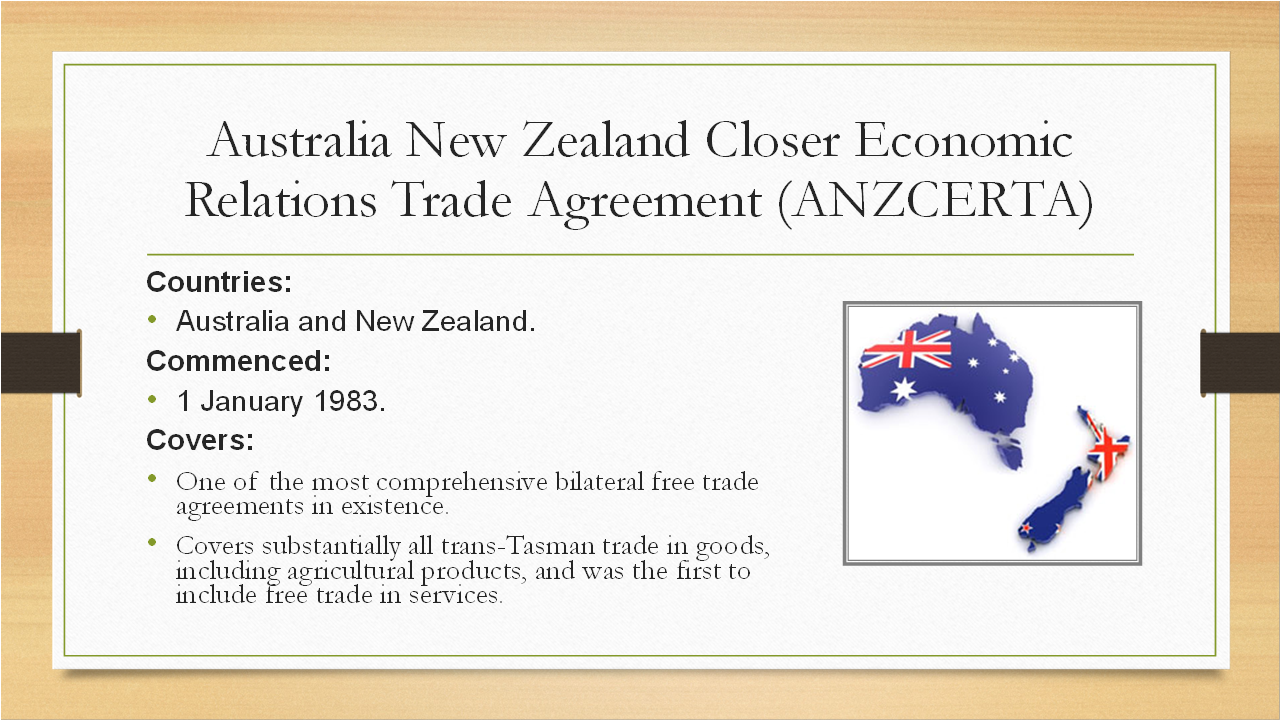
Australia New Zealand Closer Economic Relations Trade Agreement (ANZCERTA)
Some key points:
All tariffs and restrictions on import and export between the two countries are prohibited.
Minimise government industry assistance and export subsidies and incentives to ensure a level playing field.
Food standards are standardized (safety, limits, ingredients and allergens etc.)
Australia New Zealand Closer Economic Relations Trade Agreement (ANZCERTA)
Key Features:
Prohibits all tariffs and quantitative import or exports restrictions on trade in goods originating within the Free Trade Area under ANZCERTA
Reduces Distortions: Minimizes trade-distorting measures, including export subsidies and domestic industry assistance
Harmonizes Trans-Tasman food Standards: Aligns food standards via the 1995 ANZFA Agreement, reducing regulatory barriers and compliance costs.
Mutual Recognition: Facilitates the movement of goods and skilled personnel by recognizing standards and qualifications across jurisdictions.
Encourages Investment: The 2013 Investment Protocol lowers compliance costs, raises screening thresholds, and increases legal certainty for investors, with two-way investment exceeding $149 billion as of 2019.
Benefits to Australian-owned businesses as a result of FTA’s
Increased overseas market access as Australian owned businesses can sell more products overseas as the price will be less for consumers leading to increased profits.
Cost of importing supplies will be less for the Australian owned businesses so they are able to manufacture products more cheaply.
Provides job opportunities in Australia when sales increase.
Australian business owners can conduct business travel more efficiently to the country they deal with through the ‘movement of natural persons’.
Increased opportunities for foreign direct investment in Australian businesses and/or Australian owned businesses investing into overseas businesses.
Challenges to Australian-owned businesses as a result of FTA’s
Increased competition from foreign-owned business leading to reduced market share.
Job loss due to higher labour costs in Australia leading to Australian owned businesses being less competitive in global markets.
Complexities of free trade agreement clauses (such as "Rule of Origin) whereby Australia owned businesses need to determine qualification and pay the appropriate fees.
Non-tariff measures which otherwise restrict the flow of Australian products (including licenses, quotas, embargoes etc.)
More challenging for manufacturing industries as they compete on the international markets with pricing.
Inconsistent tariff reductions where various industries or products might not be included in certain FTAs
Explore top notes

