HITT EXAM 4 (C. 7-8)
 Call Kai
 Learn
Learn Practice Test
 Spaced Repetition
 Match
Match Flashcards
 Knowt Play
1/253

There's no tags or description
Looks like no tags are added yet.
Name | Mastery | Learn | Test | Matching | Spaced | Call with Kai |
|---|
No analytics yet
Send a link to your students to track their progress
254 Terms
Lymph/o
The fluid that removes cellular waste products, pathogens, and dead blood cells from the tissues.
Lymphangi/o
The capillaries, vessels, and ducts that return lymph from the tissues to the venous bloodstream.
Lymphaden/o
Bean-shaped structures of the lymphatic system where pathogens and other harmful substances are filtered from the lymph by specialized cells of the immune system.
Tonsill/o, adenoid/o
Lymphoid structures of the lymphatic system that protect the entry to the respiratory system.
Splen/o
A sac-like mass of lymphoid tissue with protective roles in both the immune and lymphatic systems.
Myel/o
Produces lymphocytes, which are specialized leukocytes (white blood cells).
Lymphocyt/o
Specialized leukocytes that play important roles in immune reactions.
Thym/o
A gland located in the upper chest with specialized roles in both the lymphatic and immune systems.
Nas/o
Exchanges air during inhaling and exhaling; warms, moisturizes, and filters inhaled air.
Sinus/o
Produce mucus for the nasal cavities, make bones of the skull lighter, aid in sound production.
Pharyng/o
Transports air back and forth between the nose and the trachea.
Laryng/o
Makes speech possible.
Epiglott/o
Closes off the trachea during swallowing.
Trache/o
Transports air back and forth between the pharynx and the bronchi.
Bronch/o, bronchi/o
Transports air from the trachea into the lungs.
Alveol/o
Air sacs that exchange gases with the pulmonary capillary blood.
Pneum/o, pneumon/o
Bring oxygen into the body, and remove carbon dioxide and some water waste from the body.
anti-
Against.
-cocci
Spherical bacteria.
-cyte
Cell.
-edema
Swelling.
immun/o
Immune, protection, safe.
lymph/o
Lymph, lymphatic tissue.
lymphaden/o
Lymph node or gland.
lymphangi/o
Lymph vessel.
-lytic
To destroy.
macro-
Large.
-oma
Tumor.
phag/o, -phage
Eat, swallow.
splen/o
Spleen.
-tic
Pertaining to.
tox/o
Poison, poisonous.
anoxia (ah-NOCK-see-ah)
(an- means without, ox/o means oxygen, and -ia means condition).
Absence of oxygen.
antitussive (an-tih-TUSS-iv)
(anti- means against, tuss/o means cough, and -ive means performing a specific action)
Medication that suppresses coughing.
aphonia (ah-FOH-nee-ah)
(a- means without, phon/o means voice, and -ia means condition).
Loss of voice.
asbestosis (***-beh-STOH-sis)
(asbest/o means asbestos, and -osis means abnormal condition).
Lung disease caused by asbestos exposure.
asphyxia (***-FICK-see-ah)
(a- means without, sphyx/o means pulse, and -ia means condition).
Lack of oxygen leading to suffocation.
asthma (AZ-mah)
Chronic respiratory condition causing wheezing and difficulty breathing.
atelectasis (at-ee-LEK-tah-sis)
(atel means incomplete, and -ectasis means stretching or enlargement).
Collapse of lung tissue.
bradypnea (brad-ihp-NEE-ah)
Abnormally slow breathing.
bronchiectasis (brong-kee-ECK-tah-sis)
Abnormal dilation of the bronchi.
bronchodilator (brong-koh-dye-LAY-tor)
Medication that relaxes and expands airways.
bronchorrhea (brong-koh-REE-ah)
Excessive bronchial mucus secretion.
bronchoscopy (brong-KOS-koh-pee)
Procedure to examine the airways.
bronchospasm (BRONG-koh-spazm)
Contraction of the bronchial muscles.
Cheyne-Stokes respiration (CHAYN STOHKS)
Abnormal pattern of breathing with periods of apnea.
chronic obstructive pulmonary disease
Progressive lung disease causing breathing difficulty.
croup (KROOP)
Viral infection causing swelling of the larynx.
cyanosis (sigh-ah-NOH-sis)
Bluish discoloration of the skin due to lack of oxygen.
cystic fibrosis (SIS-tick figh-BROH-sis)
life-threatening genetic disorder in which the lungs and pancreas are clogged with large quantities of abnormally thick mucus.
dysphonia (dis-FOH-nee-ah)
Difficulty in speaking/the loss of the ability of the larynx to produce normal speech sounds
dyspnea (DISP-nee-ah)
Difficulty in breathing.
emphysema (em-fih-SEE-mah)
Chronic lung condition causing shortness of breath.
empyema (em-pye-EE-mah)
Accumulation of pus in the pleural cavity.
endotracheal intubation (en-doh-TRAY-kee-al in-too-BAY-shun)
Insertion of a tube into the trachea to maintain an open airway.
epistaxis (ep-ih-STACK-sis)
Nosebleed.
hemoptysis (hee-MOP-tih-sis)
Coughing up blood.
hemothorax (hee-moh-THOH-racks)
Blood accumulation in the pleural cavity.
hypercapnia (high-per-KAP-nee-ah)
Excessive carbon dioxide in the bloodstream.
hyperpnea (high-perp-NEE-ah)
Increased depth and rate of breathing.
hypopnea (high-poh-NEE-ah)
Abnormally shallow breathing.
hypoxemia (high-pock-SEE-mee-ah)
Low oxygen levels in the blood.
hypoxia (high-POCK-see-ah)
Deficiency of oxygen in the tissues.
laryngitis (lar-in-JIGH-tis)
Inflammation of the larynx.
laryngoscopy (lar-ing-GOS-koh-pee)
Examination of the larynx using a scope.
laryngospasm (lah-RING-goh-spazm)
(laryng/o means larynx, and -spasm means a sudden involuntary contraction)
Involuntary contraction/sudden spasmodic of the laryngeal muscles.
mediastinum (mee-dee-as-TYE-num)
Space between the lungs containing the heart and other structures.
nebulizer (NEB-you-lye-zer)
Device that converts liquid medication into mist for inhalation.
otolaryngologist (oh-toh-lar-in-GOL-oh-jist)
Specialist in ear, nose, and throat disorders.
pertussis (per-TUS-is)
Whooping cough, a highly contagious respiratory disease.
pharyngitis (fah-rin-JIGH-tis) or Streptococcus
A sore throat is an inflammation of the pharynx.
pleural effusion (eh-FEW-zhun)
Fluid accumulation in the pleural space.
pleurisy (PLOOR-ih-see)
pleur means pleura, and -isy is a noun ending)Pleurodynia
Inflammation of the pleura.
pleurodynia (ploor-oh-DIN-ee-ah)
(pleur/o means pleura, and -dynia means pain).
Pain in the pleura when the inflamed pleural membranes rub against each other with each inhalation
pneumoconiosis (new-moh-koh-nee-OH-sis)
(pneum/o means lung, coni means dust, and -osis means abnormal condition or disease)
Lung disease caused by inhaling dust.
pneumonectomy (new-moh-NECK-toh-mee)
pneumon-ectomy
Surgical removal of a lung.
pneumonia (new-MOH-nee-ah)
An infection that inflames the air sacs in one or both lungs.
pneumothorax (new-moh-THOH-racks)
(pneum/o means lung or air, and -thorax means chest).
Air in the pleural cavity causing lung collapse.
polysomnography (pol-ee-som-NOG-rah-fee)
( poly- means many, somn/o means sleep, and -graphy means the process of recording).
Test used to diagnose sleep disorders.
pulmonary edema (eh-DEE-mah)
Fluid accumulation in the lungs.
pulmonologist (pull-mah-NOL-oh-jist)
Specialist in lung diseases.
pulse oximeter (ock-SIM-eh-ter)
Device that measures oxygen saturation in the blood.
pyothorax (pye-oh-THOH-racks)
Pus in the pleural cavity.
sinusitis (sigh-nuh-SIGH-tis)
Inflammation of the sinuses.
sleep apnea (AP-nee-ah)
Condition characterized by pauses in breathing during sleep.
spirometer (spih-ROM-eh-ter)
(spir/o means to breathe, and -meter means to measure).
Measures the amount of air inhaled or exhaled (volume) and the length of time required for each breath
tachypnea (tack-ihp-NEE-ah)
Abnormally rapid breathing.
thoracentesis (thoh-rah-sen-TEE-sis)
(thor/a means thorax or chest, and -centesis means surgical puncture to remove fluid)
Procedure to remove fluid from the pleural space.
thoracotomy (thoh-rah-KOT-oh-mee)
Surgical incision into the chest wall.
tracheostomy (tray-kee-OS-toh-mee)
( trache means trachea, and -ostomy means surgically creating an opening)
Surgical procedure to create an opening in the trachea.
tracheotomy (tray-kee-OT-oh-mee)
(trache means trachea, and -otomy means surgical incision).
Surgical incision into the trachea.
tuberculosis (too-ber-kew-LOH-sis)
Infectious disease caused by the bacterium Mycobacterium tuberculosis.
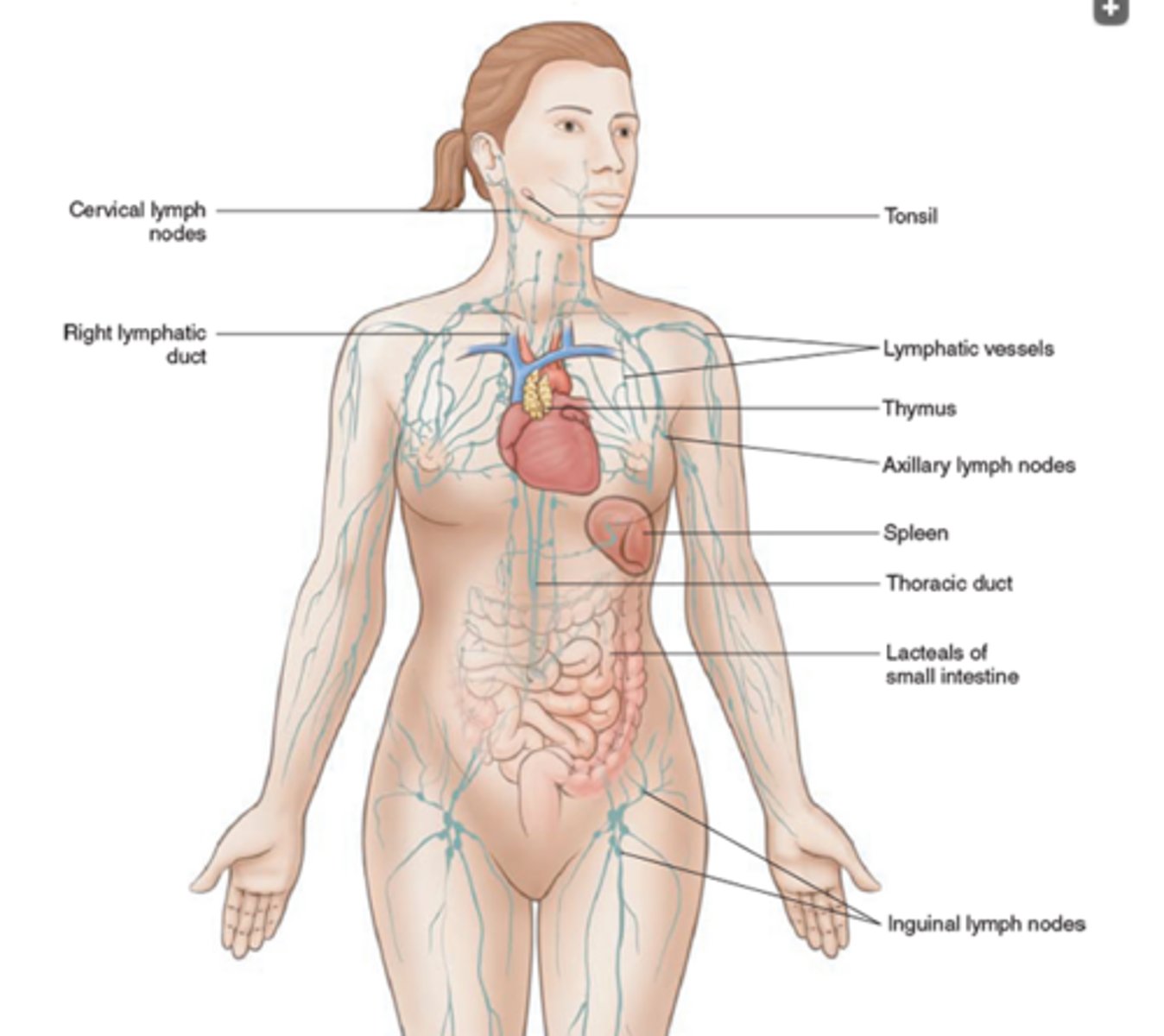
- Absorb fats and fat-soluble vitamins through the lacteals of the small intestine.
- Remove waste products from the tissues and cooperate with the immune system in destroying invading pathogens.
- Return filtered lymph to the veins at the base of the neck.
The three main functions of the lymphatic system are to Absorb Fat, Remove Waste, and Filter Lymph
Lacteals (LACK-tee-ahlz)
Specialized structures of the lymphatic system that absorb dietary fats not transported by the bloodstream.
Interstitial fluid (in-ter-STISH-al)
Plasma from arterial blood that flows into the spaces between cells of the tissues.
Lymph (LIMF)
Clear, watery fluid made up of the remaining 10% of returning interstitial fluid, containing electrolytes and proteins.
What is the primary function of the blood circulatory system?
To circulate blood throughout the body, pumped by the heart.
How does the lymphatic circulatory system differ from the blood circulatory system?
It lacks a pump and relies on muscle movement to move lymph.
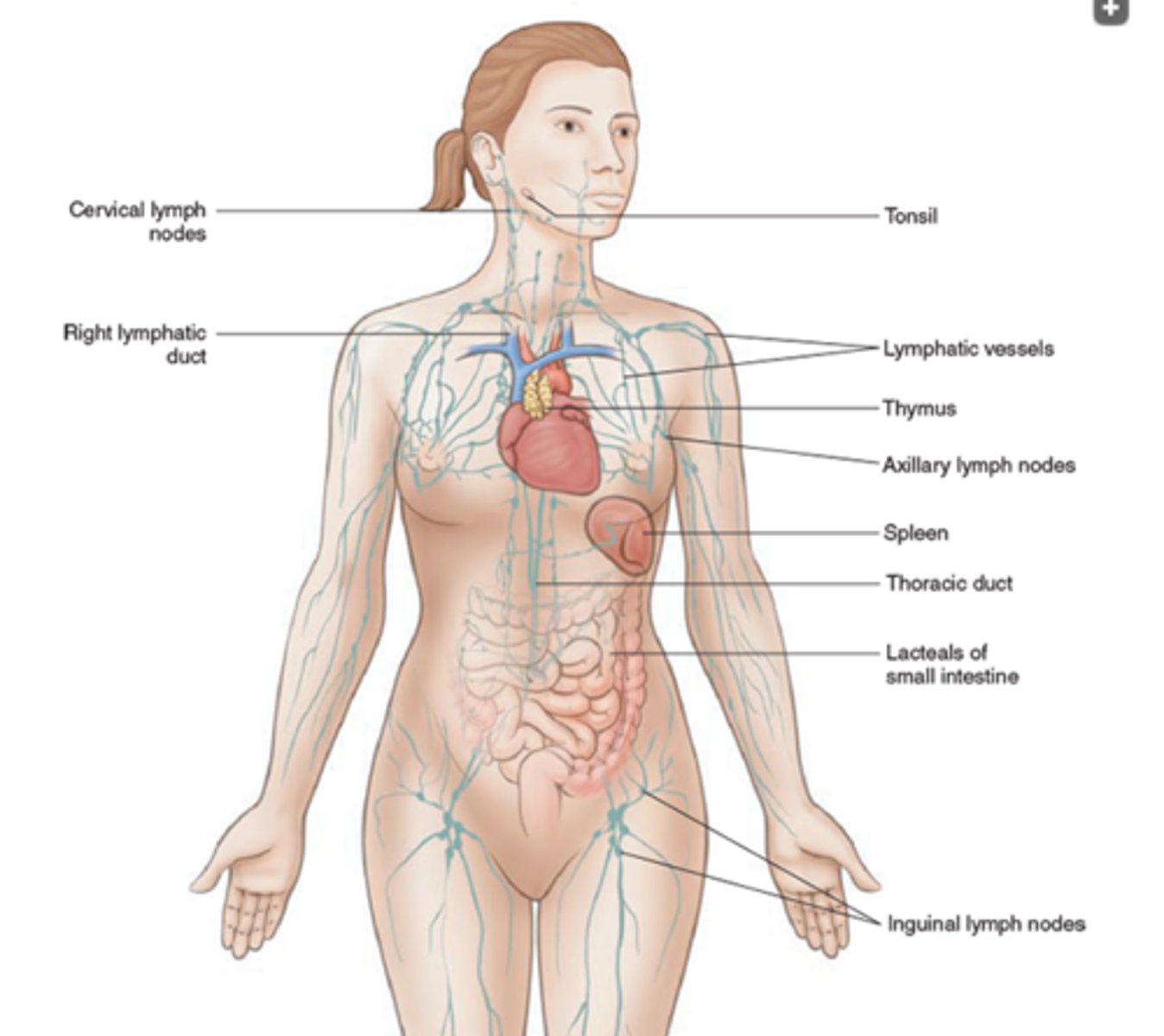
In which direction does lymph flow?
Lymph flows only upward toward the circulatory system at the neck.
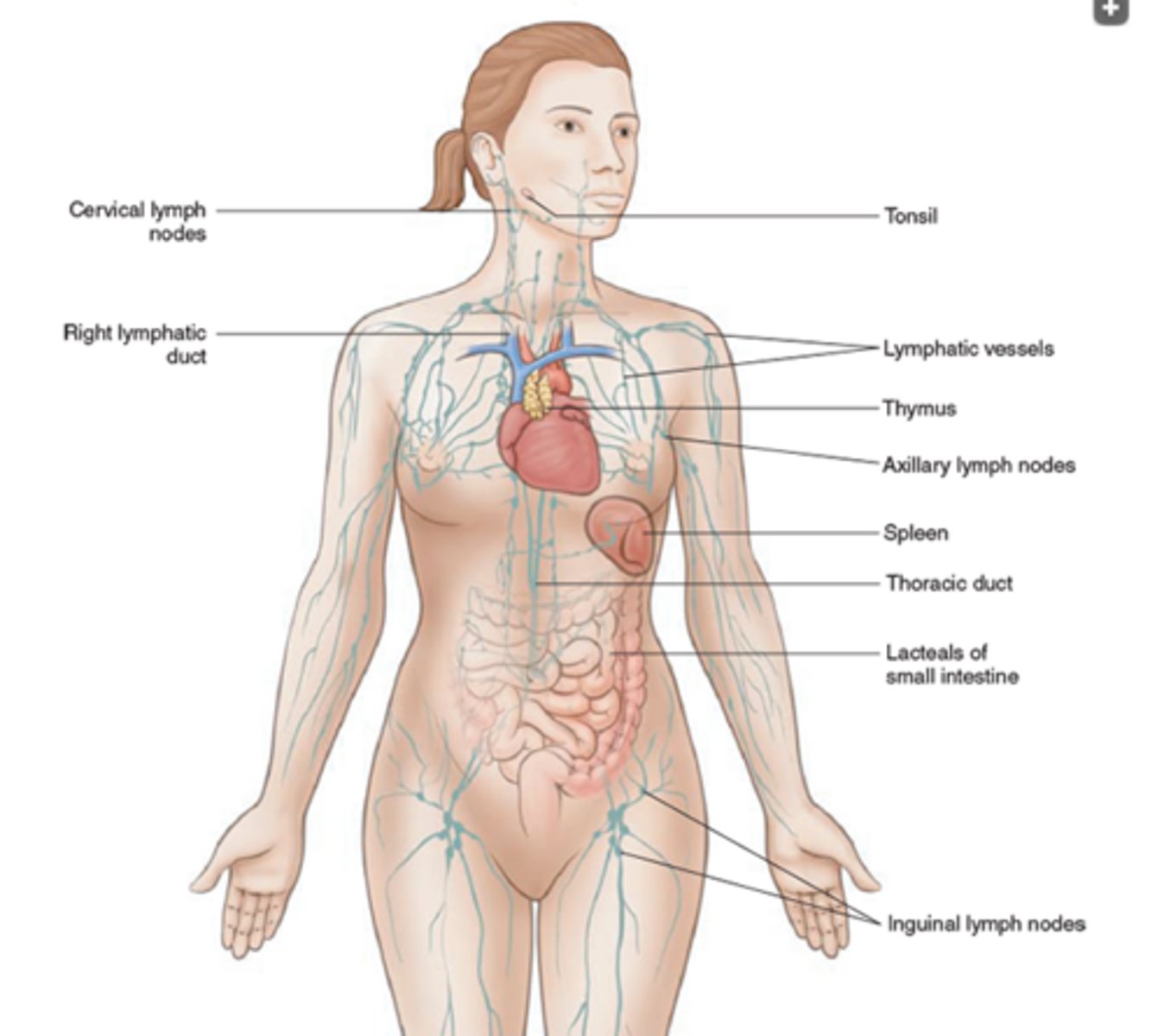
What filters blood and lymph in their respective systems?
Blood is filtered by the kidneys; lymph is filtered by lymph nodes.