IB biology C4.1 populations and communities
 Studied by 0 people
 Call Kai
 Learn
Learn Practice Test
 Spaced Repetition
 Match
Match Flashcards
 Knowt Play
1/65

There's no tags or description
Looks like no tags are added yet.
Name | Mastery | Learn | Test | Matching | Spaced | Call with Kai |
|---|
No analytics yet
Send a link to your students to track their progress
66 Terms
define population
it is an interacting group of organisms of the same species living in an area that can interbreed
what is the main factor that distinguishes populations
reproductive isolation, or if organisms from the same species are not able to breed together successfully due to geographical, temporal, or behavioral isolation
what can lead to speciations
genetic variation that accumulates overtime and leads to speciation
what is the size of a population
the total number of individuals in it
why is it hard to count populations exactly
because some animals use camouflage, and they may be spread over a large area
what are estimates based on
sampling
what is s sample and why cant we only get one
they are small portions of something, and it is not representative of the whole population usually, so you get more to get a more accurate result
what is a random sample
it is one where every member has an equal chance of being selected to minimize bias and accurately reflect the overall population better
how do you estimate the population size of sessile organisms general
repeatedly placing a quadrat frame at random positions of a habitat and recording the number of organisms present at the time
how do you estimate the population size of sessile organisms exact
use a measuring tape to mark a base line along the edge of the habitat
generate random numbers
use the first random number for the distance along the measuring tape
use the second to measure the distance across the habitat at a right angle
place a quadrat precisely at that point
count the number of organisms in that spot. if they touch the line, go by whether a majority of the organism is in or out of the quadrat
repeat the experiment more times to ensure you get more samples
what is the equation for sampling sessile organisms
(number of organisms counted /number of quadrats) x number of quadrats
how do you estimate the population of mobile organisms exact
capture as many individuals as possible in the area
mark each captured individual
release all of the marked individuals and allow them to settle
recapture as many organisms as possible
calculate the population using the lincoln index
what is the equation for the lincoln index
(number of organisms caught and marked initiall x number of all individuals recaptured) / number of marked organisms recaptured, or MN/R
what are the assumptions of the lincoln index
the population is closed
mixing is complete, so the ratio of marked to unmarked is the same throughout
it is equally easy to catch all individuals
marks stay on the organism
what are the limitations of the lincoln index and capture mark release recapture method
capturing them may injure or stress them
marking them may make them more visible to predators
define density of a population
the number of individuals per unit area or volume
what happens around carrying capacity
the number of individuals in a population may fluctuate due to density independent factors, but the density-dependent factors tend to push it back towards the carrying capacity
what is top-down control
when organisms at higher trophic levels regulate the behavior of lower trophic levels in a food chain. It is mainly with predators, which exert control by consuming and limiting their prey
what is bottom-up control
the different resources that are available at lower levels and their overall amount influence the distribution of organisms at higher trophic levels, so things like nutrient availability and climate.
it affects oppositely
how does bottom-up control work with soil
it depends on the nutrients found in the soil, which influence the plants that can grow which influences the abundance of the herbivores and then later the predators and so on
it affects directly proportionally
what are two types of processes where chemical substances are released to deter potential competitors, and affect the dynamics of the ecosystem
allelopathy and antibiotic secretion
define allelopathy
it is the phenomenon in which one organism produces metabolites that influence the growth and success of other organisms
what are the two types of metabolites
primary metabolites: involved in normal growth
secondary metabolites: to impede or kill
what is an example of allelopathy in plants
sinigrin, which is used to inhibit other plant seed germination and reduce the root growth of plants growing in the area without affecting itself.
what is an example of allelopathy in microbes
penicillin which blocks bacterial enzymes involved in building cell walls and thus prevents the growth of bacteria arounfd the fungus, giving the bacteria a competitive advantage for food and for their own colonies to spread without others
what are density independent factors
factors that have the same effect no matter how large the population is such as natural disasters
what are density dependent factors
factors that have an increasing effect as the population becomes larger, and they are the basis for negative feedback mechanisms because they can help reduce large populations and regulate them, keeping them close to the carrying capacity like predation and the transfer of pathogens
what are the three groups of density-dependent factors
competition
predation
infectious disease
describe the predator prey relationships
usually there are less predators than prey
prey number will increase overtime before the predator population increases
food availability for the predators will increase
the predators will increase because they have low competition for food
the prey will decrease because they are being killed
the predator will reach a max because eventually the prey will be too low for the predator
can habitats accommodate an unlimited number of organisms
no, growth eventually stops or plateaus
what is carrying capacity
the maximum number of individuals that a particular habitat can support, which is represented by k
is carrying capacity a limiting factor and why
yes because it limits the survival of an organism
what do density dependent factors do
they keep the population at carrying capacity
why is reproduction positive feedback?
because it increases the number of individuals exponentially
what is the graph of a population size like usually
a sigmoid curve, changing from a J shape to an S shape from positive to negative feedback
what are the three phases of a population curve
phase 1: exponential phase
phase 2: transitional phase
phase 3: plateau phase
what happens in phase 1 of a population curve
there are many resources, low competition, favorable factors and low predation, so there is a lot of reproduction and a low death rate so there are more individuals increasing exponentially
what happens in phase 2 of a population curve
the density dependent factors cause the growth rate to slow down considerably due to negative feedback. there are more individuals so more competition, predators are attracted to greater food supply, and less distance between the organisms so diseases can spread easily
what happens in phase three of a population curve
the density dependent factors cause the size of the population to stay under the carrying capacity, stabilizing it and making the growth rate low or 0. there is less space for animals, more predators, limited supply for food, and the birth rate and immigration are equal to death rate and emigration
define community
a group of populations living together in an area and interacting with each other
define intraspecific relationship
one that exists between individuals of the same species usually within the same population
what is competition intraspecific relationship
it is when individuals in a population are members of the same species so they share an ecological niche and require the same resources. this leads to competition, and there will be natural selection over the generations for traits that allow individuals to compete more effectively
what is a cooperation intraspecific relationship
it is when individuals in a population cooperate together, helping one-another
what are some examples of cooperation intraspecific relationships
lions taking turns sleeping
wolves pack hunting
vampire bats caring for a neighbor’s baby
what is an example of competition intraspecific relationships
lizards competing for a place to lie
gorillas trying to mate
oak trees for sunlight
look at this
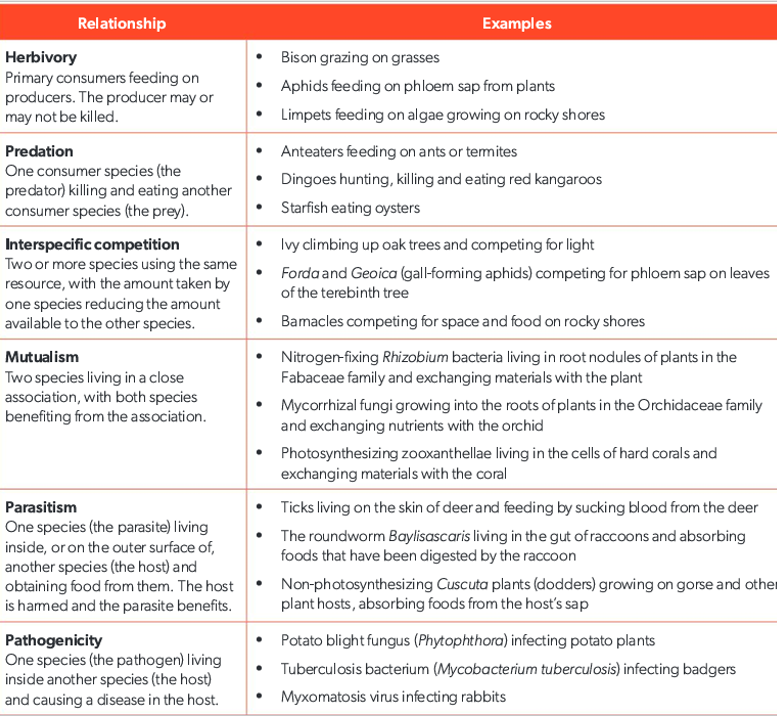
define herbivory
a feeding pattern where one animal is a herbivore and consumes plant materials as its primary source of nutrients like pandas
what is predation
an ecological interaction where a predator captures and consumes its prey like the bear
what is interspecific competition
it occurs when different species compete for limited resources within an ecosystem, which affects species distribution, abundance, and evolution of traits
what is parasitism
it is a type of symbiotic relationship where on organism, the parasite, benefits from its host like tapeworms
what is pathogenicity
it is when a pathogen invades and multiplies within the host’s tissues, disrupting the normal physiological functions and leading to various symptoms of illness like viruses like the retrovirus
what is mutualism
it is a symbiotic interaction between two or more species where both benefit from the relationship like bees and flowers
what is an example of mutualism in root nodules
legume plants which contain root fixing bacteria and play a vital role in converting atmospheric nitrogen into a usable form. the bacteria is provided compounds it needs for survival and the plant gets usable nitrogen
what is an example of mutualism in Orchidaceae
mycorrhizae fungi aid orchids by extending their hyphae into the soil, increasing the surface area for nutrient absorption
the fungi is then provided organic compounds from the orchid through photosynthesis
what is an example of mutualism in corals
zooxanthellae in hard corals live within the tissue of the coral and provide them with essential nutrients from photosynthesis that support coral growth, reproduction, and health. they also protect them from UV rays
the hard coral offer them a sheltered environment and access to sunlight for effective photosynthesis
what are the types of interspecific relationships
herbivory
pathogenicity
interspecific competition
predation
mutualism
parasitism
what is an example of invasive species
killer algae, which is not native to the Mediterranean sea but got there and it secretes a toxin that deters molluscs, herbivorous fish and sea urchins. it has no predators outside of its native range
in the Mediterranean sea, it had rapid growth, so it is leading to a decrease in biodiversity
what are endemic species
species that are only found in one place and nowhere else
what are invasive species
one that is non-native and when introduced to a new area it starts to cause problems for the species that are already living there. it is usually brought by humans
how do researches investigate the competition between two species
they selectively remove a species from the environment and observe the response of the other organisms. some species are successful, which shows interspecific competition. this is not definitive, but they can still look into patterns and make conclusions about the role of competition in the distribution and competition of species
what are the 3 general ways to investigate interspecific competition
field observation
field manipulation
laboratory experiments
what is the chi-squared test used for (test of independence)
to analyze if there is a significant association between two categorical variables , to see if there is an association in the presence of two species
what are the two hypothesis for a chi squared test
null: the distribution of species x and y are not associated
alternative: the distribution is associated (positive or negative)
what does the chi-squared test do and when is it valid
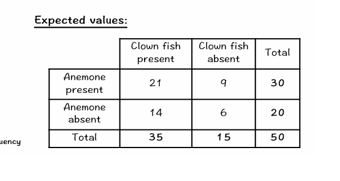
compares the observed quadrat sample values to expected values
it is only valid if all of the expected frequencies are 5+ and the sample was taken at random
how to do a chi-squared test
1-construct a contingency table where you plot observed values when x is present/absent and y is present/ absent and the total for each row and column
2-calculate the expected value by doing:
(row total x column total)/total
3-calculate the number of degrees of freedom:
(m-1)(n-1), where m is the number of rows and n is the number of columns
4-find the critical region, which is at a probability of 0.05
5-calculate the chi-squared value using:
x²= sum of (observed-expected)²/expected \
6- if x² is more than the critical value, the null hypotheses is rejected with 95% confidence. if it is equal or below, the null is accepted and there is no significant association between the two species detected
what are the limitations of the chi-squared test
it is very sensitive to sample size
can establish statistical association but not casual relationship
 Note
Note  Flashcards (161)