Mod 9: Block theory
 Call Kai
 Learn
Learn Practice Test
 Spaced Repetition
 Match
Match Flashcards
 Knowt Play
1/99

There's no tags or description
Looks like no tags are added yet.
Name | Mastery | Learn | Test | Matching | Spaced | Call with Kai |
|---|
No analytics yet
Send a link to your students to track their progress
100 Terms
Breathing involves what two cyclic phases? Describe
Inspiration (inhalation): Draws oxygen rich air into the lungs
Expiration (exhalation): Forces oxygen poor air out of the lungs
What does the respiratory system contribute to?
the functional mechanisms of
respiration
immunity
What is external respiration?
External respiration is the exchange of gases between the air and blood
Describe external respiration
Oxygen (O2) moves from the alveoli in the lungs into the blood
Carbon dioxide moves from the blood into the alveoli
Carbon dioxide is then removed from the body during expiration
What is internal respiration
Exchanges gases (oxygen + carbon dioxide) between the blood and cells of the body
What is gas conditioning?
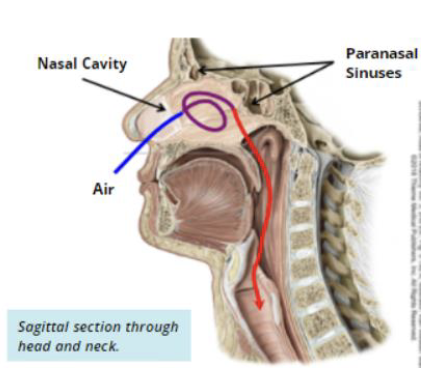
Gas conditioning is the process of warming, humidifying, and cleansing air before it reaches the lungs
prevents damage to lungs
Where does gas conditioning occur? Describe what hapens in each part
Occurs in the nasal cavities and paranasal sinuses
Air is swirled to become warmed + humidified
Particulate matter is removed by the mucosal lining of the respiratory epithelium
How does the production of sound occur?
occurs by forceful expiration of air through the vocal cords in the larynx causing them to vibrate
how do vocal cords produce different sounds?
Different tensions
Help from teeth, lips, and tongue
What does the olfactory epithelium cover?
the top of the nasal cavity
What is located within the olfactory epithelium?
receptors for the sense of smell
What happens to airborne molecules in the nasal cavity during inhalation?
Airborne molecules dissolve in the mucus lining the nasal cavity and stimulate sensory receptors
How are smell signals transmitted to the brain?
Signals from the receptors travel to the brain through the olfactory nerve (CNII), resulting in a sense of smell
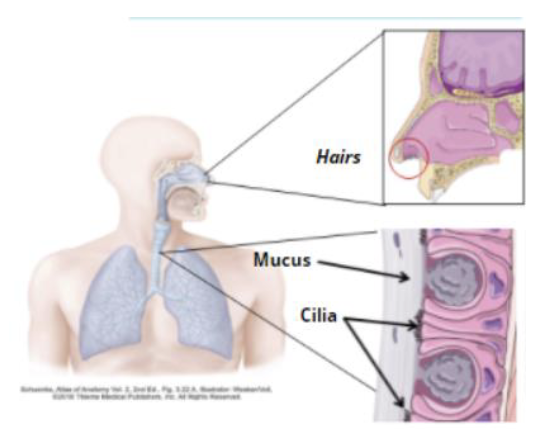
Describe the respiratory systems line of defense (3) against airborne molecules + microbes that cause disease
the coarse hairs of the nostrils
ciliated cells of the respirtatory epithelium
mucus lining help
all help to trap particles and microorgansims from entering the nose + respiratory system
What chamber of the heart does the deoxygnated blood exit from to enter the lungs?
Right ventricle
What chamber of the heart does oxygenated blood re-enter after exiting the lungs?
left atrium
What does the respiratory tract epithelum line?
lines most of the surfaces from the nasal cavity down to the terminal bronchi
large role in defense
what type of epithelium is found in the respiratory tract?
Pseudostratified ciliated columnar epithelium
apical surface: coveredi n cilia
attached to basal lamina
What is the function of cilia in the respiratory tract
Increase surface area for conditioning air (filtering, humidifying, moistening)
How do cilia help portect the respiratory system?
They trap particles + microorganisms in mucus
sweep them up the respiratory tract and out through the nose and mouth
What do goblet cells do? (4)
produce mucus
forms a protective layer over the epithelium
traps PM / microorganisms that may be inhalated
provides moisture to humidify the air before it reaches the lungs
Where are goblet cells found?
interspersed throught the pseudostratified epithetlium
Regions of the respiratory system
Conducting portion
Respiration portion
What is the function of the conducting portion of the respiratory system?
it carries air to and from the lungs without contributing to gas exchange
What processes occur in the conducting portion?
humidification of air and trapping of debris
Does gas exchange occur in the conducting portion?
No, oxygen is not absorbed because the walls are too thick
What structures are included in the conducting portion of the respiratory system?
nose + nasal cavity
paranasal sinuses
pharynx
larynx
trachea
primary/secondary/tertiary bronchi
terminal brochioles
What does the respiratory region function to do?
transfer gases between the lungs + pulmonary capillaries
Describe pulmonary capilaries
tiny blood vessels in the lungs that surround alveoli (air sacs)
where gas exchange occurs
Structures that make up the respiratory portion
Respiratory bronchioles
Alveolar ducts
Alveolar sacs
Alveoli
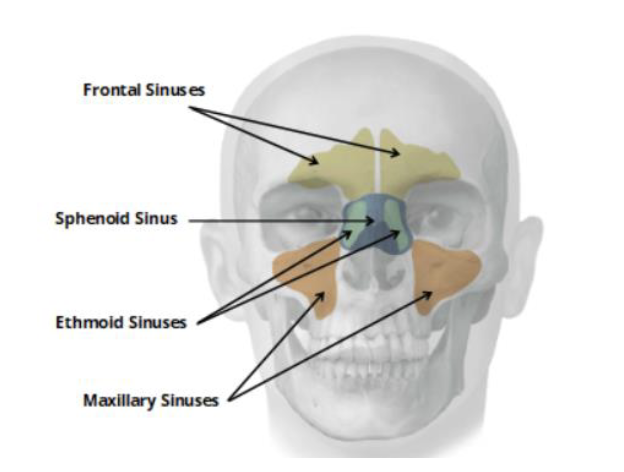
What are the paranasal sinuses?
A collection of air-filled spaces within the bones of the skull that communicate with the nasal cavity
How do the paranasal sinuses contribute to defense?
They help protect against pathogens
What role do the paranasal sinuses play in speech?
They act as resonance chambers for speech
The (4) Sinuses:
Frontal sinus (2)
Maxillary sinus (2)
Ethmoid sinus (2)
Sphenoid sinus (2)
What lines paranasal sinuses
respiratory tract epithelium
What is the first line of defence against invading pathogens + debris? What does it do?
Nose + nasal cavity
traps the in coarse hairs + mucus
air enters the nostril and is passed into the nasal cavity where it is conditioned
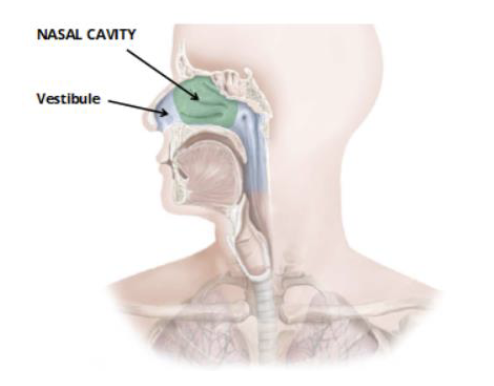
what are the 6 boundaires that make up the nasal cavity
roof
floor
medial wall
lateral wall
anterior
posterior
What is the roof of the nasal cavity?
ethmoid bone
what is the floor of the nasal cavity composed of?
hard palate
What does the medial wall of the nasal cavity make up?
Nasal septum
What is the nasal septum composed of? what does it do?
vertical bones in the skull
seperates the two halves of the nasal cavity
What does the lateral walls of the nasal cavity contain?
nasal conchae
what does the nasal conchae do?
create turbulence in the air
allows for conditioning
catches debris
what makes up the anterior boarder of the cavity?
Nares
opening between the nose + nasal cavity
What is the posterior border of the nasal cavity?
the opening to the nasopharynx (choanae)
where the nasal cavity connects to the pharynx
what is the nasal cavity covered in?
respiratory tract epithelium (RTE)
what lines the nasal cavity? what does it contain?
olfactory epithelium
contains sensory receptors for smell
what is the oflactory epithelium composed of?
pseudostratified ciliated columnar epithelium
bipolar olfactory receptor neurons
what is the pharynx? what does it connect?
muscular tube
connects the nasal cavity + the larynx
connects the oral cavity w/ esophagus
3 components that make up the pharynx? say which is superior, middle, inferior
the nasopharynx
superior
the oropharynx
middle
the laryngopharynx
inferior
What systems is the oropharynx and laryngopharynx apart of?
both apart of respiratory + digestive systems
function of the oropharynx
passes air from the nasopharynx
passes food from the oral cavity into the laryngopharynx
laryngopharynx function
passes food into digestive system
passses air into respiratory system
what is the nasopharynx lined with?
respiratory tract epithelium (RTE)
what lines the oropharynx + laryngopharynx? why?
stratified squamous epithelium
need for durability when swallowing food
what is the purpose of the larynx?
produces sound
prevents food from entering the trachea
3 main cartilages of the larynx
epiglotties
thyroid cartilage
cricoid cartilage
purpose of the epiglottis
prevents food from passing into the trachea
during swallowing, the epiglotties flips downwards and covers the opening of the trachea
what are vocal cords?
small ligaments attahed to laryngeal cartilages that vibrate when air is forced out of the lungs
what are vocal cords protected by?
false vocal cords (membranous flap)
where does the trachea extend to? what happens once it reaches it?
extends from the larynx to T4/T5 where it splits at a junction called the carina
what is the main function of the trachea?
conduction of air to the lungs
what makes up the trachea
15-20 C shaped cartilaginous rings
what is the function of the rings in the trachea?
to keep the airway open
trachea can be identified by what 3 histological layers?
Mucosa
Submucosa
Adventitia
what lines the trachea? why?
Respiratory tract epithelium
clears any debris or pathogens that make it into the lower respiratory tract
What is the submucosa made up of?
loose (areolar) connective tissue
what does the submucosa contain?
larger vessels + nerves
mucus secreting glands
What is the adventitia
outer layer of connective tissue surrounding the trachea
What is the adventitia made up of?
C-shaped cartilaginous rings
made of hyaline cartilage
Splitting of the treachea results in what?
2 primary bronchi
left + right
has the same functional + histological features as the trachea
Describe the primary bronchi’s
Right primary bronchus is shorter + wider + more verticle
Where does the primary bonchi' enter the lung?
on the medial side of the hilus
What is the end of the conducting portion
characterized by bronchi dividing into smaller and smaller tubes
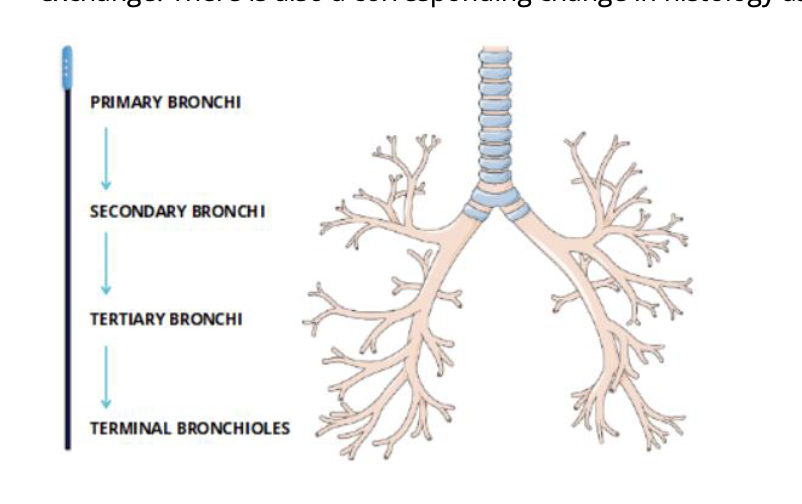
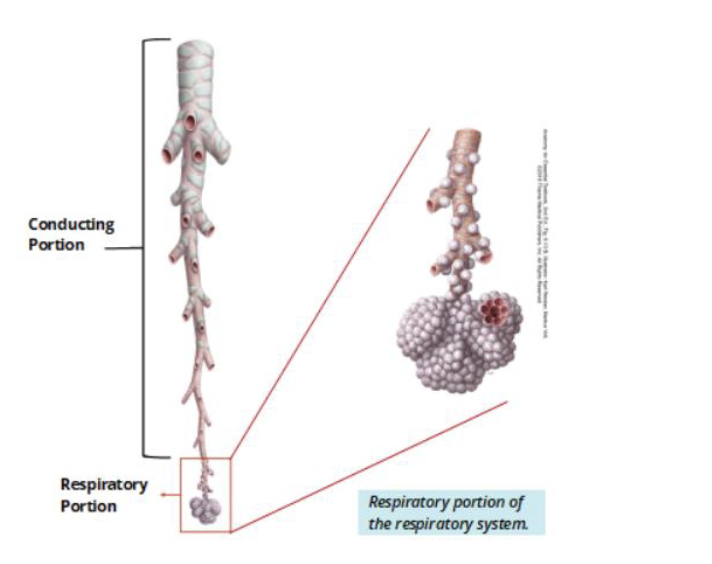
What is the purpose of the conducting portion of the respiratory system
moving air into and out of the lungs
the conducting portion of the respiratory ssytem leads into what?
the respiratory portion
Purpose of the respiratory portion
allow for gas exchange between air and blood
Describe the walls at the respiratory portion
one cell layer thick
gases are able to cross easily
WHere are the lungs located
either side of the heart
within the thoracic cavity
Which lung is bigger and why?
Left lung
due to positioning of the heart
Describe the right lung features
3 lobes
superior, middle, and inferior lobes
2 fissures → seperate the lobes
horizontal + oblique fissures
Describe the left lung
2 lobes
superior + inferior lobes
one fissure → seperates the lobes
oblique fissure
What’s special about the superior lobe on the left lung
contains the cardiac notch
a depression
lingula that covers the heart
small outward facing process
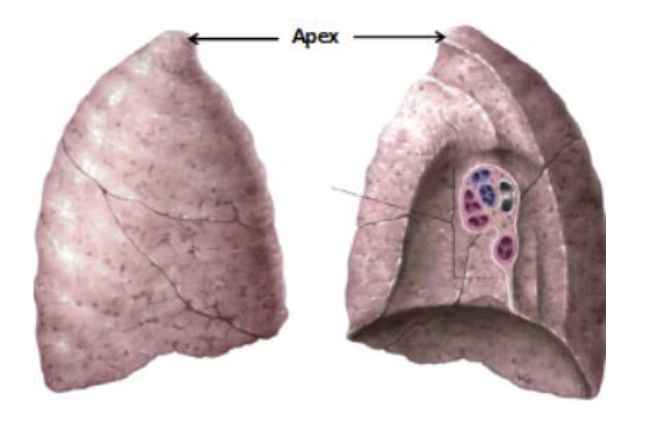
what is the apex of the lung
most superior point
sits above the first rib
what is the diaphragmatic surface
the base of the lung
surface that rests on the diaphragm
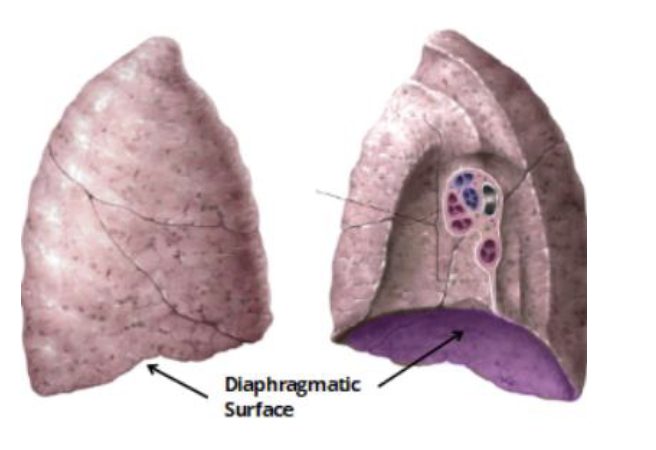
Where does the lung sit relative to the diaphragm
superiorly
What is the costal surface
Covers around the lateral aspect of the lung
What is the mediastinal surface of the lung
the medial surface
it contains the entry + exit points for all vessels and airways at a structure
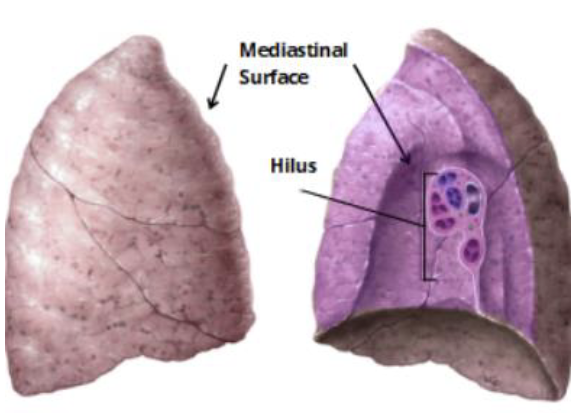
What is the pleura?
A double-layered membrane that surrounds each lung
What are the two layers of the pleura?
Visceral pleura (covers the lungs)
parietal plerua 9lines the thoracic wall)
What is the pleural space
The space between the visceral and parietal pleura
What is found in the pleural space
Pleural fluid
What is the function of pleural fluid?
Acts as a lubricant to reduce friction during breathing
Why is pleural fluid important for lung movement?
It allows the lungs to slide smoothly against the thoracic wall during inflation and deflation
Where are the parietal + visceral pleura continuous?
at the hilus of the lung
What happens at the hilus?
Parietal pleura reflects inward to become visceral pleura
What do respiratory bronchioles branch from?
Terminal brochioles
What is significant about respiratory bronchioles?
They are the first structures where gas exchange begins
What is the alveolus?
The functional unit of the lung where gas exchange occurs
Why are alveoli surrounded by capillaries?
To maximize gas exchange

