BSCI 170: Photosynthesis
 Call Kai
 Learn
Learn Practice Test
 Spaced Repetition
 Match
Match Flashcards
 Knowt Play
1/35

Earn XP
Description and Tags
Exam 2 material
Name | Mastery | Learn | Test | Matching | Spaced | Call with Kai |
|---|
No analytics yet
Send a link to your students to track their progress
36 Terms
What did Jan Baptist Van Helmont discover
the mass of a tree comes from water and carbon in the air
What’s the role of chloroplasts?
to capture light energy from the sun and covert it to chemical energy
Autotrophs & photautotrophs
self feeders
can produce organic molecules from inorganic forms of C (like CO2 in air)
photoautortrophs: use light energy to drive this process ^
they are also produces of biosphere
Heterotrophs
feed on others; cannot make their own food (C-C bonds)
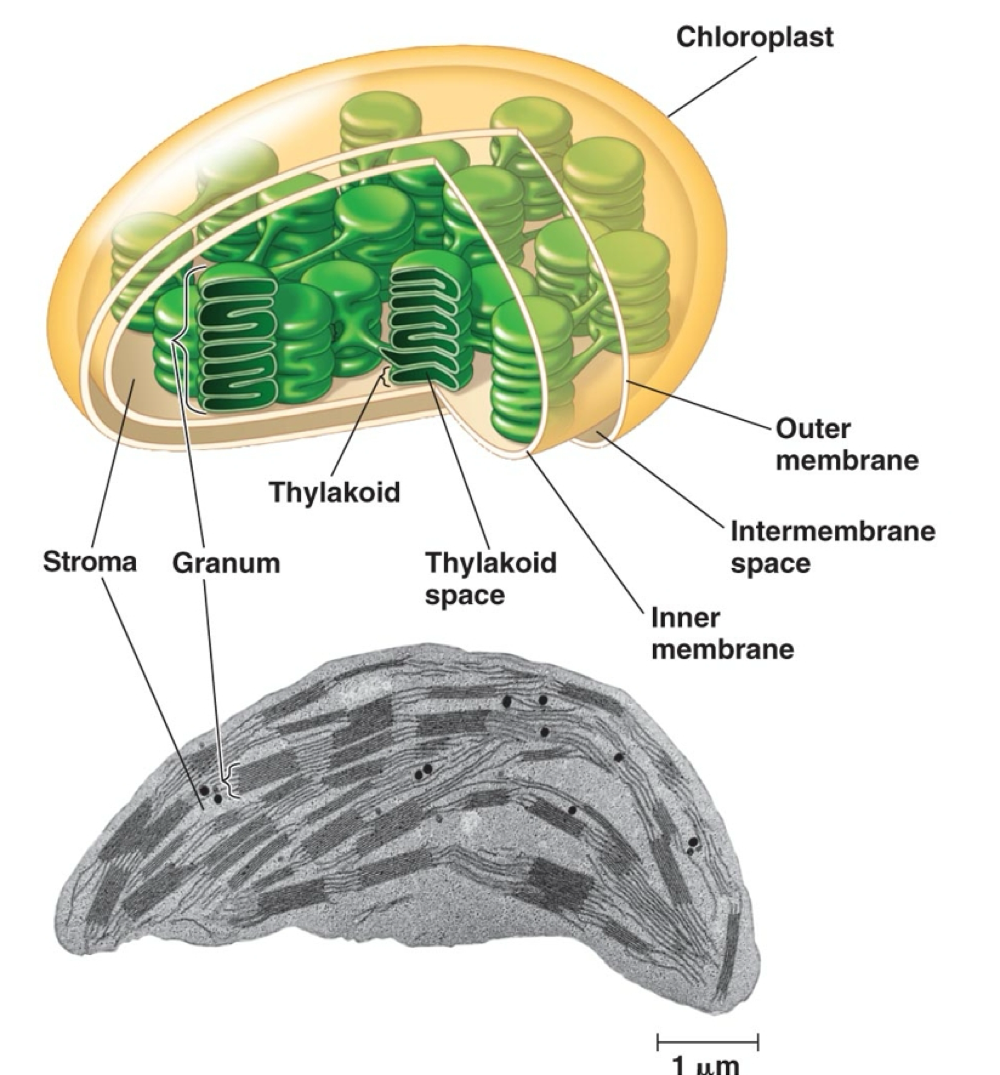
Where does photosynthesis occur?
thylakoids of the chloroplast
Photosynthesis equation
Anabolic
light + 6CO2 + 6H2O —> C6H12O2 + 6O2
electrons (& H+) from ___ are added to ___
H2O, CO2
H2O is ____ to O2.
oxidized
CO2 is ____ to a carbohydrate (CH2O)n
reduced
Is photosynthesis exergonic or endergonic?
endergonic; electrons gain energy in the process
2 stages of photosynthesis
photo: light dependent reactions (1st)
synthesis: light independent reactions (2nd)
What is the purpose of the light independent reactions (synthesis)?
to reduce inorganic atmospheric carbon (CO2) into carbohydrate (CH2O)n
What does the Calvin cycle use to convert inorganic C into sugar?
ATP and NADPH (same as NADH, just with phosphate)
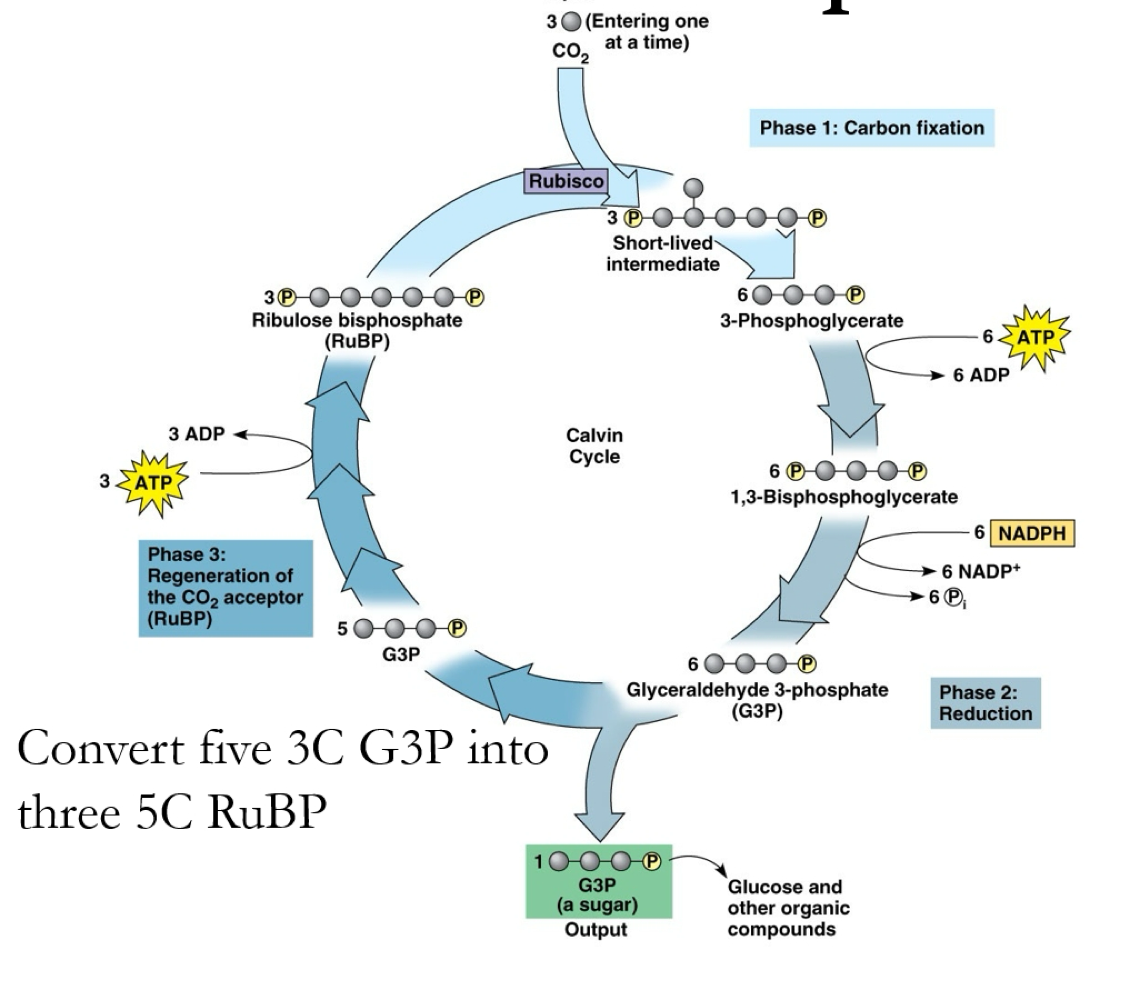
What are the 3 steps of the Calvin Cycle?
Carbon fixation
Reduction
Recognition of CO2 acceptor
Carbon Fixation (Calvin cycle)
1st step
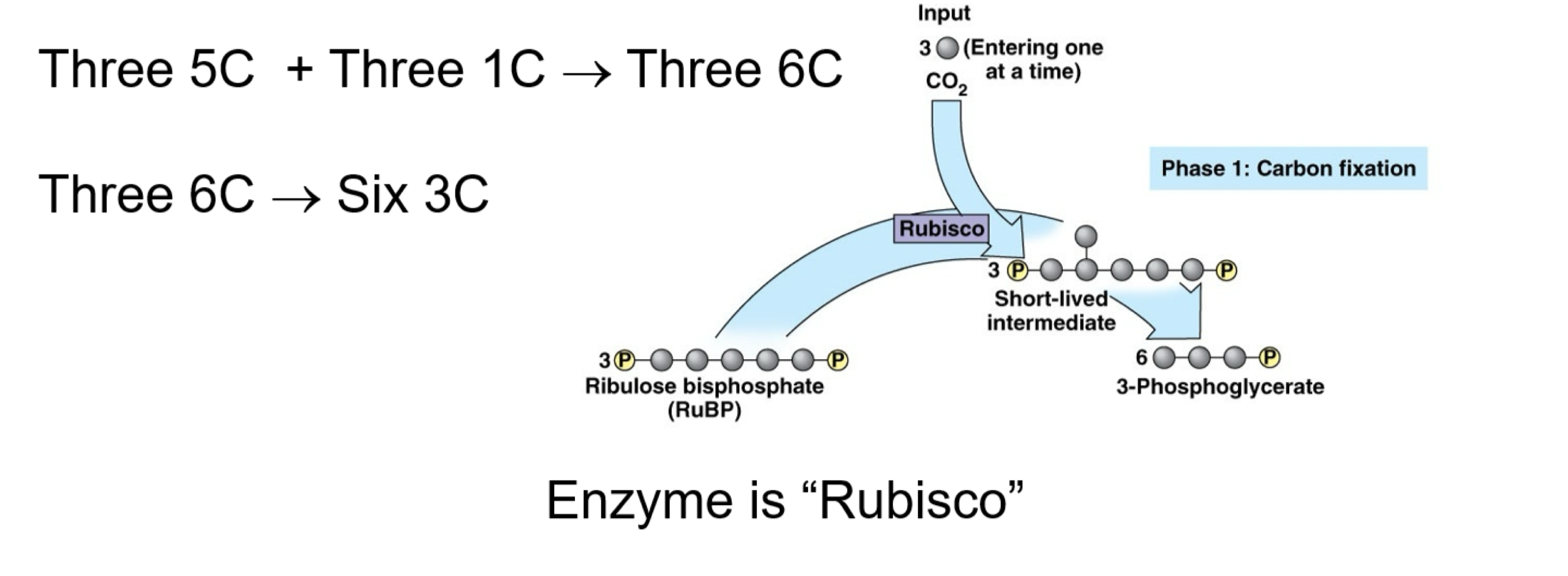
3 RuBP+ 3 CO2 ——> 6 3-PG
ribulose biphoshate (rubisco) + CO2 come in to create 3 carbon phosphoglycerate
What is Rubisco
enzyme used during crabon fixation
most abundant protein on earth (> 40 lbs per person)
Reduction of carbon (Calvin cycle)
2nd step
products of carbon fixation are phosphorylated & reduced
Input:
ATP used to phosphorylates
NADPH used to add H & high energy electron
Output:
1 G3P is removed
Recognition of CO2 Acceptor (Calvin Cycle)
3rd step
ATP atp is added to rearrange 3C G3P molecule back into 5C RuBP so that it is ready to accept more C
How many CO2 are fixed in the Calvin cycle to make one 3-Carbon molecule (G3P)?
3
How many ATPs are consumed in the Calvin cycle to make one 3-Carbon molecule (G3P)?
9 ATPs
How many NADPH’s are consumed in the Calvin cycle to make one 3-Carbon molecule (G3P)?
6 NADPHs
How many ATPs are consumed for each carbon fixed into organic form in the Clavin cycle?
3 ATPs
How many NADPH’s are consumed for each carbon fixed into organic form in the Clavin cycle?
2 NADPH
What happens to the G3P?
In starch synthesis: Energy storage
In sucrose synthesis: energy transprot
oxidation to make ATP in cytosol & mitochondria
Visible light spectrum
400-700 nm
List the 3 photosynthetic pigments
chlorophylls: green
carotenoids: yellow, orange
phycobilin & phycoerythrin: red
What happens during the light dependent reactions?
Absorbed light energy is converted and stored transiently in the form of ATP & NADPH
What are the roles of NADPH & ATP
ATP provides energy to drive anabolic reactions
NADPH: electron carrier like NADH, provides electrons needed to reduce CO2
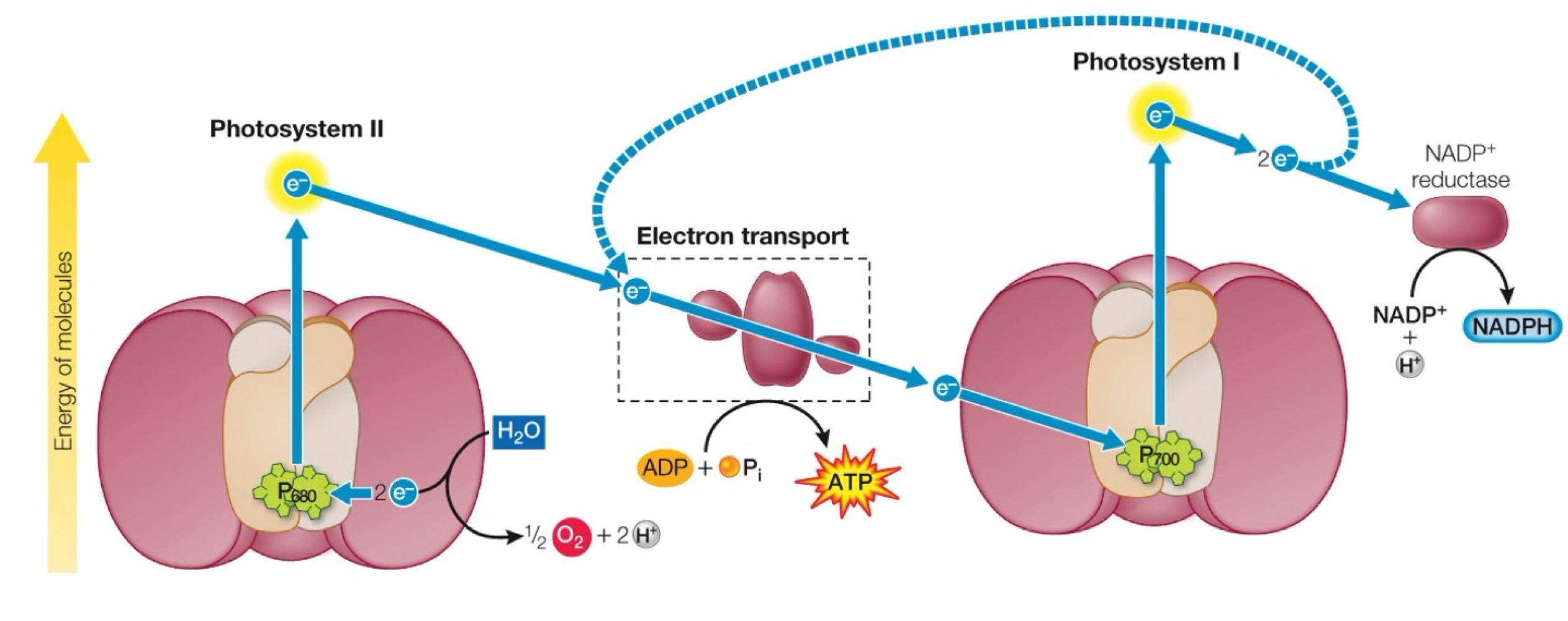
Photosystem II
functions first
P680 pigment
captures photon → excited proton goes through ETC —→ Phosphorylation
replaces lost electron by oxidizing water (water splitting complex)
photophosphorylation
Excited electrons (from light) are used to add phosphate group to ADP to form ATP:
exergonic electron transport drives H+ from stroma to thylakoid space
—> H+ gradient stores energy
—> H+ returning back to stroma through ATP synthase provides the free energy needed to drive phosphorylation of ADP (chemioosmosis)
After making ATP, how to electrons get enough energy to reduce NADPH+
PS I energizes the electrons again by accepting an electron from the ETC, a photon excites it, and then gets captured away by NADP+
NADP+ becomes NADPH (in stroma)
What happens to the ATP and NADPH produced by light-dependent reactions?
they’re used in the calvin cycle
Whats the problem with Rubisco?
it can either add O2 or CO2 to RuBp
reacting with oxygen defeats the purpose of photosynthesis
produces 1 3-C and 1 2-C compound
2-C is toxic
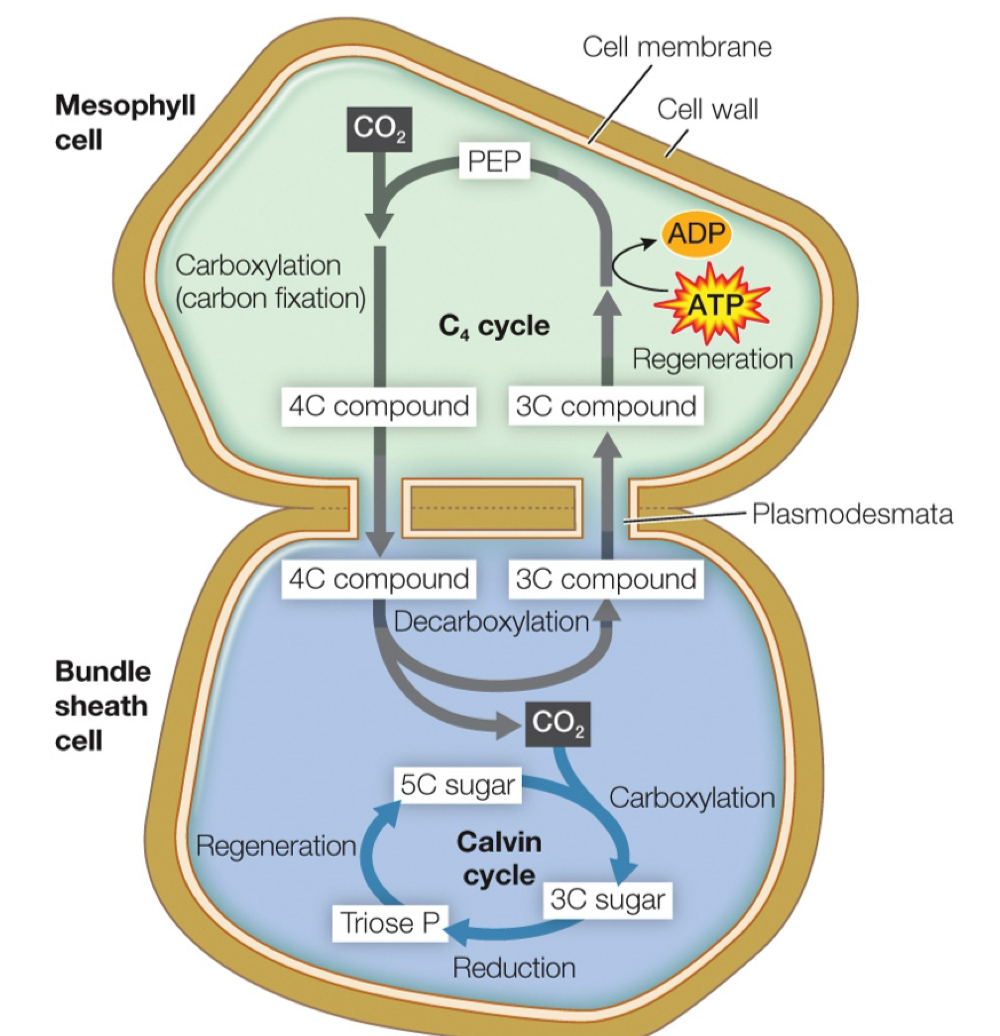
Carbon fixation by C4 Plants
separate carbon fixation from where rubisco is
C fixation happened 2x
Rubisco avoids O2
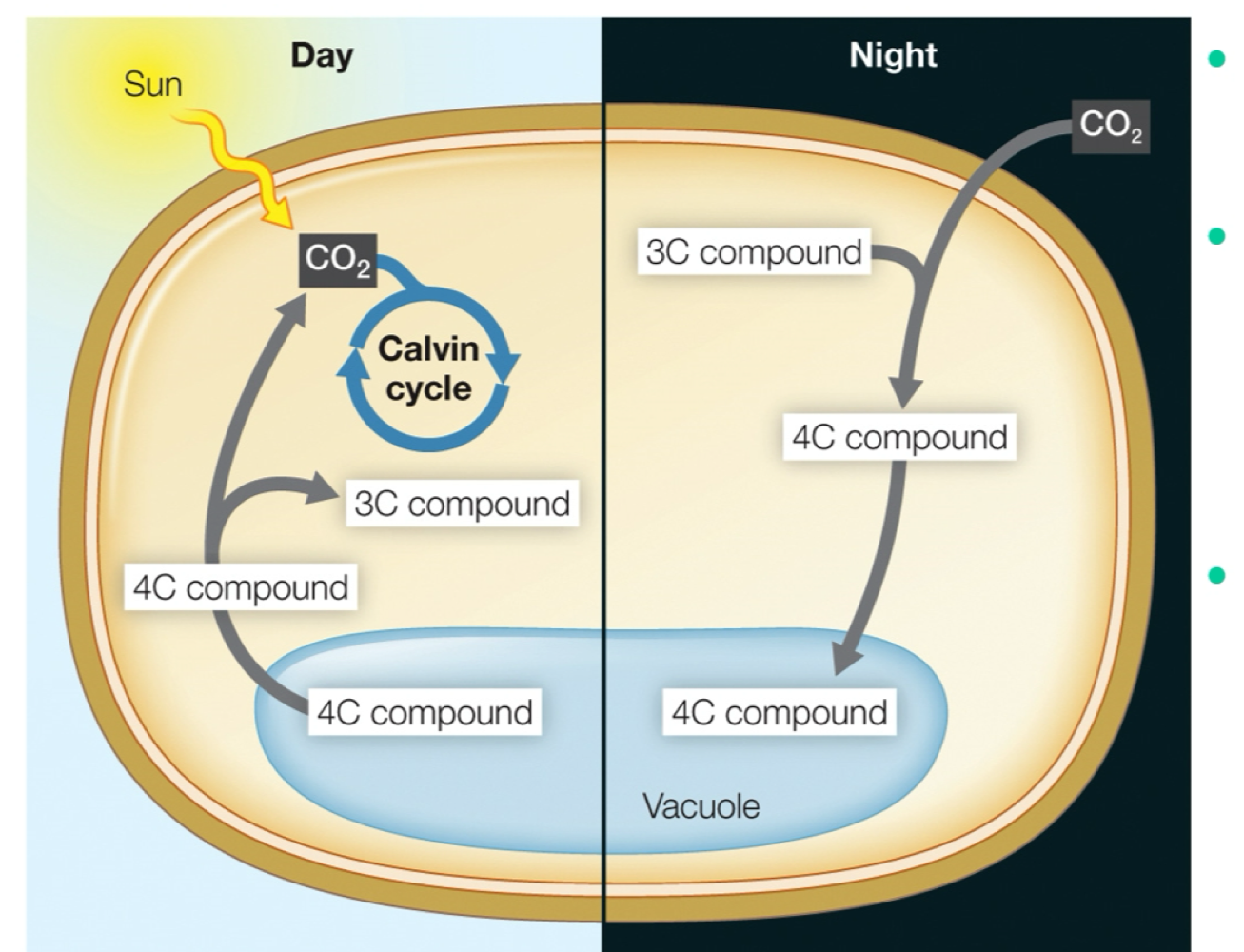
Carbon fixation by CAM plants
fix carbon at night
don’t have to open stromata & dry out during day
can clear out O2 so that it does not come in contact with rubisco
Alternate Carbon fixation pathways (to limit O2 in presence of rubisco)
fix carbon 2x
1st enzyme uses only CO2 as substate
CO2 subsequently released in presence of rubisco and fixed again
different place or time

