PSYCH 85 - Section 3 (lectures 7+8)
 Call Kai
 Learn
Learn Practice Test
 Spaced Repetition
 Match
Match Flashcards
 Knowt Play
1/16

There's no tags or description
Looks like no tags are added yet.
Name | Mastery | Learn | Test | Matching | Spaced | Call with Kai |
|---|
No analytics yet
Send a link to your students to track their progress
17 Terms
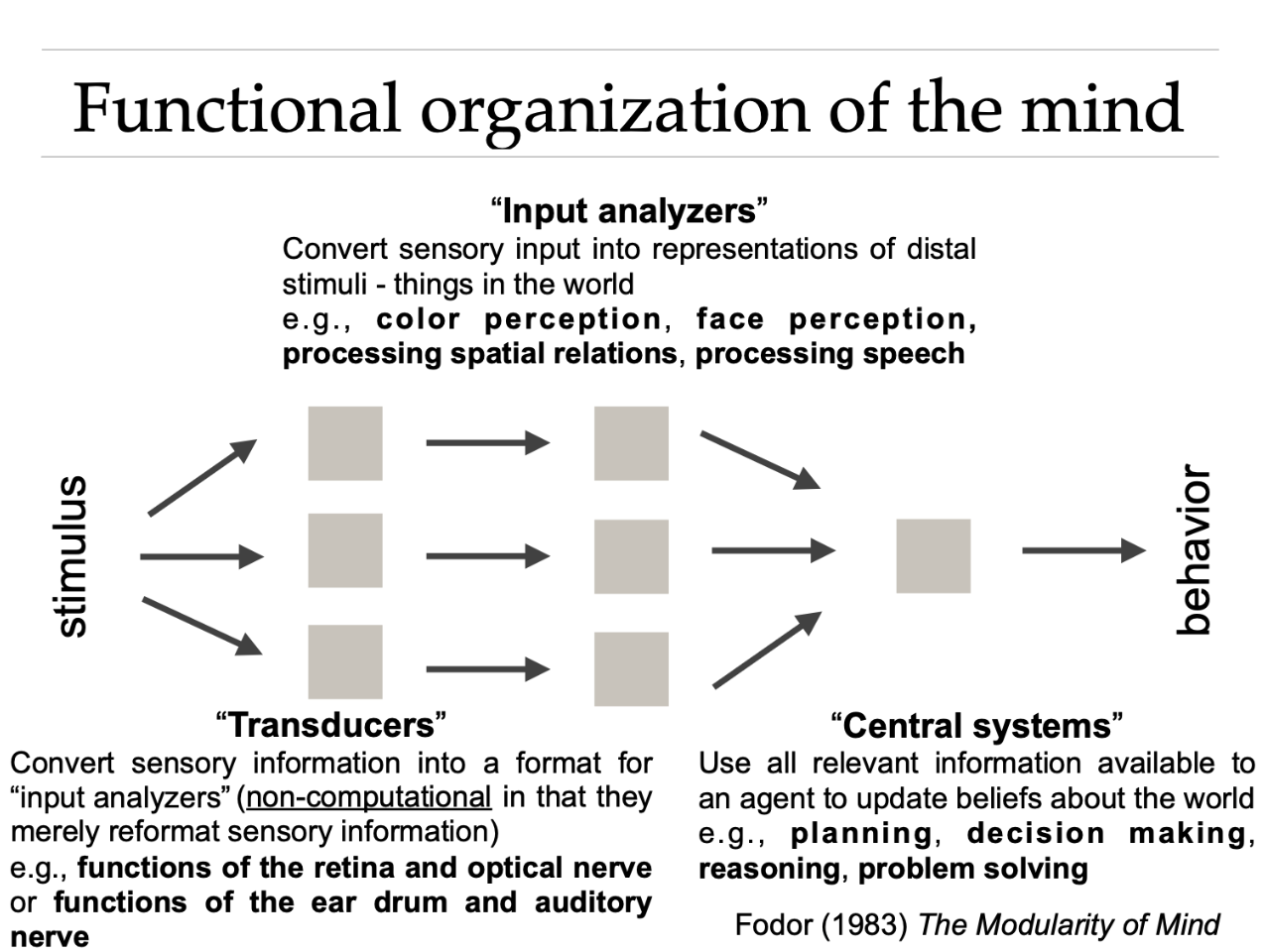
Input analyzers (like perception)
convert sensory input (light, sound waves) into representations of distal stimuli - things in the world (eg color perception, face perception, processing spatial relations, processing speech)
input analyzers are specialized, modular cognitive subsystems designed to process specific types of incoming sensory information—such as visual patterns, speech sounds, or spatial layouts—before that information is interpreted by higher-level cognitive processes.
distal stimulus
any physical object or event in the external environment, such as a tree or a ringing phone, that is distant from the observer. It represents the actual, objective reality that exists independent of the viewer, which the sensory systems (like eyes or ears) aim to perceive
what do input analyzers do?
Take what is produced by the transducers and turn it into representation of the object that produced that sensory stimulation
transducers
are mechanisms that convert environmental energy (physical, chemical, or mechanical stimuli) into the "language of the nervous system"—patterns of electrical signals (neural impulses). They function as the bridge between the external world and the internal cognitive system
central systems
high-level, non-modular cognitive processes responsible for reasoning, decision-making, and belief formation. Unlike input systems (modules) that handle specific perceptual data, central systems integrate information from multiple sources. They are characterized as isotropic and Quinean, meaning they are not domain-specific and can utilize data from anywhere in the cognitive system
modularity
the theory that the mind is composed of specialized, independent, and innate subsystems (modules) that handle specific tasks, such as language processing or visual perception
characteristics of modular input analyzers
informationally encapsulated - not influenced by other mental systems
domain-specific - processing only a restricted type of inputs
modular - distinct, specialized, and independent subsystems (modules) that process specific types of info
examples: face recognition, lang parsing, visual perception, motion tracking, color perception, fight or flight
bottom up effects: stimulus driven, no effect of higher-level knowledge.
automatic and fast
computationally cheap
intermediate steps are not accessible to consciousness
timeline (pace, sequence) of its development is stable across multiple ppl
hard wired in the brain, structure and function resistent to change
characteristics of nonmodular central systems
informationally unencapsulated - not influenced by other mental systems
isotropic: makes use of any relevant information available to the agent, cognitive processes interact with and influence one another, from the beginning of processing
domain-general - processing is unrestricted in its inputs
nonmodular - operate as integrated, holistic systems rather than separate, specialized modules
exmamples: thinking, reasoning, decision making, prob solving, planning, fixation of belief
top down effects: stimulus processing is biased by higher level knowledge
why does modularity matter?
debate in cog sci on whether or not it is possible to understand nonmodular cognitive systems/processes. (Fordor, the Modularity of the Mind, reading 4)
examples of top down effect (isotropy)
spatial relations: opening looks narrower when holding a rod horizontally to pass
visual perception: banana looks yellower despite being grey
which cognitive capacities operate on specialized inputs? FFA - example of cog capacity for domain specific
fusiform face area (FFA)
putative face regions in the brain (believed to be involved based on current evidene, but not completely certain)
replicate and test the generality of the finding (animals, head, face parts)
from this brain region, we infer that our mental tool box (BRAIN) inlcudes a cognitive capacity that is specialized fro seeing faces
strong response to pics of faces, human or not
weaker responses to anything other obj
not heads, shapes, etc
not about eyes, mouth, but FACE
tools in cognitive neuroscience
fMRI (functional MRI) - recording brain activity
neuropsychology: patients with brain damage
TMS (transcranial magnetic stimulation) - stimulation/disruption
neuropsychology: brain damage of FFA
prosopagnosia: face blindness
basic visual perception and mem
not dientifying familiar faces/celeb
no recognizing familar face
no learning new face
object agnosia: object blindness
recognizing obj from touch
draw and copy obj
no visually recognize obj
recognize faces
matching and learnign new faces
detectign faces hidden among obj
double dissociation
a research method in cognitive neuropsychology showing that two cognitive functions (e.g., speech production and comprehension) are independent and localized in different brain areas. It occurs when patient A is impaired on task X but not Y, and patient B is impaired on Y but not X, providing stronger evidence for neural specialization than a single dissociation
a double dissociation btw 2 functions (eg faces vs objs) is the strongest evidence that they rely on 2 distinct mechanisms
reasoning - example of domain general cog capacity ???
reasoning can be applied to multiple types of content (math, social situations, planning, puzzles)
brain network (larger than domain specific tools areas) activated whenever you are doing ANYTHING that is difficult (cognitively demanding) - multi-demand network
effortful tasks - learn something new, solving a hard exam Q, navigate a new city, figuring out a social sitaution
diffulty - stronger response (activation of this network)
deactivated during interally-guided thought, (eg day dreaming, introspection, recall, prospection)
activates the DMN, default mode network.
causal role in goal directed beh (this network helps you stay on task and pursue goals.)
attending to info and manipulating it in WM
inhibition (avoiding hibitual responses when inappropriate)
suppressing automatic responses
not blurting out an answer
ignoring distractions
resisting checking your phone
biasing the rest of the brain to prioritize what is relevant now
MDN works like a control system
prioritize relevant informatioon
suppress irrelevant info
the greater the damage to this network, the lower the IQ
damage = worse reasoning, problem solving, cognitive control
a system for anything to which we do not have a domain specific solution?????? - we dontknow???
ex: vision—> visual cortex, language—> lang areas
conclusion from lectures
domain-specificity is a putative input analyzer for faces and domain-generality is a capacity for reasoning within central systems.
putative
supposed, presumed, assumed, gernally considerred or reputed to be

