W5 5(d) Cloning
 Call Kai
 Learn
Learn Practice Test
 Spaced Repetition
 Match
Match Flashcards
 Knowt Play
1/8

There's no tags or description
Looks like no tags are added yet.
Name | Mastery | Learn | Test | Matching | Spaced | Call with Kai |
|---|
No analytics yet
Send a link to your students to track their progress
9 Terms
Describe the process of micropropagation. (5)
M1: Use forceps / scalpel / knife (or equivalent) to remove explants / pieces from plant.
M2: Wash in bleach / hypochlorite / ethanol / alcohol / sterile wipes (or equivalent).
M3: (Grow on) agar.
M4: Add nutrients / minerals / carbohydrates / amino acids / named mineral / growth factors / hormones.
M5: Add acid / alkali / buffer. acid + its salt or vice versa
M6: Use several / multiple explants / repeat.
M7: Control temperature / carbon dioxide / light.
M8: Use sterile agar / sterile tubes.
M9: Use same age plant / same plant / same size of explants.
M10: Count number of shoots after same / stated time.
always repeat
State one way to sterilise an explant. (1)
M1: Use bleach / hypochlorite / disinfectant / antiseptic / chlorine OR alcohol / ethanol OR radiation / UV / gamma rays / X-rays.
List the nutrients that should be added to the agar medium. (3)
M1: Nitrate / ammonium / magnesium / calcium / sulphate / potassium / phosphate / iron.
M2: Amino acids.
M3: Sucrose / glucose / fructose / sugar / starch.
micro + macro + sugar
Design an investigation to find out if adding more amino acids to the nutrient media increases the growth of the plants. (6)
C: Use with and without amino acids / a range of amino acid concentrations / different amino acids.
O: Use explants of the same age / mass / size / same plant / species / clone.
R: Repeat the experiment (for each concentration).
M1: Measure the height / width / mass / number of leaves.
M2: Measure after a stated time (e.g., 1 day+).
S1: Control the temperature / light / CO₂ / humidity / oxygen / water.
S2: Keep conditions sterile / use agar / minerals / glucose / hormones.
explants are a piece of living tissue removed from the body
State two advantages of using micropropagation (tissue culture) to produce plants. (2)
M1: Lots produced.
M2: Genetically identical / no variation / all same type / identical / same characteristics / guaranteed plant / they are clones.
M3: Can grow GM plants (or equivalent).
M4: Faster / quicker.
M5: Any time of year.
M6: Can be used for plants that are hard to germinate / grow from seed.
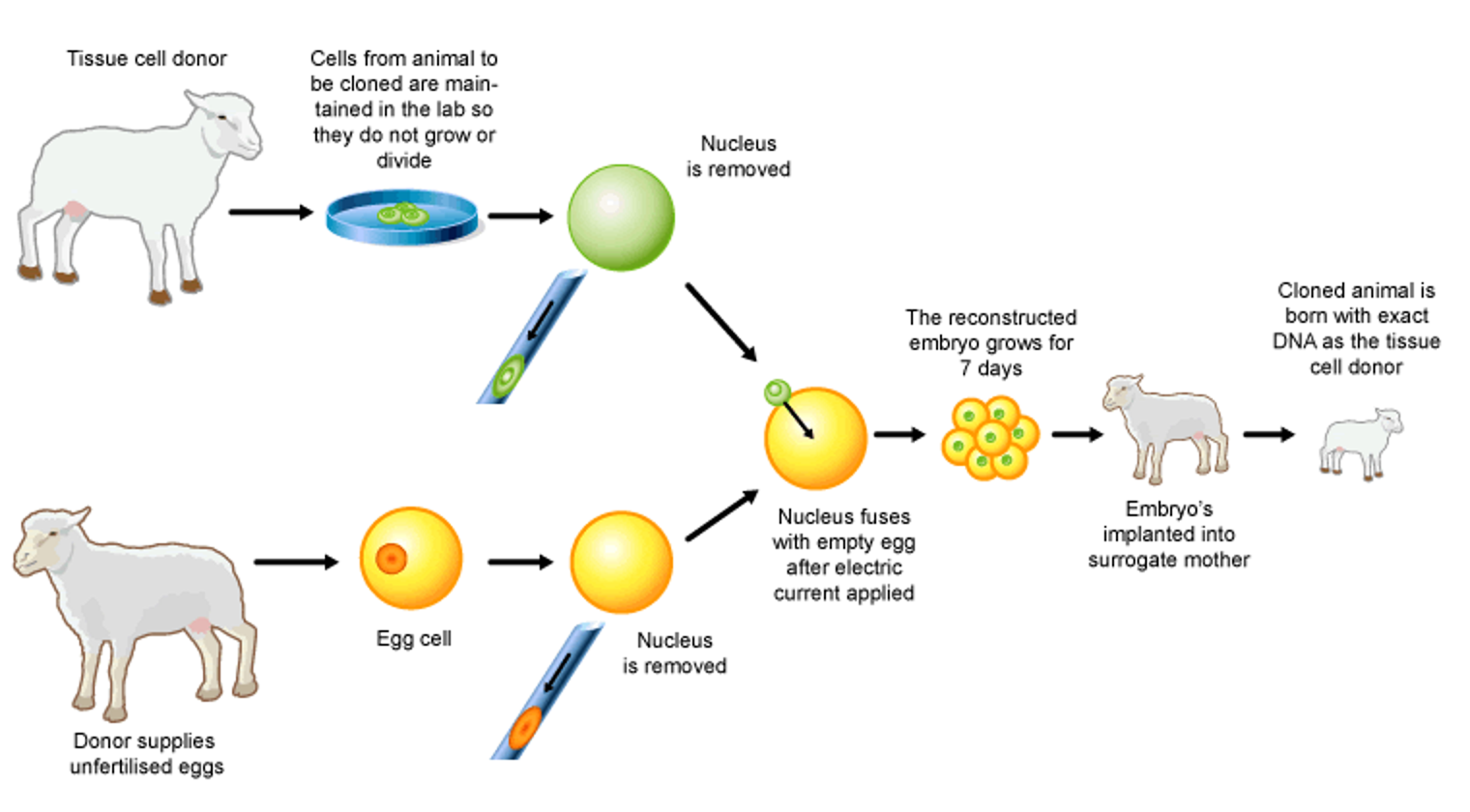
Describe the stages used to clone a mammal (such as a sheep). (6)
M1: Use enucleated egg / empty egg / remove nucleus from egg (or equivalent).
M2: Nucleus from body cell / diploid nucleus (placed into empty egg) / fuse adult cell with empty egg.
M3: Use of electricity / shock.
M4: Cell division / mitosis.
M5: Embryo.
M6: Uterus / womb.
M7: Surrogate mother.
Explain why it is better to use a live animal rather than a dead animal for cloning. (2)
M1: Cells are dead / not alive / inactive / no longer respire.
M2: Genetic material / chromosomes / gene / allele / DNA (is) destroyed / mutated / damaged / degraded (or equivalent).
NOT denatured
Explain why a clone might behave differently from the cell donor. (2)
M1: Behaviour not just due to genetic material / chromosomes / gene / allele / DNA.
M2: Behaviour affected by environment / learning / nurture / training.
in vitro
In vitro means biological processes or experiments carried out outside of a living organism, such as in a test tube, Petri dish, or glass container.

