High Intensity Interval Training
 Studied by 0 people
 Call with Kai
 Learn
Learn Practice Test
 Spaced Repetition
 Match
Match Flashcards
 Knowt Play
1/16

There's no tags or description
Looks like no tags are added yet.
Name | Mastery | Learn | Test | Matching | Spaced | Call with Kai |
|---|
No analytics yet
Send a link to your students to track their progress
17 Terms
Interval Training
performance of repeated exercise bouts with brief recovery periods between
duration and intensity of work interval varies based on goal
longer work intervals: greater involvement of aerobic energy production
shorter work intervals: greater anaerobic metabolism
not limited to only aerobic exercise
body weight, plyometrics, resistance exercises
High Intensity Training (HIT)
attempts to achieve total muscular failure within each muscle group
difference between HIT & HIIT:
HIT: exercise is performed just once per muscle group
HIIT: exercise is performed a number of times within a workout
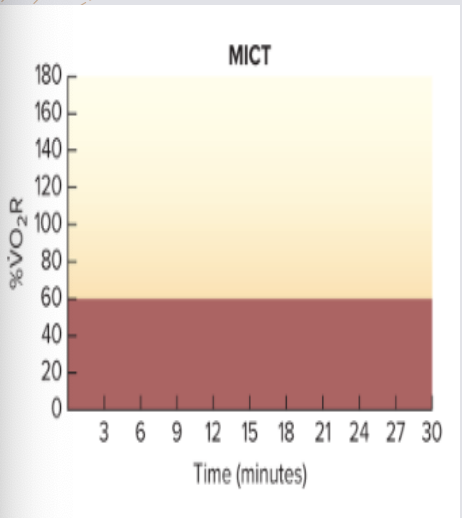
Moderate Intensity continuous training (MCIT)
constant steady state exercise is performed for an extended duration
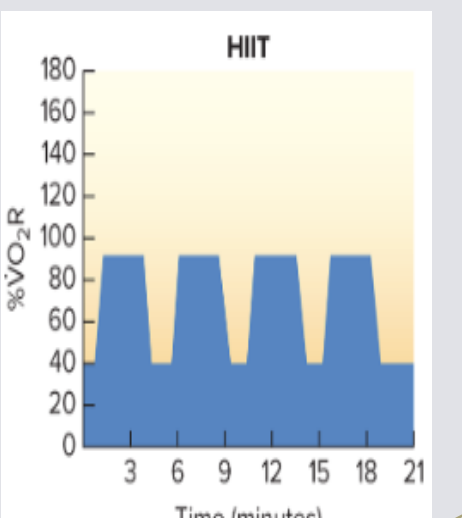
High Intensity Interval training (HIIT)
submaximal efforts that elicit >90% of VO2 max or >75% of maximal power
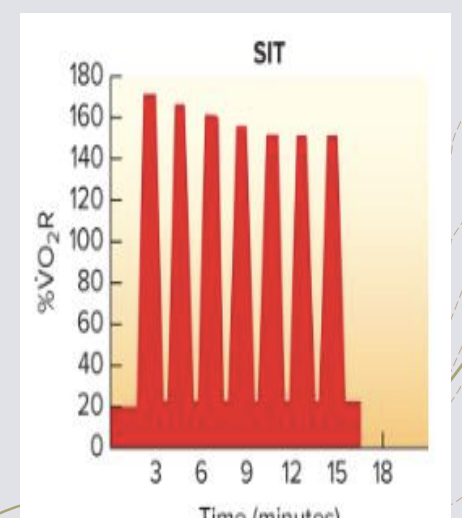
sprint interval training (SIT)
all-out/supramaxial effort >100 VO2peak or maximal power
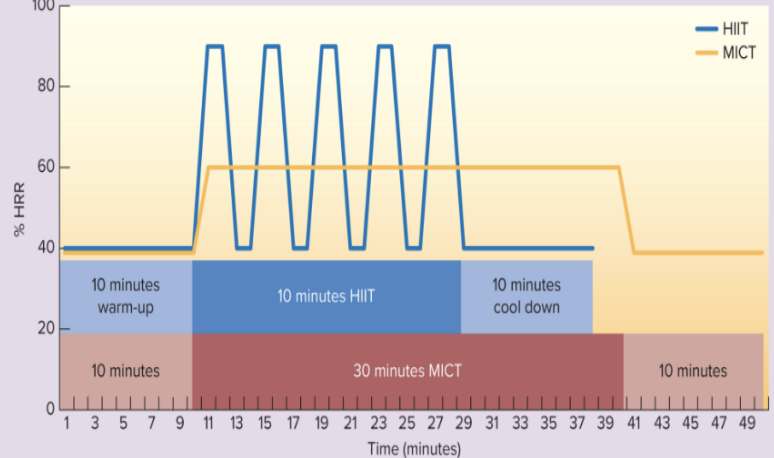
Components of HIIT
begins with a warm-up
several brief bouts of high-intensity exercise
each high intensity bout followed by a recovery period of rest OR exercise at a lower intensity
number of intervals is determined by the fitness of level of the individual
ends with a cooldown
variables included in a HIIT exercise prescription include AT LEAST:
type of exercise (I.e. running, cycling)
intensity and duration of intervals
number of intervals performed
Examples of types of HIIT and SIT
High Intensity Interval Resistance Training (HIIRT):
lifting heavy loads with partial recovery within a single set and complete exhaustion after each set
exercise is performed a number of times within a session
High Intensity Functional Training (HIFT)2:
merges high-intensity exercise with functional (multi-joint) movements
ex: crossfit
Repeated-Sprint training (RST):
high number of sprints lasting less than 10 s interspersed with relatively shorter recoveries (<60s) compared to the recovery periods of SIT
Examples of Interval Training Protocols
alternating vigorous to supramaximal intensity for duration of 20-240 seconds with light to moderate intensity for duration of 60-360 seconds
detrained individuals: alternating periods of brisk walking with walking at reduced pace
Example of Classifying HIIT Components
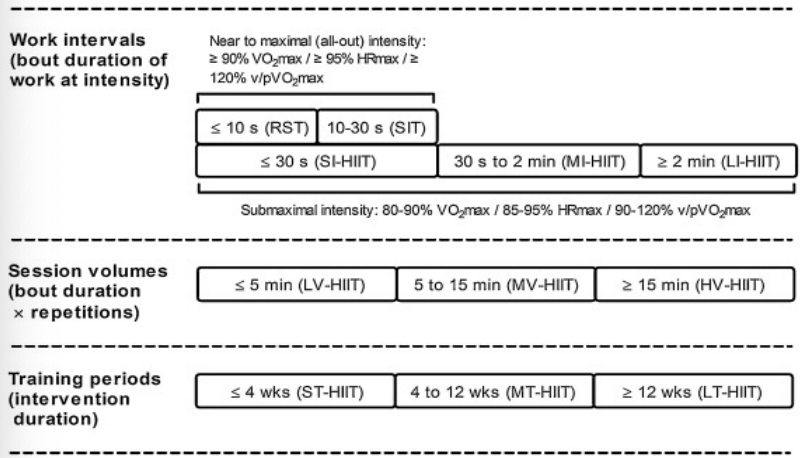
interval length
long-interval (Li-HIIT)
moderate-interval (Mi-HIIT)
short-interval (Si-HITT)
Sprint interval (SIT)
repeated-spring exercise (RST)
Volume
high volume (HV-HIIT
Moderate volume (MV-HIIT)
Low volume (LV-HIIT)
Length of Training:
long term (LT-HIIT)
moderate term (MT-HIIT)
Short term (ST-HIIT)
Effects of HIIT Protocols
results from meta-analysis of randomized control trials by Wen and colleagues:
short intervals(<30 seconds), low volume <5 minutes, and short-term <4 weeks represent effective and time-efficient strategies for developing VO2max for the general population
Long interval >2 min, high volume >15 minutes, moderate to long-term >4-12 weeks are recommended to maximize training effects
HIIT Training Responses: Short-term HIIT <12 weeks
improved in overweight/obese populations:
VO2max
DBP
fasting BG
improved in normal weight population: VO2max
HIIT demonstrated no effect on insulin, lipid profile, C reactive protein or interleukin 6 in overweight/obese population
HIIT Training Responses: Long-term HIIT >12 weeks
improved in overweight obese population:
waist circumference
% body fat
VO2max
RHR
SBP and DBP
Improved in normal weight population: VO2max
HIIT demonstrated no effect on insulin, lipid profile, C reactive protein or interleukin 6 in overweight/obese population
HIIT & SIT Training responses
both are associated with classic physiological adaptations associated with MICT despite differences in training volume
increased aerobic capacity (VO2 max) and mitochondrial content
limited evidence suggests increase in mitochondrial content is superior after HIIT compared to MICT
less evidence available regarding the role to exercise intensity in mediating changes in:
skeletal muscle capillary density
maximum stroke volume
maximum cardiac output
blood volume
Health benefits of HIIT
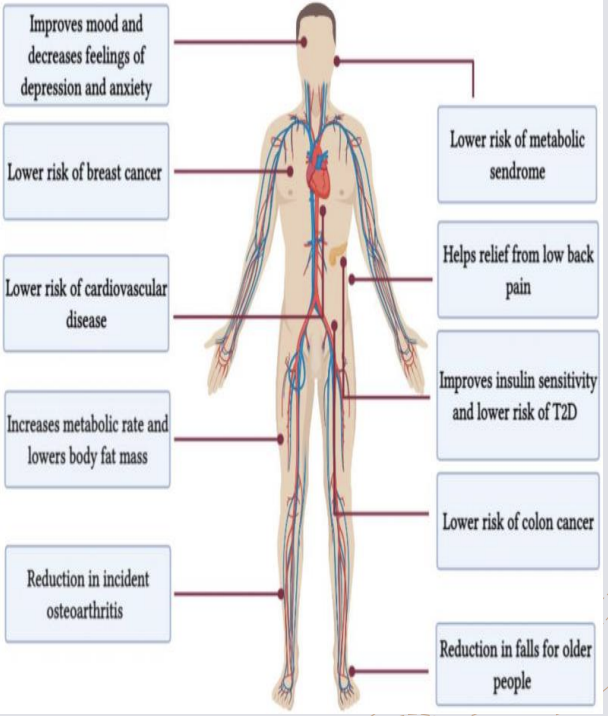
associated with similar physiologic adaptations to MICT
exercise protocols of 5 days to 12 months show
improvements in:
VO2 max
resting metabolic rate
substrate metabolism
body composition
insulin sensitivity
cognitive function
decreased risk for:
CVD
breast cancer
OA
RAmetabolic syndrome
Health Benefits of HIT & HIIT
overall benefits of HIT
lower blood pressure
lower LDL and higher HDL
lower body fat
increased muscle mass
specific benefits of HIIT
increased aerobic and anaerobic fitness levels
lower blood pressure
lower abdominal fat
weight loss with maintained muscle mass
increased insulin sensitivity
HIIT and Improved Vascular Function
HIIT prescription of 4 intervals of 4 minutes (4×4 HIIT)
frequency: 3x/week
intensity:
work: 85-95% of HRmax/peak
rest: 60-70% of HRmax/peak
Time:
work: 4 minutes
rest: 3 minutes
Duration: 12-16 weeks
Results:
FMD improved
4.31% with HIIT
2.15% with MCIT
HIIT had a greater tendency than MICT to induce positive effects on secondary outcomes including:
CRF
traditional CVD risk factors
oxidative stress
inflammation
insulin sensitivity
HIIT was more effective at improving brachial artery vascular function vs MICT
HIIT: Potenital Clinical Applications
ACSM has considerations for application of HITT in individuals with the following diagnoses/clinical settings:
cardiac rehabilitation
heart failure
cardiac transplant
diabetes mellitus
spinal cord injury
ADHD
down sydrome
 Note
Note  Flashcards (201)