microlab midterm
 Call Kai
 Learn
Learn Practice Test
 Spaced Repetition
 Match
Match Flashcards
 Knowt Play
1/138

There's no tags or description
Looks like no tags are added yet.
Name | Mastery | Learn | Test | Matching | Spaced | Call with Kai |
|---|
No analytics yet
Send a link to your students to track their progress
139 Terms
ACID FAST: What chemical is responsible for the acid-fast property of Mycobacterium species?
Mycolic acids
ACID FAST: What was the appearance of Mycobacterium smegmatis on the Myco plate? Why?
It appeared compact and wrinkled because of the cell wall’s hydrophobic nature
ACID FAST: Why was heat used with the stain?
The slide is first heat fixed to prevent the organism from washing off during subsequent steps. Later, the slide is steamed to make the cell wall a little more penetrable allowing the stain to enter the cell wall
ACID FAST: What are the primary stain, decolorizer, and counter stain when performing an acid-fast stain?
The primary stain is carbolfuchsin, the decolorizer is acid-alcohol, and the counterstain is alkaline methylene blue
ACID FAST: What important genus of bacteria is this stain used to identify?
Mycobacterium
ACID FAST: Are acid-fast bacteria gram positive or gram negative? Explain.
Positive
ACID FAST: What are two diseases caused by members of the genus Mycobacterium?
M. tuberculosis and Hansen’s Disease
ACID FAST: Why is this stain so useful for clinical diagnosis?
It can quickly identify the harmful microorganism which allows for quick diagnosis and treatment of the patient
ASEPTIC TECHNIQUES: Aseptic technique is performed to prevent___.
Contamination of bacterial cultures and the environment
ASEPTIC TECHNIQUES: What is the purpose of gently shaking a broth culture prior to using it?
To gently shake the culture and resuspend the cells
ASEPTIC TECHNIQUES: When is flaming the loop required in aseptic technique?
Before being used to transfer bacterial cultures and after culture transfer
ASEPTIC TECHNIQUES: In what way should you hold the culture tub or flask to prevent contamination from contacting the media?
It should be held at a 45 degree angle
ASEPTIC TECHNIQUES: How is the lid to a tube handled during aseptic technique?
It should be held in the same hand as the inoculating loop
ASEPTIC TECHNIQUES: When is the mouth of the tube flamed?
Before and after obtaining the microorganism with the loop
ASEPTIC TECHNIQUES: Is the culture recapped before and after placing the loopful of microorganisms on the slide? Explain why timing would matter.
Before so air contaminants do not enter the tube
BIOFILMS: What type of microorganisms were found in your biofilm? (bacteria, algae, protozoa)
Spirostomum and chlamydomonas (protozoa)
BIOFILMS: How does your biofilm appear different under phase contrast relative to the Gram stain?
Biofilms appear as live and colorless under phase contrast and under Gram stain, bacterial diversity can be seen
BIOFILMS: Is there a correlation between the type of environment and the type of microorganism found in the biofilm? (For example, do you see Cyanobacteria and algae in samples that were exposed to the sun for most of the day?)
Yes, due to the lake experiment, one would expect aqueous organisms, which protozoa are
BIOFILMS: What is the advantage of using phase-contrast microscopy over bright field?
The motion of live cells can be better viewed using phase-contrast
What do phase contrast and dark field microscopes have that brightfield scopes do not?
They have condensers and objectives that give the ability to view live organisms and their motility by showing them with contrast to their surroundings without heat fixation and staining. Brightfield microscopes don’t have this ability.
CAPSULE STAIN: What is the main component of the capsule? What are other components?
The main component is water but it is also composed of layer of polysaccharide or polypeptide-containing material surrounding the cell wall of bacteria
CAPSULE STAIN: Why was the smear not heat fixed?
If the smear is heat fixed, the capsule will be destroyed.
CAPSULE STAIN: What are four possible functions of the capsule?
Preventing desiccation, attachment of encapsulated pathogenic microorganisms to host cells, resistance of being engulfed by the phagocytic cells of the host’s immune system, and enhancing the organisms’s ability to cause disease
CAPSULE STAIN: Describe the appearance of the capsule-forming bacteria on the surface of agar. Why might this indicate that is possesses a capsule?
They appear as a gram negative, oval shaped stained cell with a clear white halo ring around it.
CAPSULE STAIN: Why is it important to stain the background with this capsule stain?
The background appears dark blue/purple, and the cells are red while the capsules remain unstained and appear as a clear area surrounding the cell
CAPSULE STAIN: A spore-forming, capsule-forming bacterium is grown on a medium rich in glucose and other required nutrients. Would you expect to see spores with the endospore stain? Explain. Would you expect to see capsules when performing a capsule stain? Explain.
No, because endospores are formed in unfavorable conditions. Yes, because capsules perform in an abundance of nutrients.
CULTURING MICROORGANISMS: Name five categories of colony morphology properties which can be used to describe the growth of a microorganism.
Shape of the colony, form of the colony margin, elevation, pigmentation, surface characteristics, and optical properties
CULTURING MICROORGANISMS: What can influence the colony morphology properties of a microorganism?
The medium on which it is grown on, the type and amount of nutrients present in the medium, and contaminants

CULTURING MICROORGANISMS: How would you describe this colony shape?
Irregular
CULTURING MICROORGANISMS: What would be an appropriate term of describe the elevation of this colony?
Umbonate (button like_
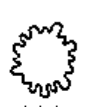
CULTURING MICROORGANISMS: How would you describe this margin shape?
Lobate
CULTURING MICROORGANISMS: Describe the growth medium used for this experiment. Would a broth culture work just as well?
Trypticase soy agar (TSA) plates are used and no broth culture would not work as well because the microorganisms would be suspended in the liquid making it difficult to observe their colony morphology
CULTURING MICROORGANISMS: Some areas sampled had more microorganisms capable of growing on TSA than other areas. Give a couple of explanations as to why this was observed.
The nutrients on the media may have not been suitable for some microorganisms to grow. The areas with high average number of colony morphology were high traffic areas that would regularly come in contact with these microbes. The area with the lowest average are the areas that may be cleaned more regularly or do not come in contact with as many microbes as in high traffic areas
CULTURING MICROORGANISMS: Do microorganisms live in all the areas sampled or might some just be transiently there? List the areas sampled where microorganisms are most likely to be residents. Consider the areas where transient microbes were found. How did the microbes get to these areas?
Areas with resident microbes could be mouth/nose, fingers, and hair. These areas can also contain transient microbes transferred onto these areas through daily activities. Areas with transient microbes can also be floor, sink, clothes, air, and dirt.
CULTURING MICROORGANISMS: Where did the microbes come from that landed on the agar surface of the plate left open for 30 minutes?
Airborne particles containing microbes could have landed on the agar plate and stuck to agar.
CULTURING MICROORGANISMS: Which of the sites tested are sources of contamination when working with cultures at your lab bench? Suggest a way to prevent contamination from each of these sites.
Your fingers/hands are a source of contamination when working at the lab bench. This can be prevented by washing hands and wearing gloves.
ENDOSPORE STAIN: What are two genera that commonly form endospores? What is the Gram reaction and morphology of these bacteria?
Clostridium and Bacillus. The gram reaction and morphology is gram positive rods.
ENDOSPORE STAIN: Are endospores reproductive structures? Why or why not?
No, they are only produced under stressful conditions. An endospore is a specialized dormant structure that will form within a genetically capable cell when essential nutrients are depleted or when water is unavailable
ENDOSPORE STAIN: Describe the process of sporulation. When will sporulation occur?
If nutrients or water become depleted, or other environmental factors become detrimental to a vegetative cell, sporulation will begin converting the vegetative cell into a single endospore
ENDOSPORE STAIN: What component of an endospore protects against harsh chemicals? What component protects the DNA from damage?
The spore coat protects the endospore from harsh chemicals and The small acid-soluble proteins (SASPs) and the calcium-complexed dipicolinic acid play a role in protecting the DNA from damage
ENDOSPORE STAIN: What are the three common diseases associate with Gram-positive spore forming rods? How does this presence of endospores in these bacteria contribute to the capacity to cause disease?
Endospores are resistant and can survive food processing processes such as heating, freezing, desiccation, treatment by chemical, and radiation. If foods are under processed, endospores can cause botulism, anthrax, and tetanus
ENDOSPORE STAIN: What is the primary stain, decolorizer, and counterstain used in the staining of endospores?
The primary stain is malachite green, the decolorizer is water, and the counterstain is safranin
ENUMERATING MICROORGANISMS: List three methods of enumerating bacteria.
Direct microscopic count, Standard plant count (spread plate, pour plate), Turbidimetric assay
ENUMERATING MICROORGANISMS: list an advantage and a disadvantage for direct microscopic count
Advantage: rapid, no culturing therefore no selection against certain organisms
disadvantage: counts live and dead cells, requires more skill, requires use of hemocytometer
ENUMERATING MICROORGANISMS: list an advantage and disadvantage of standard plate count.
Advantage: measures only living cells
Disadvantage: needs time for incubation, selection against certain organisms than can’t grow
ENUMERATING MICROORGANISMS: list advantage and disadvantage of spread plat count
Advantage: relatively simple to perform
Disadvantage: need good spread technique
ENUMERATING MICROORGANISMS: list advantage and disadvantage of pour plate count
Advantage: no alcohol or flames involved
Disadvantage: need melted, tempered agar deeps; must evenly mix agar with culture
ENUMERATING MICROORGANISMS: list advantage and disadvantage of turbidimetric assay
Advantage: Rapid (no incubation)
Disadvantage: not accurate for microorganisms that grow in clumps
ENUMERATING MICROORGANISMS: Were you calculations of cells/mL the same for each sample? Provide an example.
No, because the calculation depended on the random position of the cells in the broth as followed from freshly shaking the tube each time it was placed in the spectrophotometer.
ENUMERATING MICROORGANISMS: Yeast cells are rather large compared to most bacteria, making them east to count all of the cells in the entire grid of a cell counting chamber. What other organism you have viewed this semester could you easily count using and cell counting chamber? What characteristic of this organism might make it difficult to count?
Chlamydomonas reinhardtii are large but motile making them difficult to count
ENUMERATING MICROORGANISMS: Why are only the plates with 30-300 colonies considered countable?
Plates with fewer than 30 colonies provide to few colonies to be statistically significant to give an accurate count and plates with more than 300 colonies are not considered valid because they may not have provided adequate nutrients and space for all cells to grow to form colonies
ENUMERATING MICROORGANISMS: Why must a sterile pipette tip be used to make each dilution?
Because the tip could be cross contaminated with another concentration invalidating the dilution and results
ENUMERATING MICROORGANISMS: Name two viable plant count methods. For what type of organism(s) would each be used?
Spread plate (used for aerobic organisms) and pour plate (used for anaerobic organisms)
ENUMERATING MICROORGANISMS: Could you have used the same dilutions for the turbidimetric assay as were used for the standard plate count of E. coli? (Hint: Estimate the absorbance values for the standard plate count serial dilutions used for the turbidimetric assay).
No
GRAM STAIN: What are the primary stain, decolorizer, and counter stain used when doing the Gram stain?
The primary stain is crystal violet, the mordant is Gram’s iodine, the decolorizer is ethanol, and the counter stain safranin
GRAM STAIN: What is the function of the mordant? If the mordant was not added when performing the stain what would then be the Gram reaction of all the cells? Why?
The mordant binds the crystal violet forming a complex not easily removed from the Gram-positive cells. If the mordant was not added, all the cells would be gram negative because the primary dye would wash off, leaving no dye on the Gram-positive cells
GRAM STAIN: What would be the appearance of all cells if the decolorizer were not added? What would be the result if the smear were over-decolorized?
All of the cells would be gram positive (purple), all of the cells would be gram negative (red)
GRAM STAIN: Why is a counterstain added? What cells does the counterstain stain? Are these cells Gram-positive or Gram-negative?
A counterstain is added to stain the Gram-negative cells red
GRAM STAIN: A Gram stain was performed on Wednesday using Staphylococcus epidermis from a streak plate done on Monday. The cells appeared Gram-negative. It is known that Staphylococcus epidermis is a Gram-positive bacterium and no steps were omitted in the stain. What is the most obvious explanation for this incorrect Gram reaction.
The most obvious explanation is over decolorization or the counter stain was left on too long
GRAM STAIN: What structural component of bacteria determines their Gram reaction? How is this structure different in Gram-positive and Gram-negative bacteria?
The peptidoglycan in cell walls determines the Gram reaction. A Gram-positive bacteria has a lattice surrounding and protecting the cell while Gram-negative only has a few layers surrounded by an outer membrane
HANDWASHING: Which soap tested was the most effective in reducing the number of bacteria present? The least effective?
The most effective is antibacterial soap and the least effective is non antibacterial soap
HANDWASHING: Since most of the normal flora is not harmful, why must it be removed in a surgical scrub?
They typically do not cause disease but there are opportunistic pathogens among the normal flora that cause disease if the opportunity arises
HANDWASHING: Why would liquid soap be used in a surgical scrub instead of bar soap?
Liquid soap would lessen the possibility of cross contamination
HANDWASHING: Why could there be more bacteria present after hand washing?
Washing skin with soap and water sloughs off the dead outermost layers of skin and may expose the normal flora
HANDWASHING: What is meant by the term normal flora?
They establish themselves on or in the body but do not produce disease under normal condition. They are able to survive and multiply on an area of the body
MEDIA PREPARATION AND STERILIZATION: Beef extract in Nutrient Agar makes NA a ______ medium.
complex
MEDIA PREPARATION AND STERILIZATION: What is the difference between TSA and TSB?
TSA (Tryptic Soy Agar) is a solid medium and TSB (Tryptic Soy Broth) is a liquid medium
MEDIA PREPARATION AND STERILIZATION: Identify an agar plate that only allows the growth of Gram bacteria as selective or differential.
selective
MEDIA PREPARATION AND STERILIZATION: Identify an agar deep that allows you to see if bacteria produces an enzyme as selective or differential
differential
MEDIA PREPARATION AND STERILIZATION: Identify an agar deep that only allows the growth of bacteria capable of using citrate as a carbon source as selective or differential
selective
MEDIA PREPARATION AND STERILIZATION: Identify a flask of broth that contains no nitrogen, allowing only the growth of bacteria that can use nitrogen from the air as selective or differential
selective
MEDIA PREPARATION AND STERILIZATION: Identify an agar plate that turns color if the bacteria can produce acidic fermentation products as selective or differential
differential
MEDIA PREPARATION AND STERILIZATION: Identify if a tube of broth with a Durham tub to collect gas if it’s produced by bacteria growing in a tube is selective or differential
differential
MEDIA PREPARATION AND STERILIZATION: What sealed device is used to sterilize the growth media used in this lab?
Autoclave
MEDIA PREPARATION AND STERILIZATION: An autoclave heats to ___ C at ____ psi for at least 15 minutes
121 at 15
MEDIA PREPARATION AND STERILIZATION: When would dry heat sterilization be used?
Heating inoculating loops and needles and glassware
MEDIA PREPARATION AND STERILIZATION: When would filter sterilization be used?
Heat sensitive liquids or gases
MEDIA PREPARATION AND STERILIZATION: When would cold sterilization be used?
Heat sensitive objects like Petri dishes
MEDIA PREPARATION AND STERILIZATION: When would UV radiation sterilization be used?
Exposed surfaces
MEDIA PREPARATION AND STERILIZATION: When is ionizing radiation sterilization used?
Food industry and decontamination of medical supplies
MOTILITY: Explain the “rotary engine” model for how a bacterial flagellum rotates.
A proton gradient (Na+, K+, Rb+ can also be used) provides energy to rotate the flagellum
MOTILITY: How do the two flagella of the eukaryotic green algae Chlamydomonas reinhardtii move? Could you see the flagella when viewing the live Chlamydomonas cells?
The flagella whip back and forth to move the cell. Yes, you could view the flagella.

MOTILITY: What type of flagellation is this? Give an example of organism.
Monotrichous flagella
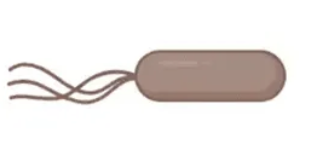
MOTILITY: What type of flagellation is this? Give an example organism
Lophotrichous flagella
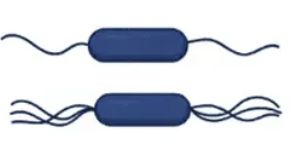
MOTILITY: What type of flagellation is this? Give an example organism
Amphitrichous flagella
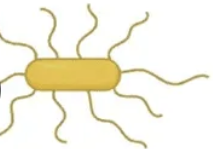
MOTILITY: What type of flagellation is this? Give an example organism
Peritrichous flagella
MOTILITY: Why does motility test medium have a low agar concentration?
To allow movement of motile bacteria
MOTILITY: Explain the color change that occurs in the motility test medium after inoculation
The motility test medium contains a tetrazolium salt (TTC) to make results easier to interpret
MOTILITY: Describe and explain the appearance of a positive and negative motility medium test result.
If the bacteria are motile (positive), red will radiate in all directions away from the stab line
If the bacteria are non-motile (negative), there will only be a red line where the stab line occurs
OBTAINING A PURE CULTURE: Why must the inoculation loop be filmed between each quadrant? Flaming is what type of sterilization method?
It preserves the dilution and it is dry sterilization (aseptic technique)
OBTAINING A PURE CULTURE: What is the difference between a mixed culture and a pure culture?
A pure culture contains a single kind of organism and a mixed culture contains multiple types of organisms
OBTAINING A PURE CULTURE: What is meant by the term colony? Is a colony a pure culture?
It is a population of cells which arise from a single cell growing on a solid medium, only an isolated colony is a pure culture
OBTAINING A PURE CULTURE: After examining your streak plate, you notice that three colony types are present while the TA says only two organisms were in the mixed broth. What might have caused this?
The third colony might be a transient flora in the air that infected the plate while doing the streak
OBTAINING A PURE CULTURE: Why is it necessary to isolate individual colonies from a mixed broth?
It is necessary to obtain a pure culture
OBTAINING A PURE CULTURE: Consider the results of your simple stain and the results of your first streak plate. Do these observations agree?
The simple stain was all dyed the same while the streak plate had gram positive and gram negative. Done with a differential stain.
OBTAINING A PURE CULTURE: Explain why a mixed broth culture may appear pure on the simple stain, but mixed when different colonies were observed on the streak plate.
A simple stain reveals cell morphology only while streak plates can differentiate between between colony morphology
PLATING: What is the purpose of performing a streak plate?
To isolate and maintain a microbial culture, allowing for individual cells or group of cells to be separated from one another for growth
PLATING: How many times do you dip into the original culture for a streak plate? For creating a lawn?
Once for all four, twice one for each half
PLATING: How does a lawn differ from a streak plate?
A streak plate is to isolate colonies sand a lawn is to form confluent growth
PLATING: In replica plating, what is touched to colonies on the agar surface of the master plate to transfer the colonies to a new plate?
A sterile velveteen square cloth

