Biology unit 1: phylogeny
 Studied by 0 people
 Call Kai
 Learn
Learn Practice Test
 Spaced Repetition
 Match
Match Flashcards
 Knowt Play
1/12

There's no tags or description
Looks like no tags are added yet.
Name | Mastery | Learn | Test | Matching | Spaced | Call with Kai |
|---|
No analytics yet
Send a link to your students to track their progress
13 Terms
Phylogeny
evolutionary history of a species or group of species
explained the diversity we will study
Taxonomy
study of how organisms are named and classified
How do Taxonomy and Phylogeny differ?
The main difference between Taxonomy and phylogeny is their primary focus: taxonomy is about organization, while phylogeny is about ancestry.
example:mTaxonomy tells you what a cat is (a Mammal, Feline); Phylogeny tells you where it came from (it shares a common ancestor with a tiger).
Why do we use Latin for classification?
it is a universal and dead language, which ensures that scientific names remain stable and understandable across the globe.
The scientific name for a common house fly is Musca domestica. In Latin, Musca simply means "fly" and domestica means "of the house".
Know the classification system from most broad to most specific.
Most broad:
Domain = Eukarya
Kingdom = Animaila
Phylum = Chordata
Class = Mammalia
Order = Primates
Family = Hominiade
Genus = Homo
species = sapiens
Most specific
(Dear King Philip Came Over For Good Soup.)
Know the binomial classification of humans.
humans are classified as Homo Sapiens
Phylogenetic Tree
A hypothesis about evolutionary relationships. using trees because of the visual analogy of branches that represent lineages “branching into similar species”
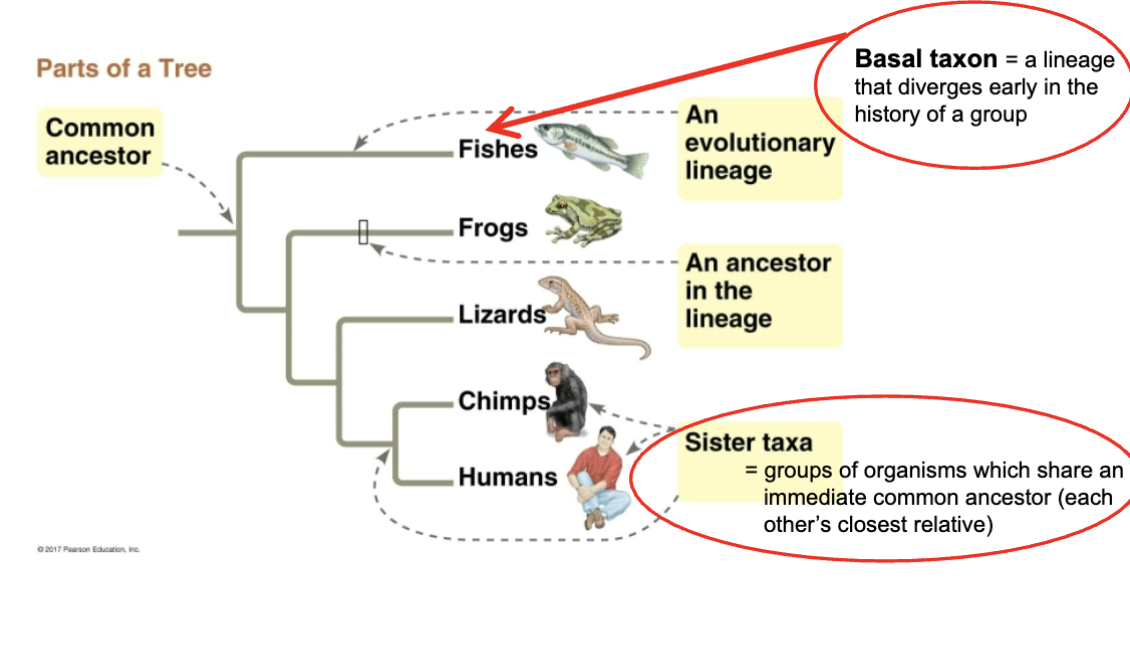
What can we learn from phylogenetic trees?
Show patterns of descent, not physical similarity
Branching patterns do not indicate absolute ages of species (unless the x-axis has time increments
Can not assume thst a taxon of a tree evolved from the taxon beside it ( merely descendant of a common ancestor)
Be able to identify common ancestors and evolutionary relationships between taxa if given a phylogenetic tree.
Identifying the Common Ancestor
To find the common ancestor of two animals, put a finger on each animal's name at the tips and trace their branches backward into the past.
The Meeting Point: The exact spot where your two fingers meet (the "node") is their Most Recent Common Ancestor (MRCA).
The Rule: The "deeper" (further back) you have to go to find that meeting point, the less related the two animals are.
2. Identifying Relationships (Who is most related?)
To figure out who is more closely related, look for the most recent meeting point.
Scenario: You are looking at a Human, a Chimp, and a Gorilla.
Trace Human and Chimp back. They meet at a node very close to the tips.
Trace Human and Gorilla back. You have to go much further down the tree to find where their lines meet
Conclusion: Humans and Chimps are more closely related because their "meeting point" happened more recently in time.
3. Identifying "Sister Taxa"
This is the easiest relationship to spot. Sister Taxa are two branches that come off the exact same node. They are each other's closest relatives on the entire tree.
Example: If a tree shows a "V" split at the very end with "Cat" on one side and "Lion" on the other, they are sister taxa.
Basal taxon
a lineage the diverges early in the history of a group
Sister Taxa
groups of organisms that share and immediate common ancestor ( each other’s closest relative)
Understand how derived characters can be used to create a phylogeny.
A shared derived character is an evolutionary novelty that is unique to a particular group ( vertebra, tetrapod, hair, mammary glands)
 Note
Note  Flashcards (25)