Pathology of the pharynx, larynx and trachea
 Studied by 0 people
 Call Kai
 Learn
Learn Practice Test
 Spaced Repetition
 Match
Match Flashcards
 Knowt Play
1/38

There's no tags or description
Looks like no tags are added yet.
Name | Mastery | Learn | Test | Matching | Spaced | Call with Kai |
|---|
No analytics yet
Send a link to your students to track their progress
39 Terms
Brachycephalic airway syndrome
What do we call the reduced breathing ability in dogs like boxers, bulldogs and pugs?
Exercise intolerance, Respiratory stridor and stertor.
What signs does brachycephalic airway syndrome lead to?
Elongated soft palate
Stenotic nares
Everted laryngeal saccules
What are the three main lesions that combine in brachycephalic airway syndrome?
SHE SAID KNOW THESE (something about her favoriet color being green, wink wink, i dunno)
soft tissue, cranial bone
soft palate
The lesions associated with brachycephalic airway syndrome are caused by a mismatch of _________ to __________ and obstruction of AIRFLOW by elongated tissue of the _____________.
nares
nasal turbinates
soft palate, hyoid apparatus
Brachycephalic breeds have increased airway resistance due to airway narrowing at the _____, _________ and nasopharynx (made of _________ and __________)
nasal & laryngeal edema
laryngeal dysfunction
In brachycephalic breeds, the fact that they have to breathe HARDER decreases the airway pressure, which leads to _____________ and _____________ which both make it even harder to breathe.
tracheal hypoplasia
What other issue is commonly seen with brachycephalic syndrome but is not a criteria for defining it?
tracheal hypoplasia
_________: Tracheal rings form closed ring, instead of C-shaped rings causing it to be rigid.
A Congenital malformation that causes diameter of trachea to be smaller than normal
DYSPNEA, EXERCISE INTOLERANCE, recurrent resp infections, anesthesia difficulties, cor pulmonale
What are some clinical signs and gross lesions in animals with tracheal hypoplasia?
the surface area covered by the cilia and epithelium in the resp tract is also small or narrowed, so we dont weed out as much bacteria
Why are animals with tracheal hypoplasia more likely to get respiratory tract infections?
cor pulmonale
______________: right-sided heart failure caused by lung disease or pulmonary hypertension, where high pressure in the lung's blood vessels makes the right side of the heart work too hard
This leads to enlargement and eventual failure, shortness of breath, fatigue, and swelling in the legs/ankles, often stemming from COPD, blood clots, or obesity
chronic pulmonary hypertension due to chronic dyspnea.
Animals with tracheal hypoplasia may get cor pulmonale due to what?
toy and miniature breeds, obese animals
We dont know why collapsing tracheas happens... but who's affected most often?
chondroitin sulfate, glycosaminoglycan
water binding
floppy
In tracheal collapse: cartilage rings lack _____________ and ______________.
This results in decreased __________ within cartilage matrix and causes __________ cartilage rings.
This leads to tracheal collapse and obstruction.
dyspnea, cough, laryngeal, tracheal, bronchial
Collapsing trachea results in _______ and _________ which lead to _______, __________ and __________ irritation.
Obesity complicates this by poor chest compliance and decreased diaphragm movement.
flattened, D shaped cartilage rings
What do the collapsed tracheas actually look like?
cervical, intrathoracic, both
Where does tracheal collapse occur?
Equine laryngeal hemiplegia
___________________: disorder of horses that is characterized by abnormal inspiratory noise during exercise associated with degeneration of the left recurrent laryngeal nerve and atrophy of the laryngeal muscles
one side of the larynx, recurrent laryngeal nerve,
guttural pouch diseases, retropharyngeal lymph node abscess or hyperplasia, neck injury, or neoplasms
Equine laryngeal hemiplegia or "roarer" is a paralysis of what? Due often to compression of which nerve?
What are some things that can cause compression of this nerve?
left vocal fold, dorsal cricoarytenoid muscles
In this case of equine laryngeal hemiplasia, incomplete abduction of _____________ results in stridor. Denervation causes atrophy of the _____________________.
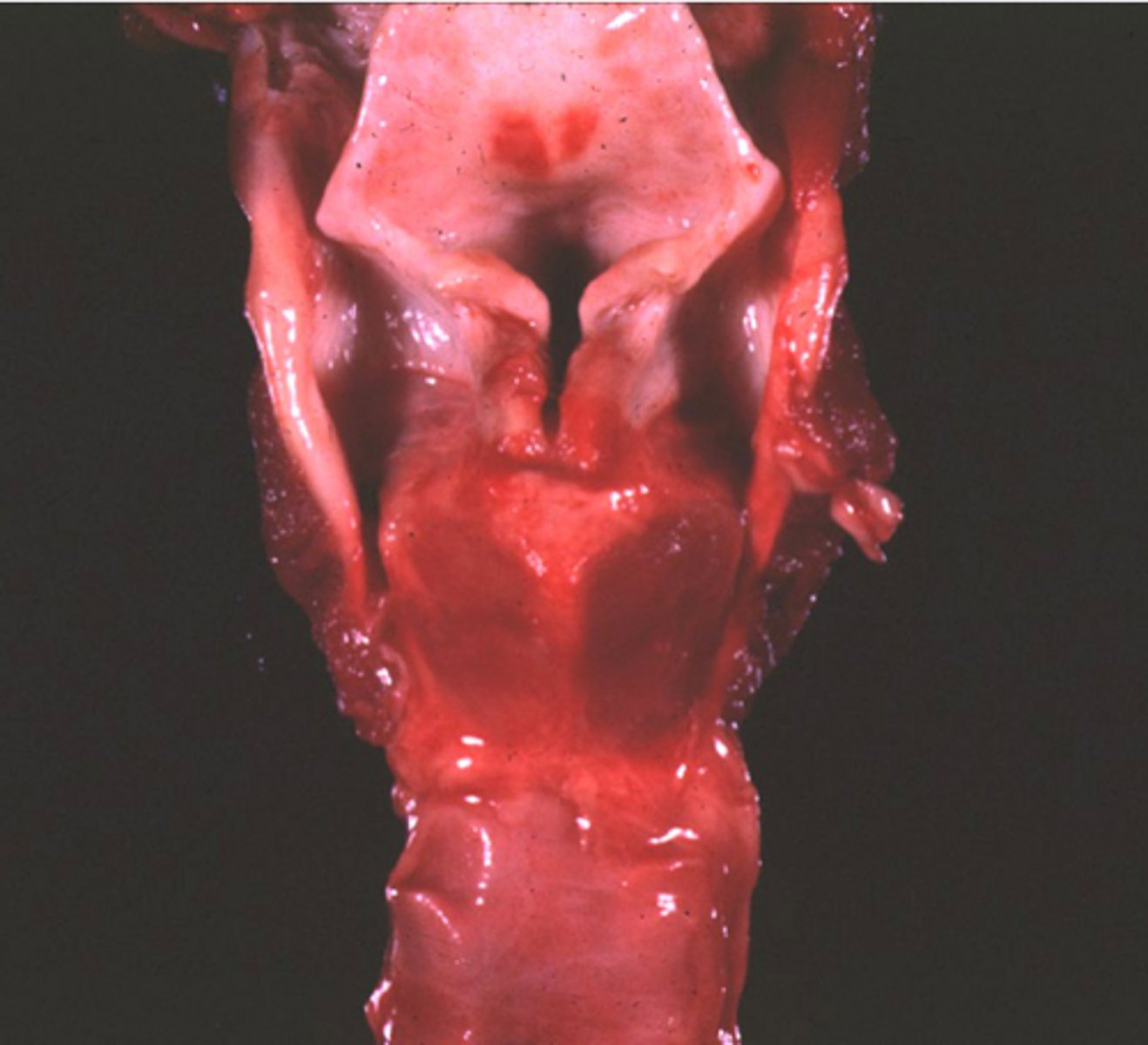
acute toxic laryngitis
______________ is caused by toxic fumes from a fire (esp burning polystyrene). Also physical (heat) damage. Industrial exposure in humans.
allergic laryngitis
________________________ in humans is a life-threatening type I HS associated with facial swelling and bronchospasm.
penetrating wounds, extra-luminal masses that impinge on the trachea
What did Dr. Joiner say may be the most common cause of Pharyngitis, laryngitis and tracheitis.
What OTHER category of things can cause this also?
Calf diphtheria
______________ is the classic example of necrotic laryngitis, and is associated with unsanitary conditions, pharyngeal trauma, and viral (IBR) infection in feedlot cattle, veal calves and sheep.
exotoxins and endotoxins from fusobacterium necrophorum
What causes calf diphtheria?
Ulceration and necrosis of larynx, tongue, gingiva, cheeks, palate and pharynx.
What lesions does calf diphtheria cause?
granulation tissue, fibrosis
toxemia, septicemia, aspiration pneumonia
As the ulcers caused by calf diphtheria heal, they are replaced by ____________ and ________ which may lead to _______, ________ or __________ in addition to constricting the laryngeal opening
acute inflammation, trauma, irritant gases, systemic anaphylaxis, forced respiration
Hemorrhage and edema in the lungs and trachea are non specific lesions but are often associated with what?
tympani, empyema, mycosis
If the guttural pouch is filled with air it is called ________.
With purulent material?
With a fungal infection?
nerve damage, dysphagia, laryngeal paralysis, horners syndrome
What are some consequences of empyema and mycosis in the guttural pouch?
vascular damage, erosion of internal carotid, fatal epistaxis, dissemination of fungal emboli into brain
What are the consequences of a guttural pouch only infected with mycosis?
foals
eustachian tube
snoring/gurgling noises
dysphagia, aspiration pneumonia
guttural pouch tympani is often seen in _______ and may be a ________ abnormality.
Results in _________ sounds, and can lead to ________ that in turn leads to _________
Aspergillus nodulans., Aspergillus fumigatus
What are the causes of guttural pouch mycosis?
fibrinonecrotic exudate, vascular
Guttural pouch mycosis leads to a guttural pouch lined by _________>
The fungi have a ______ trophism
malignant, locally invasive, low
Most nasal neoplasms are ________, -_______ and have [high/low] malignant potential
nasal turbinates, airflow, bone
Nasal neoplasms lead to pressure atrophy of the _________, restricted __________ and sometimes to local _______ invasion and lysis
true
true/false: Nasal neoplasms lead to sneezing, nasal discharge and epistaxis - often unilateral, and because of this may mimic chronic rhinitis and/or deform the face.
dog: nasal passages
cat: nasal vestibule
horse: maxillary sinus
sheep/goat: ethmoid
What are the main sites of nasal neoplasms in a dog?
Cat?
Horses?
Sheep and goats?
squamous cell carcinoma, rare if ever, squamous cell carcinoma, rare
What type of neoplasia is most often found in the guttural pouch?
In the pharynx?
In the Larynx?
In the trachea?
 Note
Note  Flashcards (36)