Chapter 10 - Nursing Assistant Care
 Studied by 0 people
 Call Kai
 Learn
Learn Practice Test
 Spaced Repetition
 Match
Match Flashcards
 Knowt Play
1/199

There's no tags or description
Looks like no tags are added yet.
Name | Mastery | Learn | Test | Matching | Spaced |
|---|
No study sessions yet.
200 Terms
body mechanics
Principles that focus on alignment, base of support, center of gravity, fulcrum and lever.
positioning
The act of helping people into positions that promote comfort and health.
supine
Body position in which a person lies flat on his back.

lateral
Body position in which a person is lying on either side.
prone
Body position in which a person is lying on his stomach, or front side of the body.
Fowler's
A semi-sitting body position, in which a person's head and shoulders are elevated 45 to 60 degrees.
Sims'
Body position in which a person is lying on his left side with the upper knee flexed and raised toward the chest.
draw sheet
An extra sheet placed on top of the bottom sheet; used for moving residents without causing shearing.
shearing
Rubbing or friction that results from the skin moving one way and the bone underneath it remaining fixed or moving in the opposite direction.
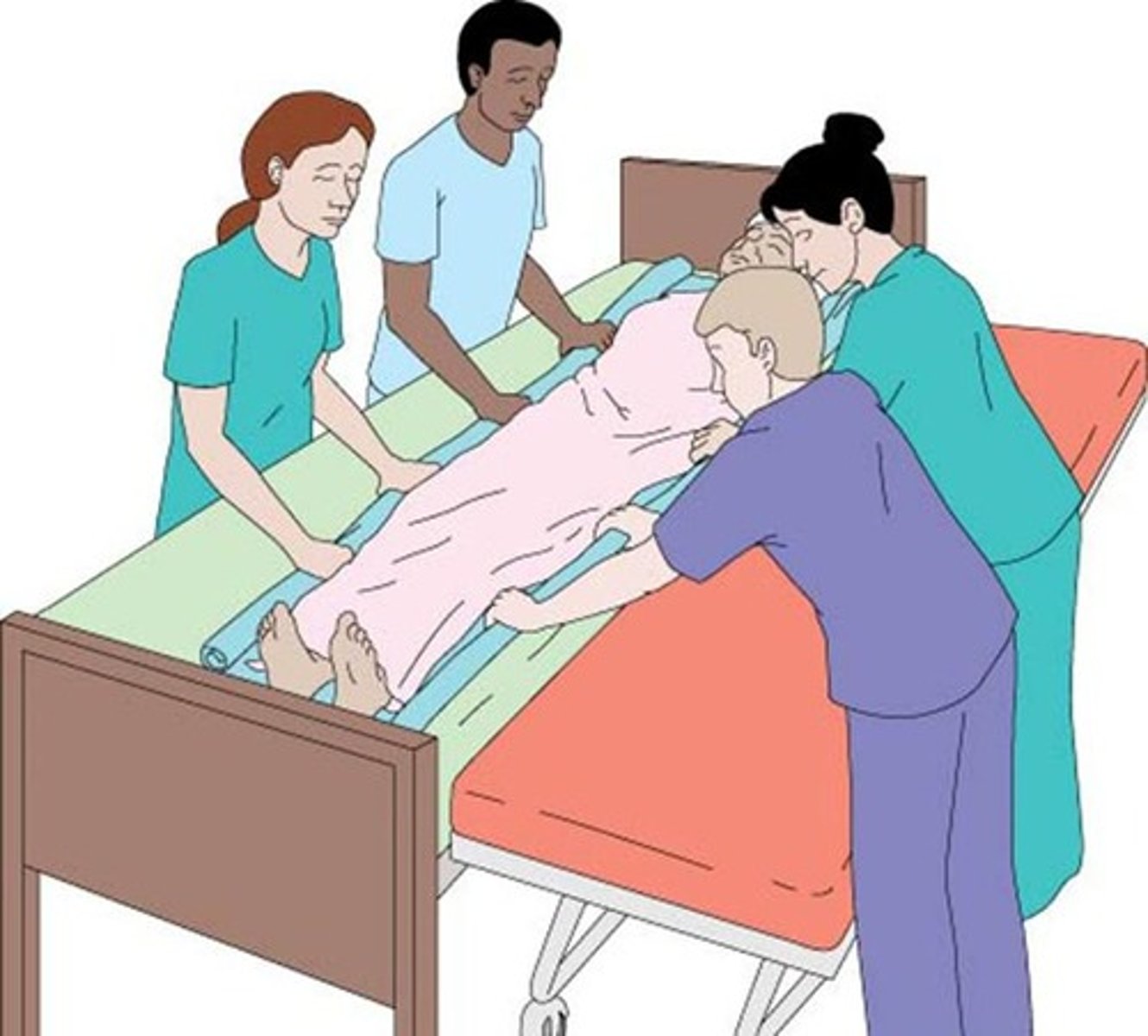
logrolling
Moving a person as a unit, without disturbing the alignment of the body.
dangle
To sit up with the legs hanging over the side of the bed in order to regain balance and stabilize blood pressure.
Supine Position
Resident lying flat on back with pillows under head and shoulders, and under calves to elevate heels.
Lateral Position
Resident lying on either side with pillows supporting head, arm, and leg on upper side.
Prone Position
Resident lying on stomach with a small pillow under head and to keep feet off bed.
Fowler's Position
Semi-sitting, head and shoulders elevated with pillows at flexed knees, at flexed feet, and under head.
Sims' Position
Variation on lateral side position, left side-lying position with lower arm behind the back and upper knee flexed.
Moving a resident up in bed
Process involving identifying yourself, washing hands, explaining the procedure, and ensuring privacy.
Equipment for moving a resident
Draw sheet or other device.
Adjusting bed for moving a resident
Adjust bed to a safe level, usually waist high, and lock the bed wheels.
Lowering head of bed
Lower the head of bed to make it flat before moving the resident.
Raising side rails
If the bed has side rails, raise the rail on the far side of the bed.
Standing position for moving
Stand by the bed with feet shoulder-width apart, facing the resident.
Proper body mechanics
Using correct posture and movements to prevent injury while assisting a resident.
Count of three
A method used to coordinate movements when shifting a resident.
Comfortable positioning
Arranging the resident's pillows and blankets to ensure their comfort.
Lowest bed position
The bed height set to its lowest level for safety.
Call light
A device placed within the resident's reach to alert staff for assistance.
Hand hygiene
Washing hands to prevent infection before and after resident care.
Reporting changes
Informing the nurse about any noticeable changes in the resident's condition.
Privacy measures
Using curtains, screens, or doors to ensure the resident's privacy during care.
Shoulder-width apart stance
Standing with feet shoulder-width apart for stability while moving a resident.
Knee against the bed
Positioning one knee against the side of the bed for leverage while moving a resident.
Face-to-face contact
Maintaining direct eye contact with the resident to enhance communication.
Adjusting bed height
Setting the bed to a safe level, typically waist high, for ease of care.
Unrolling the draw sheet
Leaving the draw sheet in place after repositioning for future use.
Moving a resident to the side of the bed
The procedure of shifting a resident laterally using a draw sheet or hands.
Bending knees
A technique to maintain back safety while lifting or moving a resident.
Using another person for assistance
Modifying the procedure to include a helper for safer resident transfers.
Grasping the draw sheet
Holding the draw sheet securely to facilitate moving the resident.
Sliding hands under the resident
Gently positioning hands under different parts of the resident's body for movement.
Facility guidelines
The specific protocols to follow when documenting procedures in a care setting.
Lowering the head of the bed
Adjusting the bed's head section downwards to assist in resident positioning.
Maintaining back straight
Keeping the spine aligned to prevent injury while moving a resident.
Positioning a resident on his side
Gently slide your hands under her midsection and move it toward you.
Make the resident comfortable
Ensure the resident is in a comfortable position.
Return bed to lowest position
Adjust the bed to its lowest position for safety.
Remove privacy measures
Take down any curtains or screens used for privacy.
Place call light within resident's reach
Ensure the call light is accessible to the resident.
Wash your hands
Perform hand hygiene before and after the procedure.
Report any changes in resident to the nurse
Inform the nurse of any observed changes in the resident's condition.
Document procedure using facility guidelines
Record the procedure according to the established protocols.
Identify yourself by name
Introduce yourself to the resident clearly.
Identify the resident according to facility policy
Confirm the resident's identity as per the facility's procedures.
Explain procedure to the resident
Clearly and slowly explain what you will be doing.
Provide for the resident's privacy
Use a curtain, screen, or door to ensure privacy.
Adjust bed to a safe level
Set the bed height to a safe level, usually waist high.
Lock the bed wheels
Ensure the bed wheels are locked to prevent movement.
Lower the head of the bed
Adjust the head of the bed to a flat position.
Turning a resident away from you
Cross the resident's arms over his chest and cross the near leg over the far leg.
Turning a resident toward you
Cross the resident's far arm over his chest and move the arm on the side the resident is being turned to out of the way.
Position the resident properly and comfortably
Ensure the resident's head is supported by a pillow and the shoulder is adjusted.
Logrolling a resident
Use a draw sheet or other device with a coworker to move the resident.
Place a pillow under the resident's head
Support the neck during the move with a pillow.
Place the resident's arms across his chest
Position the resident's arms to facilitate movement.
Place a pillow between the knees
Use a pillow to support the resident's legs.
Stand with your feet shoulder-width apart
Maintain a stable stance while preparing to move the resident.
Grasp the draw sheet on the far side
Hold the draw sheet firmly to assist in the move.
Let the resident know you will be moving him
Inform the resident about the upcoming movement for awareness.
On three, gently roll the resident toward you
Count to three and roll the resident as a single unit.
Make resident comfortable
Adjust the resident's position for comfort after the move.
ergonomics
the science of designing equipment, areas, and work tasks to make them safer and to suit the worker's abilities.
transfer belt
a belt made of canvas or other heavy material that is used to help people who are weak, unsteady, or uncoordinated to transfer or walk.
slide board
a wooden board that helps transfer people who are unable to bear weight on their legs; also called transfer board.
nonskid shoes
footwear designed to prevent slipping, often used for residents getting out of bed.
vital signs
measurements of the body's basic functions, including pulse and respiration rates.
resident comfort
the state of being comfortable, often achieved by adjusting pillows and covers.
bed position
the height and angle at which a bed is set, important for resident safety and comfort.
care plan
a documented strategy for the care of a resident, outlining specific procedures and goals.
assistance
help provided to residents who are unable to perform tasks independently.
handwashing
the act of cleaning hands to prevent infection, required before and after resident care.
transfers
the process of moving a resident from one location to another, such as from bed to chair.
ambulation
the act of walking or moving about, often requiring assistance for residents.
sitting position
the posture of a resident when they are upright, often achieved by raising the head of the bed.
shoulder blades
the bony structures on the back that are important for support during transfers.
thighs
the upper part of the leg, which is supported during transfers.
counting pulse
the process of measuring the number of heartbeats per minute as part of vital signs assessment.
respiration rates
the number of breaths taken per minute, an important vital sign.
No-lift policy
A policy adopted by many facilities that prohibits lifting residents manually.
Affected side
The side of the resident's body that is weaker or has less mobility.
Nonskid footwear
Footwear designed to prevent slipping, required for residents during transfers.
Wheelchair guidelines
Instructions for safely using a wheelchair, including locking brakes and using armrests.
Transfer procedure
A series of steps to safely transfer a resident, including identifying the resident and washing hands.
Privacy during transfer
Providing privacy for the resident using curtains, screens, or doors during the transfer process.
Buckle adjustment
The transfer belt buckle should be tightened until snug, allowing room for flat fingers to fit underneath.
Repositioning residents
Moving residents at least every hour to promote comfort, muscle tone, and circulation.
Responding to a fall
Actions to take when a resident starts to fall, including widening stance and lowering the resident to the floor.
Stretcher guidelines
Instructions for safely using a stretcher, including locking wheels and keeping safety belts fastened.
Transferring with a stretcher
Moving a resident on a stretcher requires locking wheels and moving slowly and carefully.
Assisting resident in wheelchair
Ensure the wheelchair is close and locked before assisting the resident with transfers.
Safety rails on stretchers
Safety rails should be raised and safety belts fastened while the resident is on a stretcher.
 Note
Note  Flashcards (59)