EPIB301: Experimental Study Designs
 Call Kai
 Learn
Learn Practice Test
 Spaced Repetition
 Match
Match Flashcards
 Knowt Play
1/67

There's no tags or description
Looks like no tags are added yet.
Name | Mastery | Learn | Test | Matching | Spaced | Call with Kai |
|---|
No analytics yet
Send a link to your students to track their progress
68 Terms
What study type is this?
Manipulation=Yes; Randomization=Yes
Experimental
What study type is this?
Manipulation=Yes; Randomization=No
Quasi-experimental
What study type is this?
Manipulation=No; Randomization=No
Observational
What study design is this?
Assign participants to intervention and control groups in order to examine whether an intervention causes an intended outcome
Experimental Studies/Intervention Studies
What are two types of intervention studies?
Controlled trials and Quasi-experimental
The most common and strongest interventional study design is a _________.
randomized controlled trial
Some participants are randomly assigned to an active intervention group
The remaining participants are assigned to a control group
All participants from both groups are followed forward in time to see who has a favorable outcome and who does not
What study design is this?
Randomized Controlled Trials (RCTs)
RCT vs. Cohort Studies
RCT participants are randomly allocated while Cohort study participants are naturally allocated
Participants in RCTs differ from one another in both known and unknown ways (confounding factors) that can affect the study outcome. What is this called?
Randomization
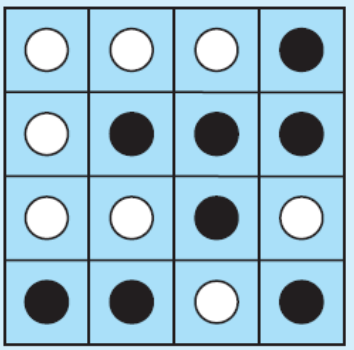
Each individual is randomized to one treatment group
Simple randomization
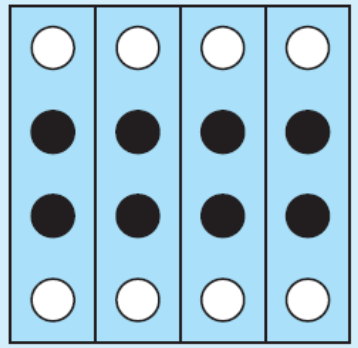
Groups of individuals are randomized to a treatment group
Block randomization
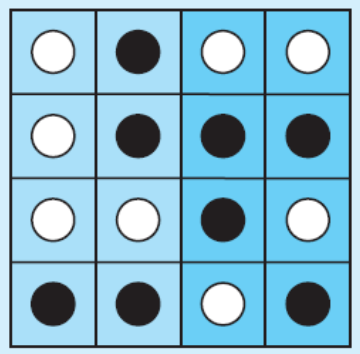
Individuals are grouped into strata and then randomized to one treatment group
Stratified randomization
These Clinical trials are frequently used to evaluate new drugs. Can also be used to evaluate the efficacy of: diets, exercise regimens, new programs, etc.
Modern Clinical Trials
This trial evaluates the effectiveness of a substance that is used to prevent disease; it can also involve a prevention program
Prophylactic trial
This trial involves the study of curative drugs or a new surgical procedure to improve the patient’s health
Therapeutic trial
How many phases are there in Clinical trials?
Phase 1, Phase 2, Phase 3, FDA approval, Phase 4
What is Phase 1 of Clinical Trials?
Tests drug on healthy individuals; Tests for safety, dosage and side effects
What is Phase 2 of Clinical Trials?
Tests on larger group of effected individuals; Tests for efficacy and side effects
What is Phase 3 of Clinical Trials?
Tests on new and wider demographic; Tests for long term effectiveness and comparisons with other medications
What is FDA approval of Clinical Trials?
Treatment determined effective and safe for public use
What is Phase 4 of Clinical Trials?
Continues to test for effectiveness and safety; Can be taken off the market if necessary
Referred to as clinical endpoints, which may include rates of disease, disability, death, and recovery. The outcome of interest is measured in the intervention and control arms of the trial to evaluate efficacy. What study design results in this outcome?
Outcomes of RCTs
What are the three different outcomes?
Superiority trial, Noninferiority trial, Equivalence trial
Success of this trial shows the intervention is better than the control
Superiority trial
Success of this trials hows the intervention is not worse than the control
Noninferiority trial
Success of this trial shows the intervention is equal to the control
Equivalence trial
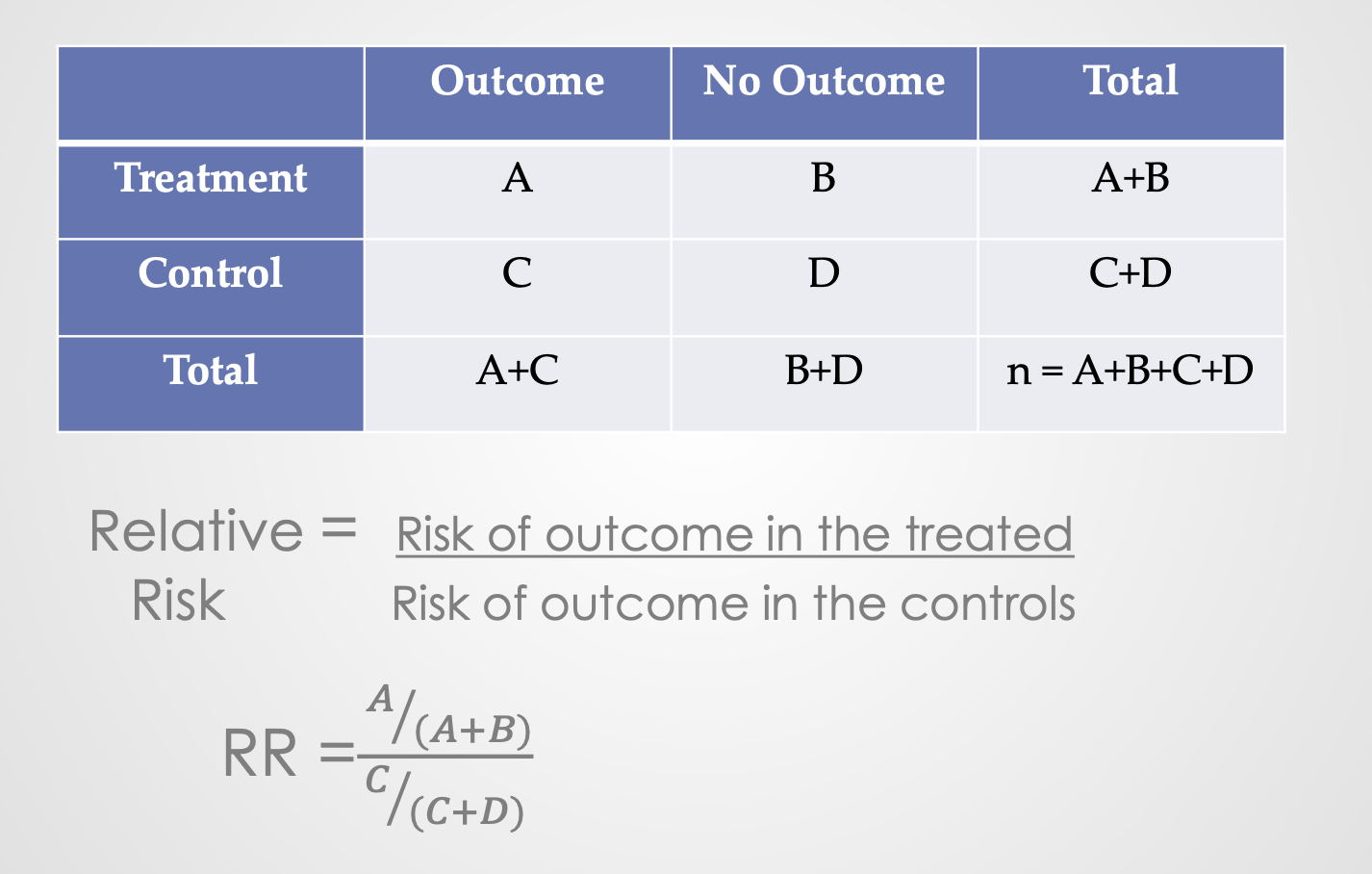
Experimental studies use many of the same measures of association that ______ do:
Relative risk (RR)
Attributable risks (ARs, AR%)
Measures of survival
Cohort studies
Interpretation of RR for if the outcome is disease incidence or mortality (prophylactic trial)
RR = 1
No association
Interpretation of RR for if the outcome is disease incidence or mortality (prophylactic trial)
RR > 1
suggests treatment group are more likely than controls to develop disease/outcome
Interpretation of RR for if the outcome is disease incidence or mortality (prophylactic trial)
RR < 1
(GOAL) suggests treatment group are less likely than controls to develop disease/outcome (protective factor)
Interpretation of RR for if the outcome is “improvement” in disease or morbidity/survival (therapeutic trial)
RR = 1
No association
Interpretation of RR for if the outcome is “improvement” in disease or morbidity/survival (therapeutic trial)
RR > 1
(GOAL) suggests treatment group is more likely than controls to show improvement
Interpretation of RR for if the outcome is “improvement” in disease or morbidity/survival (therapeutic trial)
RR < 1
suggests treatment group is less likely than controls to show improvement
The proportion of individuals in the control group who experience an unfavorable outcome who could have been expected to have a favorable outcome had they been in the active group instead
Efficacy
A high efficacy is an indicator that an intervention is
successful
The expected number of people who would have to receive a treatment to prevent an unfavorable outcome in one person (or alternately stated, to achieve a favorable outcome in one person)
Number Needed to Treat (NNT)
A small NNT indicates a
more effective intervention
NNT Example:
If a drug is intended to prevent stroke and has an NNT of 5, then _ people have to take the drug for one year (or some other specified time period) to prevent one of the _ from having a stroke
5; 5
NNT Example:
If a drug has an NNT of 102, it means that ___ people have to take the drug to prevent one of the ___ from having a stroke
102; 102
The most typical control is a ______, an inactive comparison similar to the therapy being tested
placebo
What effect is this?
Patient is given a placebo intervention; Patient believes this intervention will change or improve his/her condition; This belief can have a therapeutic effect → Sometimes it actually does improve their condition in a measureable way
Placebo effect
What type of control is this?
Active Intervention: Active pill
Comparison: Inactive pill
Placebo/Inactive comparison
What type of control is this?
Active Intervention: New therapy
Comparison: Current best therapy for the condition being studied
Active comparison/standard of care
What type of control is this?
Active Intervention: Some dose of a medication
Comparison: Alternate doses of medication
Dose-response
What type of control is this?
Active Intervention: New intervention
Comparison: Participants assigned to the control group are asked to maintain their normal routines
No intervention
What type of control is this?
Active Intervention: New intervention
Comparison: Each participant's status before the intervention is compared to his or her own status after the intervention.
Self
Any change of treatment for a patient in a clinical trial involving a switch of study treatments
Crossover designs
In ______ crossovers a protocol is developed in advance, and the patient may serve as his or her own control.
planned
_________ crossovers exist for various reasons, such as patients request to change treatment
Unplanned
Done to maintain the integrity of a study and reduce the potential for bias
Blinding (masking)
Participants do not know which treatment they are getting.
Blinded
Neither the participant nor the researchers know which treatment a participant is being given.
Double-blinded
Participants and researchers know which treatment a participant is being given.
Non-blinded
Experimental studies involve a particularly high level of ______ risk because the researcher assigns participants to exposures (treatments)
ethical
What are some ethical principles?
Equipoise, Distributive justice, Beneficence, Nonmaleficence, Respect for persons
What ethical principle is this?
Experimental research should be conducted only when there is genuine uncertainty about which treatment will work better
Equipoise
What ethical principle is this?
infers that the source population must be an appropriate and non- exploitative one
Distributive justice
What ethical principle(s) is this?
_______ (do good) and ________ (do not harm): researchers must balance the likely benefits and risks of the study
Beneficence; nonmaleficence
What ethical principle is this?
Participants must volunteer for a study without being unduly influenced by the prospect of being compensated for their participation
Participants must be able to understand what it means to be a research subject, including the possibility of being assigned to a control group instead of the new intervention
Respect for persons
What are some ethical issues of human experimentation?
Informed consent; withholding treatment known to be effective; protecting the interests of the individual patient; monitoring for side effects; deciding when to withdraw a patient
What are advantages to experimental studies?
Provides the strongest evidence of association
Manipulation means having control over:
Amount of exposure
Timing and frequency of exposure
Period of observation
Ability to randomize reduces the likelihood that groups will differ significantly
What are disadvantages to experimental studies?
Artificial setting
Limited scope of potential impact
Adherence to protocol is difficult to enforce
Expensive
Ethical concerns
What are two types of intervention designs?
Clinical trials (focus on individual, synonymous with RCTs) and Community trial (focus on group/community)
Most __________ are conducted by allocating treatments or interventions to individual subjects
clinical trials
A group trial in which the intervention is allocated to entire communities (County, State, School district)
Community Trials
Communities are randomized and followed over time BUT Individuals within the communities ______ randomized
are NOT
What are advantages to Community Trials?
They represent the only way to estimate directly the impact of change in behavior or modifiable exposure on the incidence of disease
Some level of manipulation over intervention and period of observation
Ability to randomize at community level
What are disadvantages to Community Trials?
They are inferior to clinical trials with respect to ability to control entrance into study, delivery of the intervention, and monitoring of outcomes
Fewer study units are capable of being randomized, which affects comparability
They are affected by population dynamics, secular trends, and nonintervention influences

