6.4: Nerve Impulses
 Studied by 0 people
 Call Kai
 Learn
Learn Practice Test
 Spaced Repetition
 Match
Match Flashcards
 Knowt Play
1/17

There's no tags or description
Looks like no tags are added yet.
Name | Mastery | Learn | Test | Matching | Spaced | Call with Kai |
|---|
No analytics yet
Send a link to your students to track their progress
18 Terms
What are the differences between the nervous and hormonal systems?
Hormonal system has slow transmission, nervous system has fast transmission
Hormones can travel to all parts of the nody, nerve impulses only travel to specific parts of the body
Hormones have a widespread response, nervous system has a localized response
Hormones have a long-lasting response, nervous system has a short-lived response
Hormones have permanent and irreversible effects, nervous systems has temporary and reversible effects
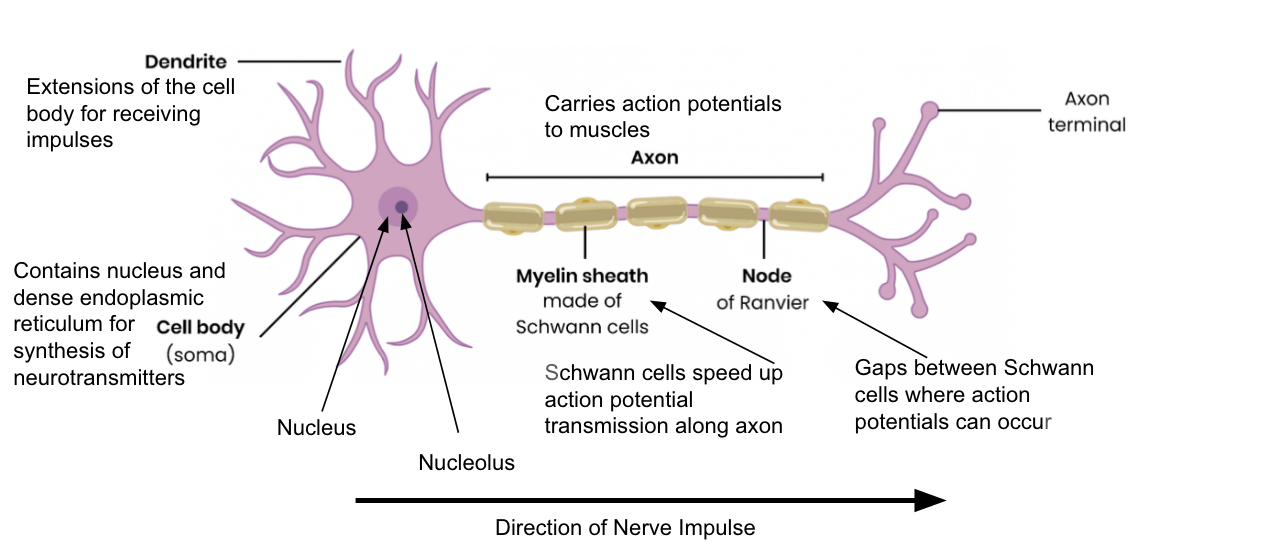
What is a myelinated motor neurone?
A nerve cell that carries impulses from the CNS to muscles/glands with its axon covered by a myelin sheath for faster nerve transmission
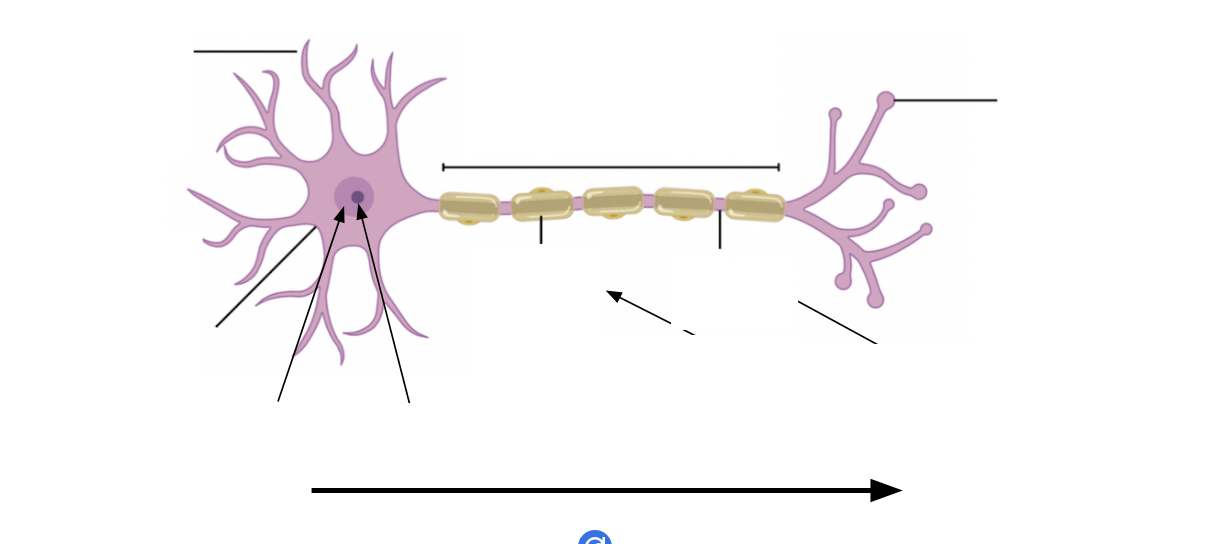
What is the structure of a myelinated motor neurone?
What is a resting potential?
The electrical charge difference across a cell membrane that is not actively transmitting nerve impulses
What is the membrane potential at resting potential?
70mV
How is a resting potential maintained?
Na+/K+ pump actively transports Na+ out of axon and K+ into axon (co-transport) using energy from ATP
An electrochemical gradient is established with both a higher K+ inside the axon and Na+ conc outside the axon
Differential membrane permeability means membrane is more permeable to K+ (as it is permanently open) so it moves out by facilitated diffusion, but Na+ channels are closed
What is an action potential?
A brief change in the electrical charge across a neurone’s membrane, making the inside positive compared to the outside, which passes along the axon as a nerve impulse
How do changes in membrane permeability lead to depolarisation and generation of an action potential?
Stimulus: Na+ channels open so the membrane permeability to Na+ increases
So Na+ diffuses into the axon down an electrochemical gradient
This causes depolarisation
Depolarisation: If threshold potential is reached, an action potential is generated
More voltage-gated Na+ channels opens, so more Na+ diffuses in rapidly
Repolarisation: voltage-gated Na+ channels close
Voltage-gated K+ channels open
K+ diffuses out of axon
Hyperpolarization: K+ channels are slow to close so too many K+ diffuse out
Resting potential: Restored by Na+/K+ pump
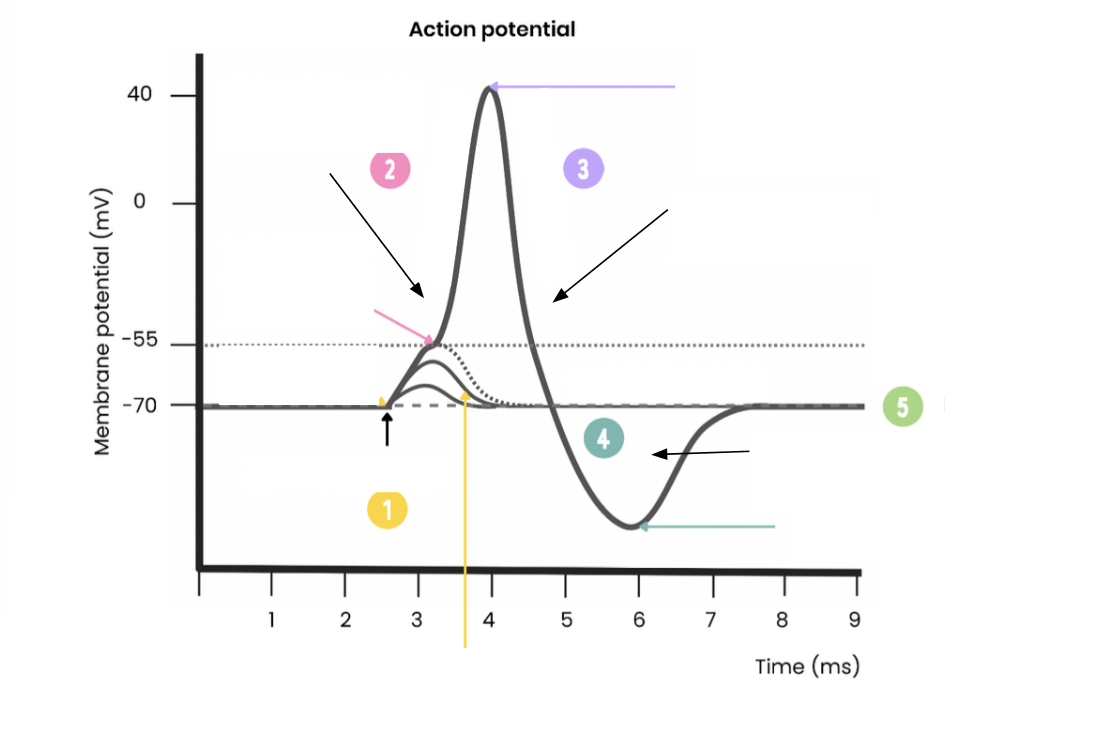
Explain this graph of an action potential
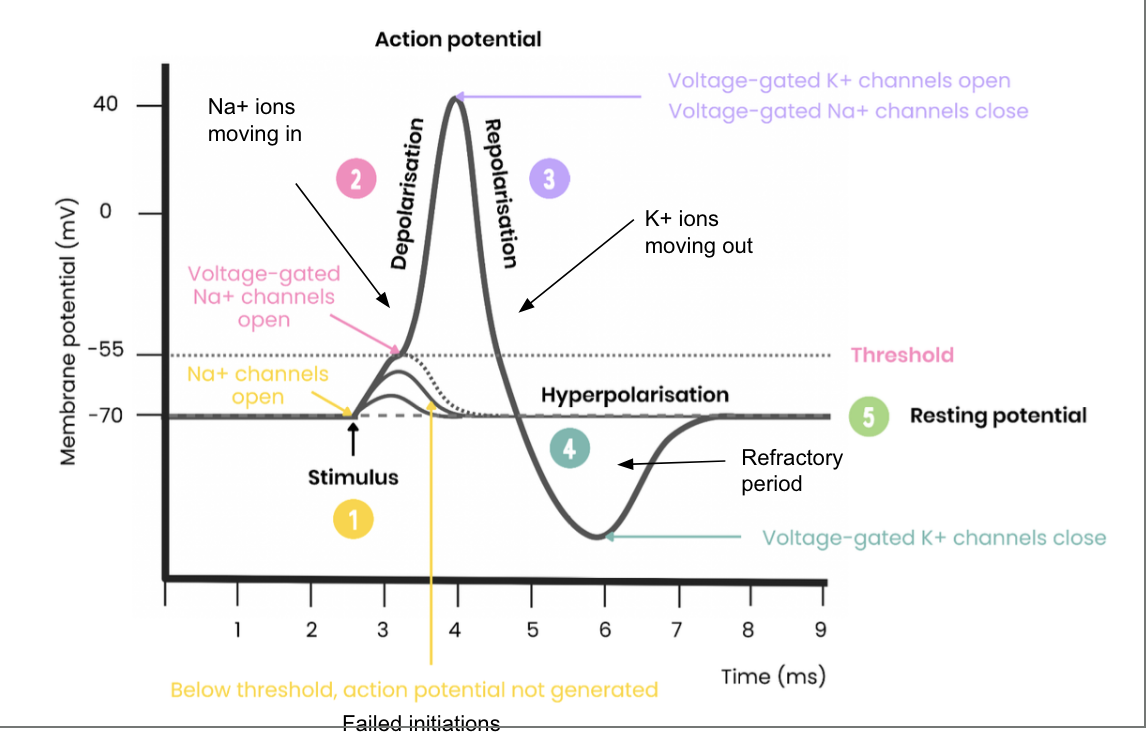
What is the refractory period?
The time taken to restore the axon to resting potential when no further action potential can be generated as Na+ channels are closed
What is the importance of the refractory period?
Ensures discrete impulses are produced as action potentials cannot overlap
Limits frequency of impulse transmission to prevent overreaction
Ensures action potentials travel in one direction as they cannot be propagated in the refractory region
How is maximum frequency of impulse conduction calculated and what is the unit?
Maximum frequency= time/duration of refractory period
Units:
mpulses sec-1
action potentials sec-1
Hz (1 Hz is equal to one impulse per second)
What is the all or nothing principle?
If depolarisation exceeds threshold potential, an action potential is always produced.
This means action potentials are always the same size
Bigger stimuli instead increase the frequency of action potentials, instead of their magnitude.
How does the passage of an action potential along an unmyelinated axon result in a nerve impulse?
Action potential passess as a wave of depolarization
Influx of Na+ in one region increases the permeability of adjoining region to Na+
Causing voltage-gated Na+ channels to open to adjoining region depolarizes
How does the passage of an action potential along a myelinated axon result in a nerve impulse?
Myelination provides electrical insulation
Depolarization of axon only happens at nodes of Ranvier
Resulting in Saltatory conduction
So no need for depolarization along whole length of axon
How does damage to the myelin sheath lead to slow responses/jerky movement?
No saltatory conduction so depolarisation occurs along the whole length of the axon
Nerve impulses take longer to reach neuromuscular junction
Causing a delay in muscle contraction
Ions may pass to other neurones
Causing wrong muscle fibres to contract
What is Saltatory conduction?
The jumping of action potentials from one Node of Ranvier to the next
What are the factors that effect speed of conductance and how do they effect it?
Myelination and saltatory conduction: depolarisation only happens at nodes of ranvier so impulse does not depolarize the whole length of axon
Axon diameter: bigger diameter means less resistance to the flow of ions in the cytoplasm
Temperature: INcreased temp increases rate of diffusion of Na+ and K+ as more kinetic energy, but at a certain temperature active sites of enzymes could denature
 Note
Note  Flashcards (23)