CH 5
 Call Kai
 Learn
Learn Practice Test
 Spaced Repetition
 Match
Match Flashcards
 Knowt Play
1/19

There's no tags or description
Looks like no tags are added yet.
Name | Mastery | Learn | Test | Matching | Spaced | Call with Kai |
|---|
No analytics yet
Send a link to your students to track their progress
20 Terms
What type of color-blindness results in a univariance problem?
Monochromacy (1 type of photoreceptor working) → all color translated into a single response
The [Part of the Visual System] is most closely tied to which step of visual processing? [Will be Cones, LGN, or V1 in the prompt]
Cones → Detection
LGN→ Discrimination
V1→ Appearance
RGB televisions and computer monitors have red, green, and blue pixels. Why don’t they need to have yellow pixels?
Light is additive → Red + Green produces the perceptual appearance of Yellow
Which of the following are pieces of evidence for color opponency?
A single opponent cell in the LGN is shown to have a Blue+ center and a Yellow- surround. What would the wavelength codes be for the center and for the surround? [I will give you the two colors on the exam]
Blue+ center → S+
Yellow- surround→ LM-
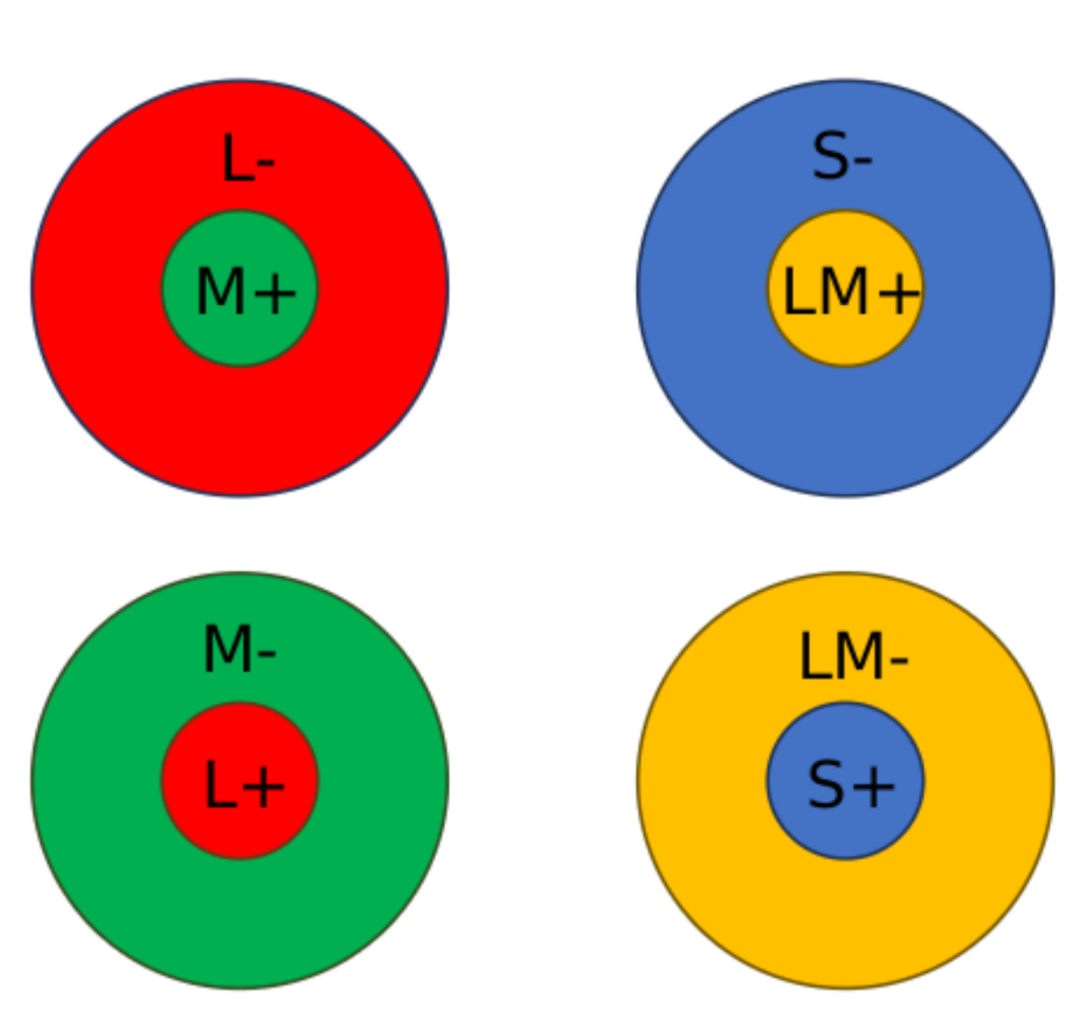
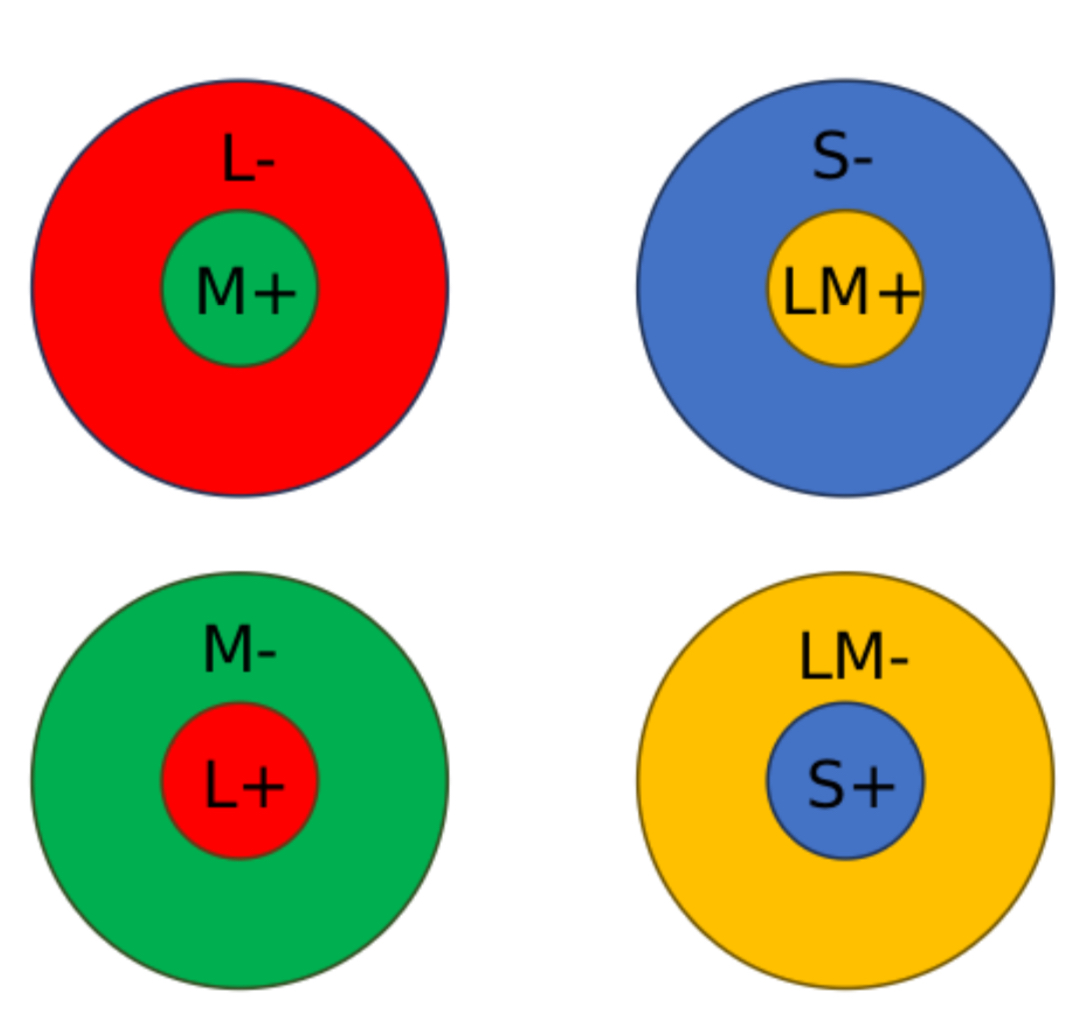
A single opponent cell in the LGN is shown to have a [S +] center. What must its surround be coded as? [I will give you the center code on the exam, you’ll need to pick the appropriate surround].
LM- surround
Frederick is traveling to a new country. While there, he learns that their language has labels that differentiate two very specific shades of orange. If someone from that country were given a color discrimination task involving shades of orange that either did or did not cross that label boundary, what would you predict their performance would look like?
Faster
More accurate
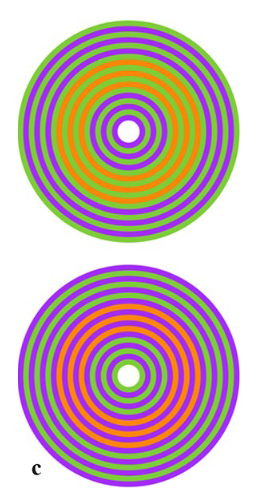
Which of the following would be an example of Color Assimilation?
Color Assimilation → color bleeds onto each other, taking on some of the chromatic quality of each other
ex) The Green looks different based on the color behind it
What is one potential explanation for why some people on the internet perceived “The Dress” as blue and black, while others perceived it as white and gold?
Differences in how the brain assumes different illuminants (light source)
Heuristics
White + Gold Dress → assume blue light source → brain infers the strip is white
Blue + Black Dress → assume yellowish light source → brain infers the strip is blue
What wavelength of light would produce no response from an S cone, a moderate response from an M cone, and a large response from an L cone? [These will be in nm’s but options will be at least 50-100nm different].
S→ 400-500 nm
M→ 450 -630 nm
L→ 500-700 nm
Under which of the following conditions would you experience a univariance problem with color vision?
Cone Monochromacy
We often perceive bananas as yellow regardless of what color the lighting is. What type of effect is this?
Color Constancy + Iluminant
CC → despite changes in overall lighting, we perceive a given object as the same color
When your brain is processing color, it often discounts what factor?
The illuminant (light hitting the object) → the brain tries to mentally subtract the color of the light source so you can perceive the objects true color
Color vision is best during what type of lighting condition?
Photopic → bright light
A(n) _______ is an individual who suffers from color “blindness” that is due to the absence of [Cone type]. [I will give you the cone type, you need to fill in the color anomalous type].
Deuteranope→ absence of M- cones → “green”
Protanope → absence of L- cones → “red”
Tritanope → absence of S- cones → “blue”
The colors these people are not processing
This heuristic results in both color constancy effects and the perception of depth. [your options will be monocular depth heuristics]
Aerial Perspective
How does mixing paints differ from mixing light?
Pain is subtractive → pigment absorbs wavelengths
Light is additive → wavelengths combine
A professor provides a study guide, where he labels all of the key information in green, and all of the irrelevant information in red. However, which type of color-anomalous student would particularly struggle with this study guide format?
Deuteranope + Protanopes
____________ is most closely tied to trichromacy, while ____________ is tied most closely to color opponency. [This is looking for stages of color perception that are most closely tied to these theories].
Detection
Discrimination
Which of the following statements about white light is true?
White is not a color
White is a combination of R,G, + B

