Module 10 Decision Analysis, Expected Value Approach, anf AHP
 Studied by 0 people
 Call Kai
 Learn
Learn Practice Test
 Spaced Repetition
 Match
Match Flashcards
 Knowt Play
1/29

There's no tags or description
Looks like no tags are added yet.
Name | Mastery | Learn | Test | Matching | Spaced | Call with Kai |
|---|
No analytics yet
Send a link to your students to track their progress
30 Terms
Regret is the difference between the payoff associated with a particular decision alternative and the payoff associated with the decision that would yield the most desirable payoff for a given state of nature. T or F?
True
The decision alternative with the best expected monetary value will always be the most desirable decision. T or F?
False
The expected value approach is more appropriate for a one-time decision than a repetitive decision. T or F?
False
The expected value of an alternative can never be negative. T or F?
False
The primary value of decision trees is that they provide a useful way to organize how operations managers think about complex multiphase decisions. T or F?
True
Lakewood Fashions must decide how many lots of assorted ski wear to order for its three stores. Information on pricing, sales, and inventory costs has led to the following payoff table, in thousands.
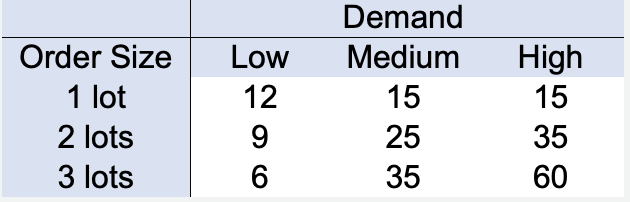
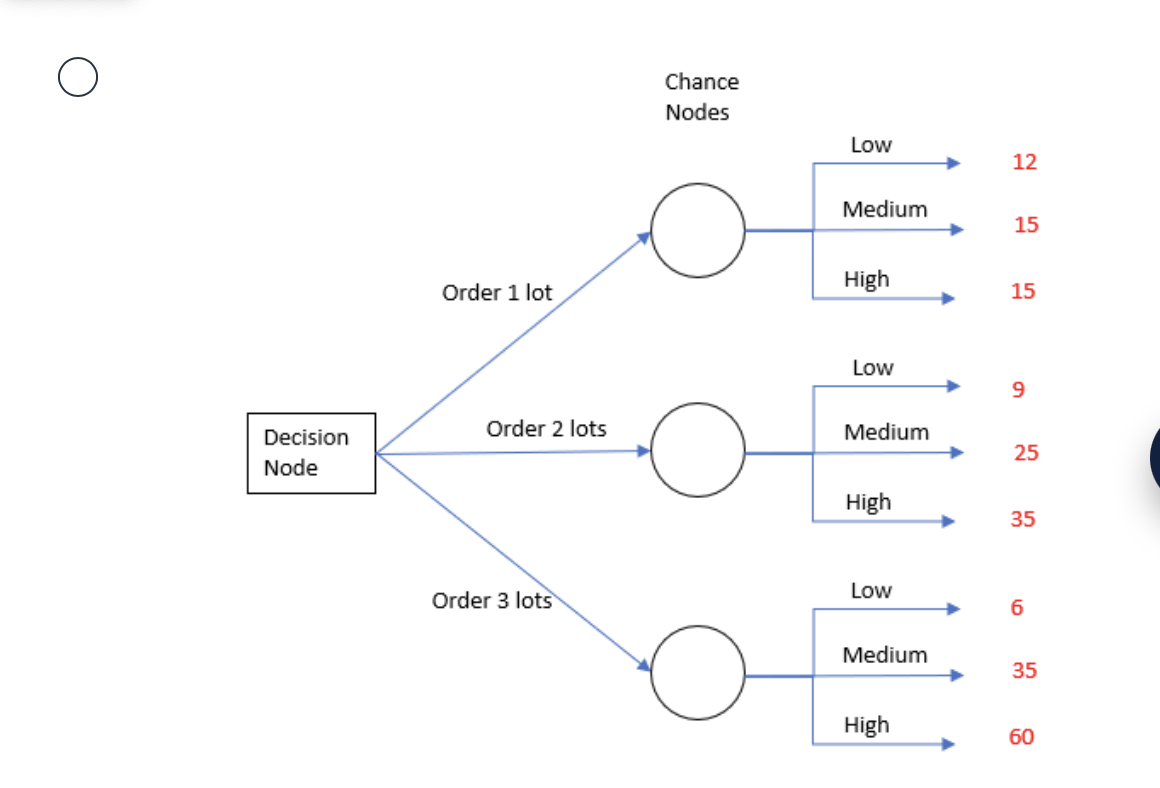
Part a) Which of the following decision trees correctly represent the problem described above?
Part b) What decision should be made by the optimist, i.e., someone using the Maximax Approach?
Order 2 lots
Order 1 lot
Order 3 lots
Order 3 lots
Part c) What decision should be made by the conservative, i.e., someone using the Maximin Approach?
Order 2 lots
Order 1 lot
Order 3 lots
Order 1 lots
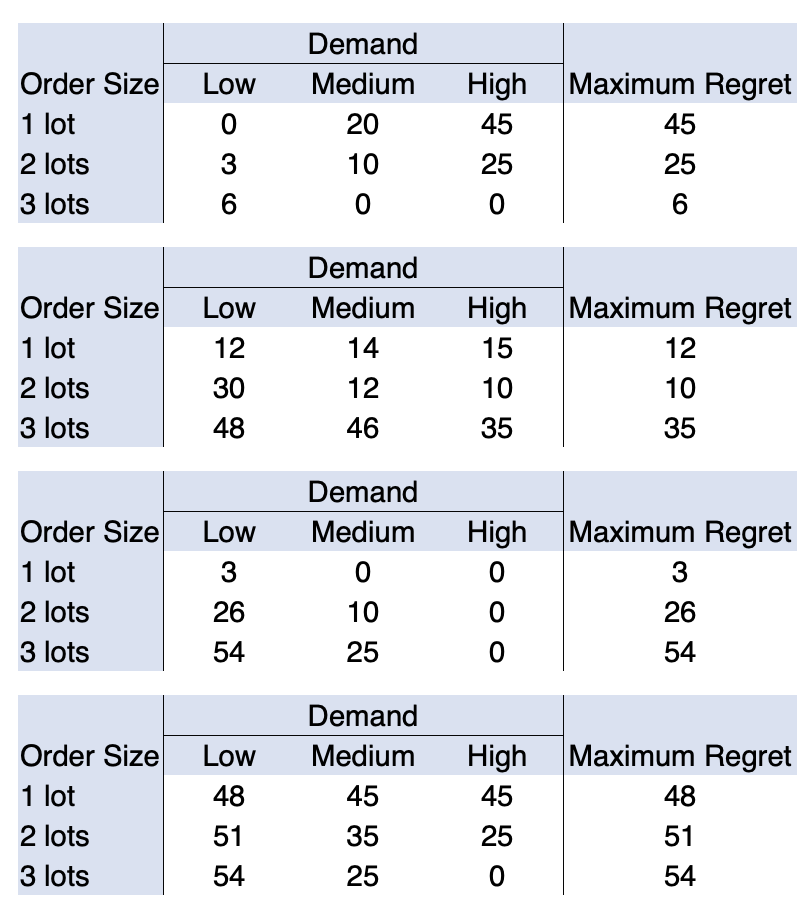
Part d) For each state of nature, calculate the regret of each choice. Which one of the following is the correct regret-table?
first table
Part e) What decision should be made using minimax regret?
order 3 lot
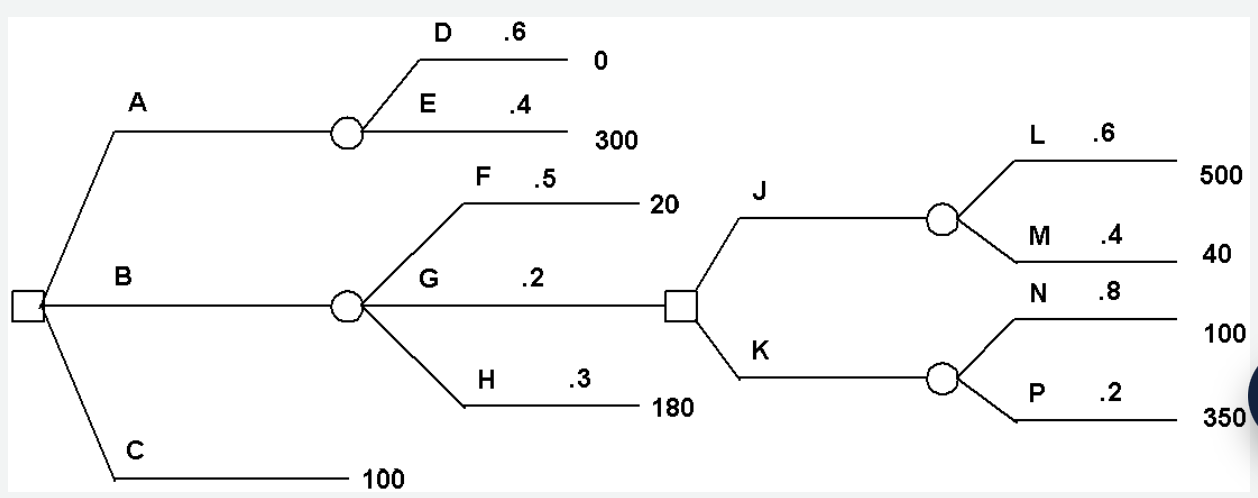
Determine decision strategies based on expected value for this decision tree.
Part a) What is the expected value after branch A, i.e., EV(A) =?
Branch A leads to a chance node with two outcomes:
D with probability 0.6 → payoff 0
E with probability 0.4 → payoff 300
So:
EV(A)=(0.6)(0)+(0.4)(300)EV(A)=(0.6)(0)+(0.4)(300)EV(A)=0+120=120EV(A)=0+120=120
Part b) What is the expected value after branch J, i.e., EV( J ) =?
Branch J leads to a chance node with two outcomes:
L with probability 0.6 → payoff 500
M with probability 0.4 → payoff 40
EV(J)=(0.6)(500)+(0.4)(40)
Compute each part:
0.6×500=3000.6×500=300
0.4×40=160.4×40=16
EV(J)=300+16=
316
Part c) What is the expected value after branch K, i.e., EV( K ) =?
150
Part d) What is the expected value after branch B, i.e., EV( B ) =?
Hint: Use the information you calculated before, i.e. EV( J) and EV( K). Use the most favorable outcome.
EV(J) = 316
EV(K) = 150
EV(B)=max(316,150)=316
Part e) What is the expected value after branch C, i.e., EV( C ) =?
100 there are no outcomes associated with branch C, meaning it has no expected value.
Part f) Based on the maximum expected value approach, what should be the initial decision strategy?
Select decision alternative C
Select decision alternative B
Select decision alternative A
Select decision alternative B
max(120, 316, 100)=316
Part g) Suppose that initially decision alternative B is selected and then G happened. Based on the maximum expected value approach, what should be the next decision strategy?
Select decision alternative J
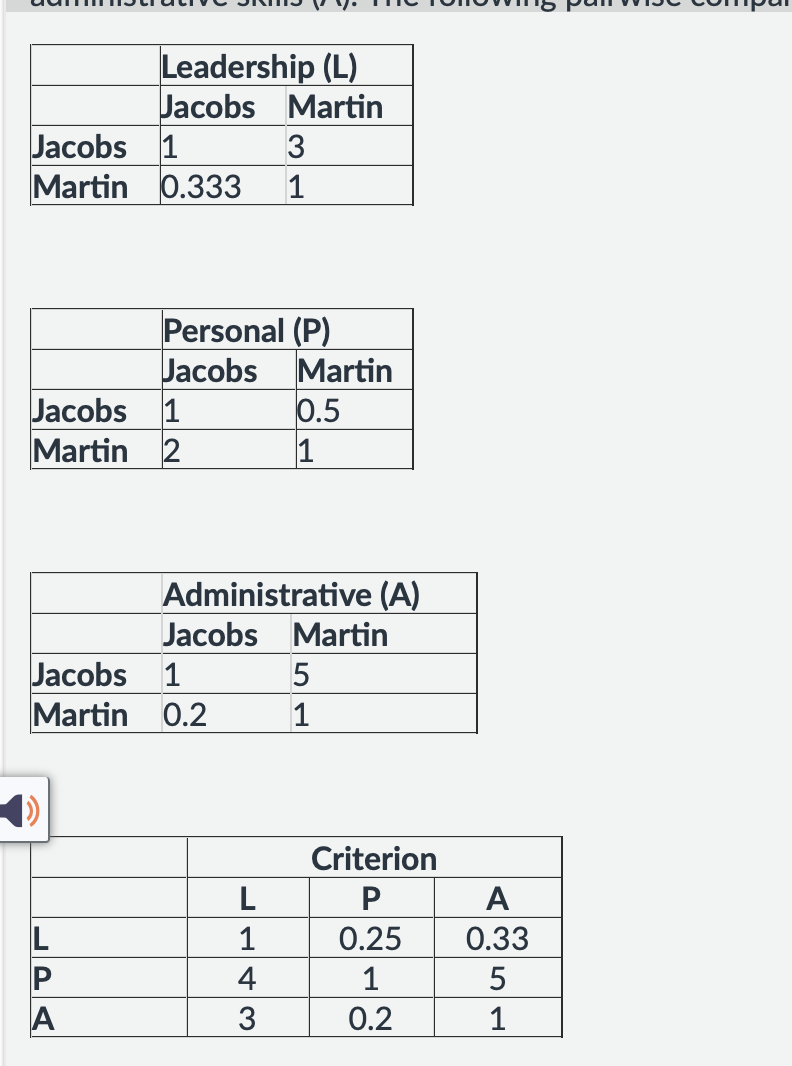
he vice president of Harling Equipment needs to select a new director of marketing. The two possible candidates are Bill Jacobs and Sue Martin, and the criteria thought to be most relevant in the selection are leadership ability (L), personal skills (P), and administrative skills (A). The following pairwise comparison matrices were obtained:
Part a) The column totals of the criteria comparison matrix are:
Leadership column total = 8
Personal column total = 1.45
Administrative column total = 6.33
Leadership column values:
From L row → 1
From P row → 4
From A row → 3
1+4+3=81+4+3=8
Personal column values:
From L row → 0.25
From P row → 1
From A row → 0.2
0.25+1+0.2=1.450.25+1+0.2=1.45
Administrative column values:
From L row → 0.33
From P row → 5
From A row → 1
0.33+5+1=6.330.33+5+1=6.33
Leadership column total = 8
Personal column total = 1.45
Administrative column total = 6.33
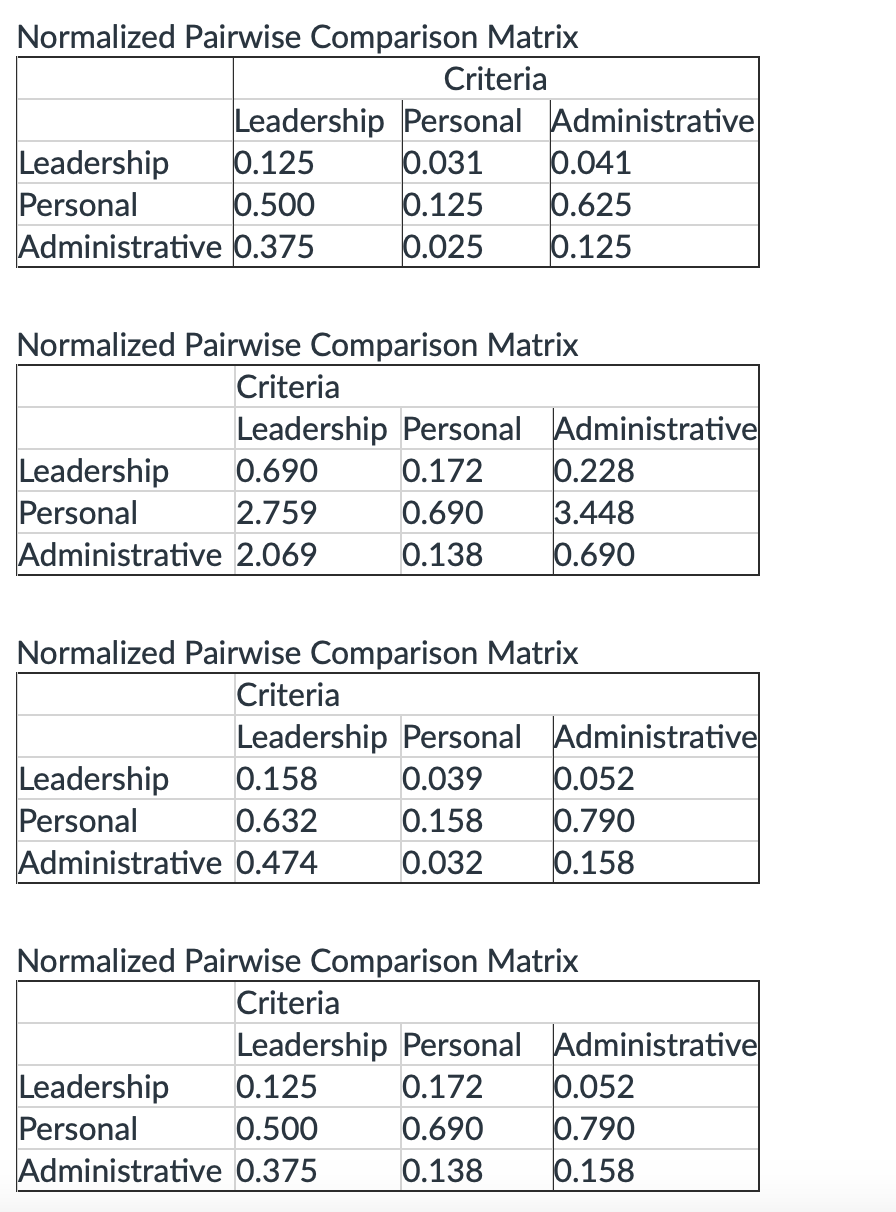
Part b) If you divide each cell in each column by the column total you get the Normalized Pairwise Comparison Matrix for the Criteria:
the 4th option
Divide each value by 8:
L row: 1/8=0.1251/8=0.125
P row: 4/8=0.5004/8=0.500
A row: 3/8=0.3753/8=0.375
Divide each value by 1.45:
L row: 0.25/1.45≈0.1720.25/1.45≈0.172
P row: 1/1.45≈0.6901/1.45≈0.690
A row: 0.2/1.45≈0.1380.2/1.45≈0.138
Divide each value by 6.33:
L row: 0.33/6.33≈0.0520.33/6.33≈0.052
P row: 5/6.33≈0.7905/6.33≈0.790
A row: 1/6.33≈0.1581/6.33≈0.158
Criteria
Leadership
Personal
Administrative
Leadership
0.125
0.172
0.052
Personal
0.500
0.690
0.790
Administrative
0.375
0.138
0.158
Part c) What are the criteria priorities (row averages on normalized comparison matrix)?
Criteria Priorities
| Row Average |
Leadership | 0.117 |
Personal | 0.660 |
Administrative | 0.224 |
Part d) Compute the priorities for the Leadership pairwise comparison matrix. We will go step by step.
| Leadership | |
| Jacobs | Martin |
Jacobs | 1 | 3 |
Martin | 0.333 | 1 |
Step 1: Column totals
Step 2: Normalized Pairwise Comparison Matrix (see slides and Excel for an example)
Step 3: Calculate row average
Jacobs column total1+0.333=1.333
1+0.333=1.333
Martin column total
3+1=4
3+1=4
Part e) Compute the priorities for the Leadership pairwise comparison matrix. We will go step by step.
| Leadership | |
| Jacobs | Martin |
Jacobs | 1 | 3 |
Martin | 0.333 | 1 |
Step 1: Column totals
Step 2: Normalized Pairwise Comparison Matrix (see slides and Excel for an example)
Step 3: Calculate row average
Normalized Pairwise Comparison Matrix
| Leadership | |
| Jacobs | Martin |
Jacobs | 0.750 | 0.750 |
Martin | 0.250 | 0.250 |
Part f) Compute the priorities for the Leadership pairwise comparison matrix. We will go step by step.
| Leadership | |
| Jacobs | Martin |
Jacobs | 1 | 3 |
Martin | 0.333 | 1 |
Step 1: Column totals
Step 2: Normalized Pairwise Comparison Matrix (see slides and Excel for an example)
Step 3: Calculate row average
Row Averages
| Leadership |
| |
| Jacobs | Martin | Row Average |
Jacobs | 0.750 | 0.750 | 0.750 |
Martin | 0.250 | 0.250 | 0.250 |
Part g) Now, this time compute the priorities for the Personal pairwise comparison matrix. We will again go step by step.
| Personal | |
| Jacobs | Martin |
Jacobs | 1 | 0.5 |
Martin | 2 | 1 |
Step 1: Column totals
Step 2: Normalized Pairwise Comparison Matrix (see slides and Excel for an example)
Step 3: Calculate row average
Part l) Based on the overall priority calculations you do in Part k), what is Jacobs' score =
0.494
Part m) Based on the overall priority calculations you do in Part k), what is Martin's score =
0.506
In the Analytic Hierarchy Process (AHP), why is the Consistency Ratio (CR) important when evaluating pairwise comparisons?
It measures how much the final priorities depend on the number of alternatives.
It ensures that all criteria are equally weighted.
It checks whether the decision maker’s judgments are logically consistent with each other.
It increases the accuracy of the eigenvalue calculation.
It checks whether the decision maker’s judgments are logically consistent with each other, helping to validate the reliability of the priority outcomes.
A decision maker prefers A > B, B > C, and C > A in their pairwise comparisons. How could this inconsistency affect AHP?
It could increase the Consistency Ratio (CR) above the acceptable level.
 Note
Note  Flashcards (24)