Topic 2 - Ecosystems and Ecology Shudhit
 Studied by 1 person
 Call Kai
 Learn
Learn Practice Test
 Spaced Repetition
 Match
Match Flashcards
 Knowt Play
1/64

There's no tags or description
Looks like no tags are added yet.
Name | Mastery | Learn | Test | Matching | Spaced | Call with Kai |
|---|
No analytics yet
Send a link to your students to track their progress
65 Terms
Abiotic
Non living factors of a habitat
Biotic
Living factors
Habitat
Where a certain species lives in terms of provision of its niche requirement for survival.
Population interactions
Predator, Prey, Producer, Consumer, Mutualism, Parasitism, Pathogen.
Population
The total amount of one species at one time and one place
Community
The interaction of living things
Ecosystems
Sustainable environment where geochemical cycles recycle nutrients for life
The Biosphere
The part of the Earth in which life exists comprising of the soil, where decomposers recycle nutrient and water systems such as lakes and oceans, land and the air.
What is classification? What are the benefits of classification?
The grouping and identification of living things based on common physical features (and DNA).
Classification makes communication of ideas easier and we can predict features if we are told about an organisms classification.
Types of competion
Interspecific - between species
Intraspecific - In the same species
Taxonomy
Taxonomy is the science of classifying organisms in to the existing natural classification systems
Dichotomous Key
A set of yes or no questions based on features in an image, it can be used to identify and distinguish animals or plants
Distribution
Where an organism is found.
A Niche
A specific set of resources required and the role by a population for it to survive, thrive and reproducing successfully.
The population distribution will be concentrated within the part pf the habitat that has these niche resource that it is adapted to.
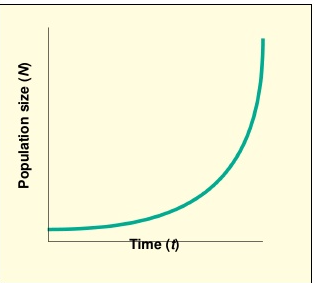
Describe the J-curve
The J-curve is what would happen if there were no biotic or abiotic limiting factors. E.g. Unlimited food, space and water and no competition, parasites, predators and toxic waste products.
Describe the S-curve
The S-curve is a more realistic model of population growth in an ecosystem. It contains the J-curve at the start as at this time there are no limiting factors.
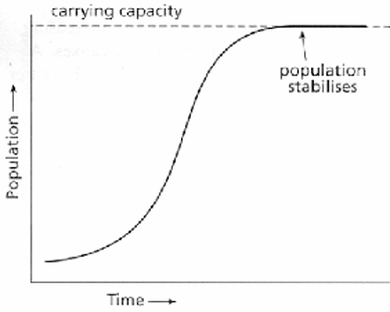
Carrying Capacity
The maximum amount of individuals that can live in one area
Random Quadrat sampling strategy
Place a random quadrat in an area
Estimate population using either percentage cover or percentage frequency.
Then multiply up
Transects
A systematic sampling strategy where you sample at set distances along a line in a direction with specific environmental factors
What are the different species abundance descriptors with there corresponding letters.
Abundant (30%+) - A
Common (20% to 29%) - C
Frequent (10% to 19%) - F
Occasional (5% to 9%) - O
Rare (1% to 4%) - R
What are the main methods for sampling animals
Pooters, Nets and Pitfall traps.
Lincoln index/capture recapture formula
Population size = n1xn2/m
no collected in 1st sample x ““ 2nd sample / no marked in second sample.
Why must the time between samples for capture recapture be long enough?
So that the marked animals can fully mix back in but it musn’t be too long so that there’s no:
Immigration
Emigration
Hibernations
Births or Deaths
Sustainability
The ability to provide for current needs whilst maintaining enough resources for future generations.
Tipping Point
A point where the extent of environmental change can lead to collapse of the original ecosystem and development of a new equilibrium.
A common example of a tipping point is deforistation.
List the 4 categories of the planetary model
Geosphere
Hydrosphere
Biosphere
Atmosphere
What is extinction and what is the background rate of extinction ?
Extinction is an endpoint for conservation. The background rate of extinction is around 1 species per million every year.
Define Autotrophs
Organisms that produce their own organic molecules and energy, e.g. plants.
Define Heterotrophs
Organisms that obtain organic materials through feeding. These organic molecules act as an energy source.
State the first law of Thermodynamics
Energy cannot be created or destroyed, it can be transferred and stored
State the second law of Thermodynamics
When energy is transferred most of it is transferred in to less useful forms. ( meaning that all food chains are inefficient and so new energy must be constantly added from the bottom up)
What do food chains do?
Food chains show the transfer of energy and matter.
Define Biomass
The energy stored in living things or the dry weight of organism.
How would you measure biomass?
Use a quadrat to take a sample of the plants.
Dry it
Weight it
Multiplying up from the quadrat size to the total area or the habitat.
To calculate the energy in the harvested sample, it can be burned and the energy used to heat water.
Productivity
The amount of growth that happens in an ecosystem.
Gross Primary Productivity
Is the total amount of biomass produced by photosynthesis in an ecosystem.
Net Primary Productivity formula and definition
The total amount of biomass stored and available for harvesting.
NPP = GPP - Respiration
Maximum sustainable yield
The amount that can be harvested without diminishing the availability for the future, assuming that they are recycled back into the ecosystem.
Describe the 3 different Ecological pyramids
Pyramids of numbers - show the given numbers of individuals in each trophic level.
Pyramids of biomass - can be created by combusting the dried samples in each trophic level.
Pyramids of Energy (or productivity) - use the unit Jm-2y-1 (Joules per meter squared year)
Pyramids of Numbers and Biomass rely on a single sample and so a given snapshot.
Pyramids of Energy are constructed by sampling energy at each level over an entire year. Giving a better picture as it takes seasons into account.
What is a persistent toxin and list examples?
Toxins that are non biodegradable and will end up in food chains, meaning they will remain in the systems indefinitely.
Examples:
Mercury, used to purify gold, mercury can affect brain function and impair foetal brain development in the womb.
PCBs, chemicals manufactured from the oil industry that are used as coolants for engines. Highly carcinogenic and non - biodegradable.
DDT, an important insecticide used to manage mosquito population in tropical countries.
Bioaccumulation
The build up of non-biodegradable toxins in organisms bodies over time. So regular exposures can mean that they become unhealthy and their lives can be cut short.
Biomagnification
The process by which toxins increase in concentration up trophic levels in a food chain. This means that individuals at the top of the food chain are most affected and can develop chronic symptoms or acute poisoning.
Why are microplastics dangerous?
They act as transport vectors for other toxic chemicals that would not otherwise get into the organism. In particular microplastics can absorb PCBs and so dramatically increase the bioaccumulation of toxins in individuals.
What is ocean acidification and why is it bad?
Oceans are great carbon sinks where the CO2 is converted into carbonic acid which means the ocean is able to absorb more CO2. Carbonate shells will eventually form limestone. However, as the concentration of carbon acid increases the pH of the oceans decrease which harms marine invertebrates such as clams and oysters.
What is carbon sequestration and what are the 2 types?
Carbon sequestration is a term used to describe any process that removes CO2 from the atmosphere ands stores it away.
Biological examples:
Any forms of primary productivity (photosynthesis) but our main example would be sustainable logging to encourage the growth of young trees. It can also include the formation of soil, including peat in bogs and swamps.
Geological examples:
Humans are developing ideas such as afforestation and rewilding.
We are employing Carbon capture Technologies - graphene production as it takes CO2 out of the atmosphere.
What are the negative impacts of agriculture on the environment and how can they be solved?
Agriculture leads to deforestation, loss of biodiversity, soil degradation, bioaccumulation of chemicals in the environment almost every aspect of the carbon cycle.
Crop reduces soil degradation. This means that the healthy soil coninues tot act as a carbon sink.
Cover grown crops over the winter protects the soil and prevents soil erosion.
No till farming does not use heavy ploughing - soil isle prone to eroding and dying out.
Climate
The long term patterns/average of a certain areas conditions.
Weather
The day to day conditions of an area.
Biomes
A group of comparable ecosystems found in different places but share similar climatic conditions.
Precipitation/Water availability
The amount of freshwater for osmosis etc.
Why is temperature important when considering biomes?
As all living things need enzymes for metabolism.
Insolation
Energy from the sun that drives photosynthesis and productivity.
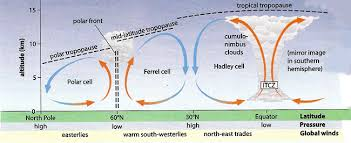
Describe the Tricellular Model of Atmosphere Circulation
At 0°N the heat from the sun causes the air to rise quickly in a circular current.
This brings moisture up into atmosphere which falls back down as rain. It is hot and wet (Tropical Rainforests).
At 30°N the hot air cools slightly and falls.
It is still warm but has no moisture. It is hot and dry (Desert).
At 60°N the air has travelled over the northern oceans - Atlantic, Pacific and Indian. It has collected moisture. It rises back up into the atmosphere getting colder and turning moisture into rain. (Temperate)
At 90°N the air has travelled through the upper atmosphere and has cooled rapidly. (Polar)
Name an example of a Global heat system
The great ocean conveyor belt
What effect does Global Warming have on the atmospheric and oceanic systems?
They have more energy, therefore the Hadley cells has more power and so it is pushing further North —> increasing the range of deserts and drying out grasslands.
This pushes the Ferrell cell above 30°N in to the Polar Cell leading to the thawing of ice and the destruction of habitats.
As the ice cap melts and fresh water falls into the sea this changes the density of the oceans.
If this is not stopped the Great Ocean Conveyor could reverse, brining cold water down from Iceland to Greenland.
Examples of Positive Feedback Loops caused by Climate Change
Increased release of CO2 from deep ocean reserves. As the warm liquid CO2 that has been trapped below the water starts to evaporate.
The reduction of the Albedo Effect. The white polar ice caps reflect vast amounts of light energy back into space. As the ice sheet melts there is less reflection. The energy is absorbed by the oceans or the rocks and then radiated back into the atmosphere as heat.
Zonation
The spatial arrangement or distribution of different plant and animal communities into distinct zones or bands across a landscape.
Succession
A directional change in populations (communities) over time.
What are the different population stages called in succession and list some typical species in the first stage?
The different population stages are known as seres, the first is called the pioneer community.
Pioneer species —> bacteria, legumes with root nodules, lichens and mosses.
How does primary succession progress towards the climax community and what are the effects on the system?
The habitat will go through several stages as one type of community replaces the previous until it reaches the climax community ( the most complex community). Each stage outcompetes the previous stage.
As a result the system becomes more complex with a higher species diversity due to each community adding to the quality and quantity of the soil. In addition the soil becomes deeper allowing more nutrient cycling and water, biomass & carbon storage.
As producers become bigger the productivity of the system increases and this supports more complex food webs, therefore more niches & habitat diversity are created, these 2 factors make a system more resilient.
An example of succession
Surtsey - the island has been studied since the 1960s and the seral stages have been well documented by ecologists.
When does secondary succession occur (natural and man made)?
Secondary Succession occurs after an established community is disrupted.
Natural Examples of disturbances are forest fires or landslides.
Man made examples include deforestation and agricultural practices such as grazing.
Why is secondary succession faster than primary succession?
The soil is already established —> contains organic matter, water and minerals.
The soil will already contain seeds, spores and living roots of plants.
Surrounding areas which were not disturbed act as reservoirs of biodiversity so plants and animals can quickly recolonise.
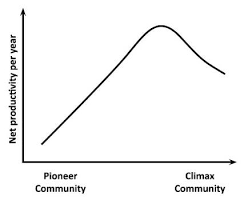
What happens to the overall productivity of an ecosystem as it goes through the seral stages of succession?
Productivity increases as succession proceeds —> as larger plant species become established in the late stages they may dominate the ecosystem blocking light from the ground reducing the amount of primary productivity. As consumers move in they do not contribute to primary productivity but do add to the ‘respiration’
How does succession lead to an ecosystem becoming more resilient?
The roots of the plants stabilise the soil and make it less prone to erosion and even severe flooding.
Large producers like tress provide protection from the elements and help regulate water flow.
As soil builds up it provides hiding places for animals and their eggs.
In a complex community not all species may survive but may will. By re - establishing the biogeochemical cycles the surrounding species provide time for missing populations to recolonise.
 Note
Note  Flashcards (117)