Edexcel A level Biology Topic 2.1.2 - Cell membranes
 Studied by 0 people
 Call Kai
 Learn
Learn Practice Test
 Spaced Repetition
 Match
Match Flashcards
 Knowt Play
1/37

There's no tags or description
Looks like no tags are added yet.
Name | Mastery | Learn | Test | Matching | Spaced | Call with Kai |
|---|
No analytics yet
Send a link to your students to track their progress
38 Terms
What is the fluid mosaic model?
fluid mosiac model
Fluid: where the phospholipid and the protein molecules move about/diffuse within their monolayer, giving the membrane a flexible structure that is constantly changing in shape.
Mosaic: where there are different protein molecules which are scattered in the cell surface membrane (within phospholipid bilayer) such as pores, channels and carrier systems in a lipid bilayer
What are cell membranes composed of?
phospholipids and proteins
Describe the phospholipid bilayer in cell membranes
hydrophilic polar heads- point outwards towards the aqueous environment inside ans outside of the cell as the heads are soluble in water.
Non polar tails- point inwards away from water towards eachother. two phospholipid monolayers make up the bilayer
The higher the number of unsaturated fatty acids in the phospholipids, the ...
more fluid the membrane
What is the main function of the membrane proteins?
to help substances move across the membrane
The proteins can form...
pores or channels that allow specific molecules through
What are gated channels?
protein channels through the lipid bilayer of a membrane that are open or closed
allow ionic substances to move through the membrane in both directions
What else do the membrane proteins do?
can act as specific receptor molecules e.g. make cells sensitive to a particular hormone
What do glycoproteins/glycolipids on cell membranes do?
help cells recognise eachother
What is the function of cholesterol on cell membranes?
gives mechanical stability
maintains the fluidity of the membrane
Cell membranes can be described as ___________ permeable or ____________ permeable.
partially
selectively
What processes is a fluid membrane needed for?
- diffusion of substances across the membrane
- membranes to fuse e.g. a vesicle fusing with the cell membrane during exocytosis
- cells to move and change shape
What are the three things that can affect membrane fluidity?
1. Temperature
2. Type of fatty acid present
3. Cholesterol
What is the effect of increasing the temperature on the structure and fluidity of cell membranes?
Structure: less tightly packed, hydrocarbon tails disordered
Increases kinetic energy of the molecules so they move around more, more fluid membrane and therefore more permeable
What other effect can increasing the temperature have on the cell membrane?
can denature the proteins in the cell membrane so their lose their tertiary and quaternary structures
Breakage of ionic, hydrophobic, hydrogen interactions
Effect of type of fatty acid present
Saturated fatty acids: fatty acids pack closely together, fluidity is low
Unsaturated fatty acid: fatty acids have bends in them due to the double bonds, so don't pack as closely together, therefore the membrane is more fluid
What is the effect of cholesterol on cell membranes?
Cholesterol maintains the fluidity of the membrane e.g. when temperature rises, cholesterol prevents the cell membrane from becoming too fluid
It inserts itself into the phospholipids and either increases or decreases the distance between the phospholipids
What does cholesterol bind to in the cell membrane?
fatty acid tails
What is the effect of ethanol on cell membranes?
Ethanol disrupts the physical structure of cell membranes by dissolving the fatty acid tails of the phospholipids
Describe the fluid mosaic model
phospholipid bilayer - hydrophilic heads point into the water and the hydrophobic fatty acid tails are in the middle
contains integral and peripheral proteins
glycoproteins and glycolipids
the phospholipids and proteins move around freely
causes of damage of cell membrane
Loss of function of membrane proteins, being unable to receive cell signals, unable to transport polar molecules.
Membrane become leaky with loss of its partially permeable nature.
Membrane can't regulate the entry and exit of substances
This will disrupt the interaction between protein and phospholipid bilayer.
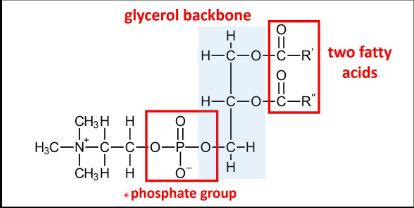
structure of a phospholipid
made of glycerol, 2 Fatty acid chains (non polar tails) and a phosphate group (polar head). glycerol joined to the fatty acids by ester bonds
cell membrane permeability on small nonpolar molecules
cell membrane is fully permeable to small nonpolar molecules (CO2, O2) these can diffuse through the gaps between phospholipids in bilayer
membrane permeability for large non-polar molecules
large non-polar molecules are soluble in the non polar fatty acid tails and can pass through the phospholipid bilayer by simple diffusion eg:Steroids
large polar molecules on membrane permeability
charged ions as these can’t pass through the fatty acid tails. these large polar molecules and ions need specific carrier or channel proteins, membrane will be imperabale if there is no carrier or channel
facillated diffusion
Requires a membrane protein to transport polar molecules, charged and water soluble molecules across the membrane. Since these molecules cannot pass through the non-polar inside of the bilayer
osmosis
movement of water molecules across a partially permeable membrane from an area of high water potential to an area of low water potential
Active Transport
Transports all types of molecules through carrier proteins from an area of low concentration to an area of high concentrating.
This process moves particles against the concentration, and so requires energy in the form of ATP.
How do transport proteins function during active transport?
They change shape when binding to target molecules to move substances against their concentration gradient.
what is exocytosis
Vesicles containing large particles are fused with the membrane and leave the cell/organelle.
what is endocytosis
the particles are enclosed in vesicles made from the cell surface membrane and transported into the cell / organelle
what are carrier proteins
Can move particles through the membrane by both active transport and facilitated diffusion
what are channel proteins?
Forms pores in the membrane for polar particles to move through by facilitated diffusion
simple diffusion
The passive movement of small, non-polar lipid soluble molecules, such as carbon dioxide and oxygen, from an area of high concentration to an area of low concentration. The molecules move directly through the phospholipid bilayer.
Water potential
Water potential is used to describe the relative concentration of water molecules. It is the tendency of a solution to gain or lose water.
A high water potential means there is a low concentration of solute, in other words a high concentration of water.
isotonic
2 solutions have the same water potential
hypertonic
solution with a lower water potential relative to another solution
hypotonic
solution with a higher water potential relative to another solution
 Note
Note  Flashcards (42)