8. A cure to conformity: Minority influence, the dynamics of change and collective action
 Studied by 0 people
 Call Kai
 Learn
Learn Practice Test
 Spaced Repetition
 Match
Match Flashcards
 Knowt Play
1/13

Earn XP
Description and Tags
Social psychology 2.
Name | Mastery | Learn | Test | Matching | Spaced | Call with Kai |
|---|
No analytics yet
Send a link to your students to track their progress
14 Terms
Minority influence
undermine consensus (general agreement)
alternative consensus is offered
reason why science and history evolve
Moscovici 1969 experiment → person starts dancing on a hill
M. coined the term group polarization
more than one person holding a minority opinion → necessary in order to have influence (one person joined)
minority must remain consistent over time (nobody stops dancing) → if unsure about opinion than influence disappears
confidence in correctness of the opinion they are presenting
Inconsistent condition → blue-green paradigm
confederates in minority
said green 24 times and blue 12 times
not a lot of people got influenced 1.25%
Consistent condition → blue-green paradigm
minority said 36 times green
little influence → 8.42%
if you have consistent minority they exert influence and people do not only listen to majority
Extended effect
Exposure to a minority viewpoint can make people more independent thinkers—even in situations unrelated to the original topic
1. Color judgements (Moscovici’s blue–green study)
Participants first take part in a task where they judge colors (blue vs. green).
A minority group repeatedly gives a dissenting answer (“green” when it is blue).
If the minority is consistent, people start thinking more deeply.
This creates cognitive conflict, making people reconsider assumptions.
This is where the minority influence begins.
2. Dissenting opinion (minority advocacy)
By being exposed to a consistent minority, participants learn:
It’s possible to disagree with the group.
It’s acceptable to question the majority.
They become less conformist in general.
In other words, the minority doesn't just influence their answers on the color task—it changes how they think.
This is the “dissenting opinion” stage.
3. Line comparison task (Asch-style conformity task)
Later, participants perform a different task:
➡ the classical Asch line comparison task, where majority pressure often leads people to give an incorrect answer.
The line task is the dependent variable written on the slide.
Nemeth & Chiles found:
People previously exposed to a consistent minority in the color task
were less likely to conform to the majority in the line-length task.
Even though the tasks are unrelated, the minority influence “spills over.”
Effective Minority
1. “Similar and diverse”
An effective minority is:
Similar enough to the majority to be seen as relatable and credible
(e.g., same background, same group membership)But also diverse internally, meaning the minority is made up of different kinds of individuals
Why this works:
Being similar makes the majority listen
Being diverse shows that the opinion is not due to some special or extreme factor—different people independently arrived at the same conclusion
2. “Disadvantage of ‘double’ minorities”
Your handwriting notes: “a minority in opinion & in number”.
A double minority means:
You are numerically a minority and
You represent a socially marginalized or low-status group
(e.g., a small subgroup that also belongs to a stigmatized category)
Why is this a disadvantage?
The majority may discount the minority’s argument because of prejudice or low perceived credibility
They may think: “They only think that because of their group identity.”
Result:
➡ Less influence, even if their arguments are strong
3. “Not TOO different”
If the minority seems too unusual, extreme, or outside the norm, the majority will dismiss them.
Effective minorities must:
Challenge the majority
But still remain within the “range” of what is understandable or acceptable
Otherwise:
They are seen as radical
Their message is ignored rather than considered
4. “Diverse individuals agreeing on the minority opinion”
➡ “best strategy to change majority consensus”
This means:
When several people from different backgrounds agree on the same minority position, it increases credibility.
Why?
It signals independence:
Different individuals arrived at the conclusion separately.The majority thinks:
“If all these different people agree on this point, there must be something to it.”
This is supported by research showing that multiple, independent sources are far more persuasive than a single minority voice.
4. Flexibility and compromise (Nemeth)
Nemeth argued that an effective minority should not be rigid or dogmatic.
They should:
show willingness to negotiate
adapt to new information
make reasonable compromises
Why this works:
If a minority is too inflexible, the majority dismisses them as extremists.
Flexibility makes the minority look rational, thoughtful, and worth listening to.
5. Openness toward alternative views
A minority must show that they:
understand the majority’s opinion
respect other perspectives
are open to discussion
This signals credibility and good faith.
It also suggests that their dissent is based on careful thought, not stubbornness.
6. Consistency without rigidity
Research shows that consistency is crucial:
➡ A minority must stick to their message over time.
But:
Consistency must not turn into rigidity.
So an effective minority is:
consistent in its core view
flexible in small details
responsive to context
This balance makes them influential without seeming unreasonable.
7. Confident and unbiased
The minority needs to appear:
confident in their position
objective, not driven by self-interest
unbiased and fair in their reasoning
Why?
Because a confident, impartial minority is seen as having strong arguments, not personal motives.
This increases trust and influence.
8. Effective Minority – “Idiosyncrasy Credits” (Hollander)
Idiosyncrasy credits is a concept proposed by Edwin Hollander.
It means:
➡ A person earns psychological “credits” or trust within a group by first conforming to the group's norms, expectations, and behaviors.
Once these credits are earned, the person has:
more freedom to deviate
more influence when they dissent
more credibility even when offering an unpopular opinion
How this applies to minority influence
A minority voice is more effective when the person:
1. First goes along with the group
They show loyalty, respect, and cooperation.
This builds trust and acceptance within the group.
2. Then introduces their dissenting view
Because they have built up credits, the group is more willing to:
listen
accept their disagreement
consider their unconventional ideas
Without these credits, the group might dismiss them as troublemakers or outsiders.
Simple example
Imagine a team. A member usually agrees, collaborates, and contributes positively.
➡ They build up idiosyncrasy credits.
Later, when they disagree with the group's opinion, others think:
“They usually support us, so this must be important.”
“They’re not just being difficult.”
Thus, the minority viewpoint is taken seriously.
Systematic processing
When people encounter a minority viewpoint, they often process the information more deeply than when they hear the majority view.
1. Considering weak and strong arguments differently
When exposed to a minority:
People carefully evaluate the quality of the arguments
They distinguish strong vs. weak arguments
In contrast, majority influence often leads to automatic agreement, without deep analysis.
Minorities force deeper thinking because their position is unexpected and requires explanation.
2. Remember nonobvious points made by the minority more
People tend to remember the minority’s arguments better—especially subtle or complex ones.
Why?
Minority views create cognitive conflict
This triggers deeper processing
Deep processing → better memory
Majority influence usually produces short-term compliance, not long-term memory.
3. Encourages considering alternatives → creativity
Minorities stimulate:
divergent thinking
openness to new perspectives
creativity
Because the minority challenges the dominant viewpoint, it forces people to think:
Are there other ways to see this?”
This encourages people to explore alternatives instead of staying in conformity mode.
4. Opinion change on unrelated issues
This is the extended effect again:
Exposure to minority dissent can lead to:
➡ more independent thinking in general,
➡ even on topics unrelated to the original issue.
So minority influence doesn’t just affect the specific argument—it changes the thinking style, making people more reflective and critical across contexts.
Public vs. Private Conformity
1. Public conformity → Normative influencePublic conformity means:
You change your behavior publicly
But you do NOT actually change your private beliefs
This includes:
Compliance → going along with the group to fit in
Superficial processing → automatic, shallow level of thinking
(e.g., “I’ll just say what they say so I’m not the odd one out.”)
This happens because of normative influence.
Normative influence
You conform because you want:
approval
acceptance
to avoid rejection
Your outward behavior changes, but your inner opinion stays the same.
Classic example:
Asch’s line study — participants publicly gave wrong answers but privately disagreed.
2. Private conformity → Informational influencePrivate conformity means:
You actually change your internal beliefs
Your mind is genuinely persuaded
This includes:
Conversion → true attitude change
Systematic processing → deep thinking, carefully evaluating arguments
This is linked to informational influence.
Informational influence
You conform because you believe:
the group knows better
their information is more accurate
their arguments make sense
Your internal belief truly changes.
Example:
Believing a minority’s logical arguments in a scientific debate, leading to real opinion change.
Influence
Majority: → produces private & public acceptance = have informational and normative power
Minority: → Produce public conformity
→ Rewards = not persuasionbut motivational influence
→ Appealing identity (normative influence) = can gain influence when:
it is socially desirable
it represents a cool, morally valued, or prestigious group
Then conformity happens because people want to identify with that minority.
This is minority-driven normative influence.
when minority changes majority consensus = social change
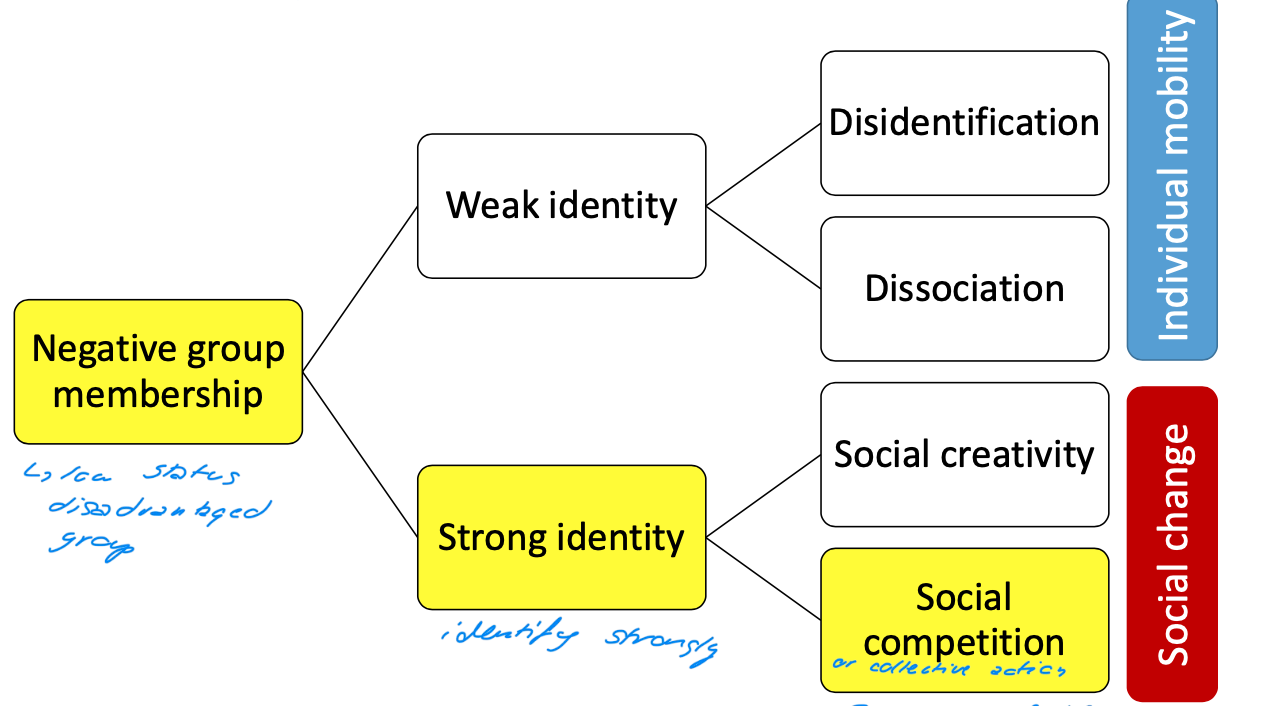
Social Identity Theory by Tajfal
what people do when belonging when belonging to a negative, low-status, disadvantage group
negative group membership → low status group
weak identification → results in disidentification and dissociation (individual solutions)
strong identification → social creativity & social competition/collective action → social change (group-based solutions)
Collective action for social change
perceived injustice of intergroup situation (politicized identity)→ anger
strong social identity - rejection of individual mobility (e.g. exiting group)
change is possible (hope, perceived efficacy → believe in efficacy of strike in achieving a goal)
→ you have to believe that change is possible & you have to know what you are aiming for
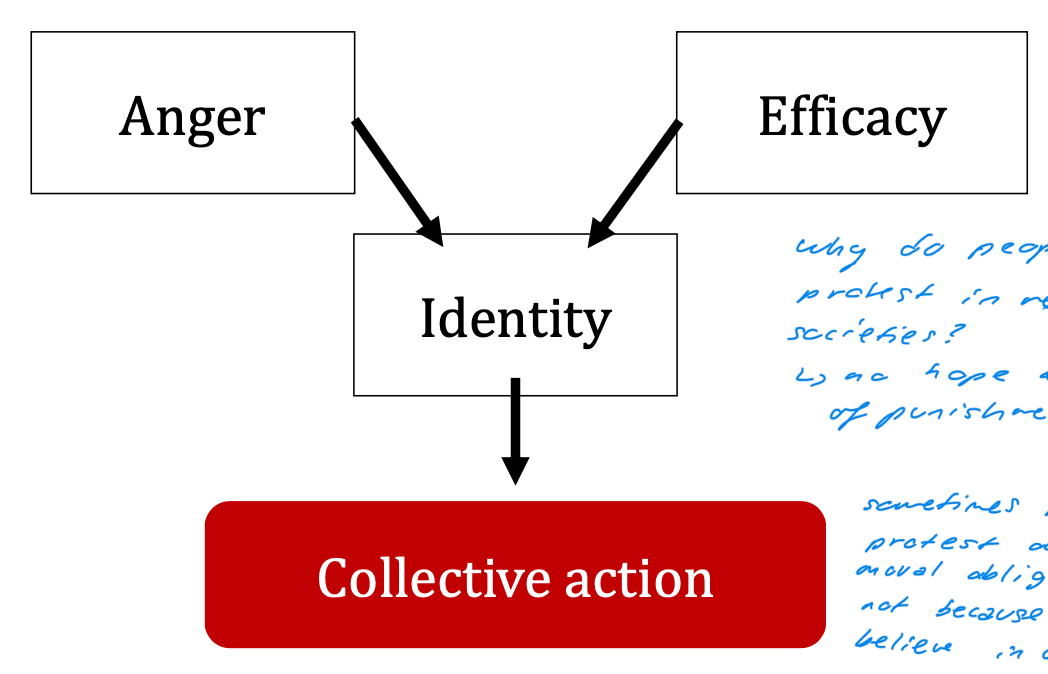
SIMCA - Social Identity model of collective action (prostests, strikes, movements) (van Zomeren, Postmes, Spears, 2008)
1. Anger → Identity → Collective ActionWhat this means:
People feel anger when they perceive injustice toward their group.
This emotion can strengthen social identity (“We are being treated unfairly as a group.”)
The stronger the identity, the more likely people are to take action on behalf of the group.
Why anger matters:
Anger is a mobilizing emotion.
It shifts people from passive to active.
Without anger, people may feel the injustice but do nothing.
2. Efficacy → Identity → Collective ActionEfficacy means:
➡ Belief that collective action can actually make a difference.
People are more likely to join a protest when they believe:
“We can win.”
“Our actions matter.”
“Change is possible.”
This belief increases group identity because people feel united by a shared purpose.
Note you wrote on the slide:
"Why do people not protest in repressive societies? → no hope & fear of punishment."
Exactly!
In authoritarian or repressive systems:
Efficacy is low (people believe change is impossible)
Fear is high (punishment risk)
Identity weakens because people cannot act collectively
→ Therefore collective action does not occur, even if anger is high.
3. Social Identity → Collective ActionIdentity is the core predictor.
You join collective action when you think:
“This is my group.”
“This injustice affects us.”
“I feel connected to the movement.”
Identity transforms individual feelings into collective motives.
Why Identity Sits in the Middle
Identity links emotions (anger) and cognition (efficacy) to behavior (collective action).
It also strengthens both:
Feeling angry as a group
Believing in our power to change something
Handwritten Note Explanation
You wrote:
“Sometimes people only protest out of moral obligations & not because they believe in change.”
This corresponds to a fourth pathway often discussed in research:
Moral conviction
People join action because:
They feel morally compelled
They want to do what is right
Even if they expect no success (low efficacy)
This is seen in:
Human rights activism
Climate marches
Protest in authoritarian regimes
Moral duty can motivate action even when hope is low
Illegitimate ingroup norms
Sometimes the ingroup (your own group) develops norms or behaviors that are:
unfair
immoral
discriminatory
inconsistent with the group’s core values
Strong identification → confronting the ingroup
The key point is:
✔ People who strongly identify with their group
are more likely to confront, criticize, or challenge their own group
when the group behaves in ways that violate its moral standards.
Why?
Because strong identifiers care deeply about:
the group’s values
the group’s moral integrity
the group’s reputation
So if the group acts in immoral or hypocritical ways, strong identifiers feel:
“This is not who we are.”
“We must correct this to protect our group.”
This is known as critical loyalty or ingroup constructive dissent.
To preserve group values and moral image
Strong identifiers challenge illegitimate norms because they want to:
✔ Preserve the group’strue identity✔ Restore the group’smoral standards✔ Protect the group’spublic image✔ Prevent the group from going in a harmful direction
This is different from weak identifiers, who often just leave the group or remain silent.
,,Nothing-to-lose’’
explanation to radical collective action → that’s when group itself splits within
people feel like that because of low efficacy in history which lead to no change till now
1. Strong Social Identity + Low Efficacy
Most models say:
Strong identity + high efficacy → protest
But here, we see something different:
✔ Strong group identity
= People strongly care about their group, feel united, share fate
BUT
✖ Low efficacy
= They believe change is impossible
→ politicians ignore them
→ past protests made no difference
→ system seems unchangeable
→ repression makes change unlikely
This creates a hopeless, trapped feeling.
When people feel tied to their group but also feel that nothing will ever improve, the result is:
2. Anger turns into Contempt
Normally, anger motivates constructive political action.
BUT:
When people repeatedly try and nothing changes
anger transforms into contempt:
disgust toward authorities
rejection of the whole system
“The system is illegitimate, not just unfair.”
“They don’t care about us anyway.”
Contempt is more destructive and less strategic than anger.
3. The “Nothing-to-lose” mindset
This is the critical idea:
When people believe they have no hope and no future,
they feel they have nothing left to lose.
This can motivate:
Radical protest
Violent actions
Riots
Extreme moves (burning property, attacking symbols, etc.)
Revolutionary attempts
People become willing to take risks they would normally avoid because the usual “costs” (e.g., arrest, punishment, future consequences) no longer matter.
This matches the quote on your slide:
“The most dangerous creation of any society is the man who has nothing to lose.” — James Baldwin
4. Why does this happen?
Your handwritten notes capture the explanation perfectly:
“If you believe in low efficacy because history led to no change…”
“People feel they have nothing to lose.”
“No hope & fear of punishment in repressive societies.”
In authoritarian societies, for example:
repression lowers efficacy
people see protests fail again and again
anger builds
eventually anger becomes contempt
then radicalization becomes more likely
5. When does this pathway occur?
It tends to appear when:
groups have repeatedly experienced failed peaceful protests
the system is corrupt, repressive, or non-responsive
grievances are long-lasting
identity is strong (“we are in this together”)
alternatives are blocked
collective suffering is high
Examples:
riots after repeated police violence
uprisings in authoritarian regimes
violent revolutions after decades of oppression
Social change and prejudice reduction
Mutually exclusive goals?
Meaning:
✔ Strategies that reduce prejudice
❌ Often weaken the possibility of social change
Why? The mechanism shown on the slide1. Blurring group boundaries
Examples:
Emphasizing that “we are all the same”
Promoting cross-group contact that focuses on individuals, not groups
Downplaying differences
→ This reduces the salience of the disadvantaged group identity.
2. Recognising similarities
Examples:
Highlighting shared humanity
Finding commonalities
Promoting intergroup harmony programs
→ This also makes original group boundaries weaker.
**Both lead to:
⬇ Reduce importance of original identity**
If being part of the disadvantaged group becomes less central, then:
Anger about injustice decreases
Collective efficacy decreases
Motivation for political or social change decreases
Your handwritten note is exactly right:
“Need to be angry & feel efficacy.”
These are required for collective action
—but harmony-focused interventions reduce both.
⭐ **Result:
Reducing prejudice AND reducing social change**
This is the irony of harmony.
Harmony → less conflict → less motivation to challenge inequality.
So:
Prejudice reduction programs (contact, similarity, harmony, shared identity)
improve interpersonal feelings
BUTThey undermine collective action needed to fix structural injustice.
Example
A minority group meets friendly majority members.
They bond, see similarities, and like each other more.
BUT:
they are less likely to protest inequality
because focusing on harmony reduces anger and group-based motivation
structural disadvantages remain unchanged
 Note
Note  Flashcards (66)