Marine Sciences Test 1
 Studied by 0 people
 Call with Kai
 Learn
Learn Practice Test
 Spaced Repetition
 Match
Match Flashcards
 Knowt Play
1/63

There's no tags or description
Looks like no tags are added yet.
Name | Mastery | Learn | Test | Matching | Spaced | Call with Kai |
|---|
No analytics yet
Send a link to your students to track their progress
64 Terms
Differentiate between benthic, pelagic, neritic, and oceanic zones, and explain why life varies across these zones.
benthic—seafloor
pelagic—open water (contains neritic and oceanic)
neritic—costal
oceanic—open ocean
Life varies across these zones because of different levels of sunlight and nutrients. The neritic zone has much more life because the water is shallower and thus the sunlight can reach further, allowing for more opportunities for marine vegetation.
Outgassing theory
Theory of where oceans water came from
water condensed from a thick early atmosphere
volcanic activity releases water vapor
Extraterrestrial explanation for where oceans water came from
meteorites and comets contain lots of water/ice
however contribution is likely small and the composition of their water is different (“heavy”) from our oceans
How are ocean biomes defined?
salinity
light
depth
temperature
pressure
substrate characteristic
Sonar
Sound navigation and ranging
used to map the ocean floor
how to calculate seafloor depth
time difference between creating a sound and receiving its echo
Why do we refer to the oceans of the world as “one world ocean.”
the oceans are continuous—the names are for our ID/understanding
What hemisphere and ocean region contain more water?
Pacific, Southern
What are the five major ocean regions?
Epipelgaic
Mesopelagic
Bathypelagic
Abyssalpelagic
Hadapelgic
Understand the evidence of the Tectonics Plate Theory
Ocean floor chemical and physical characteristics
chemical
When these crusts collide the denser oceanic subdues beneath the continental
physical
Evidence that continents move
Continents seem to fit like puzzle pieces
using longitudinal records from different years—Wegner demonstrated that Washington and Paris moved from each other
the same fossil types were found on different continents
How and where new seafloor is formed
sediment thickness is greatest at edges of continents—oceanic crust is sub-ducting
mid-ocean ridges—from volcanic activity (magma rises cools in the water and spreads laterally)
Tectonic plate boundaries
earthquakes happen along boundaries especially the mid-ocean ridge
discuss the discoveries that consolidated the mechanisms of seafloor and continents formation
Crust: Continental crust vs oceanic crust
Crust is lightweight and thin, made of part of lithosphere
Continental—consists mostly of granite, less dense
Oceanic—consists mostly of basalt (volcanic), and is denser than continental
Lithosphere vs Asthenosphere
Lithosphere—cool and rigid outer layer, crust and part of mantle, floats on top of asthenosphere
Asthenosphere—thin, hot, and slowly floating, upper layer of mantle, deforms under stress (not a solid or a liquid)
mid-ocean ridge
where new seafloor is made, here seafloor is young and thin. It spreads out and ages and thickens.
convergent boundaries vs divergent boundaries vs transform boundaries
when two plates of similar density collide and push up against each other, creating mountains OR when a denser plate subducts into the mantle, creating trenches, volcanic arcs, and earthquakes
when continental plates separate, new crust forms between them and creates deep valleys in which fresh water lakes form
where plates slide horizontally, strike-slip faults occur causing earthquakes and surface features like faults. Doesn’t create or destroy crust
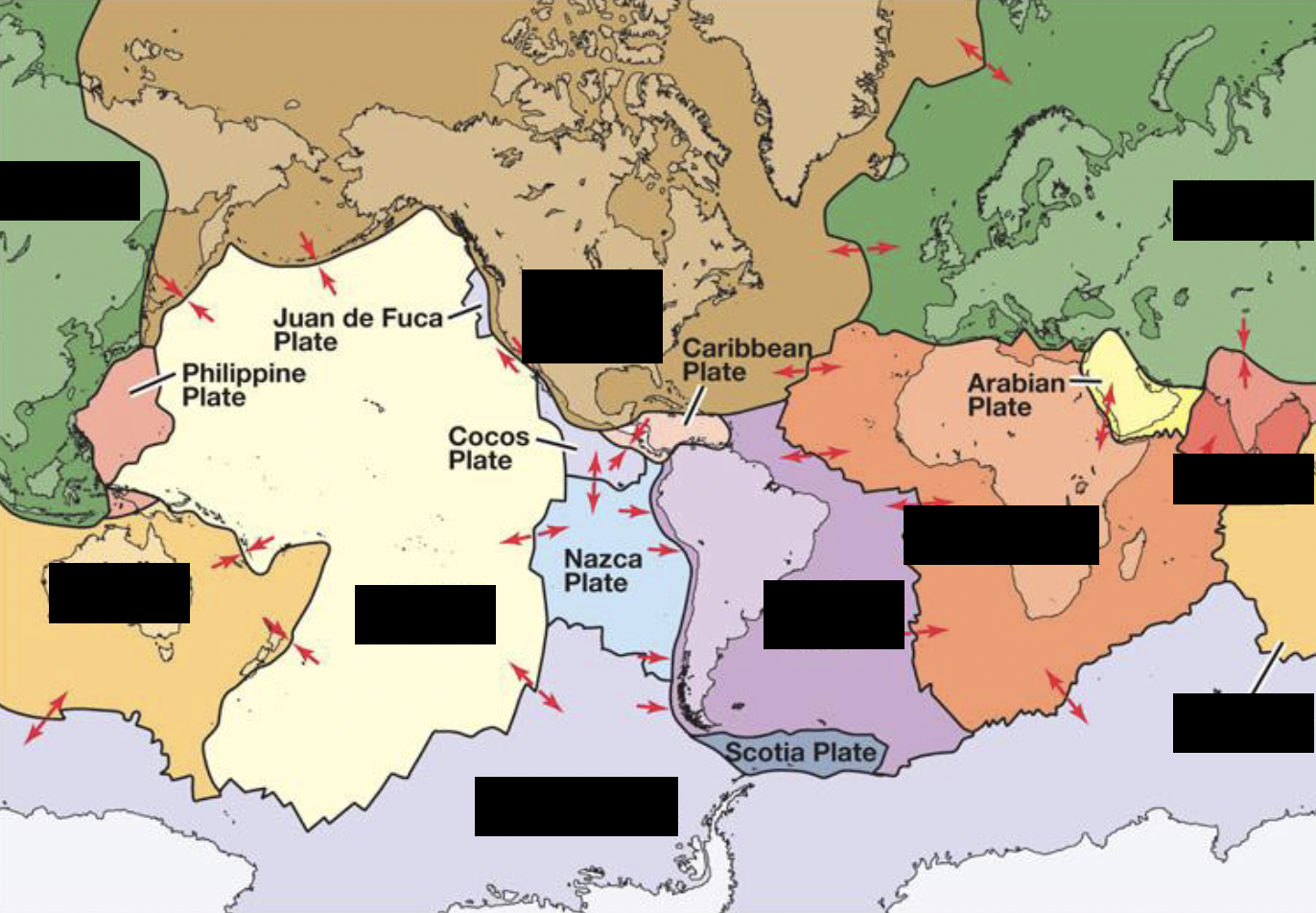
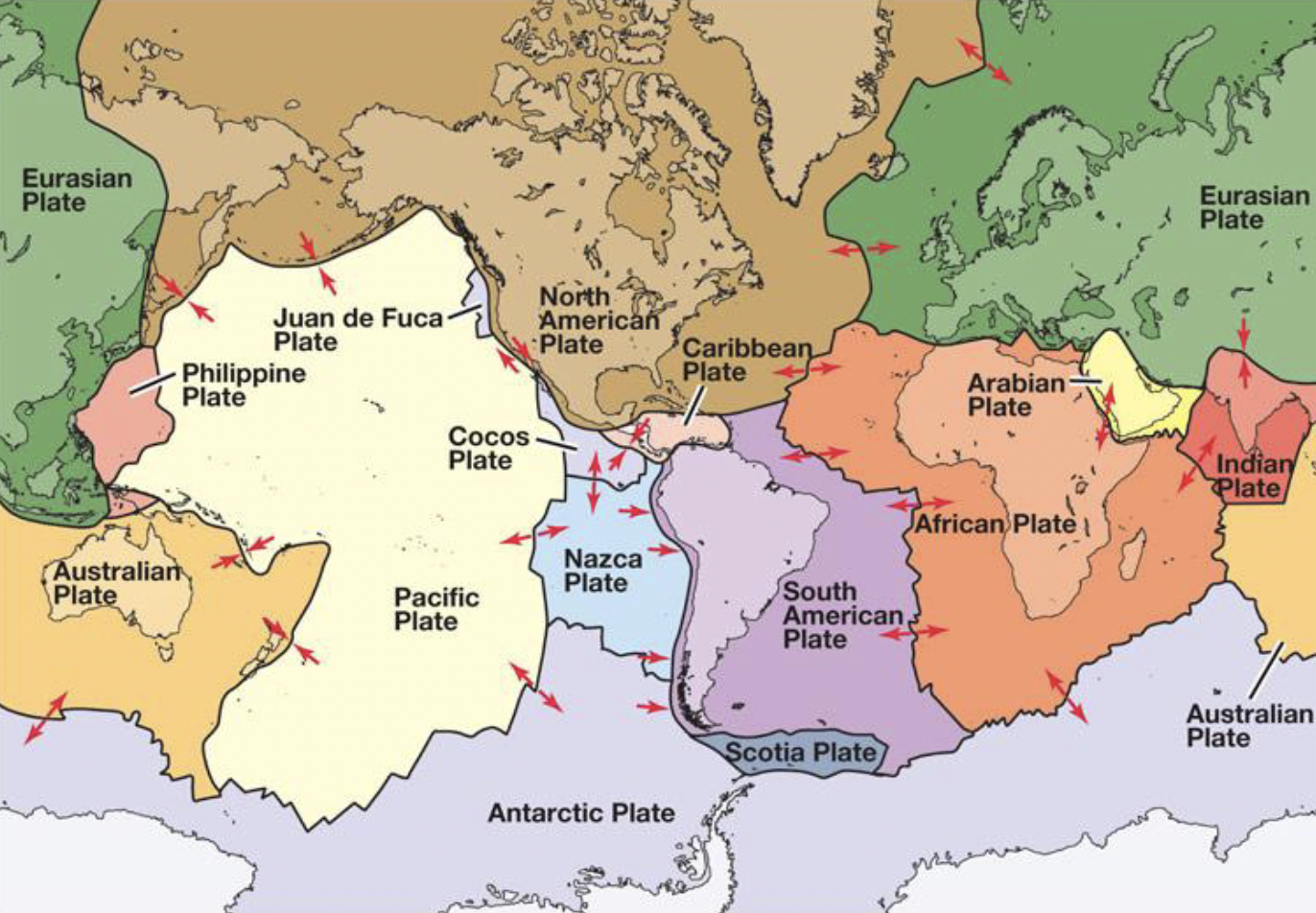
9 0f the 17 lithospheric plates (1 not pictured)
North American
Eurasian
African
Austrailain
Indo-Austrailian
Indian
South American
Antarctic
Pacific
specific heat
the heat required to raise the temp of the unit mass of a given substance by a given amount (usually one degree)
water has a high specific heat
absorbs a lot of heat before it warms
about 3.4 hydrogen bonds per water molecule
stabilizes ocean temps
surface tension
water has high surface tension
the surface of the water exposed to air is difficult to puncture because the water molecules at the surface are hydrogen bonded to other molecules below
cohesion and adhesion
cohesion—water sticks to itself
caused by hydrogen bonds
bonds are loose in warm water, tight in cold water and complete in ice cold water
adhesion—water sticks to other things
water light transmission
slows the transmission of light
latent heat
the energy absorbed or released during a phase change
80 calories is the latent heat of melting
liquid water heats up at the rate of 1 degree celsius per 1 cal
takes 540 cals to break the hydrogen bonds of liquid water (520 cals is the latent heat of evaporation)
Sources of salt for the ocean
Runoff from the land, and openings in the seafloor
what ions constitute the vast majority of the oceans salinity (in order)
Chlorine
Sodium
Sulfate
Magnesium
Calcium
Potassium
salinity
concentration of dissolved ions in the water
Salinity categories and their values
average salinity of the ocean/range
Brine—50+ ppt
Saline—30-50ppt
ocean 32-50, avg 35
Brackish—0.5-30ppt
Fresh—0-0.5 ppt
How is salinity measured?
parts per thousand (ppt) aka grams of salt per 1000 grams of water
salinity variation: coasts vs open ocean
Coast: proximity to/influence of rivers
salinity increases further from the coast
Open ocean: salinity is influenced by evaporation and precipitation
where are the highest salinities? Lowest? Moderate?
subtropics (20 degrees lat)—low precipitation, high evaporation
equator (0degrees lat)—high precipitation, low evaporation
temperate latitudes experience a lot of precipitation
saltiest ocean basins, why?
2 portions of the Atlantic, Red Sea, and a portion of the Indian ocean
high evaporation rates
Halocline
depth at which salinity rapidly changes
where is salinity at the surface highest during the summer, subtropics, equator or polar lats?
The subtropics
thermohaline circulation
important because it moves nutrients to different parts of the ocean
occurs because temp and saline determine different water densities, and the circulation is driven by differences in density
relationship between density and temp(water), why?
water density is higher in cooler waters
at colder temps water molecules move less and are tighter, which decreases volume thus increasing density
what phenomena is causing rising sea levels
thermal expansion—as water warms molecules move more and are looser which causes the volume to expand
Pycnocline
depth at which density rapidly changes
relationship between salinity and density
as salinity increases so does density
effects of increasing salinity on temp and density, subsequent effect on ocean
increasing salinity lowers the temperature of when maximum density occurs
thus the freezing temp of the ocean at 35ppt salinity is -1.9 degrees celsius compared to 3.98 for freshwater
why does salt lower the freezing temp?
salts interact with the charged ends of water molecules, interfering with the formation of hydrogen bonds
when is seawater densest?
At low temps and high salinity, which is deep in the ocean
thermocline
depth at which temp changes rapidly
When/where does the ocean freeze? What happens when it freezes?
Rarely, and if so it occurs at the poles or in shallow areas
When seawater freezes the salt is excluded so the ice is pure water, the leftover salt mixes with the water creating a brine which sinks beneath the ice
why is it important for life that ice floats?
insulates the water so organisms don’t die from extreme temperatures/freezing
albedo effect
enables ice to reflect large portion of sunlight, so the ice doesn’t melt
density increases with cooler temps and higher salinity, but what is the sole reason for its increase with depth?
pressure! As you get closer to earth’s core gravity exerts more pressure, water is compressible
speed of sound?
1500 m/s
Near the water surface, what factor effects the speed of sound the most?
Temperature—near the surface is where temp is changing radically so it has the moat significant effect
warm water produces more kinetic energy and thus the sound waves can transfer quicker
SOFAR channel
the depth (near the surface) at which the speed of sound declines because of the thermocline. Sound waves are refracted (redirected). Sound Fixing and Ranging Channel. Speed of sound is reduced but its transmission is very effective. Where whales do long distance communication.
SOSUS oceanic uses
Sound surveillance system
measure the speed and direction of deep ocean currents
study volcanic eruptions and earthquakes as well as marine mammal vocalizations
measure large-scale ocean temperature variability
As oceans get warmer how will this impact sound in the ocean?
The speed of sound will be quicker near the surface, so noises from boats and things will travel quicker
the SOFAR will become deeper, interfering with the established communication for long distance
Air density is influenced by what 4 factors?
Elevation/altitude
temp
pressure
humidity
where is air more dense, high or low elevations?
its denser at lower elevations
air density relationship with temp
warm air expands (particles have more kinetic energy and thus are less tight, so volume increases), thus density decreases, and so the warm air rises to an altitude where its surrounded by air of the same density
as air cools its density increases and it sinks until its surrounded by air of the same density
air pressure relationship with temp
areas of high pressure are cold, ares of low pressure are hot
Where is more energy absorbed? Outgoing? What causes this imbalance? What is the impact on circulation?
tropics and subtropics
increases as attitudes become lower because sunlight becomes more direct
Higher latitudes have more outgoing energy than absorbed energy, especially the poles because ice reflects the suns energy
the earth is a sphere and it is titled. The rays have to travel through a further distance of atmosphere to the poles so the energy is less concentrated. This is because the shape of the earth at the poles is rounder and thus there are more angles which means the rays are hitting the poles at a shallow angle, rather than head on like at the equator
This difference in temperature drives atmospheric circulation
What absorbs most of the sun’s energy?
the ocean
Latitudinal heat pump
term for the system of global convection cells
These cells circulate air because of differences in temp. Warm air rises and loses heat as it does so (getting further from the surface where heat is coming from), thus eventually sinking and warming near the surface
Model of circulation without the influence of the earth rotating or oceans
In this model each hemisphere is one cell. Cold air from the poles sinks and is warmed at the equator, warmed air rises and is cooled at the poles
Why are there 3 types of convection cells?
there is an unequal distribution of land, and also the speed of earth’s rotation
the three cell types, what drives them
Polar Cells
between 60 and 90 degrees N or S
forms the polar easterlies
dry and cold, forms high pressure areas
differences in air temp
smallest
Ferrel cell
30 and 60 N or S
forms westerlies
eddies from surrounding fast jet streams
flows in the opposite direction of the other cells
Hadley Cells
0 and 30 degrees N or S
form northeast and southeast trade winds (El Niño and Nina)
at 0 degrees is the intertropical convergence zone (ITCZ)/doldrums
no Coriolis effect, poor wind
differences in air temp
largest
polar vortex and polar jet stream
a large scale, high-altitude band of winds that encircles the Arctic/Antarctic which traps cold air at the poles. Occurs in the winter. In the stratosphere.
a fast moving “river” of air located in the lower atmosphere (troposphere), separating cold polar air from warmer air. It acts as a boundary that keeps the polar vortex in place
polar vortex disruption
the polar vortex weakens dramatically every other year, and move away from the poles it may even split into 2. This pushes the polar jet stream further south, and warm air gets pulled up north. Thus, why lower latitudes get hit with cold temps sometimes.
Coriolis effect
The earth is a sphere and so the equator (the widest point) must rotate at a higher speed to ensure everything is aligned. Conversely, the poles rotate at a slower speed.
As air moves towards the equator it lags behind the faster moving surface and thus is deflected to the west. Air moving towards the poles is moving much faster than the surface and is thus deflected to the east.
which deflects more: slow winds from the poles, or fast winds from the equator? What about high latitude vs at the equator?
fast winds deflect more, and winds at higher latitudes deflect more than at the equator
seasonal differences in pressure over land and the ocean
The ocean has a higher heat capacity than land. So, during the summer, the land absorbs more heat than the ocean. Thus, there is low pressure over the land and high pressure over the ocean. But, during the winter the land loses its heat readily and the ocean loses it at a much slower pace. Thus, there is high pressure over the land and low pressure over the ocean.
 Note
Note  Flashcards (21)