File Formats
 Studied by 0 people
 Call Kai
 Learn
Learn Practice Test
 Spaced Repetition
 Match
Match Flashcards
 Knowt Play
1/38

There's no tags or description
Looks like no tags are added yet.
Name | Mastery | Learn | Test | Matching | Spaced | Call with Kai |
|---|
No analytics yet
Send a link to your students to track their progress
39 Terms
What are the 2 universal concepts behind all media formats?
Container (box)
Codec (recipe).
What’s the difference between Container and Codec?
Container = a file that holds media inside (like video, audio, subtitles)
Codec = shrinks vids into smaller sizes so they’re easier to stream or store.
JPG - when to use & why?
Smallest size
Lossy
Perfect for photos only
No transparency.
What does no transparency mean?
Image cannot show through to whatever is behind it - every pixel is fully opaque
PNG - when to use & why?
100% quality
Lossless
Supports transparency → for logos/UI/assets.
WebP - why is it replacing JPG & PNG?
One format that can be lossy or lossless + transparency + animation → modern all-rounder.
Lossy Compression Definition
Throws away details permanently to make the file smaller.
Lossless Compression Definition
Keeps 100% of the original data, just packed more efficiently.
GIF - when is it a mistake to use?
Almost always - it’s ancient (256 colors) → only fine for tiny memes.
TIFF / RAW - what is their purpose?
Professional archival & editing
Never for delivery/web.
What does archival mean?
Archival = for long-term preservation, future - proof
Not for sharing, not for web, not for everyday use.
You don’t care about file size - you care about zero quality loss.
SVG vs PNG - core difference?
SVG is math (scales forever)
PNG is pixels (can blur).
PDF - what makes it special?
Can contain vector + text + raster - print & document master format.
MP4 - why is it the default?
Maximum compatibility - safe everywhere.
What is a Raster Image?
An image made of fixed pixels. If you zoom in too much → it blurs.
Examples of Raster Image
JPG, PNG, WebP.
What is a Vector Image?
An image made of math instructions (like “Draw a circle at center x=50, y=50 with radius=25, color=#FF0000.”), not pixels.
Infinite resolution.
Examples of Vector Image
SVG, PDF, EPS
What Is Alpha Channel?
The extra layer in an image that controls transparency.
If a file has no alpha channel → it can’t be transparent.
Why do pirates love MKV?
Can hold ANY codec, multi-audio, subtitles, no limits.
What is MOV?
Apple’s version of MP4
Works best with iOS ecosystem.
What is WebM?
Google’s own modern video format
Specifically for the web and YouTube.
Why do Google and YouTube love WebM?
Open-source - anyone can use it for free
Royalty-free - no legal fees or licensing costs
Optimised for streaming - loads fast, low file size
When do you use raster vs vector?
Raster = photos.
Vector = logos/UI/illustration.
What are the 4 main codecs like people?
H.264 → The “default” guy
HEVC (H.265) → The “efficient upgrade”
AV1 → The “future king”
ProRes → The “professional filmmaker”
Tell me more about H.264. Why is the “default” guy?
Used by YouTube, Netflix, TikTok - basically everything right now
Works on every phone, laptop, TV
Not the smallest file size, but 100% safe + compatible
How is HEVC (H.265) the “efficient upgrade”
Same quality, but ~50% smaller file size than H.264
Used for 4K on Netflix, iPhones, HDR video
Not supported everywhere - some older devices choke
Why is AV1 the “future king”
Even smaller files than HEVC
Completely free to use (no licensing fees - big deal)
YouTube, Netflix, TikTok are slowly switching to it right now
Best if you want future-proof, efficient streaming
Why is ProRes the “professional filmmaker?'“
Massive file size (like 50-100GB per movie)
Used only for editing - NOT streaming or watching
Apple created it for Final Cut Pro and Hollywood workflows
Why is H.264 everywhere?
Maximum compatibility - safe choice for any platform.
What is bitrate?
How much data per second a video uses - affects quality + file size.
More bits = more color shades = smoother, more realistic picture.
Unit for bitrate?
Mbps (megabits per second).
Higher bitrate means?
Better quality, larger file, more internet needed.
What is FPS?
Frames Per Second
Number of images shown per second
FPS - How smooth the motion feels
24 fps is used for?
Movies / cinematic look.
60 fps is used for?
Smooth motion - gaming, sports, TikTok
Higher FPS = smoother motion,
but bigger file and sometimes looks “too real” for movies.
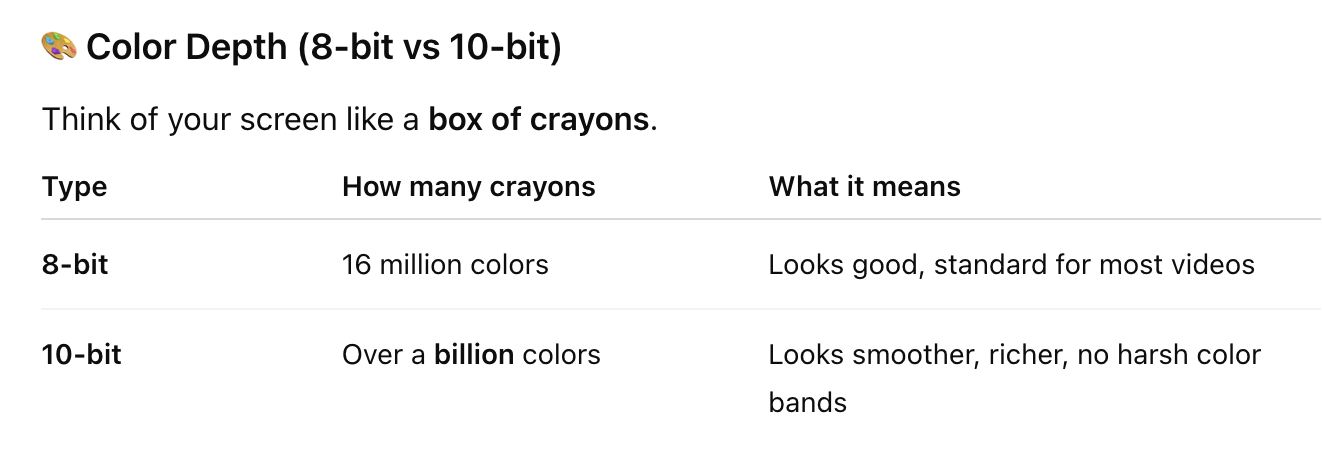
8-bit vs 10-bit - difference?
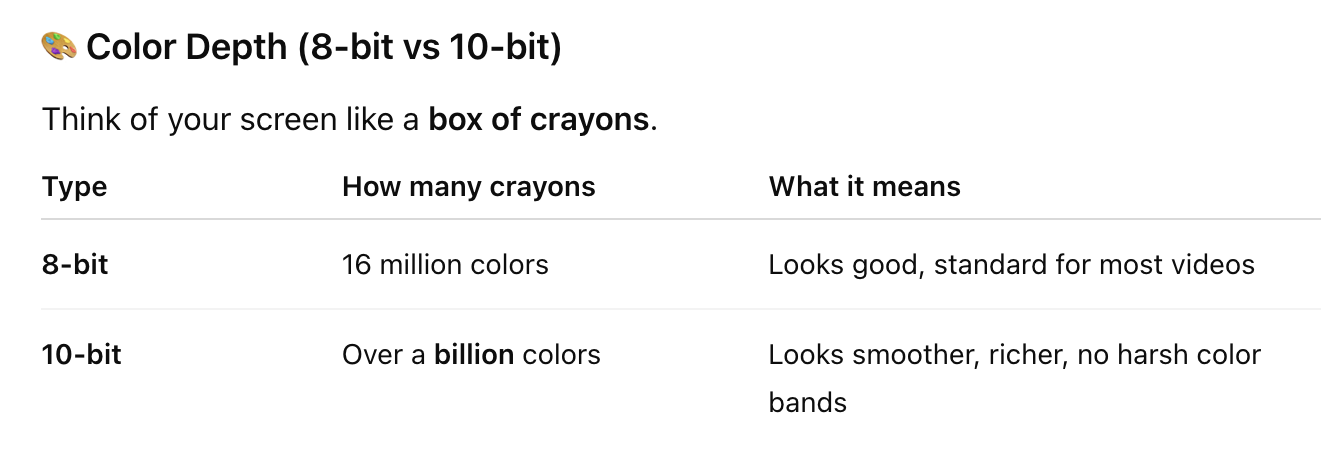
10-bit has FAR more colors → smoother gradients, no banding
What is SDR?
Standard brightness & color range - normal video.
What is HDR?
High Dynamic Range - brighter whites, deeper blacks, more realistic.
 Note
Note  Flashcards (25)