8. Microbes in Human Welfare
 Call Kai
 Learn
Learn Practice Test
 Spaced Repetition
 Match
Match Flashcards
 Knowt Play
1/145

Earn XP
Description and Tags
Pretty much every line from NCERT. Suitable for IAT and probably also NEET. Question mode: Flashcards only. Answer mode: Answer with Definition. Good luck!
Name | Mastery | Learn | Test | Matching | Spaced | Call with Kai | Chat |
|---|
No analytics yet
Send a link to your students to track their progress
146 Terms
Microbes are organisms from which kingdoms?
All organisms from Monera and Protista are microbes.
Certain unicellular organisms from other kingdoms such as Fungi and Plantae are also microbes.
Viruses, viroids, and prions are also microbes
Microbes are cosmopolitan. What does this mean?
Microbes are present everywhere – in soil, water, air, inside our bodies and that of other animals and plants.
Microbes are extremophiles. What does this mean?
Microbes are present even at sites where no other life-form could possibly exist – sites such as deep inside the geysers (thermal vents) where the temperature may be as high as 1000℃, deep in the soil, under the layers of snow several metres thick, and in highly acidic environments.
What do you call microbes that can live in extreme temperatures?
Thermophiles
What do you call microbes that can live in highly acidic conditions?
Acidophiles
What do you call microbes that can live in highly salty conditions?
Halophiles
Microbes cannot be seen with naked eye. Under which special conditions can we see an aggregate of them?
Microbes like bacteria and many fungi can be grown on nutritive media to form colonies, that can be seen with the naked eyes
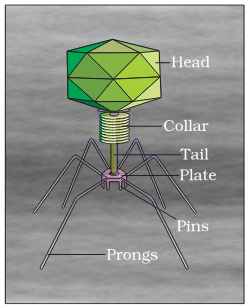
What is this organism?
it is a bacteriophage
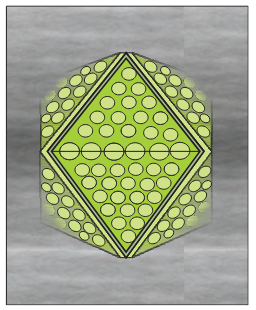
What is the name of this organism?
It is Adenovirus
What does Adenovirus cause?
it causes respiratory infections.

These are colonies. cool right?
yes
What are the microbes used in production of curd from milk collectively called?
lactic acid bacteria (LAB)
Give an example of lactic acid bacteria (LAB)
Lactobacillus
How do lactic acid bacteria (LAB) convert milk to curd?
During growth, the LAB produce acids that coagulate and partially digest the milk proteins.
What is an inoculum?
An inoculum refers to a small amount of microorganisms used to initiate growth in the given medium.
When converting milk to curd, a small amount of curd is added to fresh milk. This is called an _________.
When converting milk to curd, a small amount of curd is added to fresh milk. This is called an inoculum.
Why does curd have higher nutritional quality than milk? There are 2 significant things.
LAB increase vitamin B12
LAB play a very beneficial role in checkinng disease-causing microbes.
The dough, which is used for making foods such as dosa and idli is also fermented by ________.
(bacteria / fungi)
bacteria
The puffed-up appearance of dough is due to the production of _______.
The puffed-up appearance of dough is due to the production of CO2 gas.
Which metabolic pathway is responsible for the production of CO2 gas in the preparation of dough?
Alcoholic fermentation (glycolysis)
What is the scientific name for Baker’s Yeast, or Brewer’s Yeast?
Saccharomyces cerevisiae
Toddy, a traditional drink of some parts of southern India is made by fermenting ___ _____ _____.
Toddy, a traditional drink of some parts of southern India is made by fermenting sap from palms.
Microbes are used to ferment fish, soyabean and bamboo-shoots to make foods. What is one of the oldest food items which microbes are used to make?
cheese
Why do different varieties of cheese have different flavours and textures?
Different varieties of cheese are known by their characteristic texture, flavour and taste, the specificity coming from the microbes used.
The large holes in ‘Swiss cheese’ are due to production of a large amount of CO2 by a bacterium named _____________ _________.
The large holes in ‘Swiss cheese’ are due to production of a large amount of CO2 by a bacterium named Propionibacterium sharmanii.
The ‘Roquefort cheese’ are ripened by growing a specific _____ on them, which gives them a particular flavour.
(bacteria / fungi)
The ‘Roquefort cheese’ are ripened by growing a specific fungi on them, which gives them a particular flavour.
Production on an industrial scale, requires growing microbes in very large vessels called _________.
Production on an industrial scale, requires growing microbes in very large vessels called fermentors.
Why is Saccharomyces cerevisiae called both Baker’s Yeast and Brewer’s Yeast?
Because it is used in fermenting both bread dough and fermenting malted cereals and fruit juices, to produce ethanol.
Which microbe is used to ferment malted cereals and fruit juices, to produce ethanol?
Saccharomyces cerevisiae
Depending on the type of the raw material used for fermentation and the type of processing (with or without distillation) different types of alcoholic drinks are obtained.
Which 2 drinks are produced without distillation?
Wine and Beer
Depending on the type of the raw material used for fermentation and the type of processing (with or without distillation) different types of alcoholic drinks are obtained.
Which 3 drinks are produced with distillation of the fermented broth?
whisky, brandy and rum
What does the word “antibiotic” mean?
Anti is a Greek word that means ‘against’, and bio means ‘life’, together they mean ‘against life’ (in the context of disease causing organisms)
What are antibiotics?
Antibiotics are chemical substances, which are produced by some microbes and can kill or slow the growth of other (disease-causing) microbes.
Which was the first antibiotic to be discovered?
Penicillin.
Which bacteria was Alexander Fleming working on when he discovered Penicillin?
Staphylococci
How did Alexander Fleming discover Penicillin?
Alexander Fleming while working on Staphylococci bacteria, once observed a mould growing in one of his unwashed culture plates around which Staphylococci could not grow. He found out that it was due to a chemical produced by the mould and he named it Penicillin after the mould Penicillium notatum.
What is the name of the mould that produces the chemical Penicillin?
Penicillium notatum.
Alexander Fleming discovered Penicillin. However, its full potential was established by which two scientists?
Ernest Chain and Howard Florey.
Which antibiotic was extensively used to treat American soldiers wounded in World War II?
Penicillin
Which year did Fleming, Chain, and Florey collectively receive a nobel prize, and for what?
Fleming, Chain and Florey were awarded the Nobel Prize in 1945, for the discovery of Penicillin.
What are the four illnesses that can now be cured easily by antibiotics?
Plague
Whooping cough (kali khansi)
Diphtheria (gal ghotu)
Leprosy (kusht rog)
Which fungus is used to produce citric acid?
Aspergillus niger
Aspergillus niger is used to produce what?
citric acid
Which bacterium is used to produce acetic acid?
Acetobacter aceti
Acetobacter aceti is used to produce what?
acetic acid
Which bacterium is used to produce butyric acid?
Clostridium butylicum
Clostridium butylicum is used to produce what?
butyric acid
What bacterium is used to produce lactic acid?
Lactobacillus
Lactobacillus is used to produce what?
lactic acid
Which fungus is used in the commercial production of ethanol?
Saccharomyces cerevisiae
Saccharomyces cerevisiae is used in the commercial production of what?
ethanol
What are used in detergent formulations and are helpful in removing oily stains from the laundry?
Lipases
What are lipases used for?
Lipases are used in detergent formulations and are helpful in removing oily stains from the laundry.
Why are bottled juices bought at markets clearer than fruit juices made at home?
This is because the bottled juices are clarified by the use of pectinases and proteases.
What are pectinases and proteases used for?
Bottled juices are clarified with them
Streptokinase is produced by which bacterium?
Streptococcus
What is Streptococcus used to produce?
Streptokinase
What is Streptokinase used for?
Streptokinase is used as a ‘clot buster’ for removing clots from the blood vessels of patients who have undergone myocardial infarction leading to heart attack.
Which enzyme is used as a “clot buster” for removing clots from the blood vessels?
Streptokinase
cyclosporin A is produced by which fungus?
Trichoderma polysporum
Trichoderma polysporum is used to produce what?
cyclosporin A
What is cyclosporin A used for?
cyclosporin A is used as an immunosuppressive agent in organ-transplant patients.
Statins is produced by which fungus?
Monascus purpureus
Monascus purpureus is used to produce what?
Statins
What is Statins used for?
Statins have been commercialised as blood-cholesterol lowering agents. It acts by competitively inhibiting the enzyme responsible for synthesis of cholesterol.
What is sewage?
Sewage is municipal waste-water containing human excreta
Why is sewage treated in sewage treatment plants (STPs)?
To make it less polluting before it is released into water bodies. It has like a lot of pathogenic microbes and organic matter which is bad for water bodies.
Which quality of sewage is used in the treatment of that very sewage?
Treatment of waste water is done by the heterotrophic microbes naturally present in the sewage.
What is the significance of the primary treatment stage of sewage?
Primary sewage treatment involves physical removal of particles – large and small – from the sewage through filtration and sedimentation.
What are the two cleaning techniques used during the primary treatment stage of sewage?
filtration
sedimentation
Describe the filtration and sedimentation stages of primary sewage treatment.
Initially, floating debris is removed by sequential filtration.
Then, the grit (soil and small pebbles) are removed by sedimentation.
In primary sewage treatment, waste-water first undergoes filtration then undergoes sedimentation. The solids that settle at the bottom after this process are called?
primary sludge
After filtration and sedimentation during primary sewage treatment, all solids that settle form the primary sludge. The supernatant is called what?
effluent
What is effluent, with regards to sewage treatment?
the supernatant fluid that forms after filtration and sedimentation during primary sewage treatment
After primary sewage treatment, what happens to the effluent?
The effluent from the primary settling tank is taken for secondary treatment.
During secondary sewage treatment, where is the primary effluent sent?
The primary effluent is passed into large aeration tanks.
When primary effluent is sent into aeration tanks, why is it constantly agitated mechanically and air is pumped into it?
This allows vigorous growth of useful aerobic microbes into flocs.
What are flocs?
masses of bacteria associated with fungal filaments to form mesh like structures.
Why are flocs formed in secondary sewage treatment?
Because primary effluent is sent into aeration tanks which have air pumped inside and are constantly agitated, which enables aerobic microbes to rapidly consume organic matter and multiply.
What is the full form of BOD with regards to sewage treatment?
Biochemical Oxygen Demand
What effect does secondary sewage treatment have on the BOD of the effluent?
BOD significantly reduces
Why does the BOD of effluent significantly reduce in secondary sewage treatment?
While growing, aerobic microbes (which form flocs) consume the major part of the organic matter in the effluent, which reduces the organic matter present which reduces the oxygen demand by the microbes lol
What is BOD (biochemical oxygen demand)?
BOD refers to the amount of the oxygen that would be consumed if all the organic matter in one liter of water were oxidised by bacteria.
what is The BOD test?
The BOD test measures the rate of uptake of oxygen by micro-organisms in a sample of water.
How does the BOD of waste water indicate its polluting potential?
The greater the BOD of waste water, more is its polluting potential.
During secondary sewage treatment, what happens after the BOD of the waste water is reduced significantly?
The effluent is then passed into a settling tank where the bacterial ‘flocs’ are allowed to sediment.
Once the BOD of sewage or waste water is reduced significantly, the effluent is then passed into a settling tank where the bacterial ‘flocs’ are allowed to sediment. What is this sediment called?
“activated sludge”
During secondary sewage treatment, “activated sludge” is separated into two unequal parts. What happens to these parts?
A small part of the activated sludge is pumped back into the aeration tank to serve as the inoculum. The remaining major part of the sludge is pumped into large tanks called anaerobic sludge digesters.
What happens in anaerobic sludge digesters during secondary sewage treatment?
Here, other kinds of bacteria, which grow anaerobically, digest the bacteria and the fungi in the activated sludge.
During secondary sewage treatment, anaerobic bacteria digest the bacteria and fungi from flocs, and produce which gases?
During this digestion, bacteria produce a mixture of gases such as
methane
hydrogen sulphide
carbon dioxide
During anaerobic digestion in secondary sewage treatment, bacteria produce a mixture of gases such as methane, hydrogen sulphide and carbon dioxide. These gases form biogas. Why can it be used as a source of energy?
Because it is highly flammable
What happens to the effluent after it has passed through aeration tanks and anaerobic sludge digesters?
It is generally released into natural water bodies like rivers and streams.
Why aren’t there any other methods of sewage treatments besides microbial treatment?
Till date, no man-made technology has been able to rival the microbial treatment of sewage.
Which ministry initiated the Ganga Action Plan and Yamuna Action Plan (GAP and YAP)?
Ministry of Environment and Forests
What is the objective of the Ganga Action Plan and Yamuna Action Plan (GAP and YAP)?
The Ministry of Environment and Forests has initiated Ganga Action Plan and Yamuna Action Plan to save these major rivers of our country from pollution. Under these plans, it is proposed to build a large number of sewage treatment plants so that only treated sewage may be discharged in the rivers.
What is biogas?
Biogas is a mixture of gases (containing predominantly methane) produced by the microbial activity and which may be used as fuel.
The gas produced by microbes depends on what?
The type of the gas produced depends upon the microbes and the organic substrates they utilise.
In fermentation of dough, cheese making and production of beverages, the main gas produced is what?
CO2!
Certain bacteria, which grow anaerobically on ______ _______, produce large amount of methane along with CO2 and H2.
Certain bacteria, which grow anaerobically on cellulosic material, produce large amount of methane along with CO2 and H2.
Certain bacteria, which grow anaerobically on cellulosic material, produce large amount of methane along with CO2 and H2. What are these bacteria called?
methanogens