PSYC 2121 Chapter 4- Recognizing Objects
 Studied by 0 people
 Call with Kai
 Learn
Learn Practice Test
 Spaced Repetition
 Match
Match Flashcards
 Knowt Play
1/28

There's no tags or description
Looks like no tags are added yet.
Name | Mastery | Learn | Test | Matching | Spaced | Call with Kai |
|---|
No study sessions yet.
29 Terms
The binding problem
a question, if visual processing is done like this, how do things get bound together?
agnosia
neuro disorder characterized by the inability to recognized familiar objects
damage in parietal/temporal/occipital
how many different types of agnosia are there
2
apperceptive and associative
Apperceptive agnosia
you can perceive an object's individual features, but you can't bind them together.
Can perceive an objects features but not the object in entirety
Ex: patient D.F, drawing a ladel,
Sometimes people can infer based on their knowledge to make conclusions , but they cannot perceive these things as intact objects
Cannot solve their own binding problem
What is impaired in apperceptive agnosia?
Visual perception
What is apperceptive agnosia caused by
dissuade damage in the brain
(parietal, temporal, and/or occipital damage).
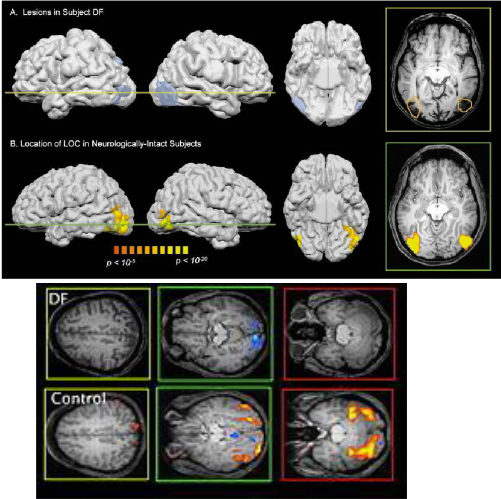
Patient DF: had bilateral lesions in …
the occipital cortex
Associative agnosia
cant name objects or link them to their functions, but they can perceive the entire object with bound features
Ex: i see the object and i see it as bound (one) but idk what the object is
Ex: I see a small yellow ball.. But I cannot make the connection to my own knowledge therefore idk what it is
No connection to semantic knowledge.
Associative agnosia is caused by damage to the…
left temporal lobe.
What does recognition involve?
binding features and recognizing the full object (that’s a line with a circular end) and linking that with your knowledge and experience (that must be a spoon)
People with agnosia struggle in these areas
with intact rec, you can…
• You can recognize a huge variety of objects within a category
• You can recognize objects even with incomplete information (“fill in the blanks”)
• You can recognize a huge number of words, regardless of capitalization and font
Sometimes the stimulus input may not vary, but the context varies
what does intact recognition rely on?
both physical features and knowledge (context)
Bottom up processes
directly shared by the stimulus
data driven/ stimulus driven
Top down processes
shared by context or task goals
Experience driven
T/F: Features are rapidly processed in parallel but this happens before binding/recognition, your brain is tuned in to individual features
True
Single feature search-
ooking for one thing, happens in parallel
Ex: look for something red.
Single feature is special
Conjunction search
searching for a multi thing takes longer than searching for a single feature.
Ex: look for something red AND horizontal
We are slower at this
how fast is rec?
depends what we are recognizing, the context, etc
Factors that influence recognition speed (4)
Familiarity-more common words are easily rec
Priming- words that were just seen is more easily rec
Context- letters are easier to rec when they are inside words (Word superiority effect)
Well-formedness: Letter sequences that conform to typical spelling patters are easier to recognize (HZQY vs. FIKE)
Well-formedness
letter sequences that conform to typical spelling patterns are easier to rec (HZQY vs FIKE)
are errors systematic?
yes. DPUM is likely read as DRUM
Word rec allows us to read by
a network of detectors that is organized into layers.
Moving from the bottom up
As we move up the layers, the networks become concerned with objects on a slightly larger scale – information flows from the bottom up.
Bottom up
Feature detectors ➡letter detectors ➡bigram detectors ➡word detectors
what does the starting activation at teach level depend on
recency
We don't need to start at feature detectors, we could start at bigram
If it has recently fired (saw), it will have a higher activation to start
what does the starting activation at teach level ALSO depend on
frequency
If it fires often, it will have higher activation to start
why is baseline activation important?
it determines how much info we need
what does recency and frequency explain?
well formedness errors
starting activation at each level depends on…
recency and frequency
what takes longer, conjunction search or a single feature search?
conjunction search
 Note
Note  Flashcards (341)