AP Psychology - Learning and Intelligence
 Studied by 5 people
 Call with Kai
 Learn
Learn Practice Test
 Spaced Repetition
 Match
Match Flashcards
 Knowt Play
1/56

Earn XP
Description and Tags
Good luck!
Name | Mastery | Learn | Test | Matching | Spaced | Call with Kai |
|---|
No study sessions yet.
57 Terms
Learning
A long-lasting change in behavior resulting from experience. (Usually becomes habitual in 66 days)
Neuroplasticity (Brain plasticity)
The ability of the brain to change throughout an individual’s life
Long-term potentiation (LTP)
A persistent strengthening of synapses based on recent patterns of activity. (produce a long-lasting increase in signal transmission between two neurons)
Associative Learning
Learning that certain events occur together. (Could be classical or operant conditioning)
Classical Conditioning
Learning to associate two stimuli and anticipate events
Stimulus
Any event or situation that evokes a response
Delayed Conditioning (Simultaneous Conditioning)
Controled stimulus (CS) begins first and overlaps with the unconditioned stimulus (US) before both end. Creates a strong, predictable association
Trace Conditioning (Backward Conditioning)
Controlled stimulus (CS) begins and ends before the unconditioned stimulus (US) is presented
Acquisition
The initial stage of learning or conditioning. (Process where a new behavior is introduced and gradually strengthened)
Extinction
The gradual weakening and disappearance of a conditioned behavior or response when the reinforcement or unconditioned stimulus is removed
Spontaneous Recovery
The sudden, temporary re-emergence of a previously extinguished conditioned response/behavior after a rest period of delay, w/o further conditioning
Generalization
The tendency to respond in the same way to different but similar stimuli; apply learned behaviors to new, similar contexts
Discrimination
The unjust or prejudicial behavioral treatment of individuals based on their integration in a particular group (often stemming from stereotypes and prejudices)
Aversive Conditioning
Type of classical conditioning; pair a negative stimulus with an unwanted behavior to reduce the habit
First-Order Conditioning
Regular process of pairing a neutral stimulus with an unconditioned response (bell with salivating)
Second-Order Conditioning
Pairing another neutral stimulus with the previously conditioned stimulus to eventually make it a conditioned stimulus
Garcia Effect
If you ingest an unusual food or drink, and then you become nauseous, you will most likely develop an aversion to that food
Operant Conditioning
A learning process through which the strength of a behavior is modified by reinforcement or punishment
Reinforcement
Anything that maintains or increases the likelihood of a behavior
Positive Reinforcement
Addition of something pleasant to increase behavior (food, shelter, water)
Negative Reinforcement
Removing something unpleasant to increase behavior (loud noise, darkness, pain)
Punishment
Anything that makes a behavior less likely to reoccur
Positive Punishment
Adding something bad to discourage behavior (A shock)
Negative Punishment
Removing something to discourage behavior (taking away electronics)
Escape Conditioning (Escape Learning)
A form of conditioning in which the subject learns to perform a behavior that terminates an aversive stimulus, pain, or punishment by escaping from the unpleasant stimulus. (Acting up in class to avoid an test)
Avoidance Conditioning
A form of conditioning that enables one to avoid the unpleasant stimulus altogether (calling parent and telling them you’re sick to avoid the dentist)
Shaping
Reinforcing the steps used to reach a single desired behavior; to mold a single behavior
Chaining
Reinforcing individual responses occuring in a sequence to form a complex behavior; to link together several separate behaviors into a more complex activity
Primary Reinforcers
An innate, unlearned stimulus that satisfies a basic biological need or drives survival (Food, physical comfort)
Secondary Reinforcers
A stimulus that gains reinforcing power by being paired with a primary reinforcer through learning (saying thank you, praise)
Premack Principle
Whichever of the two activities is preferred can be used to reinforce the activity that is not preferred (eating veggies → dessert)
Fixed Ratio
Reinforcement is delivered after a fixed number of responses
Fixed Interval
Reinforcement is delivered after a behavior is performed following the passage of a fixed amount of time
Variable Ratio
Reinforcement is delivered after a variable number of responses (think slot machines)
Variable Interval
Reinforcement is delivered after a behavior is performed following the passage of a variable amount of time
Token Economy
(Operant Conditioning) People are given a token for some behavior and can exchange the tokens for various privledges
Cognitive Learning
Learning by observing events, by watching others, or through language
Observational Learning
People and animals learning through observing others
Abstract Learning
Understanding concepts at an intellectual level rather than just through concrete experience or direct instructions
Standardized Tests
Test items have been tested on a similar population of people, and achievement norms have been established (SAT)
Split-Half Reliability
test for a single knowledge area is split into two parts and then both parts given to one group of students at the same time. The scores from both parts of the test undergo a statistical analysis, and a correlation may be uncovered.
Test-Retest Reliability
The correlation between a person’s score on one administration of the test and their score on a subsequent administration of the test
Face Validility
The criteria on which you measure the accuracy of something may not be the most reliable measure. (Ex. in choosing a doctor, you base your decision on how well a doctor can treat your symptoms by what the doctor is wearing.)
Content Validility
How well a measure reflects the entire range of material it is supposed to be testing. (Ex. looking for a doctor to treat your symptoms, looking at education and speciality)
Aptitude Tests
Predicts future performance
Achivement Tests
Assesses current performance
Intelligence
The ability to gather and use information in productive ways
Fluid Intelligence
Our ability to solve abstract problems and pick up new information/skills
Crystalized Intelligence
Involves using knowledge accumulated over time
General Intelligence (G Factor)
If you’re good at one thing, you can transfer that energy and ability to another thing
Factor Analysis
A statistical method used to describe variability among observed, correlated variables in terms of a potentially lower number of factors
Mental Age
What a person of a particular age should know
Intelligence Quotient (IQ)
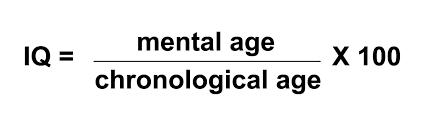
Cultural Bias
An aspect of an intelligence test in which the wording used in questions may be more familiar to people in one social group than another.
Nature
Behavior is determined by our inherited, genetic structure. Behavior can be said to be innate (in born)
Nurture
Behavior is the result of learning and experience resulting from outside factors from parents, media, peers, etc. Behavior is learned
Flynn Effect
Describes the significant, long-term rise in average IQ test scores observed globally throughout the 20th century
 Note
Note  Flashcards (123)