Resting Membrane Potential
 Studied by 0 people
 Call with Kai
 Learn
Learn Practice Test
 Spaced Repetition
 Match
Match Flashcards
 Knowt Play
1/62

Earn XP
Description and Tags
Describe the structure and classification of neurons. Explain what makes a cell excitable. Discuss the roles of membrane channels in neuronal function. Define and calculate the resting membrane potential (RMP).
Name | Mastery | Learn | Test | Matching | Spaced | Call with Kai |
|---|
No study sessions yet.
63 Terms
Why can’t neurones undergo mitotic division?
Mature neurones are permanently in G₀ phase and cannot re-enter the cell cycle. They lack centrioles, so they cannot form a mitotic spindle, and their highly specialised structure (long axons and dendrites) makes division impossible without disrupting neural circuits.
Key parts of a neuron:
Dendrite
Soma (cell body)
Axon
Axon terminals
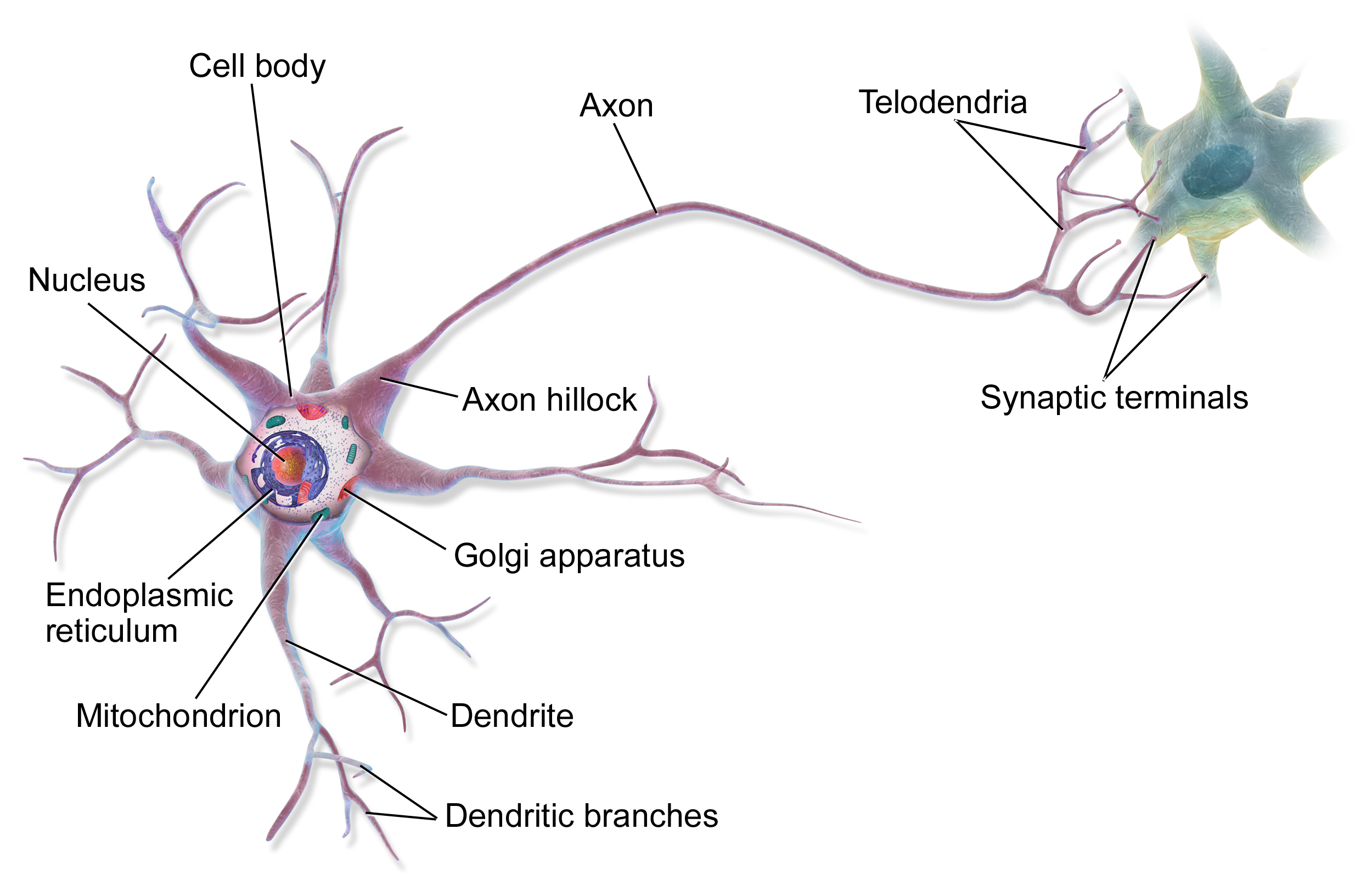
What structures attached to the neuron’s cell body are small and highly branched?
Dendrites
What is the function of dendritic processes?
They form part of the receptive zone of the neuron and detect changes in the environment, sending weak electrochemical signals toward the cell body and axon.
What property of neurons allows dendrites to respond to environmental changes?
Excitability (irritability).
What is the long, single, branched process that extends from the neuron’s cell body?
The axon
What is the function of the axon?
To transport action potentials away from the cell body (conduction).
What is released from the synaptic terminals of the axon?
Neurotransmitters
Some axons in our body can be very long. Therefore, for the information to travel fast up and down our body we need to cover the axon with what?
Myelin sheath
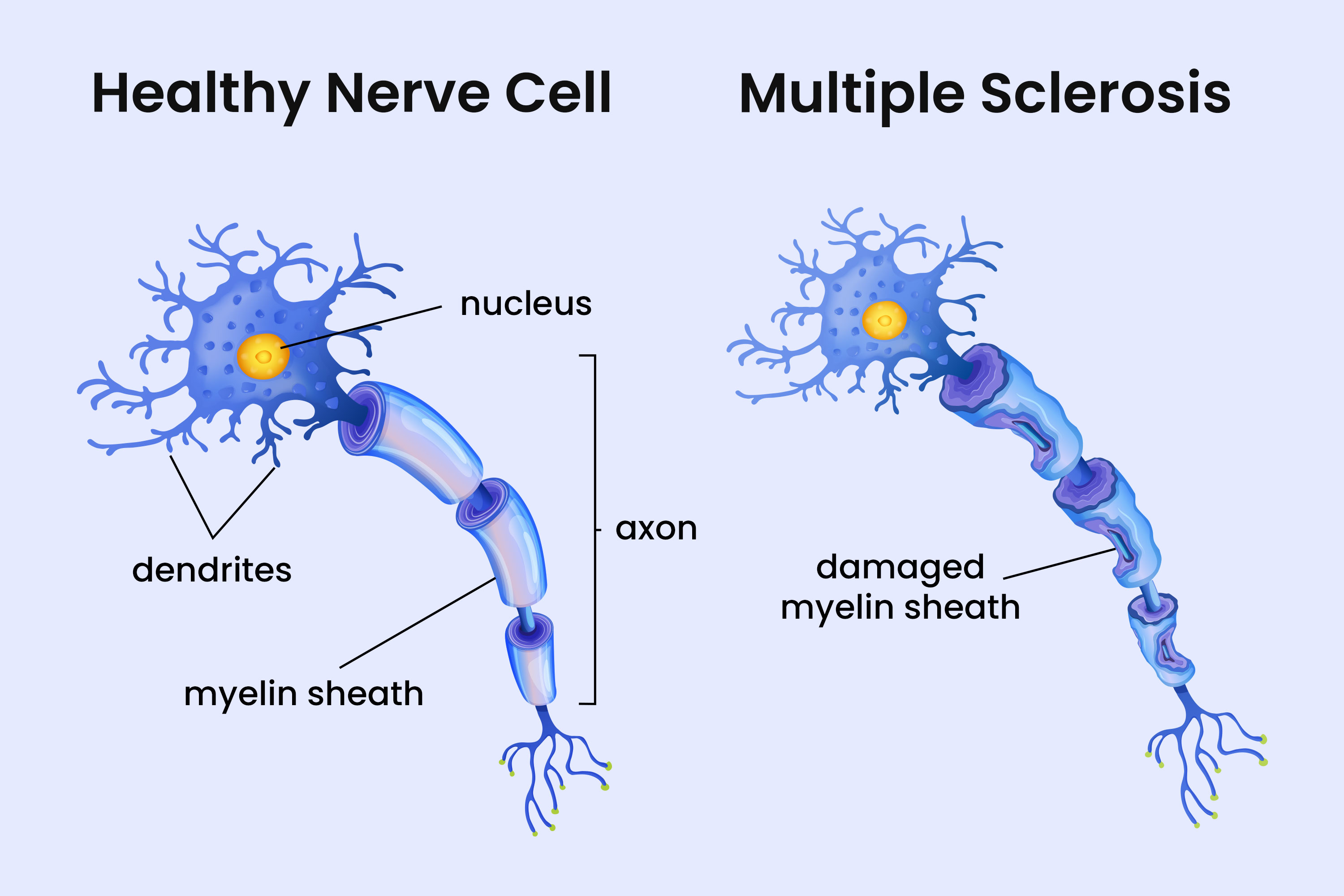
What produces myelin?
Schwann cells
When the axon is covered with a myelin sheath, what is it known as?
Nerve fibre
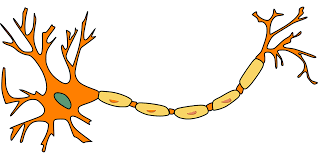
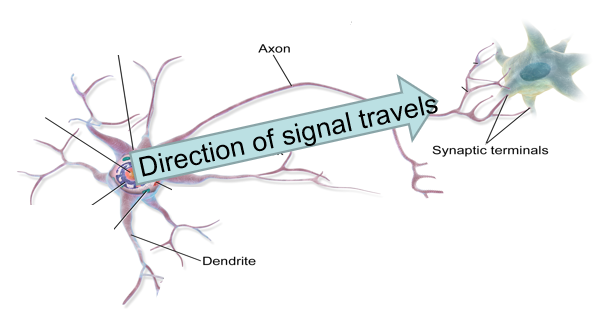
How do neurons communicate with each other?
Through dendrites and axon
Incoming signalling are received at the…
dendrites
Outgoing signals travel along the…
axon to the synaptic terminals
How are neurones classified?
Based on their structure
Multipolar
Bipolar
Unipolar
Anaxonic
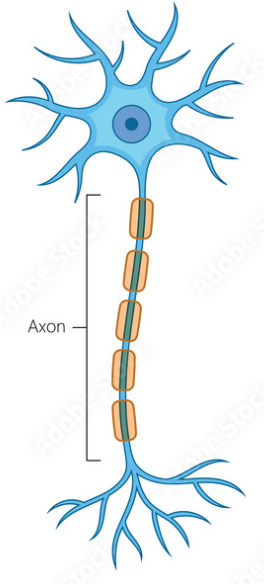
What is the classification of this neurone?
Multipolar
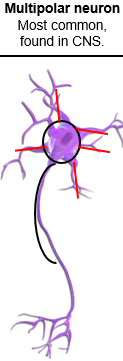
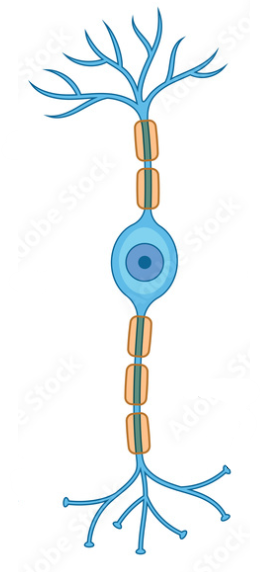
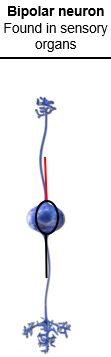
What is the classification of this neurone?
Bipolar
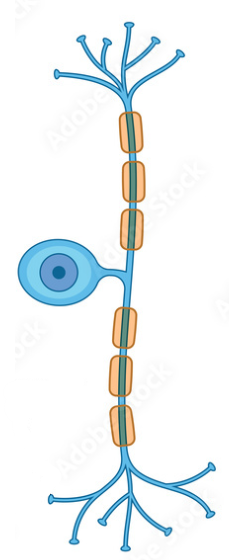
What is the classification of this neurone?
Unipolar
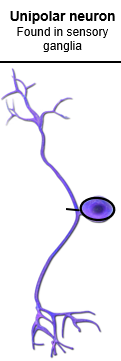
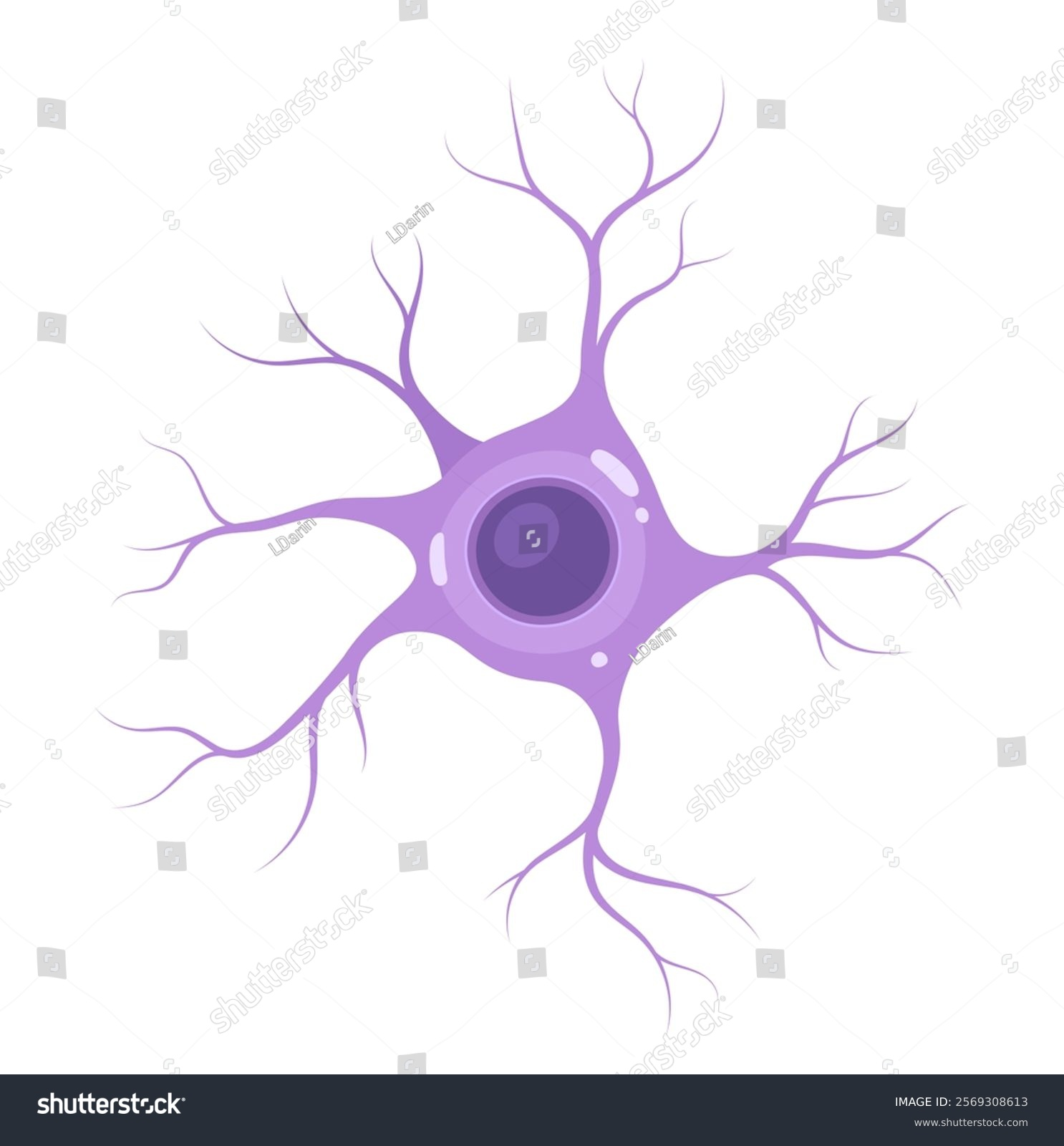
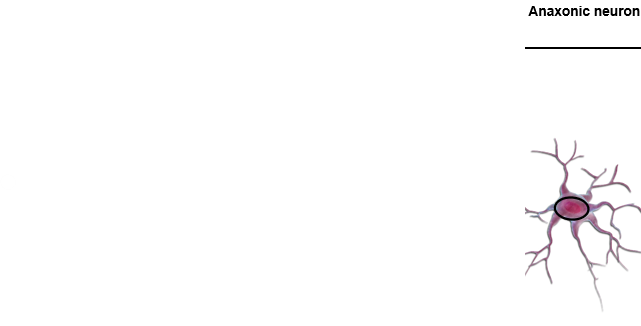
What is the classification of this neurone?
Anaxonic
Functional roles of neurones:
Afferent (sensory)
Efferent (motor)
Interneurons
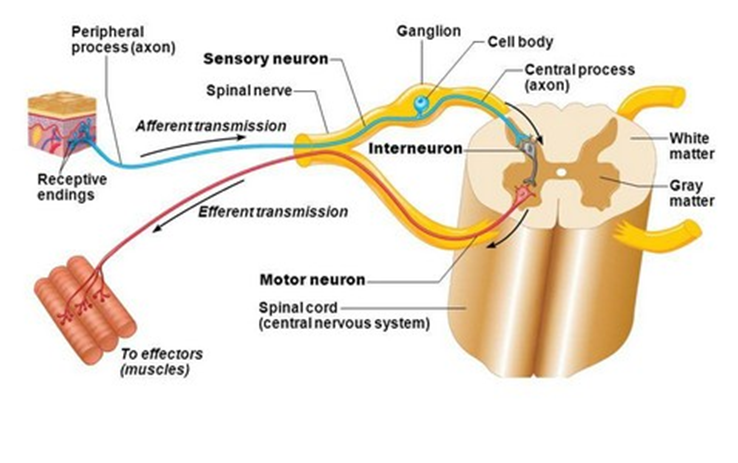
Afferent (sensory)
Transmit signals to CNS
Efferent (motor)
Send commands from CNS to muscles/glands
Interneurons
Process information within CNS
What is an excitable cell?
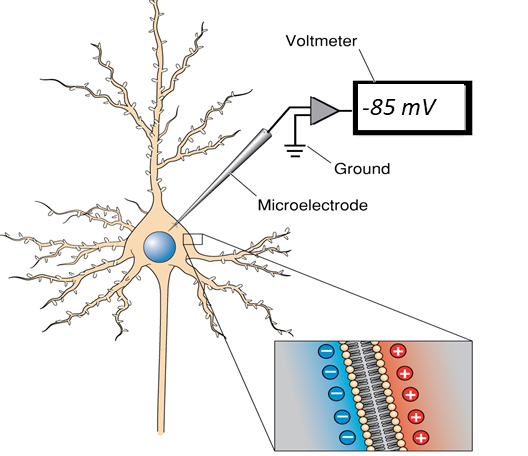
Excitable cells can generate electrical signals in response to stimuli.
Refers to the ability of some cells to be electrically excited resulting in the generation of action potentials.
All cells (not just excitable cells) have a resting membrane potential (RMP): an electrical charge across the plasma membrane, with the interior of the cell negative with respect to the exterior.
Excitable cells have resting membrane potentials that range from -50mV to -85mV, while non-excitable cells have potentials that range from -5 mV to -10 mV.
How does the membrane control ion movement?
The plasma membrane’s phospholipid bilayer is selectively permeable - only specific ions or molecules pass through via channels or pumps.
All cells have an outer plasma membrane that regulates what enters to the cells and what is secreted from the cells.
It is composed by phospholipid
Charged ion or proteins are unable to cross the membrane.
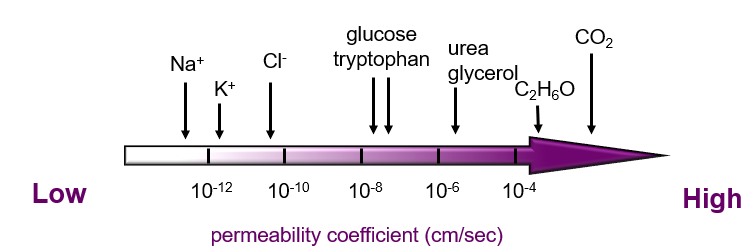
Selective permeability of membranes:
Lipid bilayer membranes are poorly permeable to charged molecules no matter how small they are. Very small ions such as Na+ cannot pass through the lipid membrane
Large uncharged molecules such as glucose also cannot cross the lipid membrane and they will need a transporter
But very small uncharged molecules like CO2 can easily cross the lipid membrane and will move following a concentration gradient
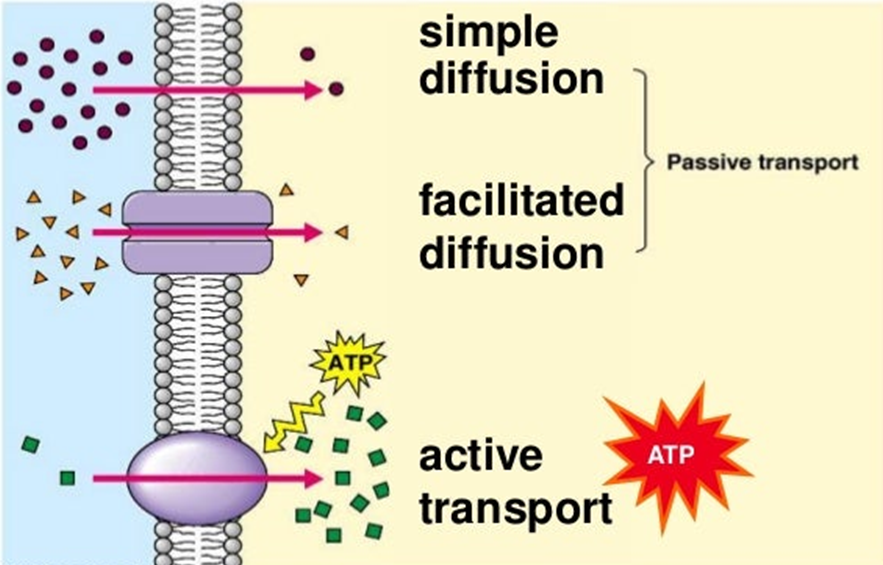
How do ions move across the membrane?
Facilitated diffusion (ion channel)
Active transporters (pump)
Facilitated diffusion (ion channel)
Ions diffuse down concentration gradient
Selectively permeable to different ions
Movement through ion channels.
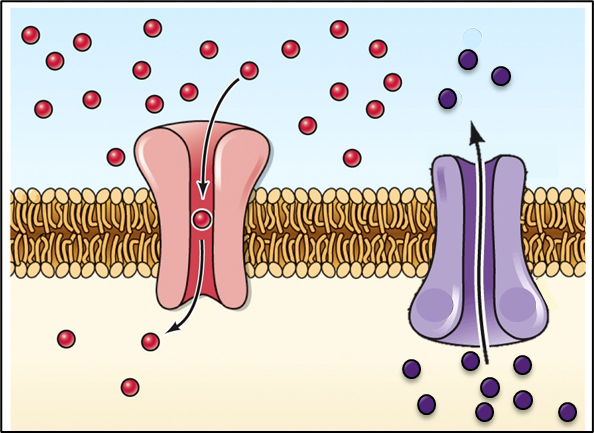
Active transporters (pump)
Move ions against concentration gradient (Na+/K+ channel)
Create concentration gradients across the membrane
Requires ATP (e.g., Na⁺/K⁺ pump)
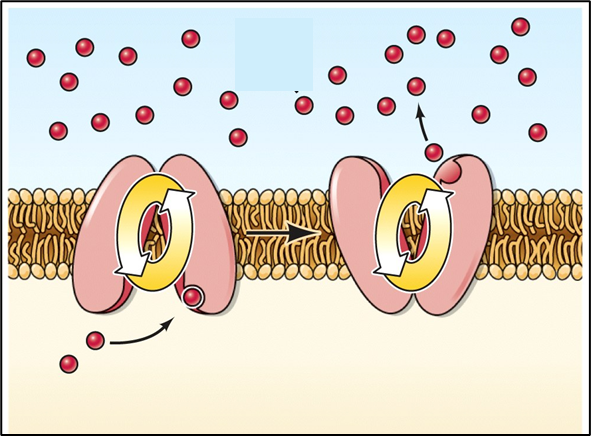
What are ion channels?
Intrinsic membrane proteins that form water filled passages through the membrane.
The flow of ions through an ion channel is according to the…
ion concentration gradient. This means that ions always move from an area of high concentration to an area of low concentration.
What are the ion channels involved in resting membrane potential?
Membrane-spanning proteins - connect the cytosol to the cell exterior
Flux of ions is passive, selective and rapid
Direction of flux determined by concentration and charge
Gated and non-gated (K+ channels are usually leaky).
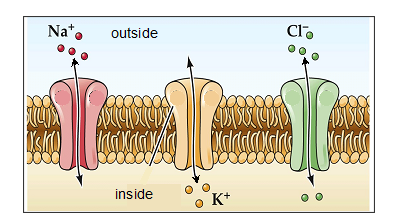
Are ion channels active or passive transporters?
Passive, they never use ATP
What’s the difference between gated channels and ion channels?
Gated channels function differently.
These ion channels have a built in mechanism (the gate) that only permits ions to flow when specific conditions are met.
When the appropriate stimulus is applied, the gate opens and ions are permitted to pass (again the directional flow of the ions is controlled by the concentration gradient of the ions, and the flow is always from high concentration to low concentration).
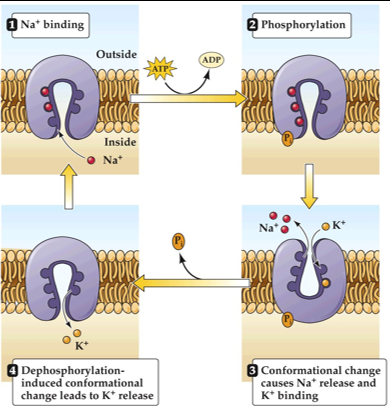
Sodium-Potassium Pump
Maintaining concentration gradients for Na+ and K+ is essential for excitability
Achieved via active exchange via the Na-K transporter aka sodium potassium pump
Chemical gradient is established with 3 Na⁺ out and 2 K⁺ in using ATP.
This pump has now created an electrochemical gradient, because this means there is a net -1 difference in electrical charged inside the cell with each cycle
Maintains the ion gradients that underlie the resting potential.
This pump uses energy in the form of ATP to perform this work
Transport summary
How is the resting membrane potential (RMP) established?
What is the typical resting membrane potential of a neuron?
About –70 mV.
What causes the resting membrane potential in neurons?
Unequal ion distribution (mainly K⁺ and Na⁺), selective permeability through K⁺ leak channels, and the Na⁺/K⁺ pump maintaining gradients.
Do all cells have a resting membrane potential?
YEs
What does membrane potential represent?
The separation of electrical charge across the membrane, with the inside negative and the outside positive.
What creates the electrical force underlying membrane potential?
Differences in ionic concentration across the membrane, causing ions to move toward equilibrium.
What conditions are required to create a membrane potential?
Uneven distribution of charges and a pathway for ions to move toward equilibrium (ion channels).
How does the Na⁺/K⁺ pump contribute to membrane potential?
It pumps 3 Na⁺ out and 2 K⁺ in, creating both chemical and electrical gradients.
What acts as an insulator between the inside and outside of the cell?
The cell membrane (lipid bilayer).
How is the electrical potential across a neuronal membrane recorded?
With a sharp electrode inserted into the soma.
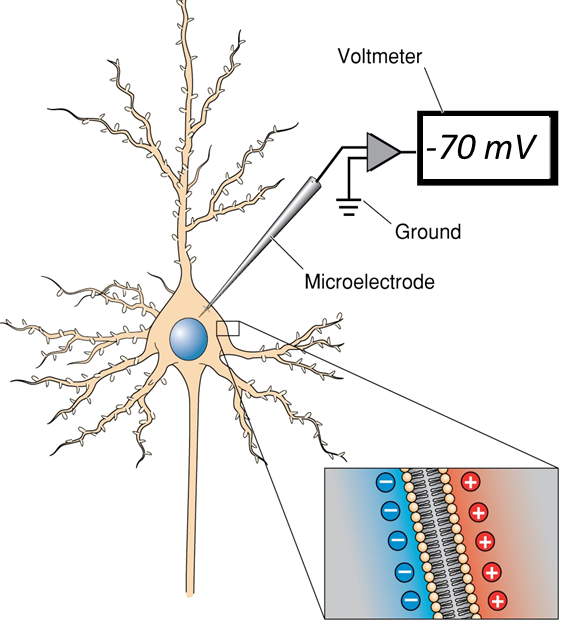
Why do ions move across the membrane?
They move along concentration gradients from high to low.
What restricts ion movement across the membrane?
The relative permeability of the plasma membrane.
What is the general distribution of K⁺ inside and outside the neuron?
K⁺ is high inside (about 140 mM) and low outside (about 4–5 mM).
What is the general distribution of Na⁺ inside and outside the neuron?
Na⁺ is high outside (about 145 mM) and low inside (about 10–15 mM).
How does asymmetrical ion distribution contribute to membrane potential?
The difference in Na⁺ and K⁺ concentrations across the membrane drives the membrane potential.
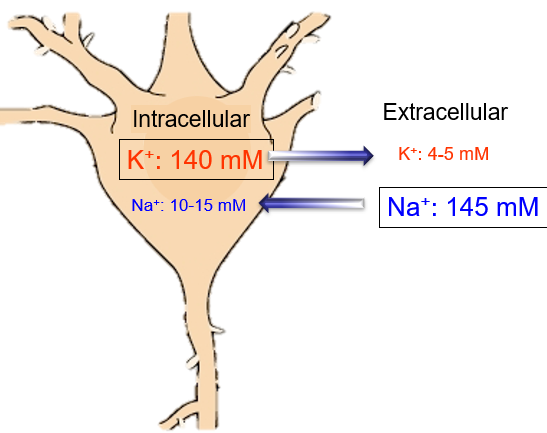
What primarily generates the resting membrane potential?
The different concentrations of Na⁺ and K⁺ across the membrane.
K+ leak channels
The most important component of the resting membrane potential is the K+.
K+ leak channels (approximately a 100:1 ratio). The resting membrane potential is established when the diffusion of K+ out of the cell is balanced by the rate of K+ influx from the Na+/K+ pumps 70mV.
Eion
Equilibrium potential for an ion
How to quantify membrane potentials?
Using the Nernst equation
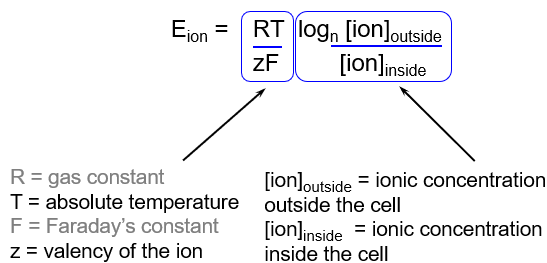
For the Nernst equation, the equilibrium potential is:
~ -85 mV for K+
~ +65 mV for Na+
~ -70 mV for Cl-
Vm
Resting membrane potential
How is the resting membrane potential (Vm) calculated?
Using the Goldman Equation
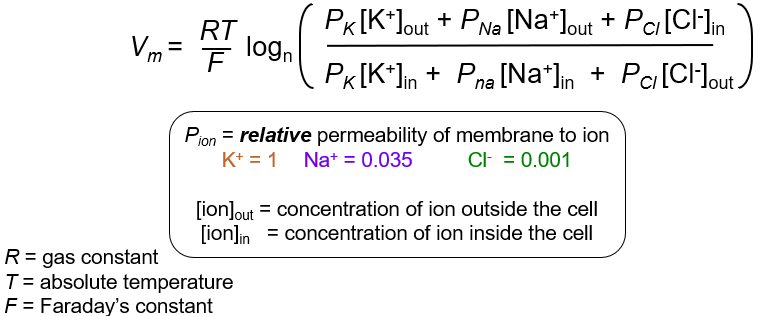
For the Goldman equation, the membrane potential is approximately:
-75 mV
What are neurones?
Specialised excitable cells
Resting potential is due to…
ionic gradients and selective permeability
K+ leak channels and Na+/K+ are essential for what?
Maintaining RMP
 Note
Note  Flashcards (42)