ch18 - aerobic respiration
 Call Kai
 Learn
Learn Practice Test
 Spaced Repetition
 Match
Match Flashcards
 Knowt Play
1/60

There's no tags or description
Looks like no tags are added yet.
Name | Mastery | Learn | Test | Matching | Spaced | Call with Kai |
|---|
No analytics yet
Send a link to your students to track their progress
61 Terms
What is respiration?
The release of energy from the breakdown of complex organic molecules such as glucose, into small inorganic molecules such as CO2
> the energy released is used to synthesize ATP in all living cells
Name the two types of cellular respiration and the key difference between them?
Aerobic respiration = requires oxygen
Anaerobic respiration = does not require oxygen
What are the three reasons why cells need energy?
-synthesis of molecules e.g. proteins
-movement (physical or mechanical) e.g. muscle contraction, movement of vesicles inside a cell along microtubules, cilia/ flagella
-active transport
What is the site of aerobic cellular respiration?
The mitochondria
What are the 7 features of the mitochondria?
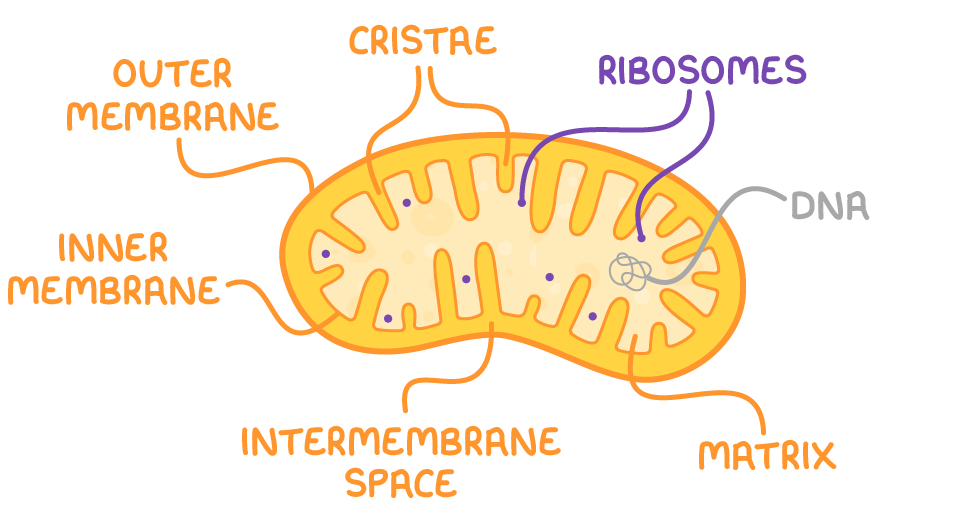
What are adaptations of these 7 features?
Outer mitochondrial membrane = compartmentalisation, separate contents from the rest of the cell - has ideal conditions for enzymes and reactions
Intermembrane space = space between outer and inner membranes - where protons are pumped in by ETC allowing the proton concentration gradient to build up quickly
Inner mitochondrial membrane = contains different proteins (ETC and enzymes like ATP synthase)
Cristae = folds of the inner membrane - which increases its SA so it can hold more proteins
Matrix = contains enzymes needed for link reaction and krebs cycle as well as ribosomes and DNA
Mitochondrial DNA = codes for proteins needed by mitochondria
Mitochondrial ribosomes (70s) = used for protein synthesis e.g. enzymes
What are the two ways in which ATP is regenerated from ADP and Pi during respiration?
Substrate level phosphorylation = the transfer of a phosphate group, from a donor molecule, to ADP to synthesize ATP
Chemiosmosis = uses the energy released from the movement of protons (H+ ions) across the inner mitochondrial membrane to synthesize ATP
What are the four stages of aerobic cellular respiration?
Glycolysis
Link reaction/ Oxidative Decarboxylation
Krebs cycle
Oxidative Phosphorylation
What is oxidation?
OIL (oxidation is loss e-) = oxidation is loss of electrons/ could also be loss of hydrogen
What is reduction?
RIG (reduction is gain e-) = reduction is gain of electrons/ could also be gain of hydrogen
What is dehydrogenation?
The loss/ removal of hydrogen
What is decarboxylation?
The loss/removal of carbon dioxide
What is phosphorylation?
addition of a phosphate group to a molecule
What is the difference between an organic and inorganic phosphate?
organic phosphate is bound to a carbon containing molecule whereas inorganic phosphate is not - free flowing
What is NAD and what is its name when it is reduced?
-It's a coenzyme
-When its reduced it forms NADH

What is FAD and what is its name when it is reduced?
-It's a coenzyme
-When its reduced it forms FADH2

Why are NAD and FAD important?
coenzymes that act as electron carriers - they accept electrons and protons, in the process becoming reduced
Later they become oxidised, donate the electrons to the ETC
What is the difference between NAD and FAD with how many electrons and protons are accepted?
NAD accepts 2electrons 1proton
FAD accepts 2electrons 2protons
What stages are these coenzymes present in?
NAD - all 4
FAD - only krebs cycle
Where does glycolysis occur?
In the cytoplasm of cells
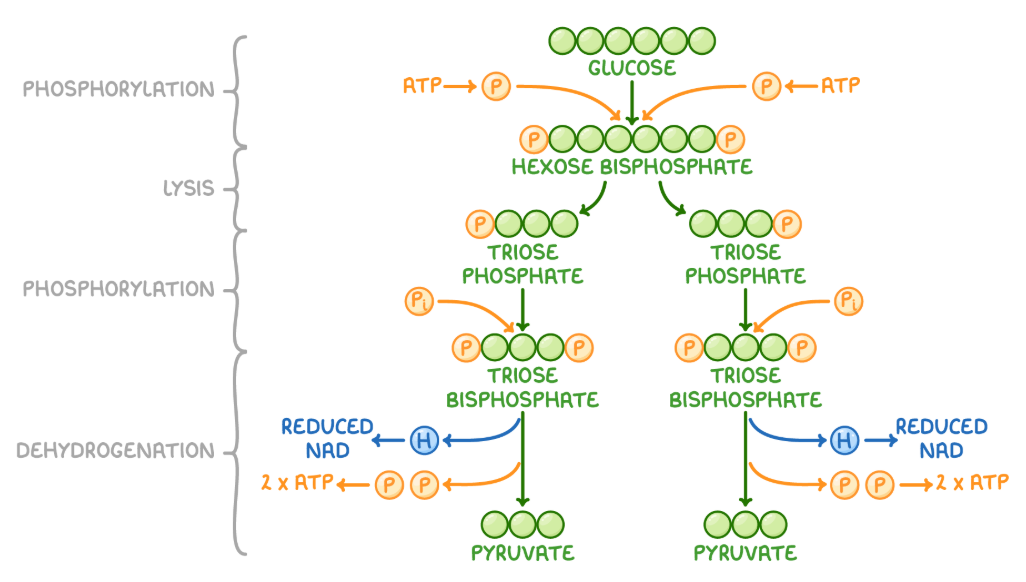
What are the four stages of glycolysis?
1. Phosphorylation = 2x ATP molecules donate a phosphate group, through ATP hydrolysis, to glucose forming hexose bisphosphate (which has 6carbons and two phosphates)
2. Lysis = Hexose bisphosphate splits in two to form 2x TP molecules (triose phosphate)
3. Phosphorylation = A free inorganic phosphate group is added to each TP molecule forming triose bisphosphate
4. Oxidation/ Dehydrogenation & synthesis of ATP = From each TB molecule: a hydrogen is removed which forms 2x reduced NAD & both phosphate groups are removed forming 4x ATP through substrate-level phosphorylation to produce end product pyruvate
What are the reactants required for glycolysis?
1x glucose molecule (6C)
2x ATP molecules
2x NAD
What is the net yield of products of glycolysis?
2x ATP molecules (because 2 are used at the start and 4 are produced at the end 4-2 = 2ATP)
2x reduced NAD molecules
2x pyruvate molecules
Why are pyruvate and reduced NAD important products?
They are used in later stages of cellular respiration to generate greater yield of energy
Is glycolysis an aerobic or anaerobic process?
Anaerobic because it does not require oxygen
Where does the link reaction occur?
In the mitochondrial matrix
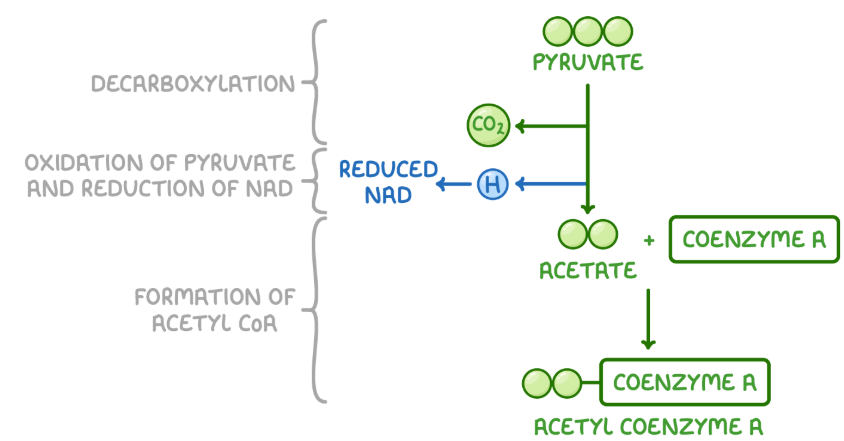
What are the 5 stages of the link reaction?
1. Active transport of pyruvate = pyruvate from glycolysis enters mitochondrial matrix by active transport using specific carrier proteins
2. Decarboxylation = each pyruvate molecule is decarboxylated, losing 1X CO2 molecule which diffuses out mitochondria as a waste product
3. Oxidation = 1x hydrogen atoms are removed from pyruvate to form 2C acetyl group
4. Reduction of NAD = the hydrogen atom are used to reduce NAD forming reduced NAD
5. Formation of acetyl CoA = acetate binds to coenzyme A to form acetyl coenzyme A (acetyl CoA)
For each glucose that enters respiration how many times does link reaction occur?
Twice
What are the reactants required for 2 link reactions?
2x pyruvate
2x NAD
2x coenzyme A
What is the net yield of products of 2 link reactions?
2x CO2
2x reduced NAD
2x acetyl CoA
What is the function of acetyl coenzyme A?
To deliver the acetyl group to another part of matrix for the next stage, Krebs cycle
Why is link reaction also called oxidative decarboxylation?
Because both oxidation and decarboxylation reactions occur
Where does the Krebs cycle occur?
In the mitochondrial matrix
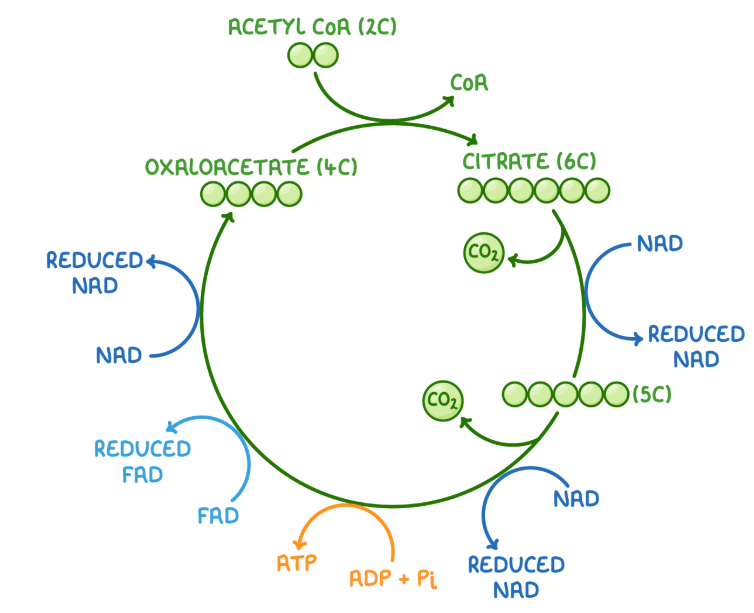
What are the 6 stages of the Krebs cycle?
1. Formation of citrate = Acetyl CoA (which contains 2C acetate) reacts with 4C molecule oxaloacetate OAA, to form 6C citrate
2. Decarboxylation and Dehydrogenation = Citrate is decarboxylated, releasing 1x CO2 & dehydrogenated, releasing a hydrogen which produces 1x reduced NAD to form a 5C molecule
3. Decarboxylation and Dehydrogenation = Another decarboxylation reaction take place releasing 1x CO2 & another dehydrogenation reaction occurs to produce 1x reduced NAD
4. Synthesis of ATP = 1x ATP molecule is produced by substrate level phosphorylation
5. Dehydrogenation = Dehydrogenation occurs twice producing 1x reduced FAD and 1x reduced NAD
6. Regeneration of 4C OAA = allows krebs cycle to continue
For each glucose that enters respiration how many times does the Krebs cycle occur?
Twice
What is the net yield of products of 2 Krebs cycles?
2x CoA
6x reduced NAD
2x reduced FAD
2x ATP
4x CO2
Where does the CO2 go?
diffuses out of mitochondria and is removed as a waste product
When citrate is formed the coenzyme A is released, where does it go?
Back to the link reaction to be reused
Are Links and Krebs aerobic or anaerobic process?
Aerobic - although they doesn’t use oxygen, oxygen is required indirectly for these reactions to operate
Why are links and krebs aerobic
-they both depend on NAD and FAD being available
-in the ETC oxygen is the final electron acceptor which allows NADH and FADH2 to be oxidised back to NAD and FAD
» if there is no oxygen the ETC stops meaning NADH and FADH2 are no longer oxidised back so NAD and FAD are not produced - none available to enter links or krebs
What is the ETC?
A series of 4 protein complexes that carry molecules and release energy
Where does oxidative phosphorylation occur?
At the inner mitochondrial membrane, where the cristae is
Why is oxidative phosphorylation important?
It produces the majority of ATP during aerobic respiration
How many ATP molecules does each coenzyme synthesize?
NAD - 3ATP
FAD - 2ATP
So far across all 3 stages how many of each coenzyme has been produced?
10X NADH
2X FADH2
When NADH and FADH2 are oxidised what happens to the electrons?
The high energy electrons are released - they are already high energy, the coeznymes just transported them to the ETC
What happens to the reduced coenzymes after they donate their electrons?
After donating their electrons they become oxidised allowing them to be reused in earlier stages
What is a redox reaction?
When something is reduced and something else is oxidised at the same time
How many protein complexes are there in the ETC?
4
What are the 4 stages of the ETC?
1. Coenzymes are becomes oxidised, releasing their protons and electrons into the matrix
2. The 2 high energy electrons pass into ETC
3. Redox reactions = As the electrons are transferred along the ETC, the previous complex is oxidised, next one is reduced - electrons loose energy as they travel across ETC
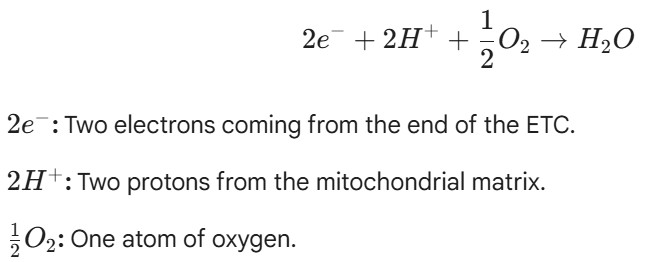
4. Once the electrons have passed along all 4 complexes and released all their energy they will bind with ½ oxygen
What is the final electron acceptor and what's its function?
½ Oxygen will bind to the 2 electrons and combine with 2 protons to produce H2O water
(O2 oxygen is naturally diatomic so to get only 1x oxygen you need half = ½ O2)
As electrons move down ETC they lose energy, what is this energy used for?
Used by the ETC to actively pump protons from matrix to intermembrane space creating a proton gradient
What is the only stage that actually uses oxygen throughout aerobic respiration?
Oxidative phosphorylation
What is the difference between the coenzymes in where the electrons enter the ETC?
Electrons from FADH2 enter at the middle rather than the start
Why do protons build up in the intermediate space?
Because the inner mitochondrial membrane is impermeable to them
Once a steep concentration gradient of protons is established what process does this lead to
Chemiosmosis
What does diffusion down the electrochemical gradient mean?
movement of ions and other substances from an area of high to low concentration
Describe chemiosmosis
1. Protons diffuse across down their electrochemical gradient from the intermembrane space back into the matrix through the ion channel center in ATP synthase
2. This movement of protons releases energy
3. This energy released is used by enzyme ATP synthase to regenerate ADP and Pi into ATP
In theory how much ATP is made in oxidative phosphorylation per glucose molecule?
34
In theory how much total ATP is made during the whole aerobic cellular respiration process per glucose molecule?
38
Why may this theoretical yield of ATP not occur?
- not all reduced coenzymes will reach ETC
- protons may leak hence not all will diffuse across ATP synthase

