Epidemiology: Natural History of Disease and Prevention Levels
 Call Kai
 Learn
Learn Practice Test
 Spaced Repetition
 Match
Match Flashcards
 Knowt Play
1/30

There's no tags or description
Looks like no tags are added yet.
Name | Mastery | Learn | Test | Matching | Spaced | Call with Kai |
|---|
No analytics yet
Send a link to your students to track their progress
31 Terms
What is the natural history of disease?
The course of a disease in an individual, from onset to resolution in the absence of intervention, providing a framework for prevention.
What are the stages in the natural history of disease?
Susceptibility, Subclinical, Clinical, Recovery, Disability, or Death.
Susceptibility
Disease in the population not yet the individual
Risk factors present
Subclinical
Exposure of individual to risk factor or disease and early
pathological change
Includes Incubation period and latent period
Clinical
Signs and Symptoms noted in individuals
Disability or Death
Outcomes of clinical disease: death, disability or recovery
What does the iceberg phenomenon illustrate in epidemiology?
The distinction between clinical disease and subclinical disease, highlighting that many cases may not be visible or diagnosed.

What is primary prevention?
Interventions aimed at preventing the occurrence of disease, injury, or disability in individuals who are susceptible but have no discernible pathology.
What is secondary prevention?
Early detection of disease during the preclinical period, primarily through health screenings to increase the probability of early diagnosis and treatment.
What is tertiary prevention?
Interventions aimed at minimizing disability and facilitating rehabilitation from disease or injury, often occurring in specialized care settings.
What is the continuum of natural history of disease?
A framework that includes exposure, susceptibility, development of signs and symptoms, and outcomes such as recovery, disability, or death.
It goes from prepathogenesis to pathogenesis
What is the role of screening in secondary prevention?
Testing individuals at risk for conditions to determine the likelihood of developing the disease, not a diagnostic test.
What are the key components of successful screening programs?
Valid, reliable, capable of large group administration, fast, inexpensive, innocuous, and high yield.
What is reliability in the context of screening tests?
The precision of a measuring instrument, which depends on its consistency and repeatability.
Major sources of error for reliability
Variation in trait being measured( e.g blood pressure changes with time of day, activity level, level of stress an other factors)
Observer variation
Inconsistency in instrument
What is validity in screening tests?
The accuracy of a test or measurement, assessed in terms of sensitivity and specificity.
What is sensitivity in screening tests?
A measure of a test's ability to correctly identify those with the disease (true positives).
What is specificity in screening tests?
A measure of a test's ability to correctly identify those without the disease (true negatives).
What is positive predictive value?
The proportion of persons with a positive test result who actually have the disease.
What is negative predictive value?
The proportion of persons with a negative test result who are actually disease-free.
How to enhance specificity testing
Series testing
Parallel testing
What is series testing?
Two or more testing procedures done in sequence to increase specificity and reduce false positives.
What is parallel testing?
Two or more tests done simultaneously to increase sensitivity and reduce false negatives.
What is the significance of the Canadian Task Force on Preventative Health Care?
It publishes clinical practice guidelines for screening and preventative health care in Canada.
What is the role of community health nurses (CHNs) in screening?
CHNs need to stay current on screening guidelines, which are regularly reviewed based on epidemiological research.
What is the importance of early detection in secondary prevention?
It increases the likelihood of early diagnosis, which can lead to successful treatment and potential cure.
What does the term 'false positive' refer to in screening tests?
A test result that incorrectly indicates a person has the disease when they are disease-free.
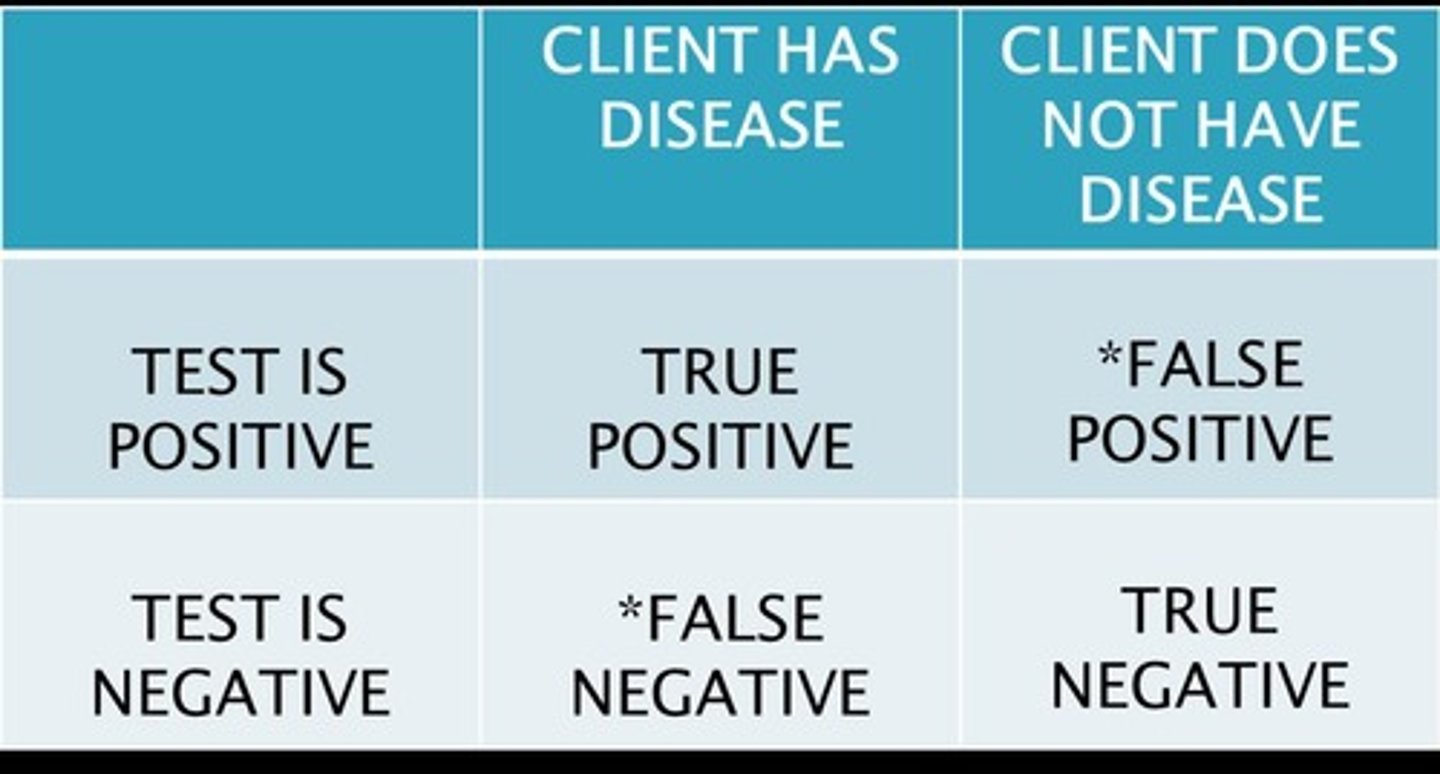
What does the term 'false negative' refer to in screening tests?
A test result that incorrectly indicates a person does not have the disease when they actually do.
What are some examples of tertiary prevention interventions?
Physiotherapy, occupational therapy, and rehabilitation services.
What is the significance of the incubation period in the natural history of disease?
It represents the time between exposure to a disease agent and the onset of symptoms.
What is the latent period in the context of disease?
The period during which the disease is present in the population but not yet manifested in the individual.

