Crustaceans & Myriapods
 Studied by 0 people
 Call Kai
 Learn
Learn Practice Test
 Spaced Repetition
 Match
Match Flashcards
 Knowt Play
1/24

There's no tags or description
Looks like no tags are added yet.
Name | Mastery | Learn | Test | Matching | Spaced |
|---|
No study sessions yet.
25 Terms
What are the 6 aspects of tardigrades that are similar to arthropods?
Segmented body (but all segments “head homologs”)
Cuticle with chitin → must molt (ecdysis)
Hemocoel
Appendages (4 pairs of lobopod legs)
Eutely (fixed cell number) similar to nematodes
Stylet mouthparts (feeding specialization)
What are the 4 ways that tardigrades are NOT like arthropods?
Legs are NOT jointed (lobopod legs)
No tracheae, no respiratory organs
All segments share same identity (no tagmata, no differentiated head/thorax/abdomen)
Very reduced body plan, microscopic
What are 5 ways that peripatus are like arthropods?
Segmented
Tracheae for respiration (air tubes)
Non-jointed legs ending in claws
Antennae on head
Shows transitional form toward arthropod segmentation
What are the 4 ways that peripatus are NOT like arthropods?
Legs lack true joints
Cuticle is soft, not hardened or articulated
No compound eyes
No tagmata
What are the S.P. Chelicerata
A subphylum of arthropods (that includes spiders, scorpions, and horseshoe crabs) characterized by the presence of chelicerae, which are mouthparts used to grasp and tear food, and typically lack antennae.
What are Eurypterids?
Sea scorpions. Ancient marine arthropods that thrived in the Paleozoic era, known for their large size and predatory behavior.
How do eurypterids influence our understanding of the origins or arachnids?
Their morphology closely resembles that of desert scorpions, suggesting that arachnids may have originated from marine habitats.
What are harvestmen? Are they more like spiders or scorpions?
Daddy long legs.
They are more like scorpions than spiders
What are the 6 main synapomorphies of C. Arachnida?
Chelicerae
Pedipalps
No antennae
Prosoma + opisthosoma
Book lungs (internal)
4 pairs of walking legs
What are C. Trilobita? What are their 3 characterizing features?
An extinct group of marine arthropods that flourished during the Paleozoic era.
Characterized by:
Three-lobed body plan
Compound eyes
Segmented exoskeleton
What are S.P. Mandibulata? What characterizes them?
A superphylum of arthropods that includes myriapods, crustaceans, and hexapods.
Characterized by having mandibles and distinct body segments.
What are the 4 main Mandibulata synapomorphies?
Mandibles
Antennae
Cephalothorax + abdomen
Segmented body with distinct appendages
Define Uniramous vs Biramous
Uniramous - Appendages that consist of a single chain of segments
Biramous - Appendages that are branched into two distinct parts, typically comprising a main axis (endopod) and one or more lateral branches (exopod).
What are S.C. Malacostraca?
A class within the subphylum Crustacea, characterized by a body divided into a head, thorax, and abdomen, and typically having a carapace and numerous jointed appendages.
Crabs, shrimp, lobsters
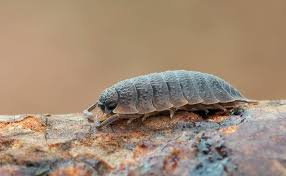
What is this animal? What are their defining characteristics?
Isopoda (pill bugs)
Dorso-ventrally flattened; same legs
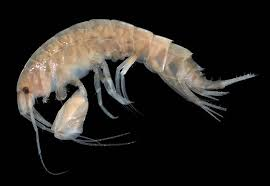
What is this animal? What are their defining characteristics?
Amphipoda (scuds)
Laterally flattened; different legs
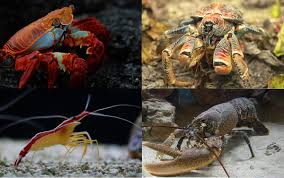
What are these animals?
Decapoda (crabs, lobster, shrimp)
A group of crustaceans with ten limbs
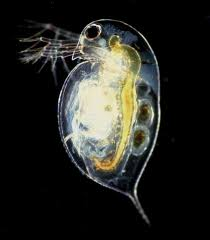
What is this animal?
Cladocera (water fleas; daphnia)
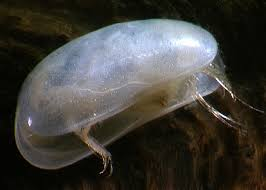
What is this animal?
Ostracoda (seed shrimp)
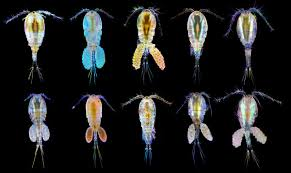
What are these animals?
Copepoda (cyclops)
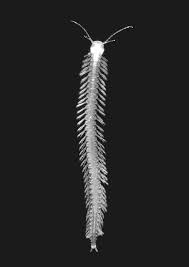
What is this animal?
Remipedia (cave crittur)
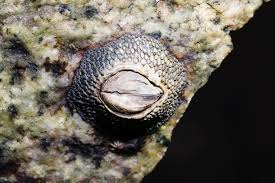
What is this animal?
Cirripedia (barnacles)
If crustaceans are biramous, how do you explain the crab’s walking legs?
Even though the ancestral crustacean appendage is biramous, in many lineages (e.g., decapods), the exopod is LOST or highly reduced, leaving a functionally uniramous walking leg.
What are C. Chilopoda? What are their defining characteristics?
Commonly known as centipedes. A class of myriapods.
Characterized by:
One pair of legs per segment
Venom delivered through forcipules (modified legs)
What are C. Diplopoda? What are their defining characteristics?
Commonly known as millipedes. A class of myriapods
Characterized by:
Two pairs of legs per fused segment
Derived from segmental fusion
 Note
Note  Flashcards (30)