soft tissue tumors

0.0(0)
studied byStudied by 0 people
0.0(0)
full-widthCall Kai
learnLearn
examPractice Test
spaced repetitionSpaced Repetition
heart puzzleMatch
flashcardsFlashcards
GameKnowt Play
Card Sorting

1/25

encourage image

There's no tags or description

Looks like no tags are added yet.

Study Analytics
Name
Mastery
Learn
Test
Matching
Spaced
Call with Kai

No study sessions yet.

26 Terms

1
New cards

diseases of skeletal muscle

neurogenic disease, myasthenic syndromes, & dystrophies

  • may all cause muscular weakness & fatigability

2
New cards

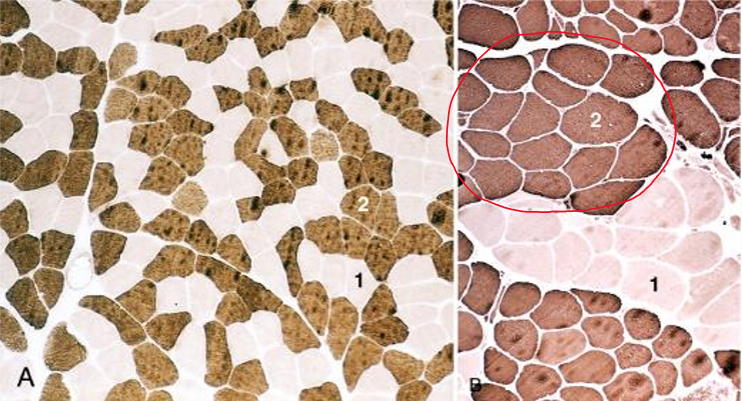
denervation atrophy

a peripheral neuropathy in which there is axial degeneration that leads to secondary muscle atrophy

  • atrophic muscles consists of small angulated fiber

    • muscle fiber is usually reinnervated by collateral sprouting from an adjacent nerve fiber

    • muscle fiber type determined by innervation → regenerated fibers will be the same as adjacent fibers

    • type grouping & group atrophy

  • ATPase stains differentiate type I & II fibers

clinical presentations

  • weakness & fasciculations → lower motor neuron deficit
<p>a <strong><span style="color: red">peripheral neuropathy</span></strong> in which there is <strong><span style="color: red">axial degeneration that leads to secondary muscle atrophy</span></strong></p><ul><li><p><strong><mark data-color="blue">atrophic muscles consists of small angulated fiber</mark></strong></p><ul><li><p><strong><mark data-color="blue">muscle fiber is usually reinnervated by collateral sprouting from an adjacent nerve fiber</mark></strong></p></li><li><p>muscle fiber type determined by innervation → <strong><mark data-color="blue">regenerated fibers will be the same as adjacent fibers</mark></strong></p></li><li><p><strong><mark data-color="blue">type grouping &amp; group atrophy</mark></strong></p></li></ul></li><li><p><strong>ATPase stains</strong> differentiate type I &amp; II fibers</p></li></ul><p>clinical presentations</p><ul><li><p><strong><mark data-color="purple">weakness &amp; fasciculations → lower motor neuron deficit</mark></strong></p></li></ul>
3
New cards

type grouping

repeated denervation & reinnervation by collateral sprouts produces clusters of fibers of a single type

4
New cards

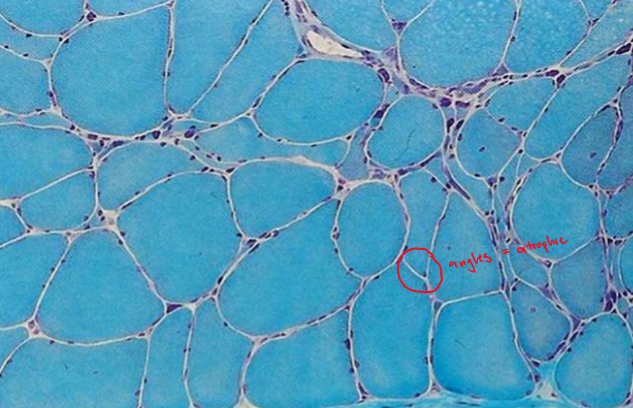
group atrophy

with damage of the innervating axon, the muscle fibers that undergo atrophy will be in groups
<p>with damage of the innervating axon, the muscle fibers that undergo atrophy will be in groups </p>
5
New cards

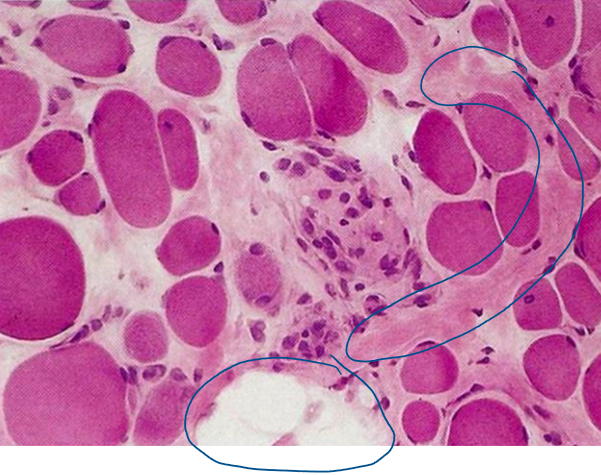
Duchenne muscular dystrophy

most commonly occurring dystrophy with an X-linked defect causing deficiency in dystrophin

morphology

  • ongoing damage in the form of segmental myofiber degeneration & regeneration associated with an admixture of atrophic myofibers

  • muscle tissue is replaced by collagen & fat cells (“fatty replacement” or “fatty infiltration“) leading to pseudohypertrophy of the calves

clinical presentations

  • first indications of muscle weakness are clumsiness & inability to keep with with peers around age 5

  • weakness begins in the pelvic girdle muscles & then extends to the shoulder girdle (proximal muscles)

  • mean age of wheelchair dependence is around 9.5 years

  • mean age of death is 25 - 30 years of age (from respiratory insufficiency, pulmonary infection, or heart failure)
<p>most commonly occurring dystrophy with an <strong><span style="color: red">X-linked defect </span>causing <span style="color: red">deficiency</span> in <span style="color: red">dystrophin</span></strong></p><p>morphology</p><ul><li><p>ongoing damage in the form of <strong><mark data-color="blue">segmental myofiber degeneration &amp; regeneration associated with an admixture of atrophic myofibers</mark></strong></p></li><li><p>muscle tissue is <strong><mark data-color="blue">replaced by collagen &amp; fat cells (“fatty replacement” or “fatty infiltration“) leading to pseudohypertrophy of the calves</mark></strong></p></li></ul><p>clinical presentations</p><ul><li><p>first indications of <strong><mark data-color="green">muscle weakness are clumsiness &amp; inability to keep with with peers around age 5</mark></strong></p></li><li><p>weakness <strong><mark data-color="green">begins in the pelvic girdle muscles &amp; then extends to the shoulder girdle (proximal muscles)</mark></strong></p></li><li><p>mean age of <strong><mark data-color="green">wheelchair dependence is around 9.5 years</mark></strong></p></li><li><p><strong><mark data-color="green">mean age of death is 25 - 30 years of age (from respiratory insufficiency, pulmonary infection, or heart failure)</mark></strong></p></li></ul>
6
New cards

Becker muscular dystrophy

X-linked defect causing insufficiency in dystrophin

  • milder type of Duchenne dystrophy

  • later onset of disease

7
New cards

inflammatory myopathies

non-infectious, immunologically mediated injury & inflammation of skeletal muscles

examples

  • dermatomyositis

  • polymyositis

  • inclusion body myositis

  • acanthosis nigricans

  • Bower’s disease

8
New cards

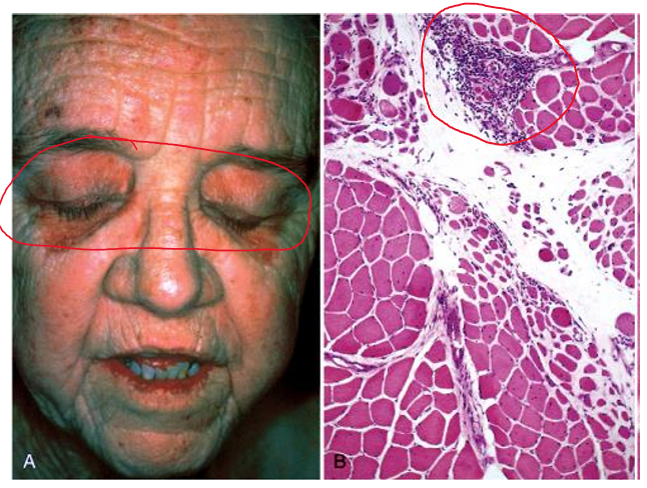
dermatomyositis

inflammatory myopathy associated with damage to small blood vessels

clinical presentations

  • heliotrope skin rash & proximal muscle disease

  • infiltrates of mononuclear inflammatory cells in the perimysial connective tissue & around blood vessels

  • risk of developing visceral cancers

<p>inflammatory myopathy associated with <strong><span style="color: red">damage to small blood vessels </span></strong></p><p>clinical presentations</p><ul><li><p><strong><mark data-color="blue">heliotrope skin rash &amp; proximal muscle disease</mark></strong></p></li><li><p><strong><mark data-color="blue">infiltrates of mononuclear inflammatory cells in the </mark><span><mark data-color="blue">perimysial</mark></span><mark data-color="blue"> connective tissue &amp; around blood vessels</mark></strong></p></li><li><p><strong><mark data-color="green">risk of developing visceral cancers</mark> </strong></p></li></ul>
9
New cards

polymyositis

inflammatory myopathy associated with proximal muscle weakness

  • CD8+ cytotoxic T cells are prominent part of the inflammatory infiltrate in affected muscle

10
New cards

inclusion body myositis

inflammatory myopathy associated with distal muscle weakness in the elderly

  • patchy often endomysial mononuclear inflammatory cell infiltrates rich in CD8+ T cells

  • abnormal cytoplasmic inclusions described as “rimmed vacuoles“

11
New cards

myasthenia gravis

an autoimmune disease with antibody production to the acetylcholine receptor (AchR) of the neuromuscular junction

  • type II hypersensitivity

  • antibodies to the AchR present in the serum of 85 - 90% of patients

clinical presentations

  • female-to-male ratio 2:1 in the young adults but male predominance in older adults

  • fluctuating weakness that worsens with exertion & often over the course of the day

  • ocular muscle weakness common

  • later involves muscles producing dysphagia & dysarthria

  • trunk & limb muscles affected in late stages

  • 10% of the patients have a thymoma & 30% have thymic hyperplasia

treatments

  • < 5% mortality rate now

  • thymectomy usually beneficial in patients with thymoma

  • response to anticholinesterase drugs seen in some patients

  • plasmapheresis & immunosuppressive drugs

12
New cards

soft tissue tumors

tumors of non-epithelial tissue excluding the skeleton, joints, CNS, hematopoietic & lymphoid tissues

  • benign — outnumber malignant sarcoma by 100x

  • arise in the extremities, especially the thigh

  • vimentin positive

superficial tumors are usually benign

deep (& retroperitoneal) tumors are usually malignant

majority of sarcomas are sporadic & have no known predisposing cause

  • origins unknown

13
New cards

lipoma

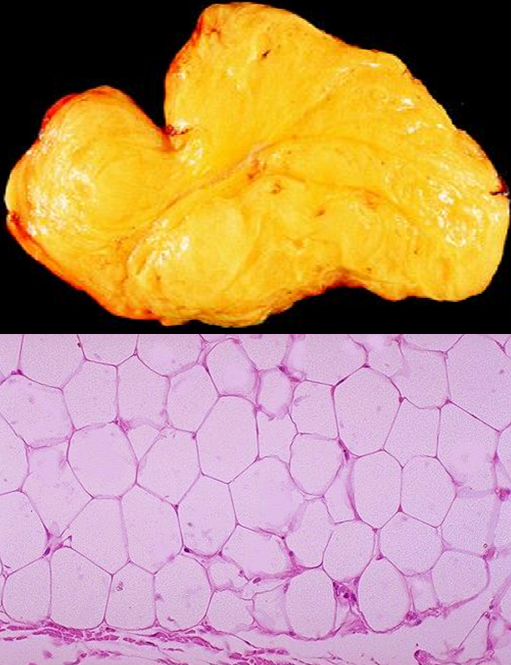
most frequent soft tissue tumor, usually arising in the subcutis of the proximal extremities & trunk

clinical presentation

  • during middle adulthood

  • superficial lesion which is well-circumscribed & partially encapsulated

  • soft & doughy to touch; rubbery & moves easily when touched

  • histologically looks likes normal adipose tissue
<p>most frequent soft tissue tumor, usually <strong><span style="color: red">arising in the subcutis of the proximal extremities &amp; trunk</span></strong> </p><p>clinical presentation</p><ul><li><p>during <strong><mark data-color="green">middle adulthood</mark></strong></p></li><li><p><strong><mark data-color="blue">superficial lesion which is well-circumscribed &amp; partially encapsulated</mark></strong></p></li><li><p>soft &amp; doughy to touch; rubbery &amp; moves easily when touched</p></li><li><p>histologically looks likes normal adipose tissue  </p></li></ul>
14
New cards

liposarcoma

one of the most common adult sarcomas that are derived from primitive mesenchymal cells & arise deep in the proximal extremities or retroperitoneum of people in their 50s & 60s

  • well-differentiated & pleomorphic types
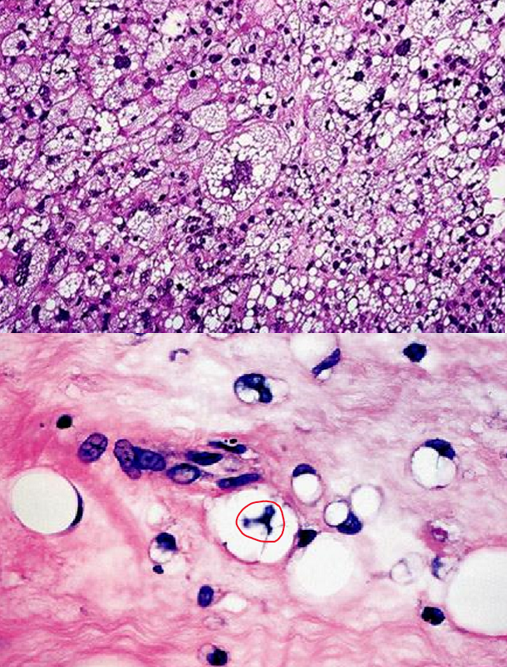
<p>one of the <strong><mark data-color="green">most common adult sarcomas</mark></strong> that are <strong><mark data-color="blue">derived from primitive mesenchymal cells</mark></strong> &amp; <strong><span style="color: red">arise deep in the proximal extremities or retroperitoneum</span></strong> of <strong><mark data-color="green">people in their 50s &amp; 60s</mark></strong> </p><ul><li><p>well-differentiated &amp; pleomorphic types</p></li></ul>
15
New cards

well-differentiated liposarcoma

liposarcoma that has adipocytes & atypical spindle cells & indolent course

16
New cards

pleomorphic liposarcoma

consists of sheets of anaplastic cells, bizarre nuclei & variable amounts of immature adipocytes (lipoblasts)

17
New cards

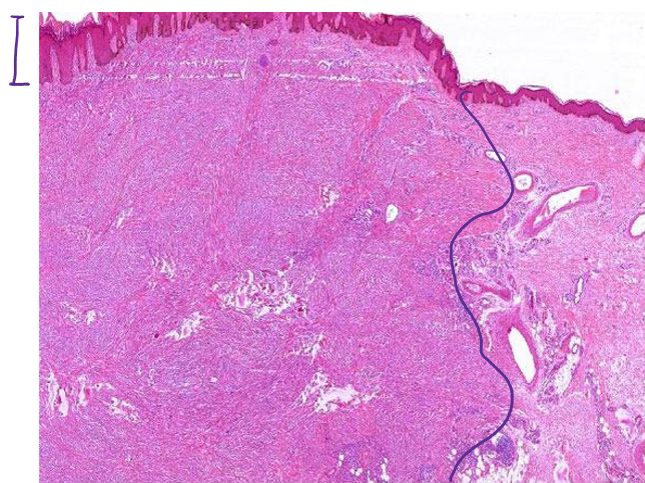
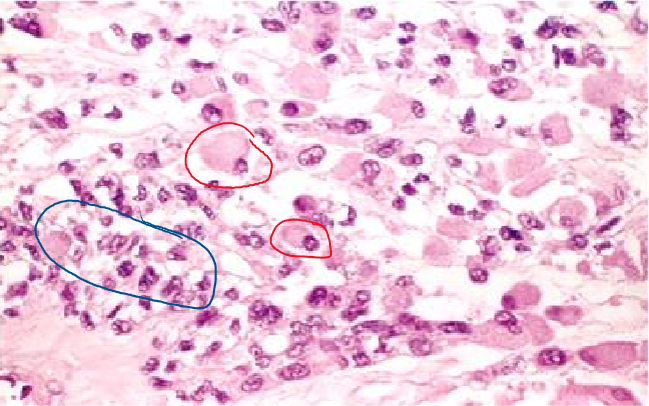
nodular (pseudosarcomatous) fasciitis

subcutaneous growth involving the extremities & has rapid growth

  • richly cellular & contains plump, immature-appearing fibroblasts & myofibroblasts arranged randomly or in short fascicles reminiscent of tissue culture fibroblasts

  • often mistaken for sarcoma

  • spontaneously regresses & rarely recurs if excised

18
New cards

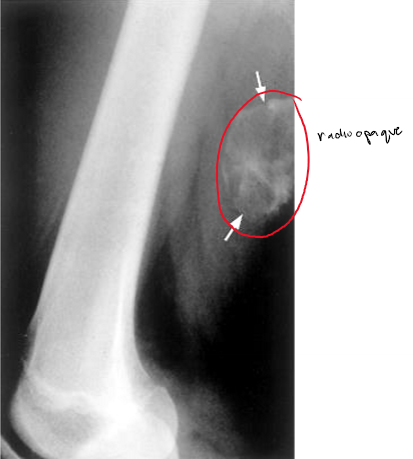
myositis ossificans

ossification of injured muscles usually caused by trauma

  • may be mistaken for malignancy

  • feels hard/firm

<p><strong><mark data-color="blue">ossification of injured muscles</mark></strong> usually caused by trauma</p><ul><li><p>may be mistaken for malignancy</p></li><li><p>feels hard/firm </p></li></ul>
19
New cards

fibromatoses

benign superficial proliferations of fibrous tissue

  • make be palmar, plantar, or penile

    • palmer = Dupuytren's contracture (digit 4 & 5)

    • penile = Peyronie’s disease (may constrict urethra & cause painful erections)
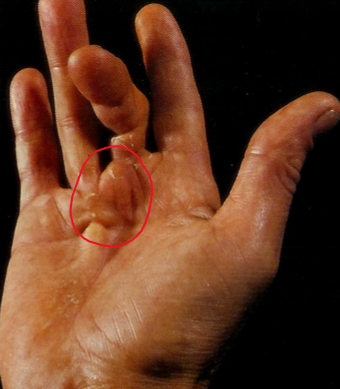
<p><strong>benign superficial proliferations of fibrous tissue </strong></p><ul><li><p>make be <strong><mark data-color="blue">palmar, plantar, or penile</mark></strong></p><ul><li><p><strong><span style="color: red">palmer = Dupuytren's contracture (digit 4 &amp; 5)</span></strong></p></li><li><p><strong><span style="color: purple">penile = Peyronie’s disease (may constrict urethra &amp; cause painful erections)</span></strong></p></li></ul></li></ul>
20
New cards

desmoid tumor

aggressive fibromatoses commonly found in the abdominal wall of women

  • associated with pregnancy & has estrogen receptors

  • mutations in APC or β-catenin genes

  • intraabdominal lesions seen with Gardner syndrome
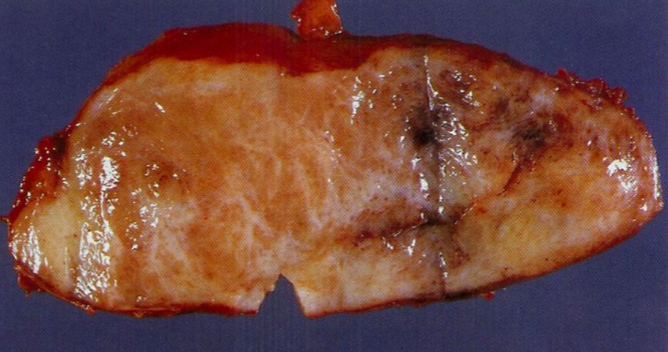
<p><strong><span style="color: red">aggressive</span></strong> fibromatoses commonly found in the <strong><span style="color: red">abdominal wall of women</span></strong></p><ul><li><p><strong>associated with pregnancy &amp; has estrogen receptors</strong></p></li><li><p><strong><mark data-color="blue">mutations in </mark><span style="color: purple"><mark data-color="blue">APC or β-catenin genes</mark></span></strong></p></li><li><p><strong><mark data-color="blue">intraabdominal lesions seen with </mark><span style="color: purple"><mark data-color="blue">Gardner syndrome</mark></span></strong></p></li></ul>
21
New cards

fibrosarcoma

rare soft tissue tumor that occurs mostly in the retroperitoneum, thigh, knee, & distal extremities

  • encapsulated, infiltrative, soft, fish flesh masses with areas of hemorrhage & necrosis

  • highly cellular neoplasm of spindle cells growing in a herringbone (or basket-weave) fashion which nuclear pleomorphism & frequent mitosis
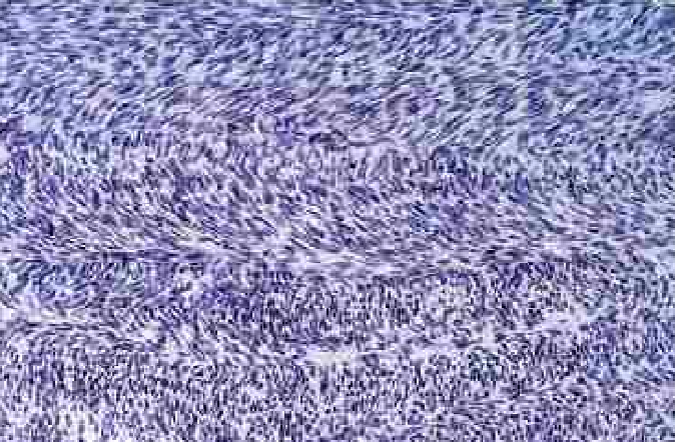
<p>rare soft tissue tumor that <strong><span style="color: red">occurs mostly in the retroperitoneum, thigh, knee, &amp; distal extremities</span></strong></p><ul><li><p><strong><mark data-color="blue">encapsulated, infiltrative, soft, fish flesh masses with areas of hemorrhage &amp; necrosis</mark></strong></p></li><li><p><strong><mark data-color="blue">highly cellular neoplasm of spindle cells growing in a </mark><span style="color: purple"><mark data-color="blue">herringbone (or basket-weave)</mark></span><mark data-color="blue"> fashion </mark></strong>which nuclear pleomorphism &amp; frequent mitosis </p></li></ul>
22
New cards

benign fibrous histiocytoma

a tumor consisting of fibroblasts and histiocyte-like cells, typically found in the skin of the lower extremities (95%)

  • also known as dermatofibroma

<p>a tumor consisting of <strong><span style="color: red">fibroblasts and histiocyte-like cells</span></strong>, typically found in the <strong><span style="color: red">skin of the lower extremities (95%)</span></strong></p><ul><li><p>also known as <strong><mark data-color="blue">dermatofibroma</mark></strong></p></li></ul>
23
New cards

malignant fibrous histiocytoma

undifferentiated pleomorphic sarcoma (UPS); most common adult sarcoma that may invade bone & is osteolytic

  • storiform-pleomorphic type is the most common - sheets of large anaplastic spindled to polygonal cells with hyperchromatic irregular, sometimes bizarre nuclei

  • treated with surgery & adjuvant chemotherapy, and/or radiation

  • most are aneuploid & prognosis is generally poor
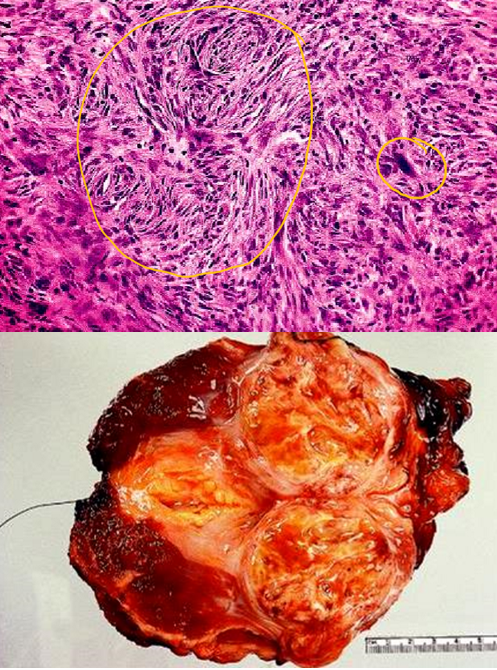
<p><strong>undifferentiated pleomorphic sarcoma (UPS)</strong>; most common <strong><span style="color: red">adult sarcoma</span></strong> that may <strong><span style="color: red">invade bone &amp; is osteolytic</span></strong></p><ul><li><p><strong><mark data-color="blue">storiform-pleomorphic type</mark></strong> is the most common - <strong><mark data-color="blue">sheets of large anaplastic spindled to polygonal cells with hyperchromatic irregular, sometimes bizarre nuclei</mark></strong></p></li><li><p>treated with <strong><mark data-color="purple">surgery &amp; adjuvant chemotherapy, and/or radiation</mark></strong></p></li><li><p>most are <strong><mark data-color="blue">aneuploid &amp; prognosis is generally poor </mark></strong></p></li></ul>
24
New cards

rhabdomyosarcoma

most common soft tissue sarcoma in children & adolescents (alveolar & embryonal) that often arise in the sinuses, head, neck, & genitourinary tract

  • only 20 - 25% arise in skeletal muscles

  • desmin & myoglobin usually present in all types

    • actin ,myosin, & glycogen also seen

  • overall average survival ~ 3 - 5 years

    • ~ 20% already have metastases @ diagnosis

    • pleomorphic type = worse prognosis

<p>most common soft tissue sarcoma in <strong><mark data-color="green">children &amp; adolescents (alveolar &amp; embryonal)</mark></strong> that often arise in the <strong><span style="color: red">sinuses, head, neck, &amp; genitourinary tract</span></strong></p><ul><li><p><strong>only 20 - 25% arise in skeletal muscles</strong></p></li><li><p><strong><mark data-color="blue">desmin &amp; myoglobin usually present in all types</mark></strong></p><ul><li><p><strong><mark data-color="blue">actin ,myosin, &amp; glycogen also seen</mark></strong></p></li></ul></li><li><p>overall <strong><mark data-color="green">average survival ~ 3 - 5 years</mark></strong></p><ul><li><p><strong>~ 20% already have metastases @ diagnosis</strong></p></li><li><p><strong><mark data-color="red">pleomorphic type = worse prognosis</mark></strong><mark data-color="red"> </mark></p></li></ul></li></ul>
25
New cards

embryonal rhabdomyosarcoma

rhabdomyosarcoma that include cambium layer with primitive around cells, oval cells, strap cells, & racquet-shaped cells

  • sarcoma botryoides - variant which presents as grape-like mass
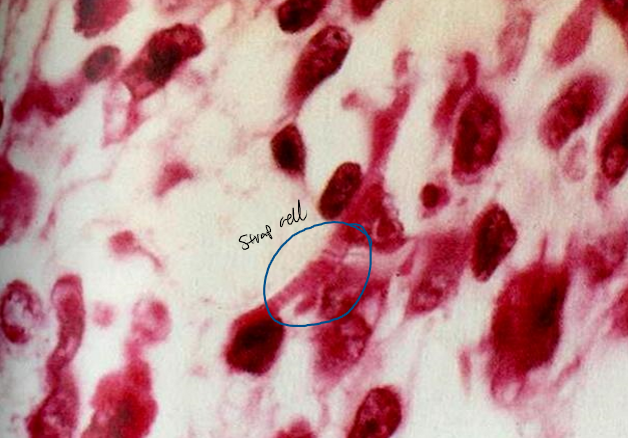
<p>rhabdomyosarcoma that include <strong><mark data-color="blue">cambium layer with primitive around cells, oval cells, strap cells, &amp; racquet-shaped cells </mark></strong></p><ul><li><p><strong><mark data-color="red">sarcoma botryoides - variant which presents as grape-like mass</mark></strong></p></li></ul>
26
New cards

synovial sarcoma

rare soft tissue tumor that occurs near joints but not usually in joints

  • associated with gene fusions SS18-SSX1, -SSX2, or -SSX4 (chimeric transcription factors)

  • probably arises from multipotential mesenchyme

clinical presentations

  • can present in locations that lack synovium (chest wall, head, neck)

  • most occur in people in their 20s - 40s

  • microscopically has a biphasic pattern of spindle cells & glands
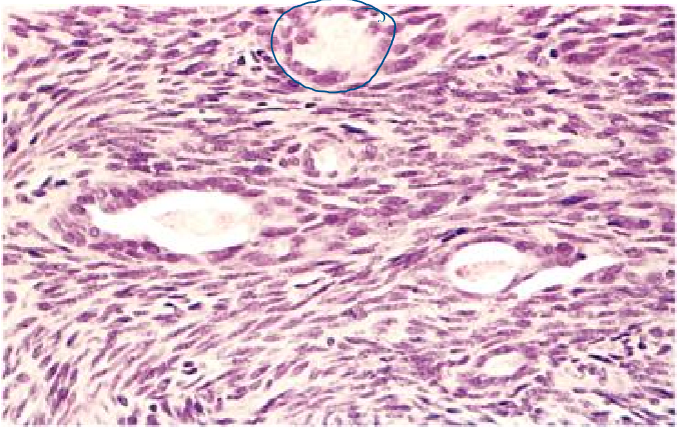
<p>rare soft tissue tumor that occurs <strong><span style="color: red">near joints but not usually in joints</span></strong></p><ul><li><p><strong><mark data-color="blue">associated with gene fusions </mark><span style="color: purple"><mark data-color="blue">SS18-SSX1, -SSX2, or -SSX4</mark></span><mark data-color="blue"> (chimeric transcription factors)</mark></strong></p></li><li><p><strong><mark data-color="blue">probably arises from multipotential mesenchyme</mark></strong></p></li></ul><p>clinical presentations</p><ul><li><p>can present in <strong><mark data-color="blue">locations that lack synovium (chest wall, head, neck)</mark></strong></p></li><li><p><strong><mark data-color="green">most occur in people in their 20s - 40s</mark></strong></p></li><li><p>microscopically has a<strong><mark data-color="blue"> biphasic pattern of spindle cells &amp; glands</mark></strong></p></li></ul>