Probability Distributions Definitions
 Studied by 0 people
 Call Kai
 Learn
Learn Practice Test
 Spaced Repetition
 Match
Match Flashcards
 Knowt Play
1/17

There's no tags or description
Looks like no tags are added yet.
Name | Mastery | Learn | Test | Matching | Spaced | Call with Kai |
|---|
No analytics yet
Send a link to your students to track their progress
18 Terms
Continuous random variable
• Has a support that is an interval in the real line.
• E.g., uniform, normal, exponential, Weibull, etc.
• Probability density function 𝑓ሺ𝑥ሻ measures the instantaneous change in the likelihood of 𝑋 having the value of 𝑥
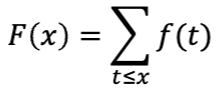
• CDF:

Discrete random variable
• The support is countable (may or may not be finite).
• E.g., Discrete uniform, Poisson, binomial, geometric, etc.
• Probability mass function 𝑓ሺ𝑥ሻ assigns probability to discrete support point 𝑥
• CDF:
Binomial
the number of successes in 𝑛 trials where each trial is independent from each other with common success probability 𝑝.
Negative binomial
the number of trials required to achieve 𝑟 successes
Geometric is a special case (r=1)
Poisson
the number of independent events that occur in a fixed amount of time and space
Normal
good at approximating the distribution of the sum of a number of random variables
Central Limit Theorem => N(0,1)
Lognormal
good approximation for the product of a number of random variables
Exponential
models time between two independent events; it is the only continuous distribution with the memoryless property.
• If the time between two consecutive events follows exponential, then the number of events in a given interval follows Poisson.
Erlang
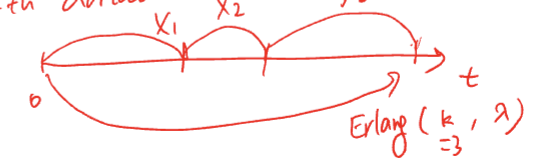
the sum of 𝑘 i.i.d. exponential random variables; a special
case of gamma (time until the kth arrival)
Gamma
generalization of Erlang; very flexible at modeling a nonnegative continuous RV
Beta
very flexible at modeling a continuous RV with an interval support; can be a smoother substitute for a triangle distribution
Weibull
models time to failure for components; can model both increasing and decreasing hazard rates
k > 1: increasing hazard rate (time inc more likely to break)
k < 1: decreasing hazard rate (time inc less likely to break)
k = 1: expon(λ) (time inc likeliness to beak stays the same)
At a carpool stand, passengers arrive one by one. When there are three passengers, a driver waiting in the car queue drives up to the stand to pick them up.
How do you model the time between two consecutive pick-ups?
Erlang (3, λ)
At a carpool stand, passengers arrive one by one. When there are three passengers, a driver waiting in the car queue drives up to the stand to pick them up.
Time until the 50th pick-ups?
Erlang (150, λ)
Approx will with N(150/λ, 150/λ²)
The number of absent students in a class of 56?
Binomial (56, p)
p = probability of absence
The number of computer chips we inspect until finding the first defect?
Geom(p)
p = prob of defect
At the customer service hotline, the number of phone calls they receive in the busiest hour?
Poisson (λ * 1)
(rate of arrivals/hr *hr)
The time until the employee fails to perform a task where the longer she works on it, the better she gets (less likely to fail)?
Weibul, k < 1
 Note
Note  Flashcards (25)