Unit 5 - Soil systems, terrestrial food production systems, and societies
 Studied by 1 person
 Call with Kai
 Learn
Learn Practice Test
 Spaced Repetition
 Match
Match Flashcards
 Knowt Play
1/56

There's no tags or description
Looks like no tags are added yet.
Name | Mastery | Learn | Test | Matching | Spaced | Call with Kai |
|---|
No study sessions yet.
57 Terms
Soil profile
A vertical section through a soil, divided into horizons (layers). All of the layers have different physical and chemical characteristics.
Gains and losses of material in soil
Transfers of materials within the soil contribute to the organization of the soil. There are inputs of organic material, like leaf litter, and inorganic matter from parent material, precipitation, and energy. Outputs include uptake by plants and soil erosion.
Decomposition in soil
This process changes leaf litter into humus. Decomposers and detrivores aid this process. Over a long period of time, humus decomposes due to mineralization.
Weathering of soil
Weathering is the decomposition (chemical) and disintegration (mechanical) of rocks in situ. There is also biological weathering, when plants and animals break through rocks through their growth and movement.
Nutrient cycling in soils
Nutrients are being recycled all the time and all natural elements are capable of being absorbed by plants. When animals eat the plants, they take up the nutrients. The nutrients eventually return to the soil when the plants and animals die and decomposers break them down.
Reasons for why soils are beneficial for plants
- Anchorage for roots.
- A supply of water.
- A supply of oxygen.
- A supply of mineral nutrients.
- Protection against adverse changes of temperature and pH.
When do soils harm plants?
When there are/is...
- Mechanical barriers (compact soils).
- An absence of cracks.
- A shortage of oxygen due to waterlogging.
- Dryness.
- Temperatures that are too high or too low.
- A high aluminum concentration, usually associated with low pH.
- Low nutrient supply.
- Phytotoxic chemicals in aerobic soil (e.g. trace metals or salinity associated with insecticides or herbicides).
Soil texture
The shape and arrangement of individual soil particles (peds).
Clay
- Poor water infiltration rate.
- Good water-holding capacity.
- Good nutrient status.
- Poor aeration.
- Poor ease of working.
Silt
- Medium water infiltration rate.
- Poor/medium water-holding capacity.
- Medium nutrient status.
- Poor/medium aeration.
- Medium ease of working.
Sand
- Good water infiltration rate.
- Poor water-holding capacity.
- Poor nutrient status.
- Good aeration.
- Good ease of working.
Loam
- Medium water infiltration rate.
- Medium water-holding capacity.
- Medium nutrient status.
- Medium aeration.
- Medium ease of working.
Air spaces in soil
The ideal soil structure is a crumb structure in which peds are small. The soil structural condition can also be measured by its porosity - this determines its air capacity and water availability.
Primary productivity of different soils
- Different soil types have different levels of primary productivity.
- PP of soil depends on mineral content, drainage, water-holding capacity, air spaces, biota, and potential to hold organic matter.
- Sandy soil has low PP due to poor water-holding capactiy and low nutrient status.
- Clay soil has a quite low PP due to poor aeration and poor water infiltration.
- Loam soil has a high PP due to its medium everything.
Suitability of soils for food production
- Light soils are susceptible to drought during the growing season because they have a poor nutrient- and water-holding capacity.
- Heavy soils where the clay content is over 28% are the most difficult for arable cultivation. They are highly water retentive, have low permeability, and field drainage is slow. Drying out is slow and they can become waterlogged when wet, or hard when too dry. They can also not be ploughed as often as other soils.
Succession and soils
Soil ecosystems change through succession. Fertile soil contains a community of organisms that work to maintain functioning nutrient cycles and are resistent to soil erosion.
Animals and their effect on soils
- Earthworms represent 50-70% of the total weight of animals in arable soils.
- Bacteria fix atmospheric nitrogen converting into a usuable form for plant roots.
- Fungi on tree roots take up soil nutrients and pass them directly to the tree.
- Decomposers break down litter, releasing nutrients into the soil.
- Soil organisms help to mix the soil, improving its structure.
- Animal burrows help to aerate the soil.
- Animal faeces return nutrients to the soil.
Reduced soil fertility by deforestation
The less trees, the more rain drops hit the soil, and thereby the more soil erosion. This is why deforestation is harmful for soil.
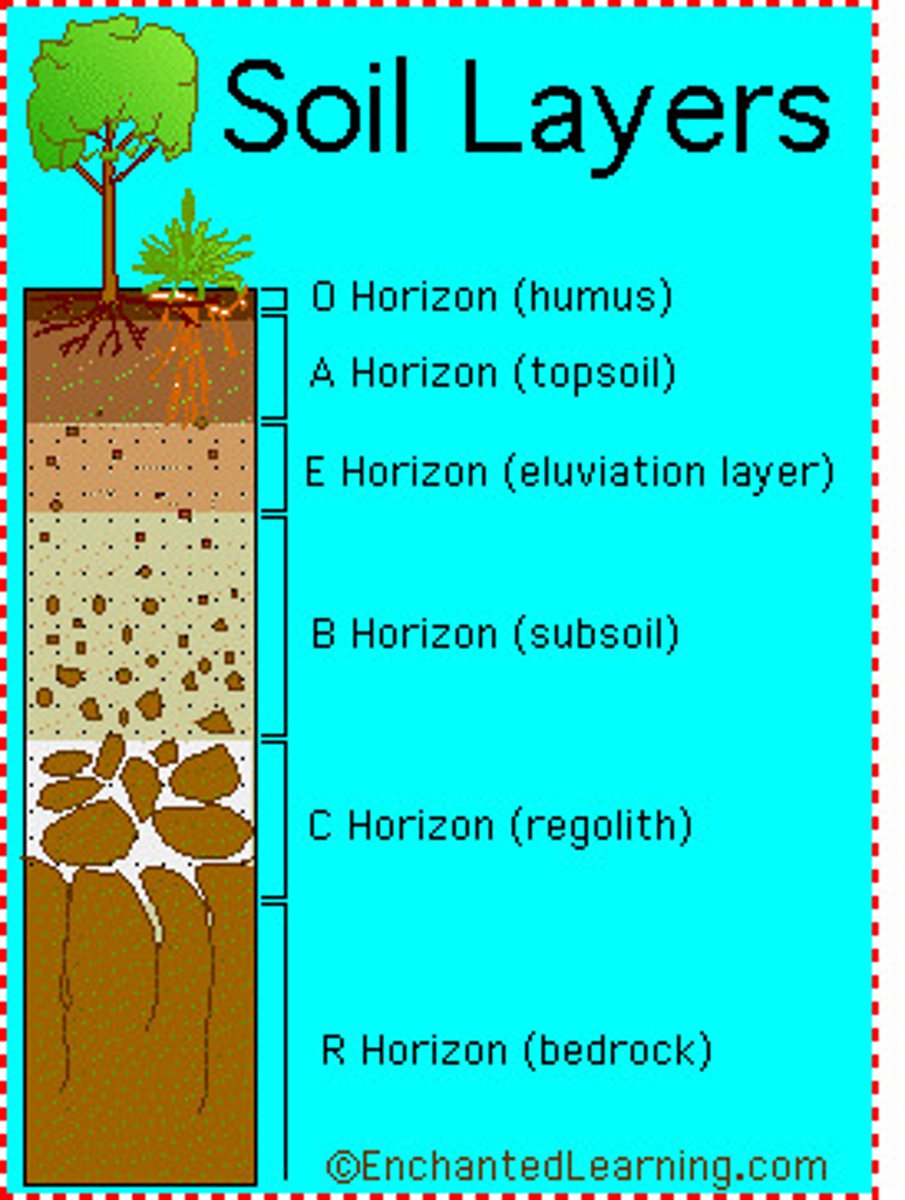
Soil horizons
O (organic horizon): First layer, consisting of undecomposed litter, partly decomposed litter, and well-decomposed humus.
A (mixed mineral-organic horizon): Second layer, consisting of humus, it's ploughed (as in a field or garden) and gleyed or waterlogged.
E (eluvial or leached horizon): Third layer, strongly leached and ash coloured, weakly bleached.
B (illuvial or deposited horizon): Fourth layer, iron, clay, and humus deposited.
C (bedrock or parent material): Fifth and final horizon, it's rock and has unconsolidated materials.
Vital functions of soil
- Soils are the medium for plant growth.
- Soils contain an important store of relatively fresh water - about 0.005% of the total global freshwater.
- Soils filter materials added to the soil and thereby maintain water quality.
- Some recycling of nutrients takes place in the soil through the breakdown of dead organic matter.
- Soil acts as a habitat for billions of microorganisms as well as for some larger animals.
- Soils provide raw materials in the form of peat, clays, sands, gravels, and minerals.
Soil as a resource and system
- Non-renewable resource.
- Open systems in a steady-state equilibrium.
- Inputs include organic material (e.g. leaf litter) and inorganic matter (from parent material) and precipitation and energy.
- Outputs include energy, uptake by plants, and soil erosion.
- Transfers of materials include biological mixing and leaching (e.g. minerals dissolving in water moving through soil).
- Transformations include decomposition, weathering and nutrient cycling.
Movement of water through soil
- In arid and semi-arid environments, water is drawn upwards from the soil because of evapotranspiration.
- When the surface is dry water from the lower layers of the soil is drawn there by capillary action.
Calcification
When the water from the soil is drawn to the surface and calcium carbonates and other solutes remain in the soil. This process is enhanced in grasslands because grasses require calcium.
Why is soil fertility reduced by grazing?
- The more grazing, the more vegetion cover is lost.
- Large herds can also destroy vegetion cover by trampling.
- Large grazers can compact the soil, making it impermeable and thereby increasing the potential for soil erosion. When erosion increases, so does water loss because the soil may end up in water holes and drying it up.
Reduced soil fertility by urbanization
Soil erosion is increased during phases of urbanization because it requires removal of vegetation for construction and heavy machines often compacts the soil in the process. This makes the soil impermeable and water cannot infiltrate it.
Reduced soil fertility by irrigation
- Irrigation leads to an increase of salt in the soil. Especially in paddy fields that require a lot of water, where the water evaporates in the hot sun and leaves high salinity levels.
- Saltwater intrusion is also a big problem (it entering soils close to coasts).
Reduced soil fertility by monoculture
It can lead to soil exhaustion; the soil being depleted of a mineral, because a constant farming of a crop uses up all that nutrient. Although, it's possible to replace them chemical and organic fertilizers, however they're expensive.
Reduced soil quality by commercialized food production systems
In recent years the demand for more goods has increased and consumers have shifted from expensive, organic products to less expensive, mass-produced, highly processed foods. Small-scale family farms have decreased in quantity, and large-scale agribusiness has expanded. This has led to a worse soil quality due to soil erosion, exhaustion, and toxification.
Case study: Commercial farming in East Anglia, UK
- This area in the UK is an area of intensive arable farming, with large open fields and heavy use of agricultural chemicals.
- As a result, the once-fertile soil is much depleted and requires further use of fertilizers for commercial crops to be grown successfully.
- There are a number of options for soil conservation on commercial arable farms in East Anglia:
● avoid inappropriate weather conditions (e.g. heavy rain) for
ploughing and harvesting
● add organic matter to the soil to increase water retention
● add clay to the soil to improve soil cohesion
● practise crop rotation so that soils do not become exhausted (this is
less common now due to specialization in farming)
● use wind breaks to reduce the risk of wind erosion
● use cover crops to protect the soil in winter
● mulching - plough in the remains of the previous season's crop to
improve nutrient retention in the soil
● leave some land fallow so that it can improve its fertility.
Case study: Sierra de Marta, Mexico
- The Sierra de Santa Marta is a remote, mountainous region in the humid tropical state of Veracruz, Mexico.
- Soil erosion and soil fertility loss are major problems and result in:
● reduced agricultural productivity
● decreased availability of drinking water in nearby urban centres
● increased road maintenance
● falling hydroelectric potential
● a decline in the fishing industry in coastal lagoons.
- Soil degradation can be severe when annual crops are grown on steep hillsides using practices that do not include cover crops or surface mulch. This is especially serious when fallow periods are reduced.
- In traditional shifting cultivation systems, the soil degradation occurring during the years of cultivation is offset by a fallow long enough to rebuild the soil's productive capacity. Such a system generally collapses with increasing land pressure, as fallow periods are reduced.
- In Texizapan, the erosive ability of the natural environment, the high erodibility of the soil, and the limited soil cover provided by the annual crop leads to high rates of soil degradation. Perennial crops such as coffee, especially when grown under shade trees, generally provide better soil protection.
- However, in Veracruz, as in other areas in Central America, annual crops such as maize and beans provide most of the food and cash needs of the population. Resource-poor farmers are generally reluctant to stop growing these crops, even when others appear economically more attractive or environmentally less degrading.
Case study: A success story - Santa Rosa, Mexico
- The Popoluca natives of Santa Rosa, Mexico, practise a form of agriculture that resembles shifting cultivation, known as the milpa system.
- This is a labour-intensive form of agriculture, using fallow periods. It is a diverse form of polyculture with over 200 species cultivated, including maize, beans, cucubits, papaya, squash, water melon, tomatoes, oregano, coffee, and chilli.
- The variety of a natural rain forest is reflected by the variety of shifting cultivation. For example, lemon trees, peppervine, and spearmint are
light seeking, and prefer open conditions not shade. Coffee, by contrast, prefers shade. The mango tree requires damp conditions.
- The close associations that are found in natural conditions are also seen in the Popolucas' farming system.
- For example, maize and beans go well together, as maize extracts nutrients from the soil whereas beans return them. Tree trunks and small trees are left because they are useful for many purposes such as returning nutrients to the soil and preventing soil erosion. As in a rainforest the crops are multi-layered, with tree, shrub, and herb layers.
- This increases net primary productivity (NPP) per unit area, because photosynthesis is taking place on at least three levels (with the highest NPP in the forest canopy), and soil erosion is reduced because no soil or space is left bare. Animals include chickens, pigs, and turkeys. These are used as a source of food, and their waste is used as manure.
- Thus, whereas there is widespread degradation in Veracruz, the Popolucas are able to maintain soil quality by working with nature.
Case study: Worse soil quality in Australia
- Australia is losing precious soil on a scale that is comparable to the desertification of Ethiopia, causing an economic disaster that now costs AU$2 billion a year.
- But far more serious is the actual loss of the land, which will cost a further AU$2.5 billion to repair where possible.
- More than half of Australia's
farming country is in need of treatment due to years of neglect, coupled with a refusal to change inappropriate farming practices.
- The problem lies in the great age and fragility of the Australian landscape and the devastating toll that 200 years of European settlement has taken on the relatively fertile soil.
- Cleared vegetation, cultivation, grazing animals and construction has placed immense pressure on the land.
- 40% of good farmland is badly eroded. Victoria is particularly badly hit by salinity, with 650000 km2 affected in varying degrees.
- Most of South Australia is prone to wind and gully erosion.
- In Western Australia, salinity and coastal erosion is the problem.
- Up to 40% of Australia's exports are produced directly from agriculture. Problems now include erosion, salinity, acidification, the effects of introduced animals, and chemical pollution from
agrochemicals.
- Australia has been described as 'an ecological disaster, characterized by a squalid history of greed, shortsightedness, and ignorance.'
Soil conservation methods
Revegation: deliberate planting, suppressing fire, grazing, etc. to allow regeneration.
Stopping bank erosion: insert corrugated iron and create concrete banks.
Stopping gulley enlargement: planting trailing plants and construction dams.
Crop management: maintaining a cover at critical times of the year and rotating crops.
Controlling slope run-off: terracing, deep tillage and application of humus, preserving vegetation strips to limit field width.
Preventing erosion from roads: intelligent geomorphic location, chanelling drainage water to non-susceptible areas, covering banks, cuttings, etc. with vegation.
Suppressing wind erosion: preserving soil moisture, increasing surface roughness through ploughing or by planting windbreaks.
Avoiding use of marginal land: don't farm land that is too dry or infertile.
Mechanical methods to reduce water flow in soil
- Doing this by either bunding, terracing, or counter ploughing.
- The point is to reduce the movement of rainwater down slopes.
- When there are steep slopes, contour ploughing is useless and terracing works much better.
Cropping and soil methods against water and wind damage
- To prevent soil erosion it is important to: maintain a crop cover for as long as possible, keep the stubble and root structure in place after harvesting, and to plant a grass crop.
- In areas where wind erosion is a problem, shelterbelts of trees or hedgerows are used. They act as a barrier for the wind and the speed of it is reduced.
Management of salt-affected soils
- Flushing the soil with water and leaching the salt away.
- Applicating chemicals to replace the sodium ions.
- Reducing evaporation losses to reduce the upward movement of water in the soil.
List of factors influencing the sustainability of terrestrial food production systems
- Scale.
- Industrialization.
- Mechanization.
- Fossil fuel use.
- Seed/crop/livestock choices.
- Water use.
- Fertilizers.
- Pest control.
- Pollinators.
- Antibiotics.
- Legislation.
- Levels of commercial vs subsistence food production.
Agribusiness
- In the mid 20th century there was a shift from producing food for people's needs to producing food for commercial profit.
- This is called agribusiness, when the food production is not to satisfy the community's needs, but rather to ensure profitable return for captial investment.
- The principal of agribusiness is to maximize productivity and profit in order to compete in a global market.
- Some characteristics of it are, large-scale monoculture, intensive use of fertilizers and pesticides, mechanized ploughing and harvesting, and food production geared to mass markets including export.
Cons of increased agriculturalization
- Lots of fertilizers --> increased run-off pollution.
- Loss of biodiversity.
- GMO crops are used in some countries to increase yield. Consequences of it are not studied enough yet, put one knows that GMOs can have a knock-on effect on wild populations if modified species cross-pollinate with wild ones.
Inequalities in global food supply
- On average, there is enough food in the world to feed the entire human population, yet there is an imbalance in the food supply.
- Many people in LEDCs are suffering from under-nourishment, while in MEDCs too much food is produced for the consumers to eat.
- 3/4 of the world's population is inadequately fed and 1/6 are going hungry. A child dies from hunger every 6 seconds. This mainly occurrs in LEDCs.
- Food production can be limited by various factors, political, economic, and environmental included.
Agriculture in MEDCs vs LEDCs
MEDCs:
- Extensive use of technology ever since the 20th century.
- Low labour.
- High fuel costs.
- Fertilizers and pesticides are factory produced.
- Product processing and packaging is large-scaled.
- Large monocultures.
- Overall technocentric.
LEDCs:
- Low levels of tech.
- Lack of capital.
- High levels of labour. E.g. dependence on working animals rather than machines.
- Mixed cropping on a small scale.
Food waste stats
THIS IS HORRIBLE :-(
- 1/2 of the food produced on Earth, around 2 billion tonnes, ends up as waste EVERY YEAR.
- 1/2 of the food bought in the US and Europe is thrown away by the consumers.
- In the UK, 30% of vegetable crops aren't even harvested because of their lack of meeting supermarkets' standards on appearance.
- It takes 20-50x more water to produce 1 kg of meat than 1 kg of veggies.
- By 2050, we could need as much as 3.5 times the current total human use of fresh water to grow our food.
Waste in LEDCs
- Occurrs mostly at the farmer-producer end of the supply chain.
- Inefficient harvesting, inadequate local transportation and poor infrastructure mean that the produce is often handled inappropriately and stored under unsuitable farm site conditions.
- The above results in higher levels of mould and pests destroying the foods.
Waste in MEDCs
- Here, consumerism, excess wealth, and mass marketing lead to wastage.
- Supermarkets tend to reject 'ugly' fruits and veggies.
- Consumers often don't feel like they need to care about not wasting food as their lives don't depend on it and so they waste a lot as well.
Case study: Slash-and-burn agriculture
- New land is cleared by cutting down small areas of forest trees and setting fire to them. The ash fetilizes the soil for a while and the clearing produced enables crops to grow. Once the area has been exhausted, the farmer moves on to a new area and repeats the process. Old land can be returned to once it has recovered.
- This method is commonly used in tropical forest areas, such as the Amazon.
- This type of farming works as long as there is a low population to sustain. Once it increases, so does the demand for food, and the farmers will then be forced to use soil that hasn't fully recovered.
Case study: Wet rice ecosystems of South East Asia
- Paddy field agriculture has become the dominant form of rice growing in South East Asia.
- A good example of high labour and low tech.
- There is a high demand for rice in Asian countries as it is a staple part of their diet and culture.
- Paddy fields can be placed mear rivers or on hills by using terracing.
- High rainfall facilitates this type of agriculture and allows farmers to lower irrigation levels.
- Recently, less land has been available for paddy fields and soil fertility has decreased, which are two problematic aspects.
Examples of how sociocultural factors influence food production
- A demand for organic products in Europe has lead to an increase in organic farming.
- In MEDCs, there is a growing concern for animal wellfare and about eating them or their products in general, which has affected farming methods and products sold.
- Educational levels determine the degree of development in farming practices and the technology used.
- Environmental constraints (e.g. rainfall) influence choice of farming practices.
Availability of land for food production
- With a growing population demandning ever-more land to live on, less land is available to grow crops on.
- However, this is a concern since more people means an increased need for food.
- Relatively little new land has been brought into agriculture over the past few decades. Between 1967-2007, the area of land used for farming only increased by 8% around the world.
Efficiency of terrestrial food production systems vs meat industry
- Systems that produce crops are more energy efficient than those that produce livestock because crops contain a greater proportion of the Sun's energy.
- The meat industry takes up far more land than farming crops.
- Despite this, many countries continue to use livestock as a large part of their farming systems. This could be due to taste and cultural values.
Inputs & outputs in a food production system
Inputs:
- Fertilizers.
- Water.
- Pest control.
- Labour (human or mechanical).
- Seeds.
- Breeding stocks.
- Livestock growth promoters (e.g. antibiotics).
Outputs:
- Food quality.
- Food quantity.
- Pollutants.
- Soil quality.
- Transportation.
- Processing and packaging.
Commercial farming
Farming for profit, often of a single crop.
Subsistence farming
Farming only enough to feed the farmer and their family with none to sell for profit.
Intensive farms
Take up a small area of land, but aim to have very high outputs per unit area of land (achieved through large inputs of capital and land).
Extensive farms
These are large compared to the money and labour put into them (e.g. cattle ranches in Australia where only a few workers are responsible for thousands of acres of land).
Case study: Intensive beef production in MEDCs vs the Maasai tribal use of livestock
MEDCs:
- Cattle are housed all year round and fed a diet
of rolled barley mixed with a protein concentrate (often beans, soya, or rapeseed meal), fortified with vitamins and minerals.
- In the USA, cattle are put into pens containing up to 10000 or 100000 cows and fed corn for the last weeks of their lives, which can double their biomass before slaughter. Their movement within the pens is restricted.
- Intensive beef production is an energy inefficient form of farming, with yield as low as one tenth the level of energy as is invested in energy inputs.
- However, it's cheap.
- There is not much space for the animals to move about, so they use less energy. This means less food is required, which leads to cheaper product.
- On the other hand, the animals are fed continuously for maximum growth and selective breeding has produced cows with high yield and good quality meat, which adds to overall costs.
- Inputs are therefore high (technology, heating, food) but so are the outputs (cost-effective production), although there may be hidden costs, such as transport.
- Environmental impact is high - energy usage releases greenhouse gases, and cows produce waste.
- Restraining animals in this way also has ethical implications
Maasai tribe:
- The Maasai are an indigenous group living semi-nomadically in Kenya and parts of Tanzania.
- Their livestock are able to wander freely, herded by their owners (i.e. this is a nomadic form of farming).
- The Maasai diet is traditionally meat, milk, and blood supplied by their cattle. Once a month, blood is taken from living animals by inserting a small arrow into the jugular vein in the neck. The blood is mixed with milk for consumption.
- Virtually all social roles and status derive from the relationship of individuals to their cattle.
- This is an example of extensive subsistence farming - inputs are low (the animals are allowed to roam freely so fences and pens are not required, only human labour is used) and so are outputs (enough food to feed the community).
- As with other subsistence methods, efficiency is high and environmental impact is low (the Maasai use their natural environment to raise their animals).
- Socio-cultural factors can, however, lead to problems: for the Maasai: cattle equal wealth and quantity is more important than quality, and this has lead to overgrazing and desertification.
Environmental impacts of food-production systems
- Soil degredation from erosion.
- Desertification.
- Eutrophication from agricultural run-off.
- Pollution from insecticides, pesticides, and fertilizers.
- Salinization from over-irrigation.
- Lowered water tables and over-abstraction of ground water.
- Loss of valuable habitats (e.g. wetlands drained for agriculture).
- Disease epidemics from high-density livestock farming and monoculture.
Methods of increasing sustainability of food production
- Altering human activity to reduce meat consumption.
- Increasing consumption of organically grown, seasonal, and locally produced food products.
- Planting buffer zones to support biodiversity and avoid pollution from run-off.
- Improving the accuracy of food labels to assist consumers in making informed food choices.
- Monitoring and having control of the standards and practices of multinational and national food corporations by governmental and intergovernmental bodies.
 Note
Note  Flashcards (36)