Period 3: Trends, Properties and their Oxides
 Call Kai
 Learn
Learn Practice Test
 Spaced Repetition
 Match
Match Flashcards
 Knowt Play
1/39

There's no tags or description
Looks like no tags are added yet.
Name | Mastery | Learn | Test | Matching | Spaced | Call with Kai |
|---|
No analytics yet
Send a link to your students to track their progress
40 Terms
why is Na more reactive Mg ?
amount of energy required to remove one electron from Na is less than energy required to remove 2 from Mg
Na + cold H2O equation, observations, pH
2Na(s) + 2H2O(l) → 2NaOH(aq) + H2(g) vigorously fizzes with water, exothermic
pH = 13
Mg + cold H2O equation, observations and pH
Mg(s) + 2H2O(l) → Mg(OH)2(aq) + H2(g) sparingly soluble, reacts slowly with water
pH = 9
Mg + steam equation and observations
Mg(s) + H2O(g) → MgO(s) + H2(g) bright white flame, white solid
Na + O2 equation and observations
2Na(s) + 1/2O2(g) → Na2O(s) bright yellow flame & white solid
Mg burned equation and observations
Mg + O2 → MgO white flame and white solid
Al + O2 (burned) equations and observations
4Al + 3O2 → 2Al2O3
white flame + white powder
Si + O2 equations and observationsx
Si + O2 → SiO2 white flame and white solid formed
P burned in O2 equations & observations
P4(s) + 5O2(g) → P4O10(s) white flame and white solid formed
S burned in O2 equation and observations
S(s) + O2(g) → SO2(g)
blue flame choking acidic gas
S + O2 burned with catalyst & high temp
2S(s) + 3O2(g) → 2SO3(g)
m.p. metal oxides
Na2O has high mp because of giant ionic lattice
MgO has higher because it has a higher charger density
Al2O3 distorts the electron cloud - it has some covalent character, less energy required to break the bonds
m.p. covalent oxides
SiO2 macromolecular structure strong covalent bonds, high mp
P4O10 & SO2 are simple covalent weak IMFs
how can you distinguish between SO2 and SO3?
universal indicator
SO2 → orange-red
SO3 → red
P4O10 + NaOH
P4O10 (aq) + 12NaOH (aq) → 4Na3PO4 (aq) + 6H2O (l)
SO2 + NaOH
2NaOH(aq) + SO2 (aq) → Na2SO3 (aq) + H2O (l)
SO3 + NaOH
2NaOH (aq) + SO3 (g) → Na2SO4 (aq) + H2O (l)
Al2O3 + NaOH
role of Al2O3
2NaOH (aq) + Al2O3 (s) + 3H2O (l) → 2NaAl(OH)4 (aq)
aluminium oxide as an acid
Al2O3 + HCl
role of Al2O3
Al2O3(s) + 6HCl (aq) → 2AlCl3 (aq) + 3H2O (l)
aluminium oxide as a base
Al2O3 + H2SO4
role of Al2O3
3H2SO4 (aq) + Al2O3 (s) → Al2(SO4)3 + 3H2O(l)
base
P4O10 + Na2O
P4O10 + 6Na2O → 4Na3PO4
SO2 + water equation and pH
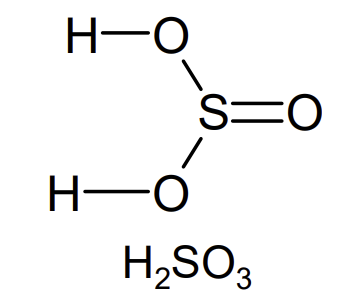
SO2(g) + H2O(l) → H2SO3 (aq) pH = 3
SO3 + water and pH
SO3 (g) + H2O → H2SO4 (aq) pH = 0
P4O10 + water and pH
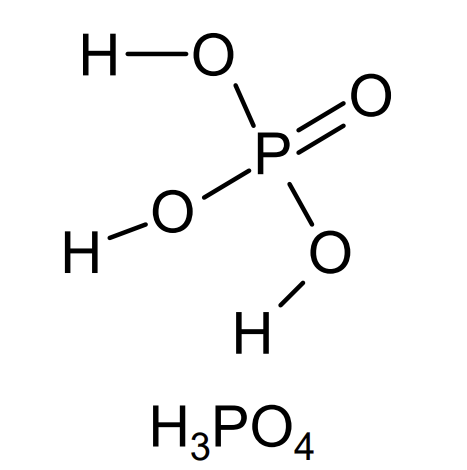
P4O10 + 6H2O → 4H3PO4 pH = 0
violent exothermic reaction
why do Al2O3 and SiO2 not dissolve in water?
Al2O3 - due to strong ionic lattice
SiO2 strong macromolecular structure both give pH 7
display formula of H2SO3
display formula of H3PO4
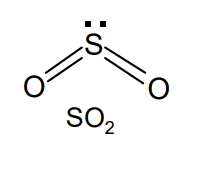
draw the display formula of SO2 with any lone pairs
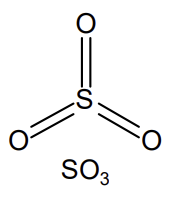
draw the display formula of SO3
periodicity
repeating patterns of physical or chemical properties going across a period
what is the trend in atomic radius for period 3?
atomic radii decrease going across due to the increased no. of protons → more positive attraction to electrons with similar shielding
what is the trend in ionisation energy across period 3? what are the deviations
general increase in first IE due to increasing no. of protons with similar shielding
drop Mg → Al electron in 3p subshell, easier to remove because electrons are higher in energy
drop P → S outer electron is paired in same orbital, slight repulsion makes it easier to remove
melting point trends Na, Mg, Al, Si
strong metallic bonding increases due to increasing charge density
Si is macromolecular - strong covalent bonds high mp
melting point trends Cl2, S8, P4, Ar
simple molecular, weak van der waals
S8 has higher mp than P4 because there are more electrons in its van der waals
SiO2 + very concentrated NaOH
SiO2 (s) + 2NaOH(l) → Na2SiO3 (aq) + H2O(l)
MgO + phosphoric acid
3MgO + 2H3PO4 → Mg3(PO4)2 + 3H2O
how can you prove that metal oxides contain ions?
melt the solids and show that they conduct electricity
how is aluminium metal is protected from corrosion in moist air?
a thin layer of Al2O3 forms impermeable to water and air
why is Mg(OH)2 better than NaOH for treating excess acid in rivers and the stomach
sparingly soluble and weakly alkaline so using an excess would not make the water too alkaline
Na2O and water
Na2O + H2O → 2NaOH pH = 13