Progress of women in medicine
 Studied by 0 people
 Call Kai
 Learn
Learn Practice Test
 Spaced Repetition
 Match
Match Flashcards
 Knowt Play
1/9

There's no tags or description
Looks like no tags are added yet.
Name | Mastery | Learn | Test | Matching | Spaced | Call with Kai |
|---|
No analytics yet
Send a link to your students to track their progress
10 Terms
Throughout history, were most doctors men or women and why?
Most doctors were men partly because it was thought that women were not as intelligent as men.
true or false? men and women received the same level of education
false, they did not, partly because it was thought that men were more intelligent than women
describe the attitudes towards women in medicine
women cared for sick at home but were blocked from becoming doctors
girls were taught skills for marriage, not higher education
florence nightingale made nursing seem acceptable but medicine was still seen as unnatural for many women
How did women push back against the attitudes towards meddicine?
they joined suffragist groups which campaigned for votes, jobs, and education
How were women treated in places of medicine study?
They faced many obstacles. They were sometimes harassed by male students. They were taught separately from male students and couldn’t do practical work. They were less recognized.
In 1874, Edinburgh University forced female students to leave, claiming they had been admitted by mistake.
How did Garrett’s family react when she said she wanted to become a doctor?
they were horrified
Why could Garrett not be licensed even after completing medical training?
The three societies that carried out licensing would not accept her as a member
What action did Garrett’s father take and why? When did Garrett become officially qualified to practice medicine?
Garrett’s father now supported her with wanting to become a doctor. Since the Society of Apothecaries (basically chemists) did not have regulations that banned female members, her father threatened the society that he would sue them if she wasn’t given a license. So, they gave her a license but then changed their regulations so no other woman could join. She became officially qualified to practice medicine in 1865.
What were Garrett’s achievements?
In 1866, she opened St Mary’s Dispensary in London. This provided medical treatment for women. In 1872 the dispensary added a 10 bed ward staffed entirely by women. It moved site and expanded several times, becoming the New Hospital for women, then the London School of Medicine for women and it was renamed the Elizabeth Garrett Anderson hospital in 1918 just after her death.
In 1873 Garrett became a member of the British Medical Association (BMA) → the only woman to be a member for the next 19 years because the BMA voted against any further women being admitted
In 1908 she became the first female mayor in England
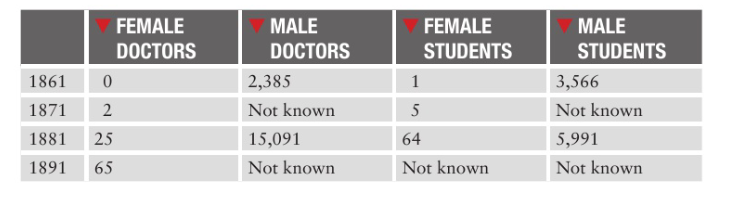
How many male/female students/doctors were there in 1861 vs 1871 and 1881 and 1891?
 Note
Note  Flashcards (73)