Cell Biology Exam 4: Chapter 14 pt.1
 Call Kai
 Learn
Learn Practice Test
 Spaced Repetition
 Match
Match Flashcards
 Knowt Play
1/76

Earn XP
Description and Tags
Cellular Reproduction: Mitosis
Name | Mastery | Learn | Test | Matching | Spaced | Call with Kai |
|---|
No analytics yet
Send a link to your students to track their progress
77 Terms
how do cells reproduce
by the process of cell division
what does mitosis lead to & what is it the basis for
cells that are genetically identical to their parent and serves as the basis for producing new cells
what does meiosis lead to & what is it the basis for
production of cells with half of the genetic content of the parent and is basis for producing new sexually reproducing organisms
2 stages of the cell cycle
M phase
Interphase
M phase: what does it include
mitosis
cytokinesis
Interphase: what does it include
G1 phase (growth)
S phase (synthesis)
G2 phase (growth)
Interphase: G1 phase
cell grows and carries out normal metabolism & organelles duplicate
Interphase: S phase
DNA replication & chromosome duplication
only time chromosomes are duplicated
Interphase: G2
cell grows & prepares for mitosis
cell growth & copying of chromosomes in preparation for cell division
cell grows during _____ 3 phases but chromosomes are duplicated only during the ___ phase
all 3 (G1,S,G2),
cells in vivo: what cells lack the ability to divide & why
nerve cells, muscle cells, or red blood cells
they are highly specialized, once these cells have differentiated they remain in that state until they die
cells in vivo: cells that do not normally divide can be _____ to begin DNA synthesis (how & what types of cells)
the cells can be induced to begin DNA synthesis and divide when given an appropriate stimulus
liver cells & lymphocytes
in vivo: cells that normally possess a relatively high level of mitotic activity
hematopoietic stem cells
what kind of division do stem cells have
asymmetric in which the daughter cells have different dates
ex.) some can become lymphocytes or liver cells etc
Mitosis & Cytokinesis: prophase
chromosomal material condenses to form compact mitotic chromosomes, chromosomes are seen to be composed of two chromatids attached together at the centromere
cytoskeleton is disassembled, and mitotic spindle is assembled
golgi complex and ER fragment, nuclear envelope disperses
Mitosis & Cytokinesis: prometaphase
chromo
Mitosis & Cytokinesis: metaphase
chromosomes are aligned along metaphase plate, attached by chromosomal microtubules to both plates
Mitosis & Cytokinesis: anaphase
centromeres split and chromatids separate
chromosomes move to opposite spindle poles
spindle poles move farther apart
Mitosis & Cytokinesis: telophase
chromosomes cluster at opposite spindle poles
chromosomes become dispersed
nuclear envelope assembles around chromosome clusters
golgi complexes and ER reforms
daughter cells formed by cytokinesis
prophase: what is prepared for segregation & what is assembled
duplicated chromosomes are prepared for segregation
mitotic machinery is assembled
prophase: 2 ways that form the mitotic chromosome
chromosome compaction occurs during prophase
condensin protein is also responsible for compaction
prophase: condensin
protein responsible for compaction
helps compaction of intramolecular DNA
centromeres: where do they occur & what do they serve as
they occur at primary constriction (center) on chromosomes and serve as the binding site for proteins
kinetochores: where are they located & what occurs here
they are on the outer surface of centromeres
they are the sites where chromosomes attach to the microtubules of the mitotic spindle
what is the centrosome
a microtubule-organizing structure
what is the mitotic spindle made of
microtubules
centrosome cycle
centrioles are duplicated, progresses along with the cell cycle
what happens to the centrosomes during prophase
the centrosomes move apart from one another as they organize the bundles of microtubules that form the mitotic spindle
prometaphase: nuclear envelope
the nuclear envelope 1st breaks down, freeing the sister chromatids from the nucleus, which is necessary for separating the nuclear material into two cells
prometaphase: protein formation (what is it called & where does it form)
development of protein formation called a kinetochore around the centromere, the central point joining the sister chromatids
centromere
central point joining the sister chromatids
metaphase: what occurs to the chromosomes
the chromosomes are aligned at the spindle equator on the metaphase plate
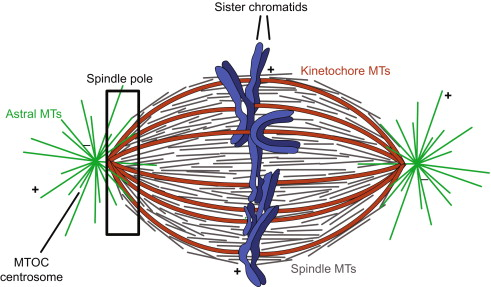
microtubules in a mitotic spindle are highly organized: 3 types of microtubules
astral microtubules
chromosomal microtubules
polar microtubules
astral microtubules
radiate from the centrosome to the region outside the body of the spindle
chromosomal microtubules
move chromosomes to the poles
polar microtubules
maintain the integrity of the spindle
when does anaphase begin
when sister chromatids split and move apart
anaphase: what happens to the chromosomes
chromosomes are split in synchrony
anaphase: where do chromosomes move to & what happens to microtubules
as chromosomes move towards a pole, microtubules attached to kinetochores are shortened
anaphase A
movement of chromosomes toward the poles
anaphase B
when the two spindle poles move in opposite directions due to elongation of microtubules
what forces are required for chromosome movements at anaphase
ATP-driven microtubule motor proteins (dynein & kinesin)
____ and ___ are found at kinetochores of chromosomes
dynein & kinesis
what does depolymerization of microtubules generate
sufficient force to move the chromosomes
anaphase: in yeast, a protein is pushed by the force of depolymerization to do what
help move the chromosome toward the spindle pole
movement of chromosomes during anaphase in animal cells: where does the force required for DNA movement come from
the release of strain energy from when a microtubule depolymerizes
spindle checkpoint
operates as the metaphase/anaphase transition to check for misaligned chromosomes
spindle checkpoint: what do unattached kinetochores contain
a protein complex that sends a “wait” signal to prevent entry into anaphase → must have attachment for anaphase to pull the chromosomes apart
spindle checkpoint: if a cell were not able to postpone chromosome segregation
it would greatly elevate the risk of the daughter cells receiving an abnormal number of chromosomes (aneuploidy)
telophase: what stage of mitosis is it & what happens to the daughter cells
final stage of mitosis
the daughter cells return to interphase
telophase: mitotic spindle
disassembles
telophase: nuclear envelopes
nuclear enveloped of the two nuceli are reassembled
telophase: chromosomes
becomes dispersed
telophase: cytoplasm
is partitioned into two cells in a process called cytokinesis
telophase: why do chromosomes become dispersed
so genes involved an be expressed
cytokinesis
division of the cytoplasm into two distinct daughter cells
cytoplasm partitioned into two cells
what is mitotic movement powered by
microtubule motors (dynein and kinesin-related proteins)
where are the molecular motors located
at the spindle poles and kinetochores
what are the 3 features of the motor proteins
keep the poles apart
bring chromosomes to the metaphase plate and keep them there
elongate the spindle during anaphase B
cytokinesis in animal cells: where does it start
starts with the indentation of the cell surface
cytokinesis in animal cells: what does the contractile ring theory suggest
that a thin band of actin and myosin filaments generates the force to cleave the cell
cytokinesis in animal cells: what is the site of filament assembly (the plane of cytokinesis) determined by
a signal coming from the spindle poles
cytokinesis in plant cells: cell plate
formation of the cell plate → precursor to a new cell wall
cytokinesis in animal cells: cells build a cell _____ and cell ___ in the cell center
membrane, wall
cytokinesis in animal cells: phragmoplast & material for the cell wall
the cell plate begins with the appearance of the phragmoplast, which then proceeds laterally
material for the cell wall is brough to the phragmoplast by golgi vesicles
mitosis mneumonic
Intelligent → Interphase
Parents → Prophase
Pay → Prometaphase
More → Metaphase
Attention → Anaphase
To - Telophase
Children → Cytokinesis
is interphase a part of mitosis
no, but since the cells spends most of its life in the interphase stage, it is usually considered and discussed together with the other stages
cell cycle control system
sequential events
similar to clock
involves 2 types of proteins
cell cycle control system: 2 types of proteins
cyclins
cyclin-dependent kinases (Cdks)
cell cycle control system: when do protein kinases like cdk become activated
just before the start of the s phase
checkpoints
cycle stops until a go-ahead signal is received
G1 to S
G2 to M
what was the first cyclin-cdk complex discovered
MPF (maturation promoting factor)
what does kinase activity depend on
presence of cyclin subunit
what must happen for cells to pass through a point of commitment
Cdks must be transiently activated by specific cyclins
why is the cyclin concentration & MPF activity low during the G1, S, and G2 phase but high during the M phase
you don’t want the cell to divide during G1, S, and G2
cyclin & MPF activity are highest during promotion of cell division (M phase)
what does activated cdk do
phosphorylates proteins for specific for the particular transition
what happens to cyclin after mitosis & what must occur for the cell cycle to proceed again
it gets degraded after mitosis
must accumulate before cell cycle can proceed again

