smell & taste 2
 Call Kai
 Learn
Learn Practice Test
 Spaced Repetition
 Match
Match Flashcards
 Knowt Play
1/31

There's no tags or description
Looks like no tags are added yet.
Name | Mastery | Learn | Test | Matching | Spaced | Call with Kai |
|---|
No analytics yet
Send a link to your students to track their progress
32 Terms
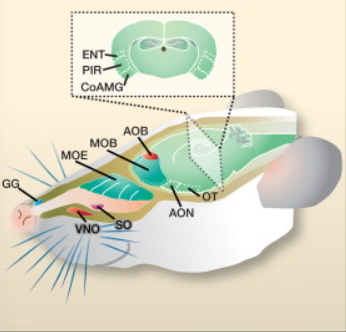
describe the olfactory system of mice
has 4 olfactory organs: main olfactory epithelium, vomeronasal organ, grueneberg ganglion, septal organ of Masera
MOE, GG and SO project to main olfactory bulb, VNO project to the accessory olfactory bulb
describe the olfactory system of drosophila
2 olfactory organs: the 3rd antennal segments & maxillary palps
the olfactory info relayed to antennal lobe (processing then takes place at lateral horn of protocerebrum & kenyon cells in the mushroom body)
how does the human olfactory system differ?
larger number of glomeruli and smaller number of functional odor receptor genes,
lack the accessory olfactory system (detects low volatility odorants in liquid phase),
larger and more intricate orbitofrontal cortex (for processing)
how many ORs in humans vs in mice
1100 in mouse, 350 in human (alot were pseudogenized)
how much of human ORs are pseudogenized
15-78% or Ors & all V2Rs
what are the 2 classes of vertebrate ORs
teleost fish class 1 - tuned to water-soluble odorants
terrestrial vertebrates class 2 - tuned to hydrophobic odours (amphibians have both classes, in dolphins class II have been pseudogenized)
how could polymorphisms in ORs underlie variation in human odour perception?
-can cause anosmic for certain odours
-altered detection threshold
-altered perceptual quality
what is the buck and axel method?
dissected out olfactory epithelium -> extracted RNA -> RT to cDNA -> pairs of degenerate primers used for GPCRs to amplify further candidate members of the GPCR superfamily (in olfactory epithelium)
how did Buck and Axel analyse their results?
if PCR products =a mixture of DNA sequences, then= amplification of members of a multigenefamily
if an individual PCR product =several different DNA sequences (consistent with the amplification of members of a multigene family) -> restriction endonuclease digestion
should generate a large array of fragments whose molecular weights sum > than the molecular weight of the original PCR product
what are the features of ORNs?
-8-20 non-motile cilia
-cilia contain receptors
-other end has unmyelinated axon
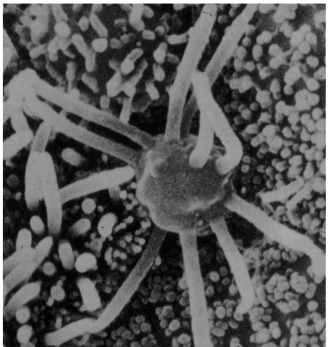
10-100 axons from into a bundle, becomes a primary olfactory nerve fibre. where does it go?
passes through cribriform plate, first synapse at olfactory bulb
what do odorant binding proteins (OBP) do?
help odorants bind receptors on cilia, clear cilia of odorants
how does clearance work (aided by OBPs ofc)
olfactory epithelium & nasal & Bowmans glands secrete enzymes e.g. cytochrome P450, dehydrogenates, oxidases, reductases and esterases
what are the steps of olfactory transduction?
OBP binds odour to receptor
G protein binds adenyl cyclase so it converts ATP to cAMP
cAMP binds CNG carion channel
depolarisation means Ca activates Cl channel
more depoarisation
how can adenylyl cyclase cause smell dysfunction?
no/ reduced cAMP -> completely anosmic (US offer PDE inhibitor treatment)
what is an example of a ciliopathy causing smell dysfunction?
Bardet-Biedl syndrome- mutation in BBS4 gene -codes for a protein in the basal body of cilia (causes anosmia 60% cases)
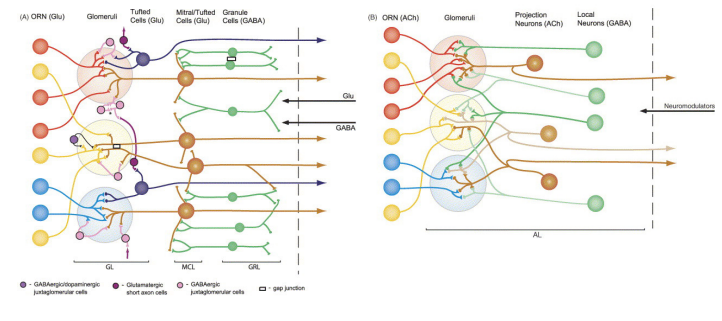
differences between mouse and fly glomerular
mouse- tufted cells (glu), mitral/tufted cells (glu), granule cells (GABA)
fly- projection neurons (ach), local neurons (GABA) (ORNs use ach not glu)
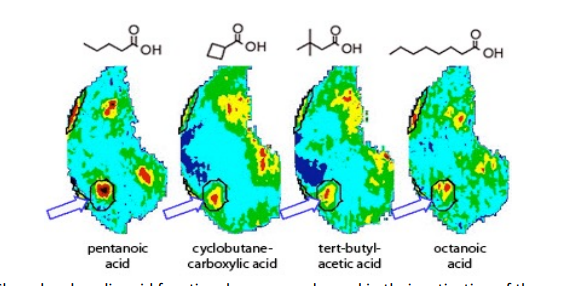
what has Mapping The Glomeruli with 2DG (labeled glucose analogue) revealed?
if more similar chemicals then lights up same areas
why do we crave salt?
sodium and chloride needed for maintenance of osmotic balance, membrane potential, nutrient absorption and transport, blood volume and pressure
the 5 basic tastes?
salt, sour, sweet, bitter, umami
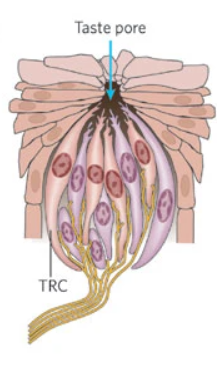
what do taste buds look like? what are they composed of?
50-150 taste receptor cells
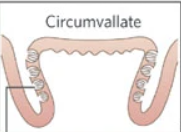
what do circumvallate papillae look like? where are they found?
are at back of the tongue (have hundreds-thousands taste buds)
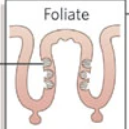
what do foliate papillae look like? where are they found?
posterior lateral edge (dozen -hundreds taste buds)
what do fungiform papillae look like? where are they found?
in anterior 2/3 of tongue (containone/ a few taste buds)
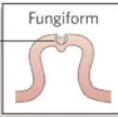
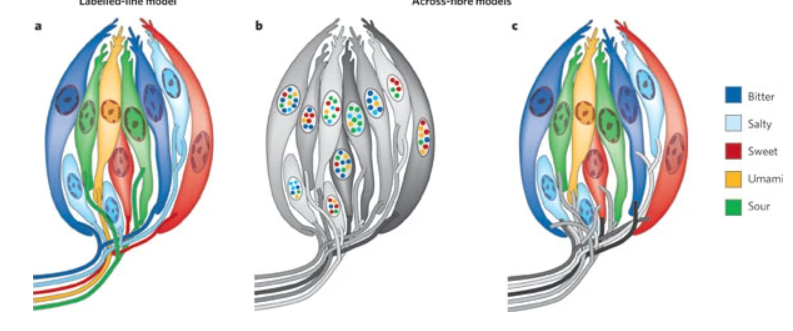
what were the 3 proposed models for how taste buds encode smell?
labelled line- receptor cells tuned to single taste modalities (innervated by individually tuned nerve fibres) (most evidence)
across-fibre pattern (1)- individual TRCs are tuned to multiple taste qualities
across-fibre pattern (2)- receptor cells tuned to single taste modalities, same afferent fibre carries info from more than one taste modality
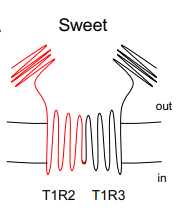
what is the structure of sweet receptors?
heteromeric, made of T1R2 & T1R3
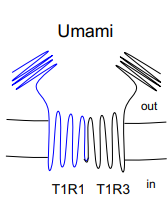
what is the structure of umami receptors?
heteromeric, made of T1R1 & T1R3
what does an insect sensillum do?
olfaction, taste, chemoreception, hygroreception
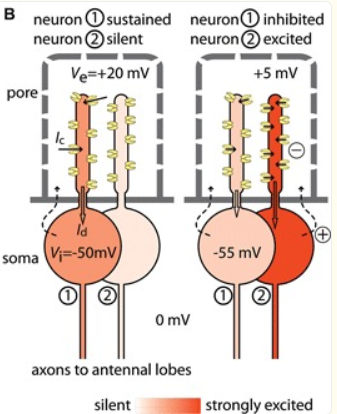
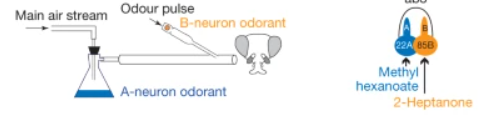
activation of one neuron inhibits its neighbour.
can be seen via optogenetics- use light to stimulate one neuron
or can deliver background odour, deliver a second odour to a separate neuron to activate (sustained train of APs from neuron A, when 2nd odour imposed, neuron B fires & theres a marked reduction in neuron a firing)
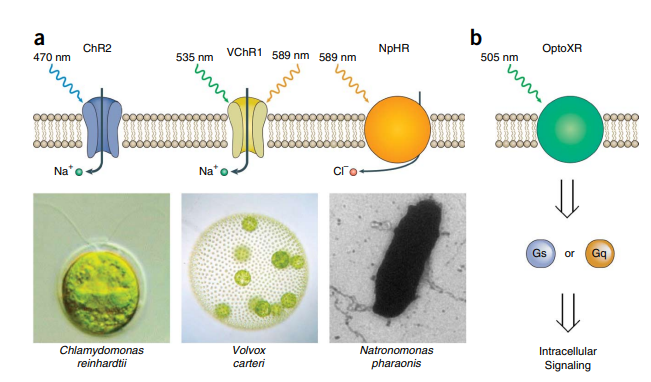
what channels can be used in optogenetic control, (ionic vs g protein)
ionic- ChR2, VChR1, NpHR
G- synthetic rhodopsins (intracellular loops of bovine rhodopsin replaced w loops of GPCRs- light activated) OptoXR
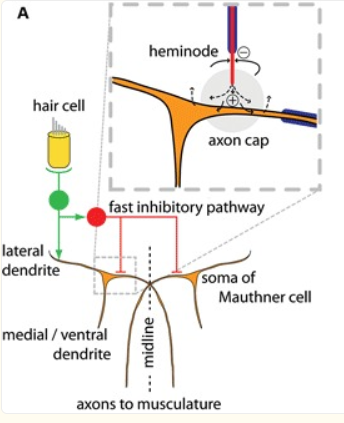
how does ephaptic inhibition work in maunther cells?
hair cell excites VIII nerves
this excites ipsilateral Mauthner cells & inhibitory interneurons
the inhibitiory interneurons act on both Mauthner cells (go at the axon cap (a structure of high resistivity), influx at the heminode increases extracellular potential, hyperpolarises the zone where impulse initiation occurs)
how does ephaptic inhibition work in drosophila olfactory receptor neurons?
odour molecules enter via pores
dendrites of 2 neurons in hair lumen
both share an extracellular space
opening in channels in neuron 1 draws current from this space (so when channels open in neuron 2 there is less to draw from)