Lecture 35 - Dwarf Planets
 Studied by 0 people
 Call with Kai
 Learn
Learn Practice Test
 Spaced Repetition
 Match
Match Flashcards
 Knowt Play
1/20

Earn XP
Description and Tags
ASTR 1210 (Exam 3)
Name | Mastery | Learn | Test | Matching | Spaced | Call with Kai |
|---|
No analytics yet
Send a link to your students to track their progress
21 Terms
Anatomy of a Comet
Icy snowball will start to melt and sublimate, releasing dust and particles - those dust particles will get swept away by solar wind (charged particles from the sun)
Sending them away from the sun
Dust tail is slightly impacted by the comet’s motion — still primarily dominated by the sun’s motion
Coma: atmosphere that comes from a comet’s heated nucleus
Growth of Tail
Normally don’t have tails because they’re farther from the sun
Meteor Showers
Comets are the result of meteor shower - Orionids, Leonids
Earth is zipping through all those particles of gas and dust that were left behind
Seems as if the Earth is zipping in that direction - if you imagine that you were driving in a car and it’s not windy, if you drive through the snowstorm, the snow is zipping by you
Meteor showers emanate from the constellation
Bigger the comet, the more material it releases —> bigger meteor showers
Where Do Comets Come From?
Deep outer solar system - Oort cloud: random orbits extending to about 50,000 AU
Depends on how often they come to the inner solar system
Sun perturbed Oort Cloud and sent so much comets to us
The ice melted into the water on Earth
Kuiper Belt: on orderly orbits from 30-100 AU in disk of solar system
Meteor Terminology
Meteorite:
Rock from space that falls through Earth’s atmosphere
Meteor:
Bright trail left by a meteorite
Meteroid:
Rock from space
Meteorite Types
Primitive: unchanged in composition for 4.6 billion years
Processed: younger, have experienced processes like volcanism or differentiation
Frequency of Impacts
Small impacts happen daily
Depends on size
Impacts large enough to cause mass extinctions happen many millions of years apart
True or false: A meteorite has never impacted a home around the world within the past 100 years.
False - super rare occurrences
Smacks into oceans and desolate land masses
Cosmic Collisions
Comet was gravitationally ripped apart by Jupiter
Impact and energy that was associated with the collisions - little black spot is the size of the Pacific Ocean
Huge impact
Jupiter protects Earth from comets
First Sun, then Earth
Mass Extinctions
Some result of natural climate change
Others catastrophic collisions - dinosaur extinctions 65 million years ago
Iridium layer around the Earth - commonly found in meteorites and comets
Collision of a giant rock - layer of iridium
Found dinosaur fossils below this layer
After this collision happened, the dinosaurs were unable to survive, get the oxygen, the food they need to, and the energy they need to thrive
Likely Impact Site
Geologists have found large subsurface crater about 65 million years old in Mexico
Facts About Impacts
Asteroids and comets have hit Earth
Major impact is only a matter of time
20 meter object in Russia in 2013 - cosmic collision - Russia is huge
Asteroid Deflection Techniques
Fund the deflection techniques and the science
Exactly how many planets are there in our solar system?
Depends on who you ask
Discovery of Uranus
William and Caroline Herschel
Uranus is barely visible to the naked eye with no light pollution
Direct method for discovery
Telescopes — very good invention
New elements discovered - Uranium
The Next Planet
Giuseppe Piazzi discovered Ceres - between Mars and Jupiter
Cerium got named
Pallas
Palladium
All in the same region of space
Planets 10/11 in same region of space
Found in asteroid belt - more like each other than the planets
What is a Planet?
What is a planet?
Pluto reclassified as a dwarf planet
Plutonium
More and more icy bodies - discovered one that was bigger than Pluto - Eris
Pluto got demoted to a dwarf planet
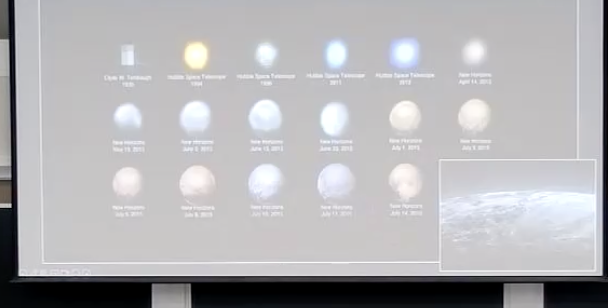
Evolution of the best view of Pluto
Better images of Pluto
Explored it because we thought it was a planet
Haven’t explored other things because of the terms we use to refer to objects
The IAU Defines a Planet
Planet orbits the sun
Spherical
Cleared its neighborhood of orbit - most dominant gravitational member of the neighborhood
Pluto didn’t pass the third criteria
Language
More precise we are with our language, the more we can name things
 Note
Note  Flashcards (78)