Vectors Formulae (Shortest Distance, Angle Between)

0.0(0)
Studied by 6 people
call kaiCall Kai
learnLearn
examPractice Test
spaced repetitionSpaced Repetition
heart puzzleMatch
flashcardsFlashcards
GameKnowt Play
Card Sorting

1/5

encourage image

There's no tags or description

Looks like no tags are added yet.

Last updated 2:14 PM on 5/13/26
Name
Mastery
Learn
Test
Matching
Spaced
Call with Kai

No analytics yet

Send a link to your students to track their progress

6 Terms

1
New cards

Point Line

  • Take the vector from a point on the line to your point.

  • Cross it with the line’s direction vector.

  • Divide the length of that cross product by the length of the line’s direction vector.

  • Gives the shortest (perpendicular) distance.
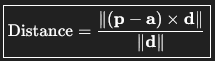
<ul><li><p>Take the vector from a point on the line to your point.</p></li><li><p>Cross it with the line’s direction vector.</p></li><li><p>Divide the length of that cross product by the length of the line’s direction vector.</p></li><li><p><span data-name="check_mark_button" data-type="emoji">✅</span> Gives the shortest (perpendicular) distance.</p></li></ul><p></p>
2
New cards

Skew Lines

  • Take the vector connecting any point on line 1 to any point on line 2.

  • Dot it with the cross product of the two lines’ direction vectors.

  • Take the absolute value and divide by the length of the cross product of the directions.

  • Gives the shortest distance between the lines.

<ul><li><p>Take the vector connecting any point on line 1 to any point on line 2.</p></li><li><p>Dot it with the cross product of the two lines’ direction vectors.</p></li><li><p>Take the absolute value and divide by the length of the cross product of the directions.</p></li><li><p><span data-name="check_mark_button" data-type="emoji">✅</span> Gives the shortest distance between the lines.</p></li></ul><p></p>
3
New cards

Angle Line and plane

  • Take the line’s direction vector.

  • Dot it with the plane’s normal vector.

  • Divide by the product of their lengths.

  • Take the arcsine of that value.

  • This gives the angle between the line and the plane.
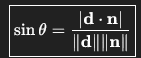
<ul><li><p>Take the line’s direction vector.</p></li><li><p>Dot it with the plane’s normal vector.</p></li><li><p>Divide by the product of their lengths.</p></li><li><p>Take the <strong>arcsine</strong> of that value.</p></li><li><p><span data-name="check_mark_button" data-type="emoji">✅</span> This gives the angle between the line and the plane.</p></li></ul><p></p>
4
New cards

Angle Plane and plane

  • Take the normals of the two planes.

  • Dot them together and divide by the product of their lengths.

  • Take the arccosine of that value.

  • This gives the angle between the planes.
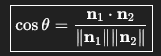
<ul><li><p>Take the normals of the two planes.</p></li><li><p>Dot them together and divide by the product of their lengths.</p></li><li><p>Take the <strong>arccosine</strong> of that value.</p></li><li><p><span data-name="check_mark_button" data-type="emoji">✅</span> This gives the angle between the planes.</p></li></ul><p></p>
5
New cards

Perpendicular distance between a line and a plane in parallel

  • Pick any point $P(x_0, y_0, z_0)$ that lies on the line (this is usually given as the position vector in the line's equation).

  • Ensure the plane equation is in Cartesian form: $ax + by + cz + d = 0$.

  • Substitute the point's coordinates into the plane's expression: $ax_0 + by_0 + cz_0 + d$.

  • Take the absolute value of that result and divide it by the magnitude (length) of the normal vector $\sqrt{a^2 + b^2 + c^2}$.

  • This gives the perpendicular distance $D$.
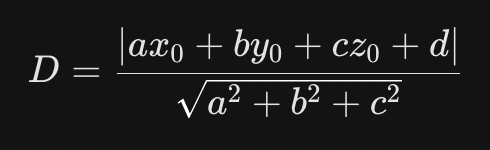
<ul><li><p><strong>Pick any point</strong> <span style="line-height: 1.15;">$P(x_0, y_0, z_0)$</span> that lies on the line (this is usually given as the position vector in the line's equation).</p></li><li><p><strong>Ensure the plane equation</strong> is in Cartesian form: <span style="line-height: 1.15;">$ax + by + cz + d = 0$</span>.</p></li><li><p><strong>Substitute the point's coordinates</strong> into the plane's expression: <span style="line-height: 1.15;">$ax_0 + by_0 + cz_0 + d$</span>.</p></li><li><p><strong>Take the absolute value</strong> of that result and divide it by the <strong>magnitude (length) of the normal vector</strong> <span style="line-height: 1.15;">$\sqrt{a^2 + b^2 + c^2}$</span>.</p></li><li><p><span data-name="check_mark_button" data-type="emoji">✅</span> This gives the <strong>perpendicular distance</strong> <span style="line-height: 1.15;">$D$</span>.</p></li></ul><p></p>
6
New cards

Distance between parallel planes

  1. Make sure both planes are written in the form

    ax+by+cz+d=0ax+by+cz+d=0

  2. Check that the x,y,zx,y,z coefficients are the same.
    This confirms the planes are parallel.

  3. Subtract the constant terms.

    ∣d2−d1∣∣d2​−d1​∣

  4. Find the magnitude of the normal vector.

    a2+b2+c2a2+b2+c2​

  5. Divide the difference in constants by the magnitude of the normal vector.

  6. This gives the perpendicular distance between the planes.
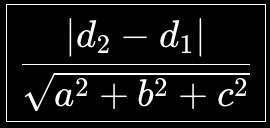
<ol><li><p>Make sure both planes are written in the form</p><p>ax+by+cz+d=0ax+by+cz+d=0</p></li><li><p>Check that the x,y,zx,y,z coefficients are the same.<br><span data-name="check_mark_button" data-type="emoji">✅</span> This confirms the planes are parallel.</p></li><li><p>Subtract the constant terms.</p><p>∣d2−d1∣∣d2​−d1​∣</p></li><li><p>Find the magnitude of the normal vector.</p><p>a2+b2+c2a2+b2+c2​</p></li><li><p>Divide the difference in constants by the magnitude of the normal vector.</p></li><li><p><span data-name="check_mark_button" data-type="emoji">✅</span> This gives the perpendicular distance between the planes.</p></li></ol><p></p>



