Topic 9: Strengthening Mechanisms in Steel

0.0(0)
studied byStudied by 0 people
0.0(0)
full-widthCall Kai
learnLearn
examPractice Test
spaced repetitionSpaced Repetition
heart puzzleMatch
flashcardsFlashcards
GameKnowt Play
Card Sorting

1/8

encourage image

There's no tags or description

Looks like no tags are added yet.

Study Analytics
Name
Mastery
Learn
Test
Matching
Spaced

No study sessions yet.

9 Terms

1
New cards
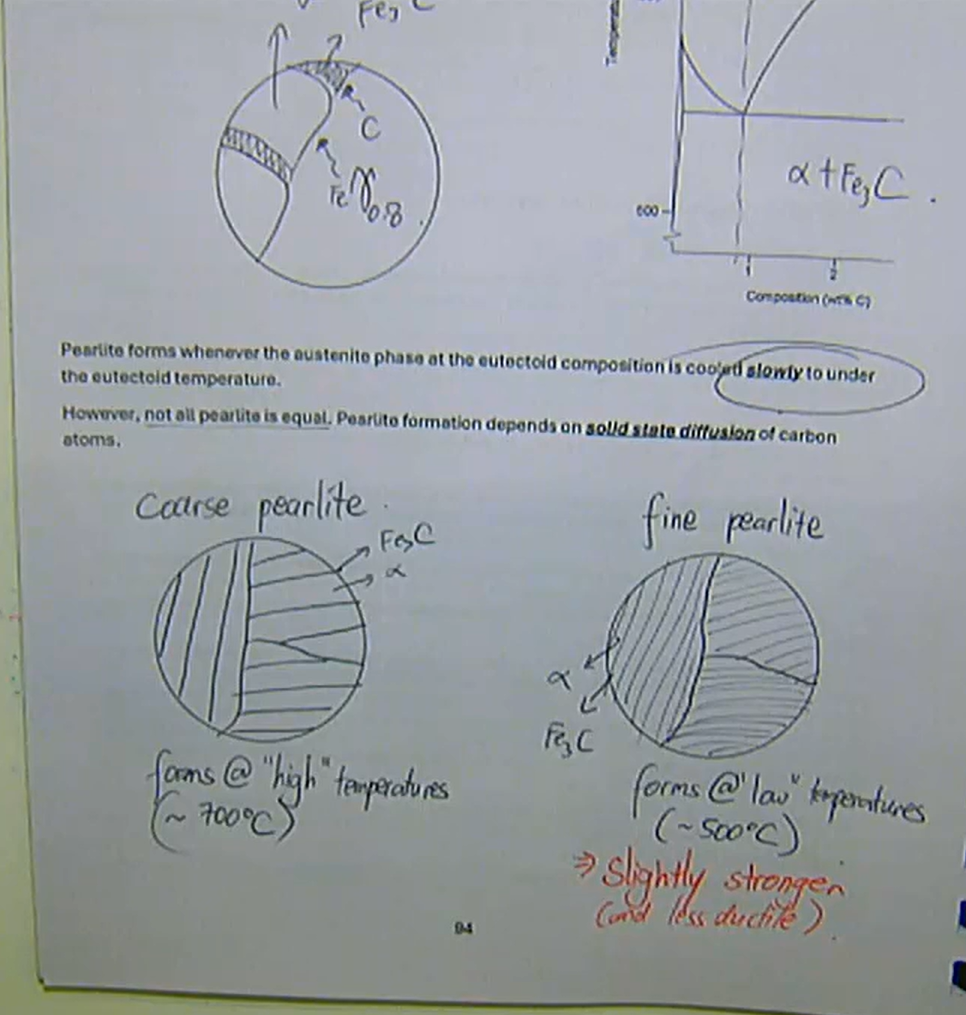
<ul><li><p>to get the layered structure required for effective multiphase strengthening in steels, recall the eutectoid transformation:<br>γ<sub>0.8</sub> = α + Fe<sub>3</sub>C</p></li><li><p>pearlite forms whenever the austenite phase at the eutectoid composition is cooled slowly to under the eutectoid temperature</p></li><li><p>however, not all pearlite is equal pearlite formation depends on solid-state diffusion of carbon atoms</p></li><li><p>coarse pearlite:</p><ul><li><p>forms at ‘high’ temperatures: ~700 degrees </p></li></ul></li><li><p>fine pearlite: </p><ul><li><p>slightly stronger (and less ductile) </p></li><li><p>forms at ‘low’ temperatures: ~500 degrees</p></li></ul></li></ul><p></p>
  • to get the layered structure required for effective multiphase strengthening in steels, recall the eutectoid transformation:
    γ0.8 = α + Fe3C

  • pearlite forms whenever the austenite phase at the eutectoid composition is cooled slowly to under the eutectoid temperature

  • however, not all pearlite is equal pearlite formation depends on solid-state diffusion of carbon atoms

  • coarse pearlite:

    • forms at ‘high’ temperatures: ~700 degrees

  • fine pearlite:

    • slightly stronger (and less ductile)

    • forms at ‘low’ temperatures: ~500 degrees

Pearlite
2
New cards
<ul><li><p>when austenite is quenched instead of slow-cooled, solid-state diffusion of carbon atoms cannot occur, and thus pearlite is not formed. Instead, a metastable phase called martensite is formed</p></li><li><p>martensite has a BCT crystal structure and is formed through shear/displacive transformation, which does not require any diffusion at all → this transformation is instantaneous</p></li><li><p>three facts about martensite:</p><ol><li><p>it is a supersaturated solid solution of carbon in atom</p><ul><li><p>at RT →&nbsp;α should have 0%</p></li><li><p>BCT → no slip systems → hard and brittle</p></li></ul></li><li><p>it is a metastable structure</p><ul><li><p>not on the Fe-C phase diagram</p></li><li><p>will transform into&nbsp;α + Fe<sub>3</sub>C IF solid state diffusion is allowed</p></li></ul></li><li><p>the hardness of martensite increases with the carbon content of the steel</p><ul><li><p>solid solution strengthening</p></li><li><p>more C → more lattice distortion</p></li></ul></li></ol></li></ul><p></p>
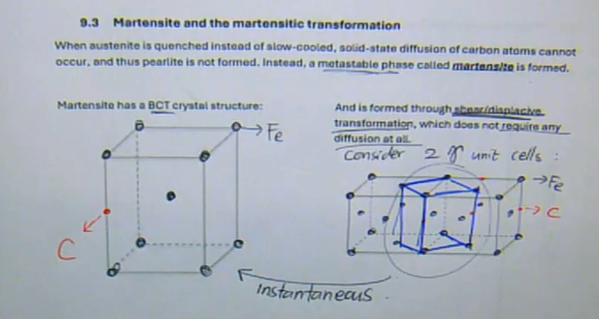
  • when austenite is quenched instead of slow-cooled, solid-state diffusion of carbon atoms cannot occur, and thus pearlite is not formed. Instead, a metastable phase called martensite is formed

  • martensite has a BCT crystal structure and is formed through shear/displacive transformation, which does not require any diffusion at all → this transformation is instantaneous

  • three facts about martensite:

    1. it is a supersaturated solid solution of carbon in atom

      • at RT → α should have 0%

      • BCT → no slip systems → hard and brittle

    2. it is a metastable structure

      • not on the Fe-C phase diagram

      • will transform into α + Fe3C IF solid state diffusion is allowed

    3. the hardness of martensite increases with the carbon content of the steel

      • solid solution strengthening

      • more C → more lattice distortion

Martensite and the martensitic transformation
3
New cards
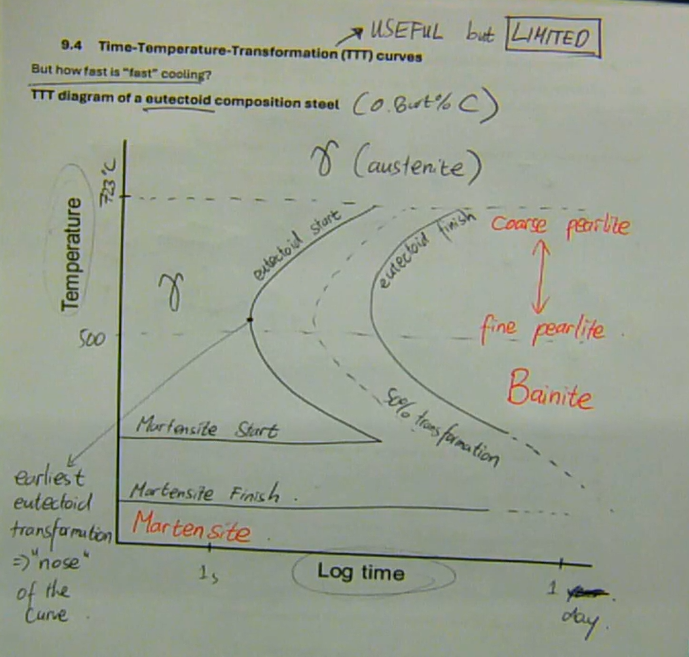
<ul><li><p>TTT diagrams are useful, but limited, because they only make sense for isothermal (constant temperature) heat treatments</p></li></ul><p></p>
  • TTT diagrams are useful, but limited, because they only make sense for isothermal (constant temperature) heat treatments

Time-Temperature-Transformation (TTT) curves
4
New cards
<ul><li><p>martensite has a BCT structure with no slip systems, which means it is very hard and strong, but extremely brittle</p></li><li><p>however, martensite is also a metastable phase, it does not appear on the Fe-C phase diagram</p><ul><li><p>will form&nbsp;α + Fe<sub>3</sub>C if solid state diffusion is allowed</p></li></ul></li><li><p>what equilibrium phase should there be under eutectoid temperature:</p><ul><li><p>M (BCT) →&nbsp;α + Fe<sub>3</sub>C (not pearlite)</p></li><li><p>this process is known as tempering and produces the microstructure known as tempered martensite</p></li></ul></li><li><p>tempered martensite is the ideal microstructure for producing optimum strength in a steel, with sufficient ductility to provide the critical property of toughness</p></li><li><p>the tempering temperature influences the size and dispersion of the Fe<sub>3</sub>C particles in the ferrite matrix and, therefore, the final mechanical properties of the steel</p></li></ul><p></p>
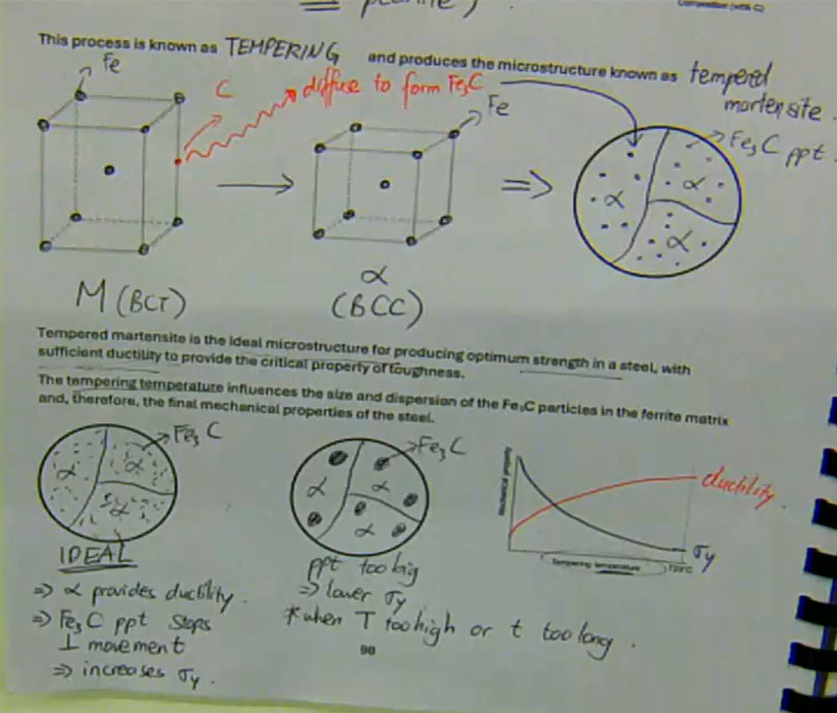
  • martensite has a BCT structure with no slip systems, which means it is very hard and strong, but extremely brittle

  • however, martensite is also a metastable phase, it does not appear on the Fe-C phase diagram

    • will form α + Fe3C if solid state diffusion is allowed

  • what equilibrium phase should there be under eutectoid temperature:

    • M (BCT) → α + Fe3C (not pearlite)

    • this process is known as tempering and produces the microstructure known as tempered martensite

  • tempered martensite is the ideal microstructure for producing optimum strength in a steel, with sufficient ductility to provide the critical property of toughness

  • the tempering temperature influences the size and dispersion of the Fe3C particles in the ferrite matrix and, therefore, the final mechanical properties of the steel

Tempered martensite
5
New cards
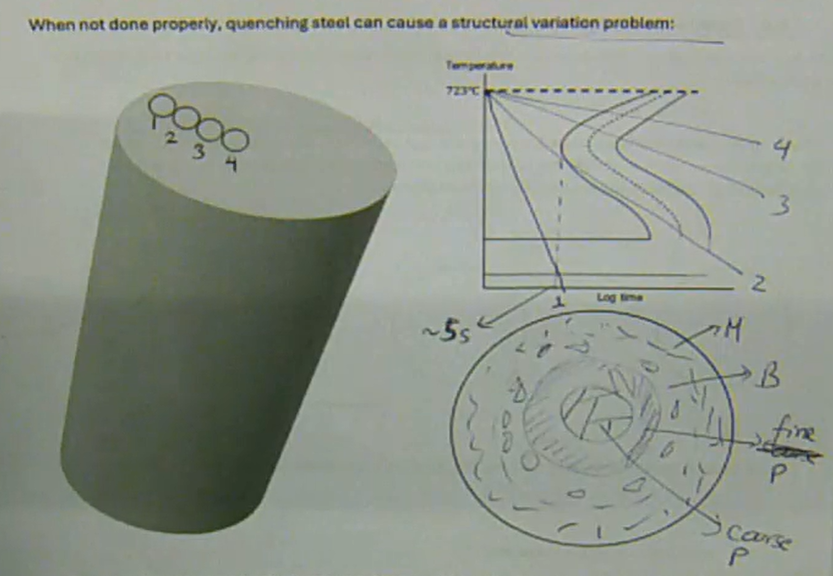
<ul><li><p>when tempering is not done properly, quenching steel can cause a structural variation problem</p></li><li><p>certain areas get cooled faster than others → <span>leads to non-uniform microstructures and mechanical properties, as well as the formation of </span><strong>highly stressed and brittle martensite</strong><span>, which can cause cracking and distortion. Improper quenching can also result in </span><strong>quenching defects</strong><span> such as oxidation, decarburization, and insufficient or uneven hardness across the material</span></p></li></ul><p></p>
  • when tempering is not done properly, quenching steel can cause a structural variation problem

  • certain areas get cooled faster than others → leads to non-uniform microstructures and mechanical properties, as well as the formation of highly stressed and brittle martensite, which can cause cracking and distortion. Improper quenching can also result in quenching defects such as oxidation, decarburization, and insufficient or uneven hardness across the material

how can quenching steel cause a structural variation problem
6
New cards
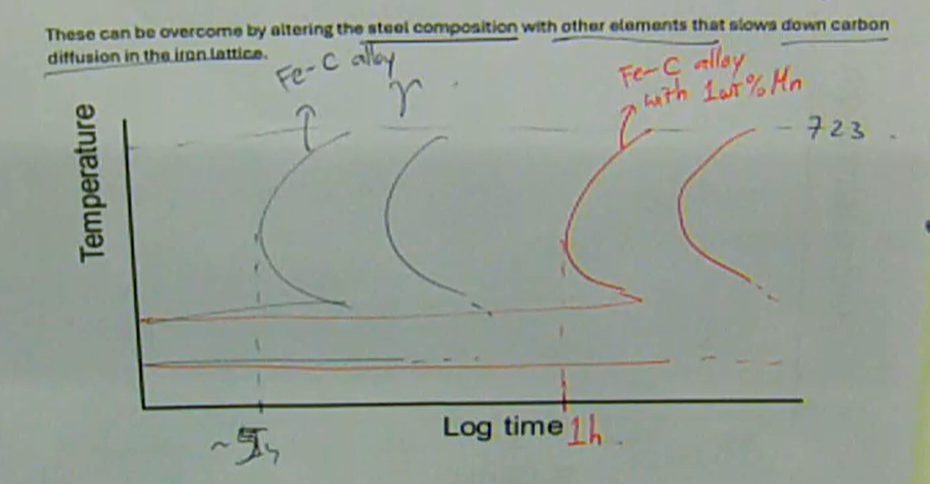
<ul><li><p>these can be overcome by altering the steel composition with other elements that slows down carbon diffusion in the iron lattice</p></li></ul><p></p>
  • these can be overcome by altering the steel composition with other elements that slows down carbon diffusion in the iron lattice

how can the quenching of steel be avoided when tempering
7
New cards
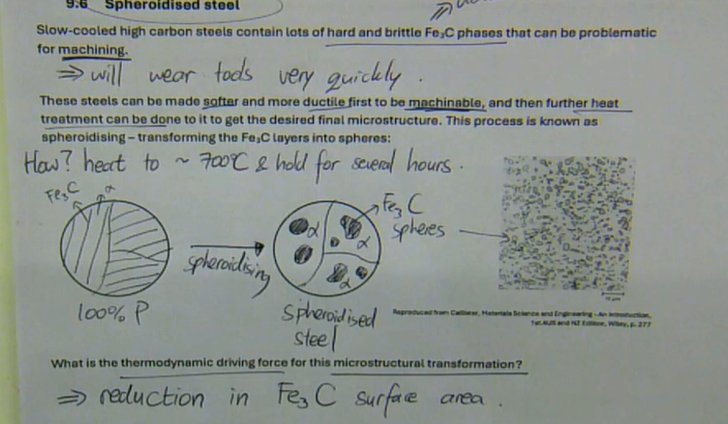
<ul><li><p>slow-cooled high carbon steel contains lots of hard and brittle Fe<sub>3</sub>C phases that can be problematic for machining</p><ul><li><p>will wear tools very quickly</p></li></ul></li><li><p>these steels can be made softer and more ductile first to be machinable, and then further heat treatment can be done to it to get the desired final microstructure</p></li><li><p>this process is known as spheroidising - transforming the Fe<sub>3</sub>C layers into spheres:</p><ul><li><p>heat to ~700 degrees and hold for several hours</p></li><li><p>100% P → spheroidised steel (made up of Fe<sub>3</sub>C within α)</p></li><li><p>the thermodynamic driving force for this microstructural transformation is a reduction in Fe<sub>3</sub>C surface area</p></li></ul></li></ul><p></p>
  • slow-cooled high carbon steel contains lots of hard and brittle Fe3C phases that can be problematic for machining

    • will wear tools very quickly

  • these steels can be made softer and more ductile first to be machinable, and then further heat treatment can be done to it to get the desired final microstructure

  • this process is known as spheroidising - transforming the Fe3C layers into spheres:

    • heat to ~700 degrees and hold for several hours

    • 100% P → spheroidised steel (made up of Fe3C within α)

    • the thermodynamic driving force for this microstructural transformation is a reduction in Fe3C surface area

spheroidised steel
8
New cards
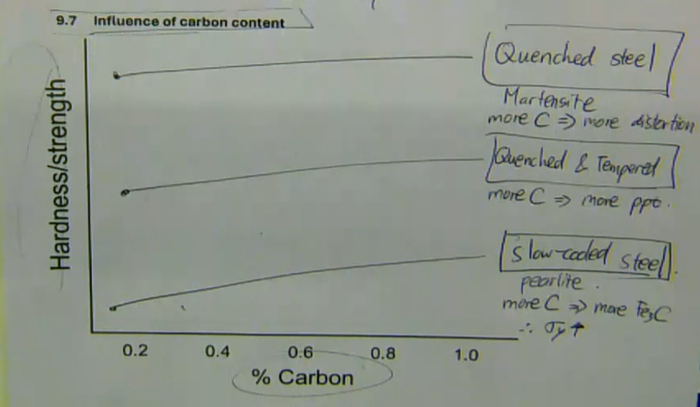
<ul><li><p>quenched steel:</p><ul><li><p>Martensite</p></li><li><p>more C → more distortion</p></li></ul></li><li><p>quenched and tempered:</p><ul><li><p>more C → more ppt</p></li></ul></li><li><p>slow-cooled steel:</p><ul><li><p>pearlite</p></li><li><p>more C → more Fe<sub>3</sub>C therefore σ<sub>y</sub></p></li></ul></li></ul><p></p>
  • quenched steel:

    • Martensite

    • more C → more distortion

  • quenched and tempered:

    • more C → more ppt

  • slow-cooled steel:

    • pearlite

    • more C → more Fe3C therefore σy

influence of carbon content
9
New cards
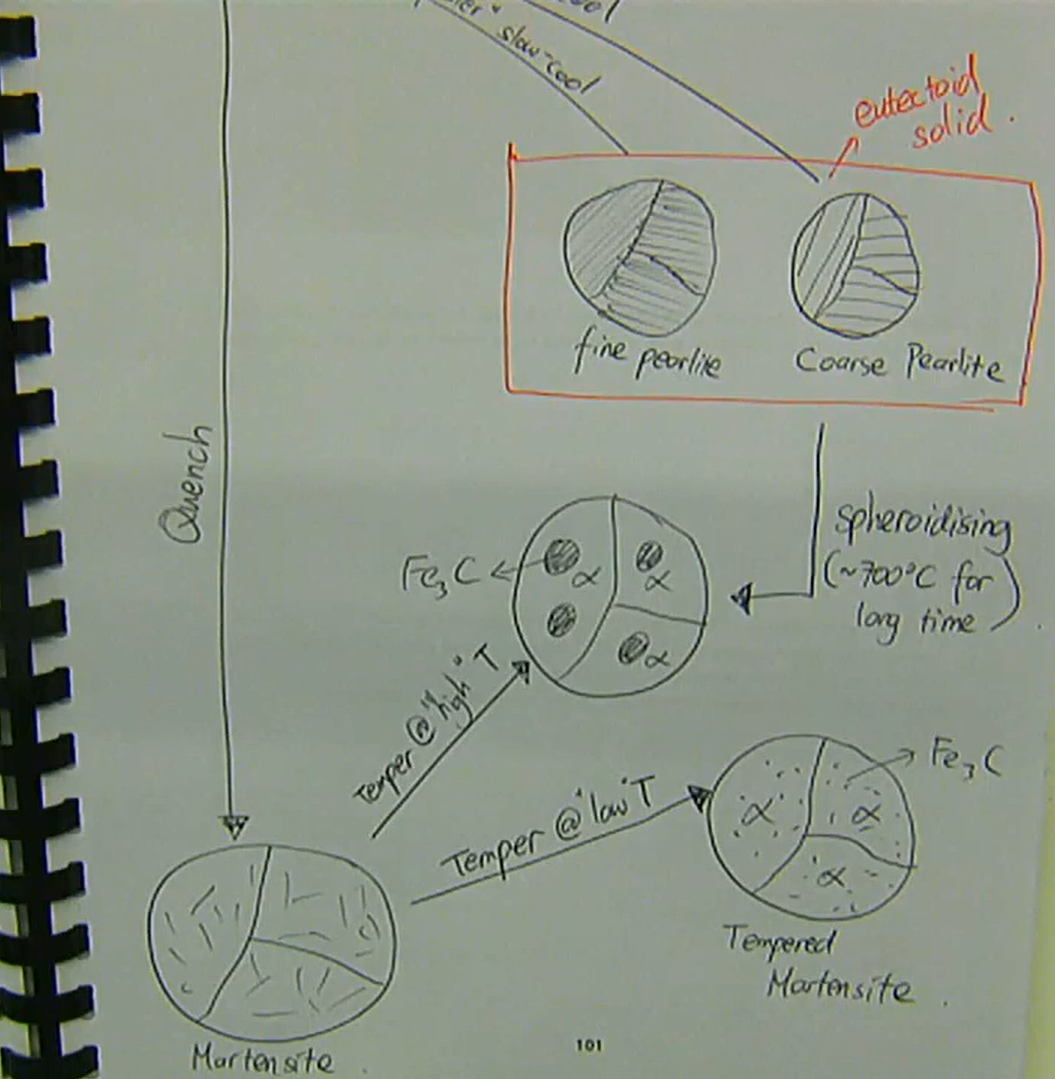
<ul><li><p>γ → austenite → FCC → weak and ductile</p><ul><li><p>slow-cooling γ:<br>→ coarse pearlite (eutectic solid)</p></li><li><p>‘faster’ slow-cool:<br>→ fine pearlite</p></li><li><p>quenching γ:<br>→ martensite → very hard and brittle</p><ul><li><p>tempering martensite at low temperature:<br>→ tempered martensite (α + Fe<sub>3</sub>C)</p></li><li><p>tempering martensite at high temperature:<br>→ α + Fe<sub>3</sub>C with larger Fe<sub>3</sub>C → also formed from spheroidising pearlite at ~700 degrees for a long time</p></li></ul></li></ul></li></ul><p></p>
  • γ → austenite → FCC → weak and ductile

    • slow-cooling γ:
      → coarse pearlite (eutectic solid)

    • ‘faster’ slow-cool:
      → fine pearlite

    • quenching γ:
      → martensite → very hard and brittle

      • tempering martensite at low temperature:
        → tempered martensite (α + Fe3C)

      • tempering martensite at high temperature:
        → α + Fe3C with larger Fe3C → also formed from spheroidising pearlite at ~700 degrees for a long time

summary of transformations in steel