Anaerobic Respiration
 Studied by 0 people
 Call with Kai
 Learn
Learn Practice Test
 Spaced Repetition
 Match
Match Flashcards
 Knowt Play
1/32

There's no tags or description
Looks like no tags are added yet.
Name | Mastery | Learn | Test | Matching | Spaced | Call with Kai |
|---|
No analytics yet
Send a link to your students to track their progress
33 Terms
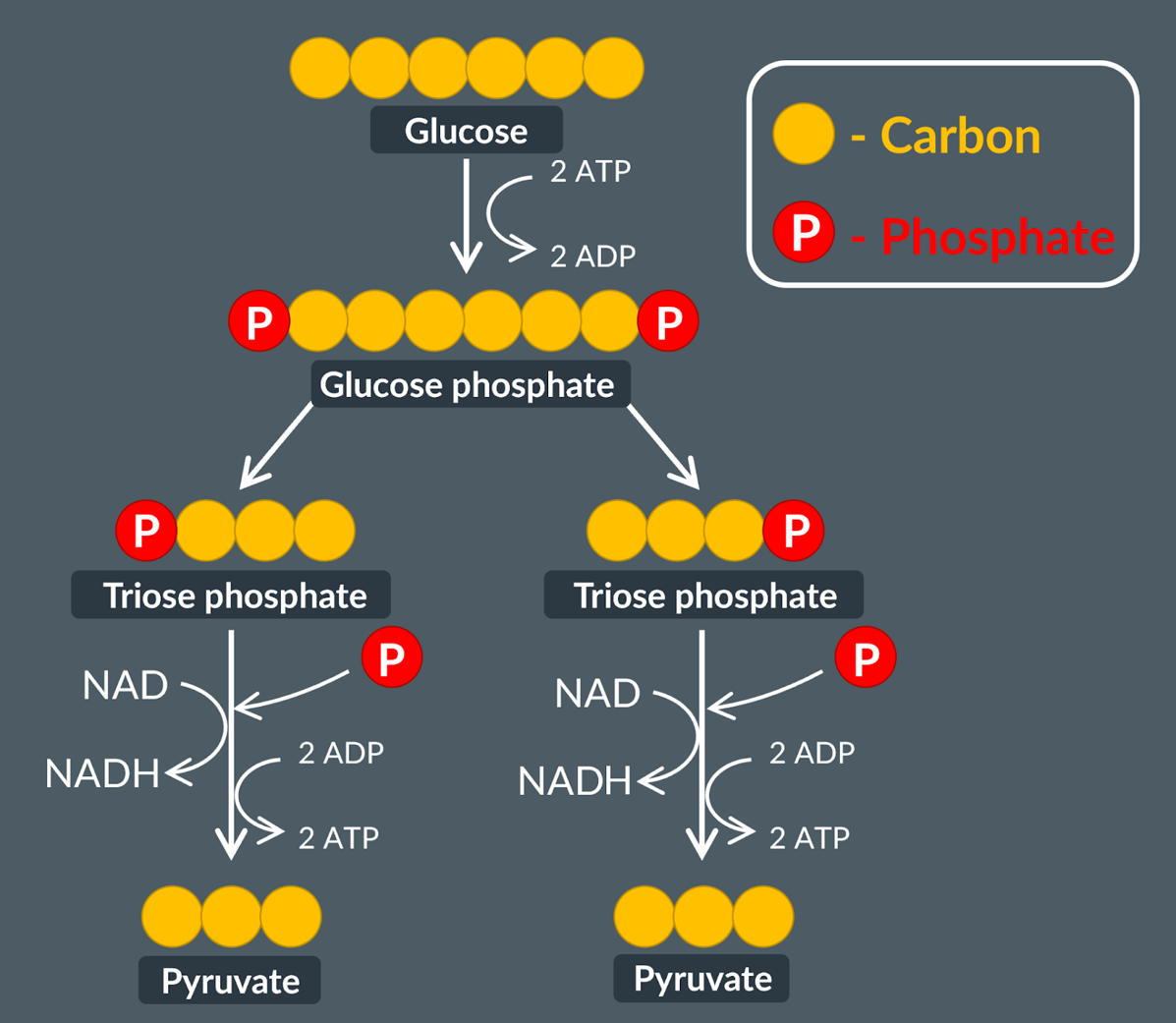
Glycolysis Recap
The first stage in both aerobic and anaerobic respiration is glycolysis, which takes place in the cytoplasm.
At A-level, an important detail in respiration is the number of carbon atoms in each molecule.
To make these carbon numbers really easy to spot, we represent glycolysis like this:
Glycolysis is key to understanding anaerobic respiration. So, if anything in this diagram looks unfamiliar, you should watch the videos on glycolysis before continuing with this set of videos!
At the end of glycolysis, we’re left with two molecules containing 3 carbons, which are called…
pyruvate
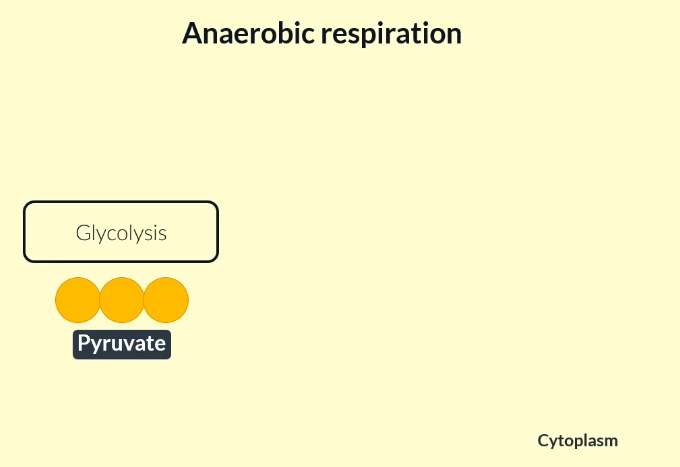
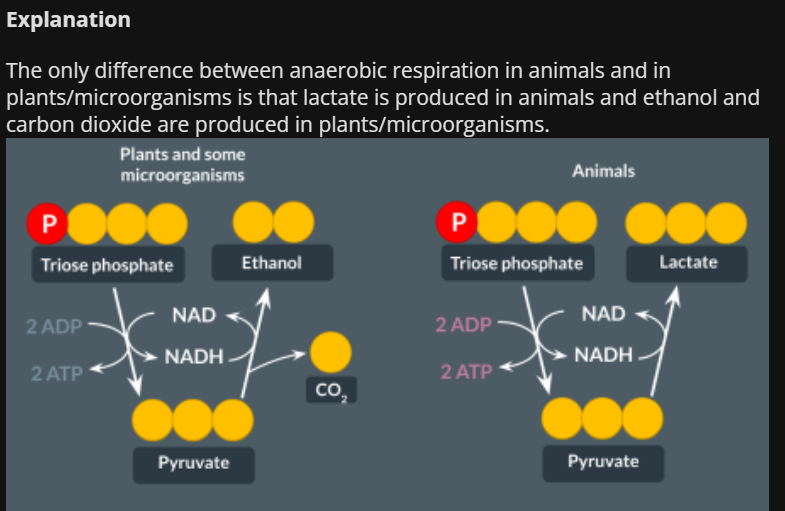
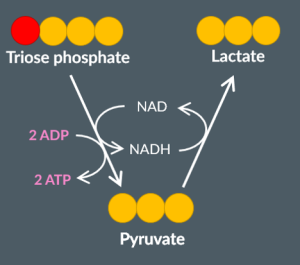
2nd stage of anaerboic repsiration in ANIMALS can be repersented as this after glycolysis prodcuts are converted

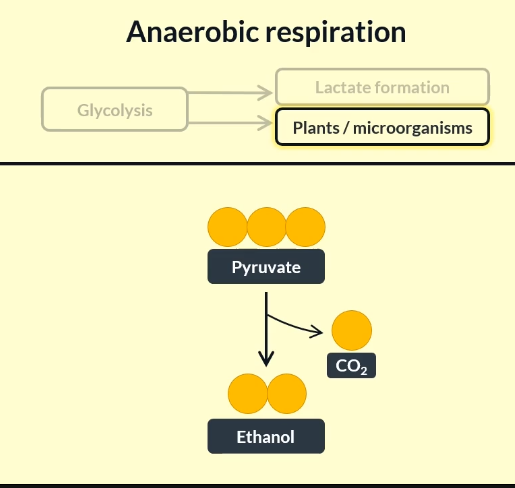
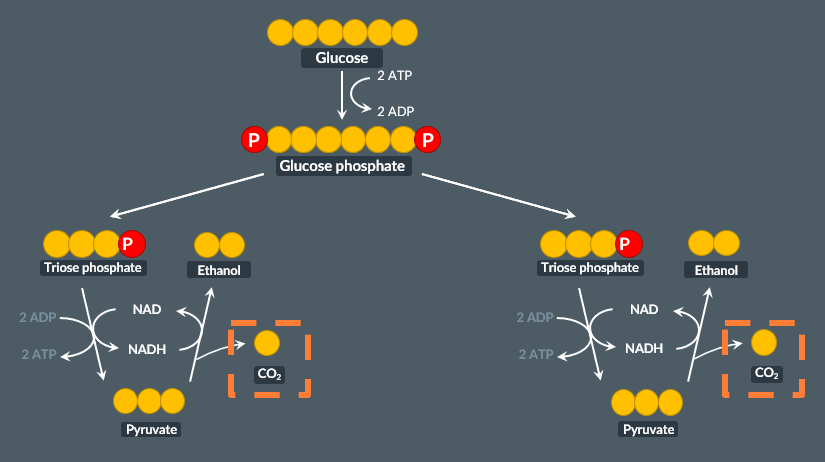
2nd stage of anaerboic repsiration in PLANTS can be repersented as this after glycolysis prodcuts are converted
During anaerobic respiration in animals, pyruvate is converted to…
lactate.
ethanol.
glucose.
ATP.
A
During anaerobic respiration in plants and microorganisms, pyruvate is converted to…
lactate.
ethanol.
glucose.
ATP.
B
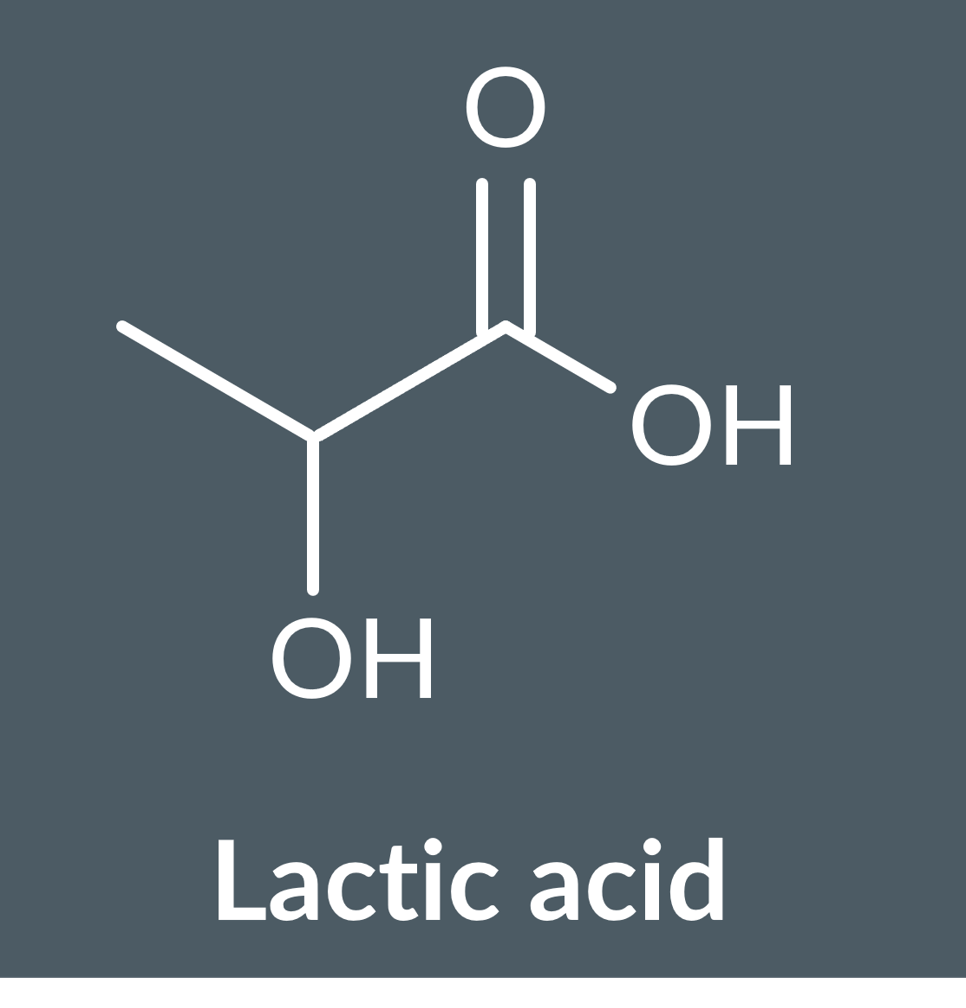
Lactate vs Lactic Acid
At A-level, we’ve now seen that the final product in anaerobic respiration in animals is lactate.
However, at GCSE, you may have seen this equation for anaerobic respiration in animals:
glucose → lactic acid
So, why are different products given?
Lactate and lactic acid have very similar chemical structures. The only difference between them is that lactic acid has an extra hydrogen atom bonded to an oxygen atom.
During anaerobic respiration in animals, pyruvate is first converted to lactic acid. However, the majority of lactic acid is then converted to lactate and protons (H+).
As they’re so similar in structure, lactate and lactic acid are often used interchangeably.
However, since lactate is the name given in the A-level specification, this is the name you should use in the exam.
In order to form lactate, pyruvate needs hydrogen.
When pyruvate gains hydrogen this means that it is…
hydrated.
hydrogenated.
reduced.
oxidised.
C
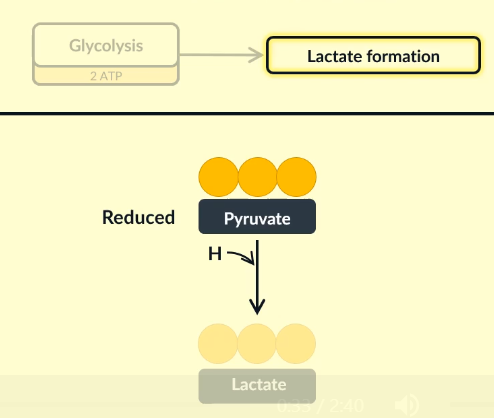
Hydrogen is supplied by reduced NAD.
So, when reduced NAD loses hydrogen, it is…
dehydrated.
dehydrogenated.
reduced.
oxidised.
And is as a redult of glycolysis
D
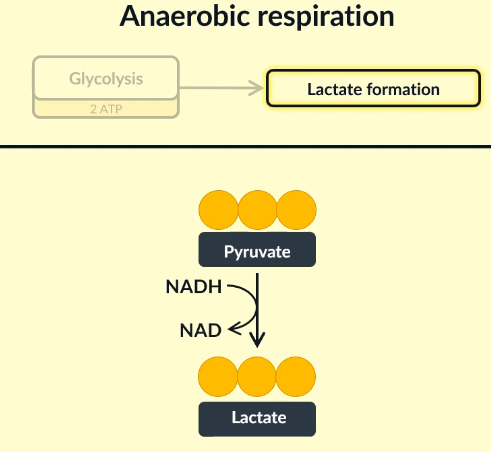
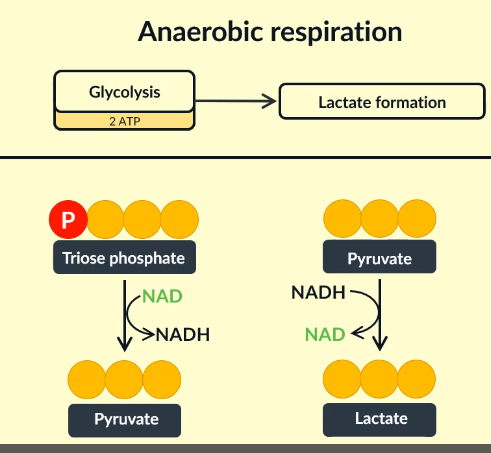
Describe the stage of glycolysis in which reduced NAD is produced.
triose phosphate is converted to pyruvate
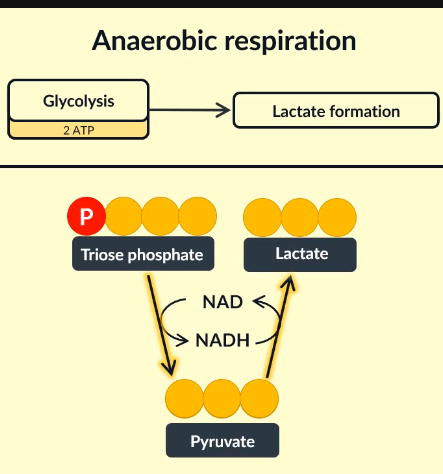
The conversion triose phosphate into pyruvate also produces…
ATP.
ADP.
glucose.
reduced NAD.
A
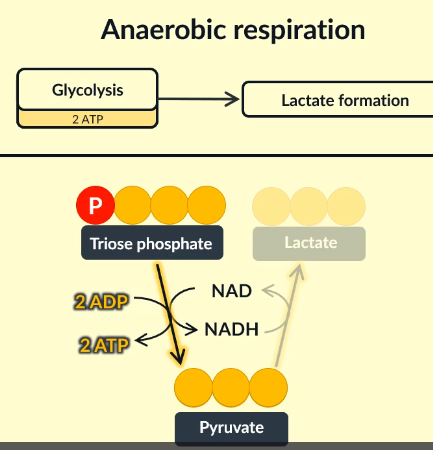
When pyruvate is converted to lactate…
Select all that apply
pyruvate is reduced.
ATP is produced.
NAD is reduced.
pyruvate is oxidised.
NADH is oxidised.
ADP is produced.
A E
(pyruvate os reduced as it gains hydrogen from reduced NAD (NADH) which s osidised in this process to produce NAD)
During anaerobic respiration in animals……….. is reduced to………..Hydrogen atoms for this reaction are provided by……….. which is converted into………. This NAD molecule then returns to glycolysis, specifically the stage in which………is converted…………This ensures glycolysis can continue and ATP is produced.
pyruvate
lactae
NADH
NAD
triosephosphate
pyruvate

During anaerobic respiration in animals, pyruvate is…
oxidised to lactate.
reduced to lactate.
reduced to NAD.
oxidised to NAD.
B
Which of the following statements about anaerobic respiration is correct?
NADH provides hydrogens for the reduction of lactate into pyruvate, and is itself oxidised to NAD.
NAD provides hydrogens for the reduction of pyruvate into lactate, and is itself oxidised to NADH.
NADH provides hydrogens for the reduction of pyruvate into lactate, and is itself oxidised to NAD.
C ( not A as pyruvate is redcued to lactate and not B as NADH is oxidised to NAD
)
NAD produced in anaerobic respiration returns to glycolysis, specifically the stage where…
triose phosphate is converted to pyruvate.
glucose is converted to glucose phosphate.
glucose phosphate is converted to triose phosphate.
A
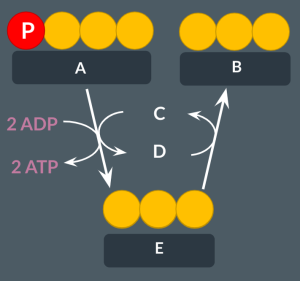
The image below shows anaerobic respiration in animals.
Give the name of the process that converts molecule C to molecule D.
A: triose-phosphate
B: lactate
C: NAD
D:NADH
E: pyruvate
reduction (as NAD gains a poroton(electrons) to form NADH)
During anaerobic respiration in plants and some microorganisms, pyruvate is converted to…
ethanol and CO2
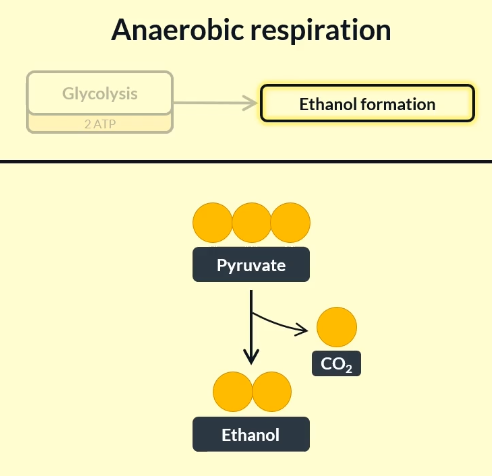
In the conversion of pyruvate to ethanol and carbon dioxide, pyruvate gains hydrogen.
This hydrogen is provided by NADH.
So, NADH is ………….while pyruvate is…………
oxidised
reduced
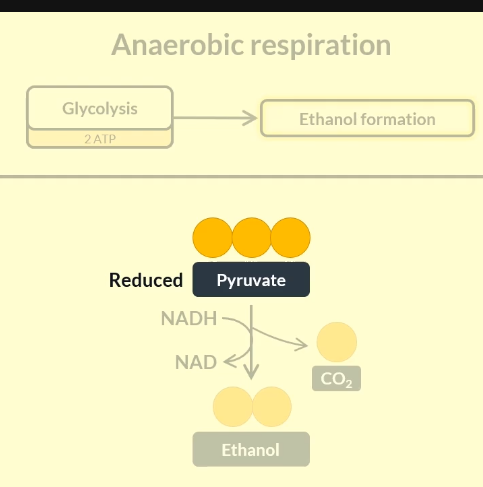
When pyruvate is converted to ethanol, oxidation and reduction take place.
Pyruvate is …….. while NADH is………..
reduced
oxidised
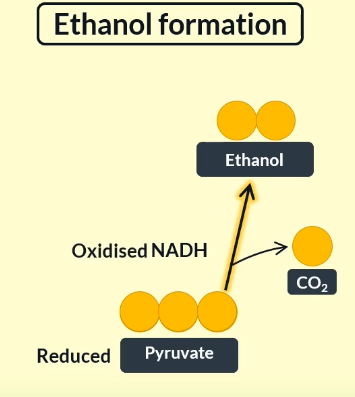
The NAD is returned to be used in ……..
glycolysis
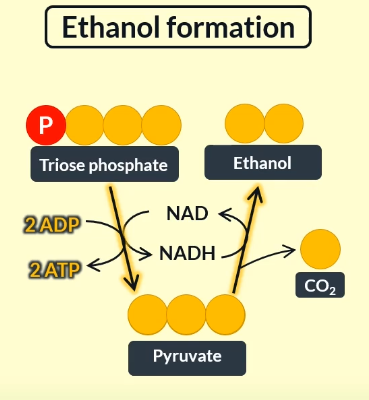
Identify whether the following are features of anaerobic respiration in animals, plants and some microorganisms, or both.
a)ATP is produced.
b) Pyruvate is converted to ethanol
c) NADH is oxidised to NAD.
d) Carbon dioxide is produced.
e) Lactate is produced.
Both
Plants and microorganisms
Both
Plants and microorganisma
Animals
Explain how the conversion of pyruvate to lactate allows ATP to be continuously produced.
In anaerobic respiration in animals, pyruvate is reduced to lactate as it gains hydrogens from NADH.
Therefore, NADH is oxidised into NAD.
The NAD formed in this reaction returns back to glycolysis, ensuring glycolysis can continue and ATP can be produced.
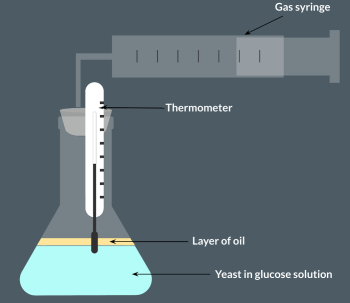
Some students investigated anaerobic respiration in yeast using the set-up below.
Yeast was mixed in a glucose solution and added to a beaker. The solution was at 25°C.
A layer of oil was added to the top of the solution. Suggest why.
The layer of oil prevents oxygen from entering the solution, which prevents aerobic respiration in the yeast.
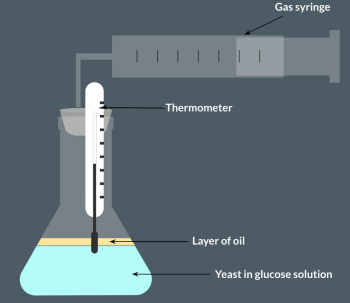
Some students investigated anaerobic respiration in yeast using the set-up below.
Yeast was mixed in a glucose solution and added to a beaker. The solution was at 25°C.
After 5 minutes, the gas syringe pushed out to 3cm3. Explain why the gas syringe pushed out.
Gas syringe measures the amount of gas in the container.
It pushed out as CO2 was produced as a result of anaerobic respiration in yeast.
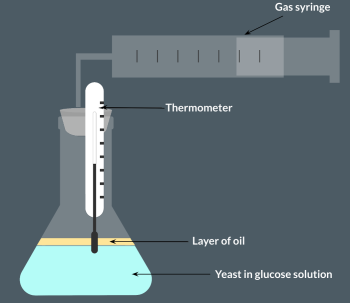
Some students investigated anaerobic respiration in yeast using the set-up below.
Yeast was mixed in a glucose solution and added to a beaker. The solution was at 25°C.
The students then repeated the experiment with the yeast solution at 30°C. This time, the gas syringe pushed out to 7cm3. Using your knowledge of enzymes, explain why more gas was produced.
Anaerobic respiration is an enzyme-controlled reaction.
The higher temperature was closer to the optimum temperature of the enzymes responsible for anaerobic respiration in yeast.
As a result, the enzymes worked faster at the higher temperature so the rate of anaerobic respiration was higher and more CO2 was produced.
What Happens to the Products of Anaerobic Respiration?
We’ve seen that anaerobic respiration in animals produces lactate and that anaerobic respiration in plants and some microorganisms produces ethanol and carbon dioxide.
We’ll now focus on what happens to lactate and ethanol after anaerobic respiration
What do you need to know for the exam?
In the exam, you don’t need to remember what happens to lactate and ethanol after they’re formed. Instead, you just need to remember which products form for which species during anaerobic respiration.
Lactate: If lactate builds up in the body, it can decrease the pH of the blood. This can result in a range of symptoms such as muscle pain and headaches. Fortunately, our bodies have ways of dealing with this pesky molecule.
First, lactate can be converted back into pyruvate. This pyruvate can then participate in anaerobic respiration again, or if oxygen is now available, it can move into the mitochondria to continue aerobic respiration.
Second, lactate can be converted into glycogen, which is a storage molecule.
Ethanol: Ethanol doesn’t have a use inside plant or microorganism cells, and so it is expelled as a waste product. However, it is used by the food and drink industry to make alcohol
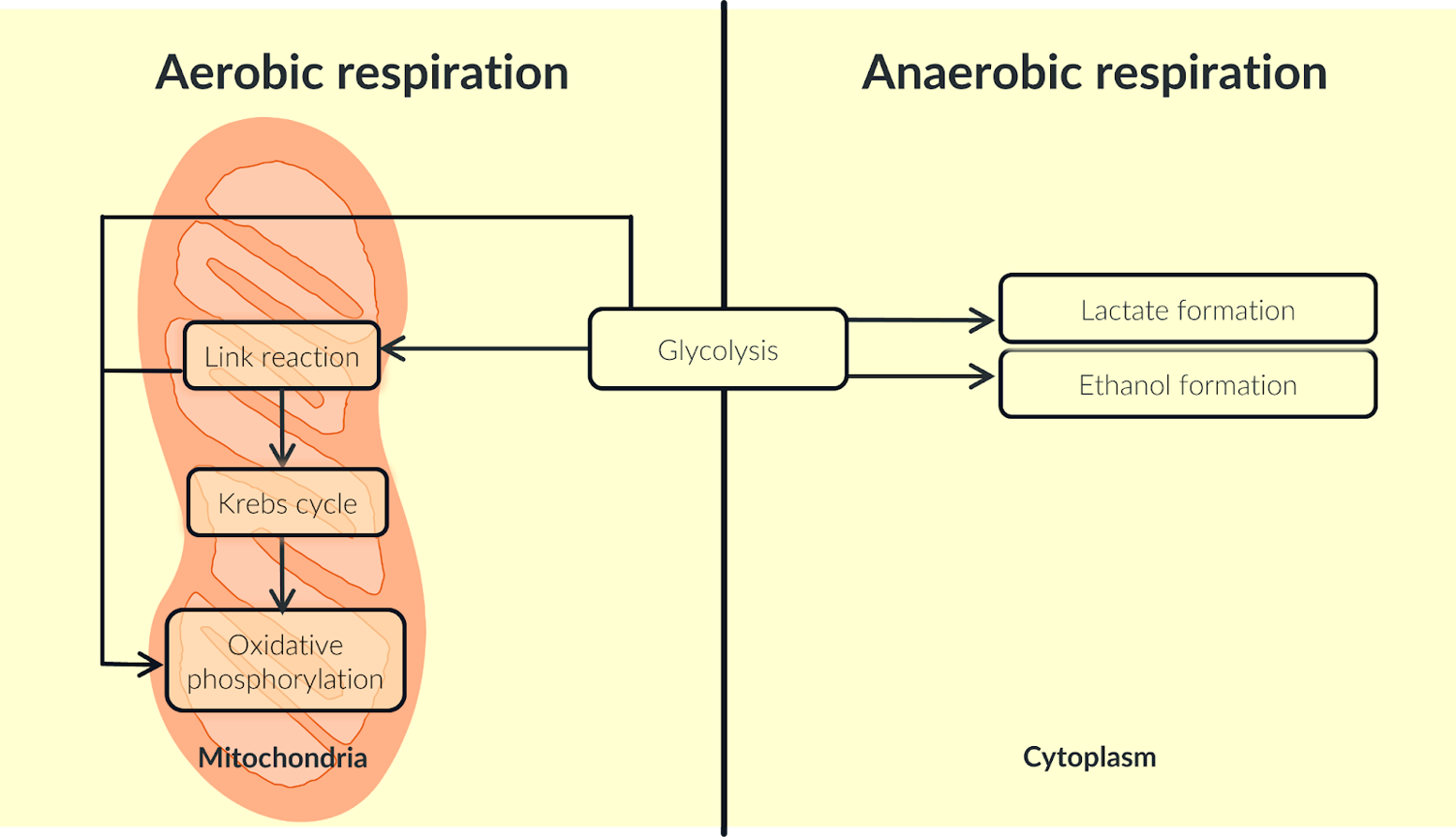
Aerobic Respiration vs Anaerobic Respiration:
This article focuses on two differences: the location of the types of respiration and their ATP yield.
Location: Anaerobic respiration takes place just in the cytoplasm..
Aerobic respiration, on the other hand, takes place in both the cytoplasm and the mitochondria.
Yield: From a single molecule of glucose, there’s an overall yield of 2 ATP in anaerobic respiration. This is because the only stage that produces ATP is glycolysis.
However, in aerobic respiration, ATP is made in glycolysis, the Krebs cycle and oxidative phosphorylation. From a single glucose molecule, it’s possible for over 30 ATP molecules to be made during oxidative phosphorylation.
Therefore, aerobic respiration produces way more ATP than anaerobic respiration!
Finally, as well as the location of the type of respiration and the ATP yield, you may also be expected to compare the stages involved in each type of respiration as well as the molecules produced. So, you should ensure that you’re familiar with all of the stages and reactions in both aerobic and anaerobic respiration

Identify whether the following are features of aerobic respiration, anaerobic respiration or both.
a) ATP is produced.
b) Takes place in only the cytoplasm.
c) CO2 is produced.
d) Triose phosphate is converted into pyruvate.
e) NADH is oxidised to NAD.
Both:ATP is produced in both aerobic and anaerobic respiration but way more ATP is produced in aerobic respiration.
Anaerobic resp: The glycolysis stage of aerobic respiration takes place in the cytoplasm but the remaining stages, the link reaction, Krebs cycle and oxidative phosphorylation, take place in the mitochondria. Anaerobic respiration only takes place in the cytoplasm.
Both:CO2 is produced in the link reaction and in the Krebs cycle in aerobic respiration, and is also produced in anaerobic respiration in plants and microorganisms
Both:The conversion of triose phosphate to pyruvate takes place during glycolysis. Both aerobic and anaerobic respiration involve glycolysis.
Both: NAD produced during anaerobic respiration is used in glycolysis to keep producing ATP.
NADH is oxidised to NAD during oxidative phosphorylation.
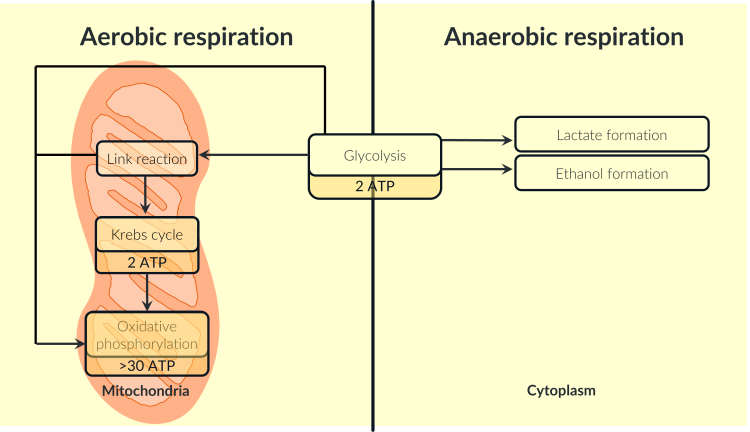
Explain why more ATP is produced in aerobic respiration compared to anaerobic respiration.
From a single molecule of glucose, there’s an overall yield of 2 ATP in anaerobic respiration.
This is because the only stage that produces ATP is glycolysis.
However, in aerobic respiration, ATP is made in glycolysis, the Krebs cycle and oxidative phosphorylation.
From a single glucose molecule, it’s possible for over 30 ATP molecules to be made during oxidative phosphorylation.
Therefore, aerobic respiration produces more ATP than anaerobic respiration.
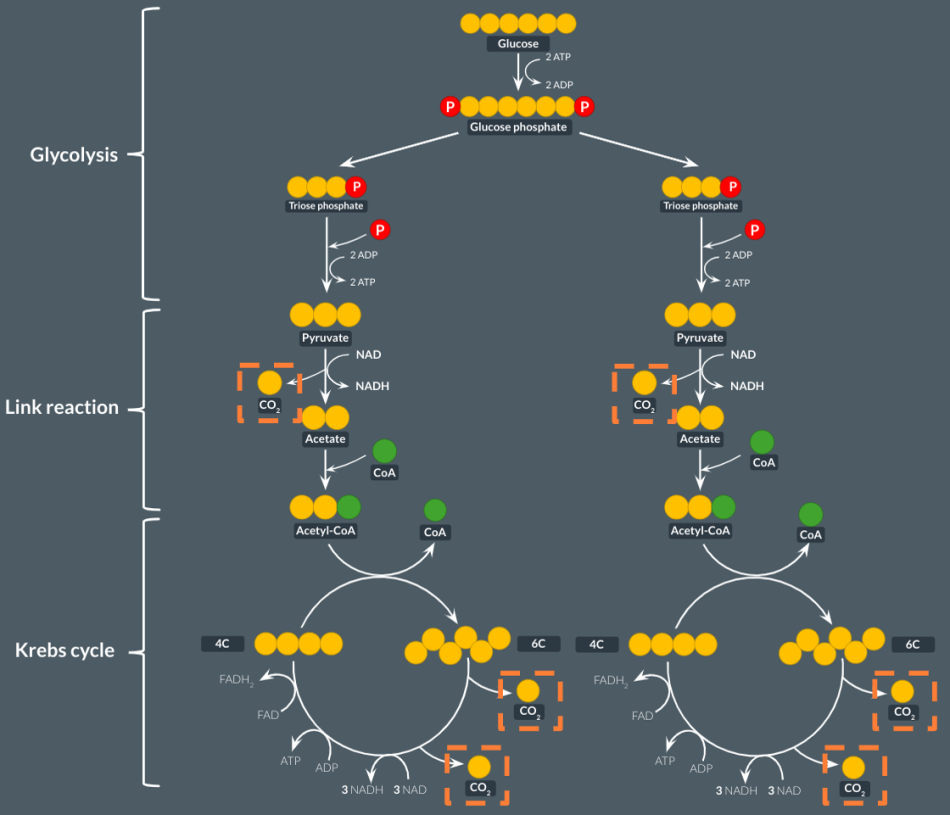
In plants, for a single molecule of glucose, how many CO2 molecules are produced in aerobic respiration?…………
In plants, for a single molecule of glucose, how many CO2 molecules are produced in anaerobic respiration?…………
6: In aerobic respiration, 2×CO2 is produced per glucose molecule during the link reaction, and 4×CO2 is produced per glucose molecule during the Krebs cycle.
2: In anaerobic respiration in plants, 1×CO2 is produced per triose phosphate molecule in the conversion of pyruvate to ethanol. As 2× triose phosphate molecules are produced per glucose molecule, 2×CO2 molecules are produced per glucose molecule in anaerobic respiration.
Some scientists investigated the effect of regular exercise on respiration in humans. A group of volunteers were split into two groups. Group A followed a vigorous exercise plan for 6 months. Group B did not exercise.
After 6 months, the scientists compared the time that the volunteers could run continuously. It was found that volunteers from Group B became fatigued and stopped much more quickly than those from Group A, as a result of build-up of lactate in the muscles. Using your knowledge of respiration, explain why.
Lactate is produced during anaerobic respiration. In Group B individuals, anaerobic respiration took place sooner than in Group A individuals, so there was more lactate present. Anaerobic respiration also produces less ATP than aerobic respiration so less ATP was available for muscle contraction during running, so Group B became fatigued quicker.
Some scientists investigated the effect of regular exercise on respiration in humans. A group of volunteers were split into two groups. Group A followed a vigorous exercise plan for 6 months. Group B did not exercise.
A sample of muscle fibre was obtained from the volunteers after 6 months. The muscle fibres were then stained for citrate synthase, an enzyme in the Krebs cycle.
What difference would you expect to see in the staining of muscle fibres between Group A and Group B individuals? Explain your reasons.
Individuals in Group A were able to carry out aerobic respiration for longer, delaying anaerobic respiration, and produce more ATP to keep running for longer.
Group A are able to carry out aerobic respiration for longer, which is explained by more mitochondria present as a result of the 6 months of training. The Krebs cycle takes place in the mitochondria, so more citrate synthase is expected to be found in Group A individuals. Therefore, darker staining would be expected in Group A individuals.
 Note
Note  Flashcards (49)