Week 9 - prosocial behaviour
 Studied by 0 people
 Call Kai
 Learn
Learn Practice Test
 Spaced Repetition
 Match
Match Flashcards
 Knowt Play
1/25

There's no tags or description
Looks like no tags are added yet.
Name | Mastery | Learn | Test | Matching | Spaced | Call with Kai |
|---|
No analytics yet
Send a link to your students to track their progress
26 Terms
Altruism:
the desire to help another person even if it involves a cost to the helper
Darwin’s Theory of Evolution: Kin selection
Natural selection favours genes that promote the survival of the individual
Genes that further survival and increase the probability of producing offspring are more likely to be passed on to the next generation
Genes promote selfish behaviour as then more likely to be passed on.
Kin selection: the idea that behaviours that help a genetic relative are favoured through natural selection - help those who share genetics survive so genetics passed on.
Increase chances genes will be passed by ensuring that genetic relatives have children
Natural selection should favour altruistic acts directed towards genetic relatives
Bernstein et al 1994:
survey research people report that they would be more likely to help genetic relatives than non relatives in life-and-death situations such as house fire. :( self report
Anecdotal evidence from real emergencies is consistent with these results - fire in hotel and found people looked for family members compared to friends.
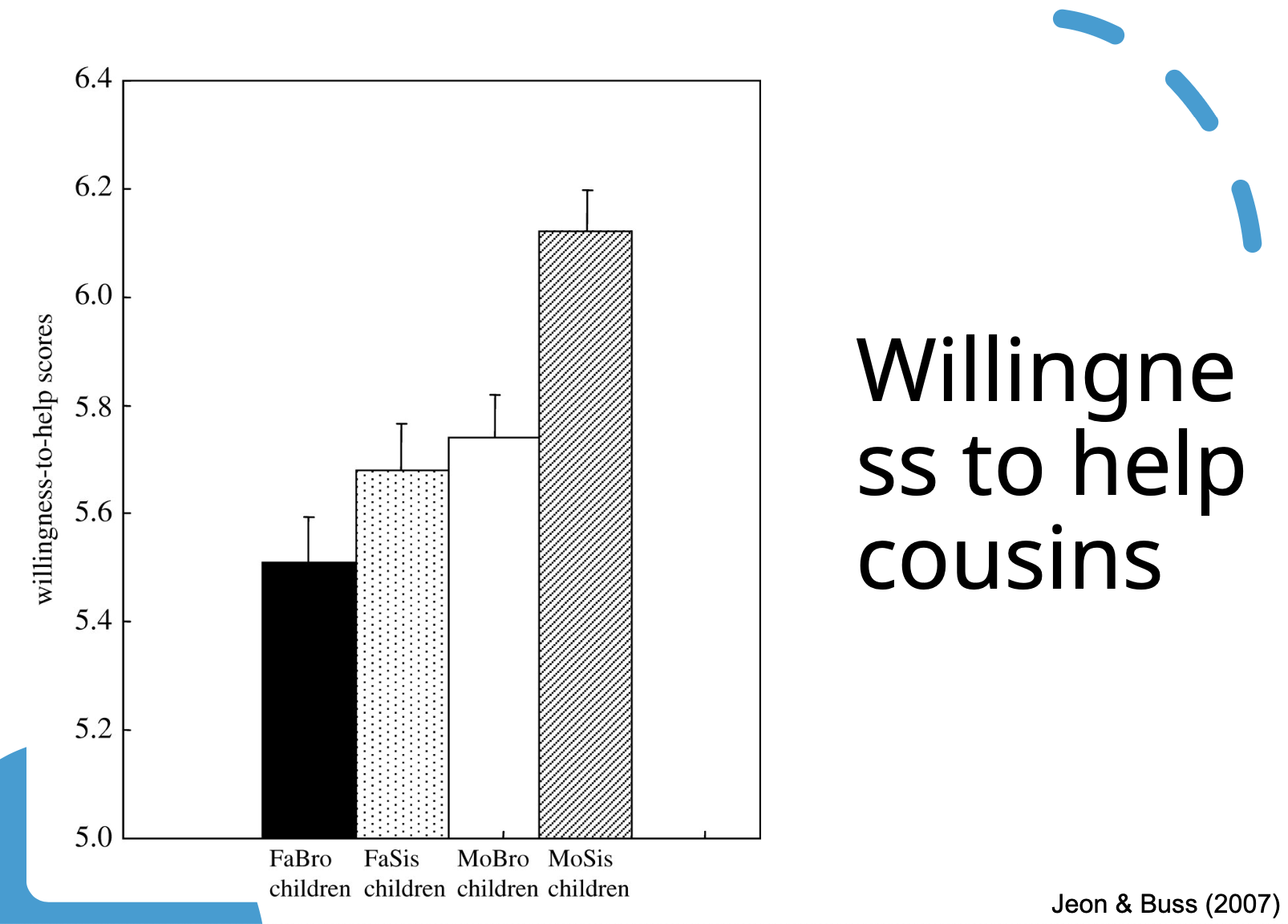
Jeon & Buss 2007 - willingness to help cousins.
Different ways to genetically have cousins: fathers brother child, fathers sisters child, mothers sisters child, mothers brothers child
Hypothesised that influence of how altruistic you are is impacted by how genetically similar you are to cousin.
Due to paternity uncertainty - more likely to be genetically similar to some cousins than others. Women sure their baby is theirs but fathers have uncertainty.
Mothers, sisters child = no paternal uncertainty. More likely to be genetically similar to mother’s sisters child. But mothers brother = some paternal uncertainty. Father’s brother - highest genetic uncertainity.
More likely to help mothers sisters child cousin.
Innate predisposition to be more willing to help those who are more likely to pass our genetics
explain Prosocial behaviour towards strangers
Makes sense to be prosocial to strangers to foster group living which increase survival. Helps relationships be formed which helps survival
It doesn’t make sense to be altruistic to strangers — risking the self (own genes) for those who do not share your genes
It does make sense to be altruistic to family - risk self to collectively pass on shared genes
Social exhange theory - Thibault and Kelly 1959
What u do stems from desire to maximise reward and minimise cost
In relationships with others, try to maximise the rations of social rewards to social costs
Helping another can be rewarding:
The norm of reciprocity - increase likelihood of future help/ someone will help us when we need it
Gain - social approval, Increased feelings of self worth, Relief of bystander distress
Costs of helping others -Physical danger, Pain, Embarrassment, Time
According to social exchange theory - altruism doesn’t exist. People help when the benefits outweigh the costs.
However - people do help when costs massively outweigh rewards. No genetic reward or personal reward
Due to empathic concern
Empathy
The ability to put oneself in the shoes of another person and experience events and emotions (e.g., joy and sadness) the way that person experiences them
Empathy-Altruism Hypothesis (Batson, 1991)
When we feel empathy for a person, we will be inclined to help that person for altruistic reasons, regardless of what we have to gain
issue with empathy as reason for altruistic behaviour
Difficult to test peoples true intentions; is it empathy. e.g. agentic narcissism - showing off and look good. Communal narcissism - wanting to be seen as the best at helping others.
Tested by seeing if anyone is watching or if they tell people. However, does it matter? Help is still given.
Toi & Batson, 1982 - empathy experiment method
psych ppts asked to evaluate recordings of new programmes for the university radio station. Called news from the personal side. Told there were lots of submissions about people talking about personal matters at uni.
All ppts listened to clip from carol - spoke about car crash and loosing both legs. Difficulty to keep up with her intro to psych course, concerned about falling behind. Need to support brother and sister so need to graduate on time and support children with a well paid job. Mentioned that she will have to drop out of class unless she can find another student to help her. Ppts told they were the only ones who would hear this interview. Told research didnt know who had carol’s story - all anonymous. Requested that the individual who had carol could share notes with her - says carol is reluctant to ask someone but agreed if completely anonymous help found she would share story.
High empathy condition - try to imagine how the person felt and how it affected their life - predisposition of empathetic perspective
Low empathy condition - told to be objective and not concerned about how carol felt.
Those in high empathy condition reported feeling more empathy
Also manipulated self interest: varied how costly it would be to not help carol
High cost / self interest - told carol would be returning to psych class following week: high empathy and guilt as seeing her in person in wheelchair
Low cost - carol would continue studying from home - no cost of interaction
Basically 4 conditions: high empathy + high self interest, low empathy + high self interest, high empathy + low self interest, low empathy + low self interest.
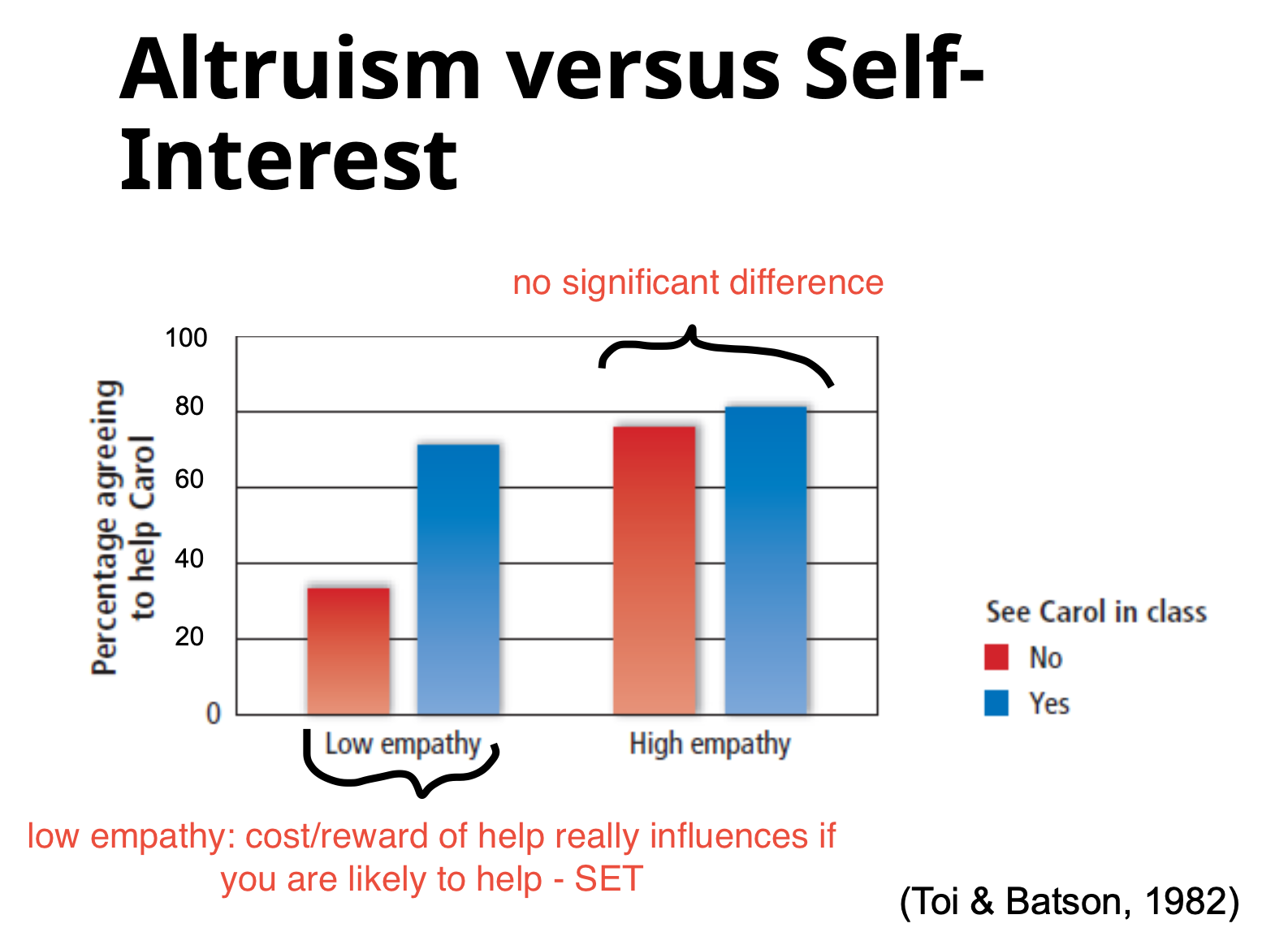
Toi & Batson, 1982 - empathy experiment results
Regardless of how costly it was to help Carol, those in high empathy condition were more likely to help.
Three Basic Motives Underlying Prosocial Behaviour
Three Basic Motives Underlying Prosocial Behaviour: Evolutionary psychology, Social exchange theory, Empathy- altruism hypothesis
Altruistic Personality
The qualities that cause an individual to help others in a wide variety of situations.
Gender Differences (Eagly, 2009; Eagly & Koenig, 2006; Einolf, 2011) - Altruistic Personality
Men are more likely to engage in heroic acts
Women are more likely to engage in nurturing long-term relationships
Cultural Differences (Levine, 2003; Levine, et al., 2001; Ramírez-
Esparza et al., 2012) - Altruistic Personality - Simpatia
Simpatia – refers to a range of social and emotional traits including being friendly, polite, good-natured, pleasant, and helpful towards others
A higher percentage of people in countries that value Simpatia engaged in helping behaviours
Who Are We Most Likely To Help? Empathy-altruism Theory:
We help in-group members due to our empathy however - may be more due to self interests, not similarity to member. Can fuel self identity when you identify with social groups as put more effort into the group
We help out-group members due to potential for gaining rewards
Who Are We Most Likely To Help? Religion
Religious people are more likely than non-religious people to help people in need (if they share their religious beliefs)
Religious people are no more likely to help strangers. Religious beliefs increase hostilities toward outgroup members
Situational Determinants of Prosocial Behaviour: When Will People Help? Smaller vs larger towns
People are more likely to help in smaller compared to large towns
Why?
• Residential Mobility - more likely to help those you interact with more frequently
• Urban Overload Hypothesis - overstimulation due to large number of people therefore people often retreat from care. People often report being in larger towns can feel lonely
The Bystander Effect - case study
• Kitty Genovese’s prolonged murder
• Many witnesses failed to call police.
• Bibb Latané and John Darley (1970) considered why few bystanders helped.
• The greater the number of bystanders who observe an emergency, the less likely any one is to help.
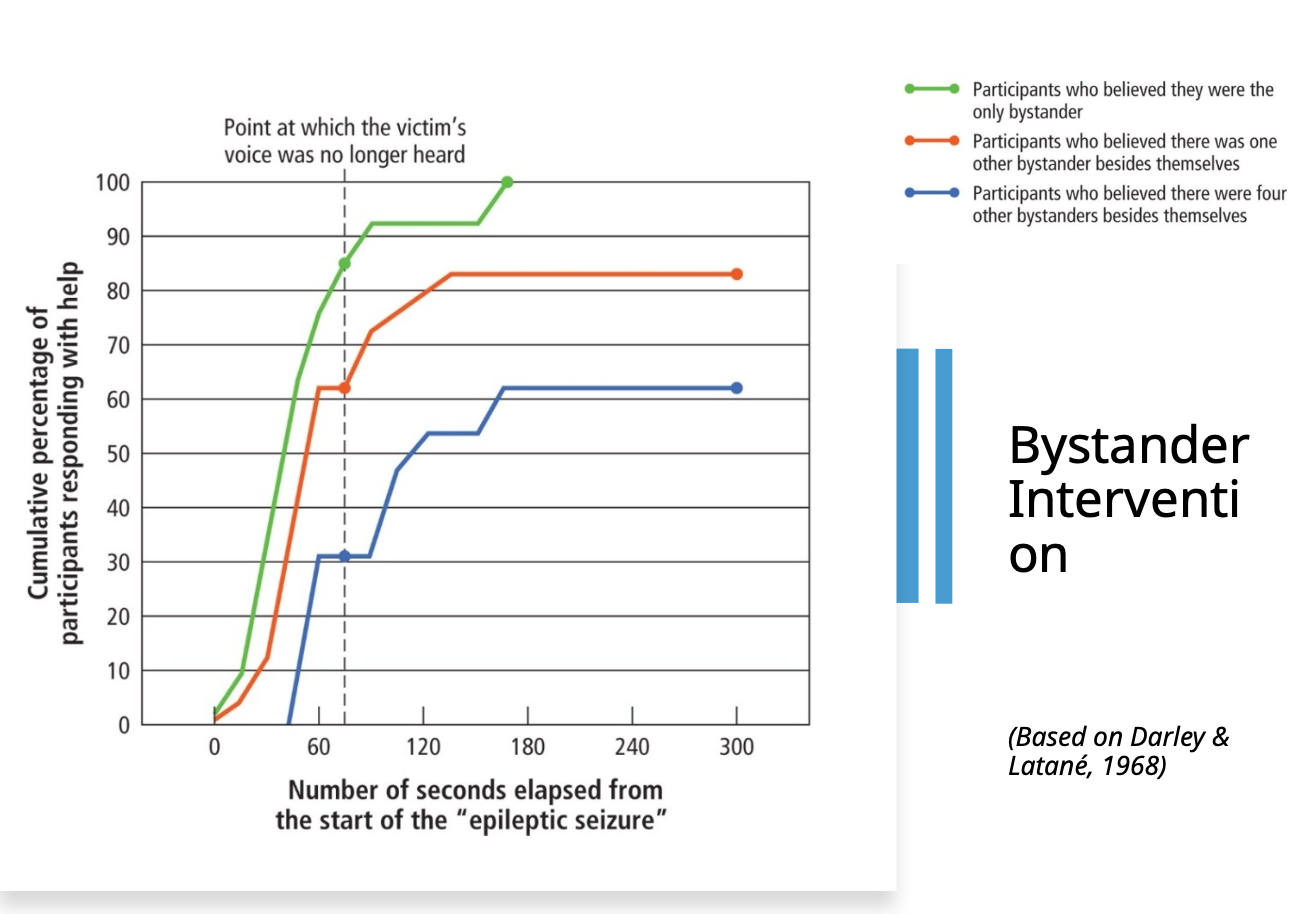
Study - Latané and Darley 1970
Uni students sit in cubicles by themselves
Believed to be participating in a discussion with others taking about collage life over an intercom.
Scenario: one person they could hear had a seizure - chocking, crying for help, falling silent
Manipulated how many people they believed were in this conversation.
Found when others were in conversation - less likely to seek help. Due to diffused responsibility to do so.
Diffusion of Responsibility
The phenomenon wherein each bystander’s sense of responsibility to help decreases as the number of witnesses increase
Steps to interviewing and offering help:
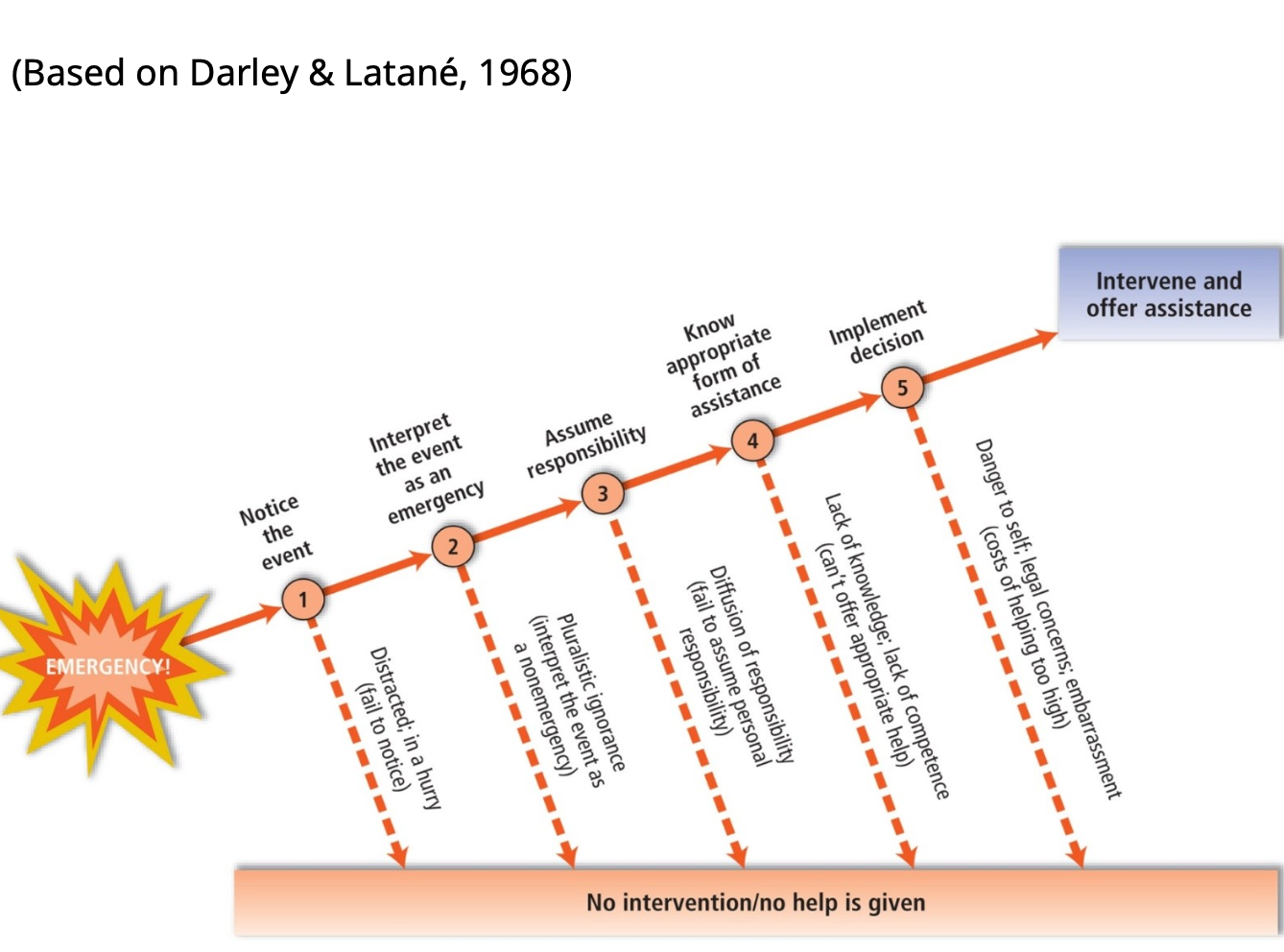
Darley and Batson (1973) - Noticing an Event
demonstrated that something as trivial as being in a hurry can make more of a difference than what kind of person someone is.
Time pressure (a situational variable) had a stronger effect on helping than individual differences in religiosity. Hurry condition = only 10% stopped to help. When no hurry = only 63% offered to help.
Seminary students who were the most religious were no more likely to help than those who were the least religious.
Even when giving a talk about the Good Samaritan did not increase helping in those students in a hurry.
interpreting the Event as an Emergency
• To help, the bystander must interpret the event as an emergency where help is needed.
If people assume that nothing is wrong, they will not help.
When other bystanders are present, people are more likely to assume that it is not an emergency.
Pluralistic ignorance: interpreting event as non problem due to others not looking worried
ISI - follow crowd to interpret risk of event
Study: ppts fill out questionnaire in room either alone or in group - smoke starts to fill room.
When alone they seek for help
When group they remain in situation as others look unconcerned
Assuming Responsibility
Sometimes it is obvious that an emergency is occurring.
Example—when Kitty Genovese cried out, “Oh my God, he stabbed me! Please help me! Please help me!”
- Even if we interpret an event as an emergency, we have to decide that it is our responsibility to do something about it.
Knowing How to Help
If people don’t know what form of assistance to give, obviously they will be unable to help.
Even if you know exactly what kind of help is appropriate, there are still reasons why you might decide not to intervene:
Might not be qualified to deliver the right kind of help.
Might be afraid of:
Making a fool of yourself • Doing the wrong thing
Placing yourself in danger
 Note
Note  Flashcards (117)