Astronomy Lab Midterm
 Call Kai
 Learn
Learn Practice Test
 Spaced Repetition
 Match
Match Flashcards
 Knowt Play
1/126

There's no tags or description
Looks like no tags are added yet.
Name | Mastery | Learn | Test | Matching | Spaced | Call with Kai |
|---|
No analytics yet
Send a link to your students to track their progress
127 Terms
What is 0.000001?
1.0 x 10⁻⁶
What is Scientific Notation?
a x 10ⁿ
What is 1,000,000?
1.0 × 10⁶
What is 8,200 to Scientific Notation?
8.2 × 10³
What is 4.5 × 10⁶ to Standard Notation?
4,500,000
Astronomical Unit
Average distance from the Earth to the Sun; approximately 149.6 million km (93 million miles)
Light year
Distance that light travels in one year; 9.46 trillion km (5.88 trillion miles)
Parsec
Distance at which an object would have a parallax angle of 1 arcsecond when viewed from Earth; 3.26 light years
How much is 1cm?
0.01m
How much is 1km?
1,000m
Degree
The full sky is 360° across
Arcminute
Each degree is divided into 60; allows for more precise measurements
Arcsecond
Each arcminute is divided into 60; used for very small objects
Sources of Uncertainty for Astronomy
Instrument Precision
Observer error
Environmental factors
-+ (represents possible margin of error)
How many cm in a meter?
100cm
What is 2.54cm to mm?
25.4mm (2.54 × 10)
What is 1500m to km?
1.5km (1500 divided by 1000)
The average distance from Earth to Mars is about 225million km. What is the distance to AU?
Roughly 1.5 AU (225million divided by 149.6million)
Star A is 45 arcminutes away from Star C and Star B is 5 degrees away from Star C. Which star (Star A or Star B) is farther from Star C?
Star B is farther than Star C (60 × 5 = 300 arcminutes)
What do the different sizes of the dots on a star chart represent?
The magnitude (brightness) of stars
What does the circular border around the star map represent?
The horizon
Why do you think there is a different chart for every month?
The orbit of the Earth around the Sun places different regions of the sky in our night-time view
What is the horizon?
The boundary between the sky and the ground
What is the meridian?
An imaginary half-circle connecting south, zenith and north
What is the ecliptic?
The path of the sun in the sky
Constellation
A group of stars forming a recognized pattern in the sky (e.g. Ursa Major)
Defined by the International Astronomical Union (there are 88 of them named)
Asterism
An identifiable group of stars that is not recognized as a constellation (e.g. Big Dipper)
Zodiac Constellations
12 constellations that the Sun blocks out at a given time of the year
Situated along the elliptical line
Why do you think there is a difference in what constellations you are able to observe at different hours?
Earth’s daily rotation and the annual orbit of the Sun
What is significant about the 12 constellations of the zodiac, astronomically speaking?
They lie along the elliptic (the path of the Sun), and also mark the path where the Moon and stars are found
Do all stars appear to rise and set in Costa Mesa?
No, but because we are at an angle, some stars appear to rise in the East and set in the West (past the horizon), while others appear to not set at all (not passing the horizon)
Do all stars appear to rise and set in the North Pole?
No, because all visible stars here are circumpolar, circling the sky parallel to the horizon; more accurate portrayal of stars and their motion
Circumpolar stars
Stars that never rise or set below the horizon; remain visible at all night and all year-round
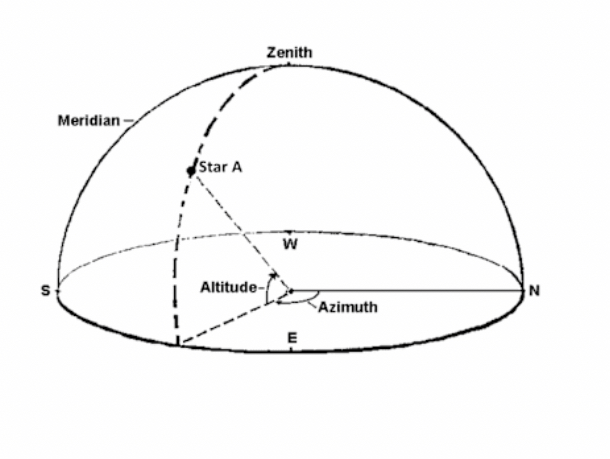
What is the azimuth of this star? (insert image)
120 degrees
If you measure the North Celestial Pole (NCP) to be 0 degrees above the horizon, your location is…?
The equator
Which planet is most similar in size to the earth?
Venus
What happens to the length of the year of the planets around the Sun as the distance from the Sun increases?
It increases
Aphelion
The point of the Earth’s orbit farthest from the Sun; slower
Perihelion
The point of the Earth’s orbit closest to the Sun; faster
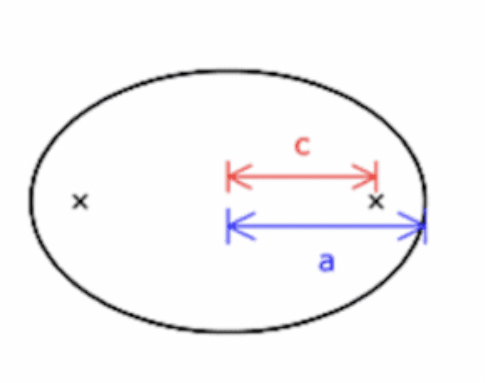
This ellipse has an eccentricity of about…? (insert image)
0.75 (since “a” like 75% on the semimajor axis)
What did we use for our refracting telescopes in class?
Lenses
Refraction
Bending of a light path as the light moves from one medium to another
Changes the angle light makes with the surface
Reflection
Light changing direction at the surface of an object
Convex
Thicker in the middle, thinner on the outer edges; light rays are bent so they can come closer together (converge)
Concave
Thinner in the middle, thicker on the outer edges; light rays are bent so they diverge, moving farther apart (diverge)
Magnification
Ratio and height of the image object to the height of the original object
If it is summer in Costa Mesa, California. What season is it in the southern hemisphere?
Winter
What season is it when the sun’s altitude is high, the angle is more direct, and sunbeam spread is more concentrated?
Summer
What is the declination of a star that is located on the celestial equator?
0 degrees
Altitude
Measures how high an object is above the horizon
0° at horizon
90° at zenith
What is the altitude of an object located at the zenith?
90°
What is the altitude of an object located at the horizon?
0°
What is the altitude of an object located halfway from the horizon?
45°
What is the altitude of an object located 2/3 up from the horizon?
60° (90 × 2 = 180) (180 divided by 3 = 60)
Azimuth
Measures the direction along the horizon
0° North
90° East
180° South
270° West
What is the azimuth of an object located in the southeast?
135°
Reason: Southeast is exactly in between South and East, which equals around 45°. So, if you take 90° and add 45°, you get 135°
What is the azimuth of an object located in the northwest?
315°
Reason: Northwest is exactly in between North and West, which equals around 45°. So, if you take 270° and add 45°, you get 315°
What is the azimuth of an object located in the south-southwest?
202.5°
Reason: South is 180° while Southwest is 225° (180 + 45), so if you add both and divide by two, you get 202.5°
What is azimuth of an object that is transiting (at its highest point in the sky)?
0°
Latitude
Measures north-south position from 0° (equator), up to +90° (North Pole) or down -90° (South Pole)
Longitude
Measures east-west position from 0° (Prime Meridian), ranging from -180° to +180°
What is the latitude and longitude of Costa Mesa?
Roughly 34° N and 118° W
Where is the celestial equator located in your local sky if your latitude is 0° (you are on the Earth’s equator)?
90° in our local sky
Where are the north and south poles located in your local sky if your latitude is 0°? (you are on the Earth’s equator)? Could you see Polaris?
Both at 0° from our local sky; yes, you could see Polaris, but just barely as it is only visible in northern horizon near the NCP
What is the altitude of the north celestial pole?
0°
How does the north celestial pole’s altitude compare with the latitude of the Earth’s equator?
They compare the same at 0°
Where is the celestial equator located in your local sky if your latitude is 90° (you are on the Earth’s North Pole), what is its altitude?
0°
What is the altitude of the North Celestial Pole?
90°
How does the altitude of the North Celestial Pole compare to the latitude on the Earth’s North Pole?
They compare the same at 90°
The altitude of the NCP and Polaris are equal to what on Earth?
Your latitude
What is the altitude of the North Celestial Pole in Costa Mesa?
Roughly 34° above the horizon
What is the altitude of the celestial equator when it crosses the meridian?
56°
Reason: 90° (degrees of the celestial equator from the NCP) - 34° (Costa Mesa latitude) = 56°
What path would a star (located on the celestial equator) make if it were at the latitude equator?
0°; Star would rise in the east, pass through the zenith and then set in the west
What path would a star (located on the celestial equator) make if it were at the North Pole?
90°; Star is circumpolar and is exactly at your latitude
Does not pass through zenith
What path would a star (located on the celestial equator) make if it were in Costa Mesa?
34°; Star would rise in the East and only reach an altitude of about 56° above our horizon (below the zenith) before setting West
Right Ascension
Like longitude but measured in hours, minutes and seconds
0h - vernal equinox
12h - autumnal equinox
24h - vernal equinox, one full circle around the sky
Declination
Like latitude, measured in degrees, arcminutes and arc seconds
+90° = north celestial pole
0° = celestial equator
- 90° - south celestial pole
Costa Mesa vs Victoria - What do you notice about the azimuth values and altitude values of Polaris compared to Arcturus?
The altitude and azimuth of Polaris remains very consistent, only changing by a few degrees between locations. Meanwhile, the altitude and azimuth of Arcturus is less consistent, changing degrees far more drastically between locations
Costa Mesa vs Victoria - What do you notice about the right ascension values and declination values of Polaris compared to Arcturus?
The RA and declination values of both Polaris and Arcturus remain very consistent, with the exception of a few seconds between locations
Which star is closest to the North Celestial Pole?
Polaris
Which star is closest to the celestial equator?
Regulus (it lies on the ecliptic)
What happens to the horizontal and equatorial coordinates as a star moves across the sky?
The equatorial coordinates (altitude/azimuth) remains fixed while the horizontal coordinates (right ascension/declination) change constantly as the star moves across the horizon
What are some advantages of equatorial coordinates over horizontal coordinates?
Equatorial coordinates provide more accurate results that can be measured multiple times from:
any location
any time
any season
What causes the seasons?
Earth’s tilt (23.5°); different regions receive more or less direct sunlight at different times of the year
What also causes the seasons?
Earth’s orbit around the Sun; throughout the yearly orbit, the tilt remains constant
What is NOT a cause for the seasons?
Earth’s distance from the Sun
Direct Sunlight
When the Sun is high in the sky, sunlight is concentrated in a small area:
more intense
warms surface more efficiently
Which season is there more direct sunlight?
Summer (when a hemisphere is tilted toward the Sun)
Indirect Sunlight
When the Sun is lower in the sky, sunlight is spread over a larger area:
less concentrated
less intense
provides less heat
Which season is there more indirect sunlight?
Winter (when a hemisphere is tilted away from the Sun)
Spring
Vernal Equinox (March 21st)
Sunlight is moderate, neither as concentrated as in summer or as spread as in winter
Summer
Solstice (June 21st)
The Northern Hemisphere is most likely tilted toward the Sun
Sun appears higher at noon
Sunlight is more concentrated; hits ground at steeper angle, more intense warmth
Longer days
Fall
Autumnal Equinox (September 21st)
Sunlight is moderate, neither as concentrated as in summer or as spread as in winter
Winter
Solstice (December 21st)
The Northern Hemisphere is least likely tilted from the Sun
Sun appears lower in the sky at noon
Sunlight is spread over a larger area; less concentrated, less warm
Shorter days
The Northern and Southern hemispheres experience…?
Opposite seasons
They reverse after six months
What are the seasons at the equator?
Gets consistent sunlight year-round, so seasons are minimal
What are the seasons at the Mid-latitudes (e.g. US, Europe)?
Experience noticeable seasonal changes due to varying sunlight angles
What are the seasons at the poles?
Get continuous sunlight in summer and no sunlight in winter, leading to extreme seasonal variations
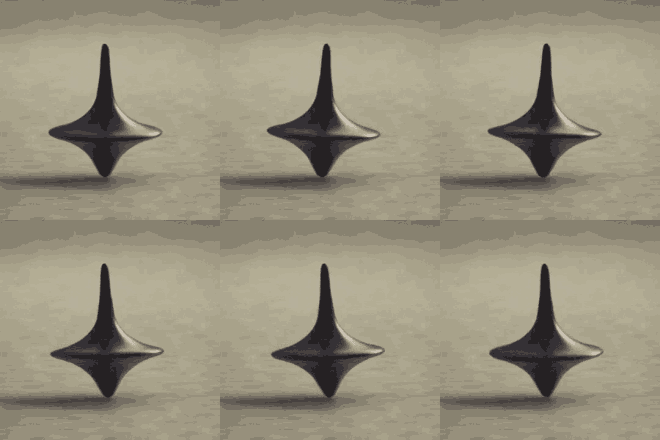
Precession
The changing of Earth’s axis over a very gradual period (wobble motion) due to the gravitational pull of both the Sun and the Moon
The most direct sunlight is…?
Perpendicular to the earth's surface (90° angle)
Explore top notes

Explore top flashcards
