Hair, swabs and impressions
 Studied by 0 people
 Call with Kai
 Learn
Learn Practice Test
 Spaced Repetition
 Match
Match Flashcards
 Knowt Play
1/48

There's no tags or description
Looks like no tags are added yet.
Name | Mastery | Learn | Test | Matching | Spaced | Call with Kai |
|---|
No study sessions yet.
49 Terms
What are the clinical signs which indicate a need for skin sampling
Alopecia
Otitis
Pruritis
Erythema
Seborrhea
Pyoderma
Uticaria
Atopy
Hyperkeratosis
pododermatitis
What dies alopecia mean
Hair loss
What does otitis mean
Ear infection
What does pruritic mean
Itching
What does pyoderma mean
Skin infection
What does erythema mean
Redness
What does seborrhoea mean
Flaky skin
What does pododermatitis mean
Foot infection
What does atopy mean
Allergic skin disease
What does urticaria mean
Hives
What does hyperkeratosis mean
Excess growth of the horny layer of the epidermis
What equipment for tape impression
Gloves
Clippers
Tape
Slides
Diff quick
Immersion oil
Microscope
What method tape impression
Apply tape onto skin area
Ensure to not to touch sticky side of tape
Rub tape with thumb nail to ensure good contact
Stick on the slide
Diff-quick
Can be examined under oil immersion for bacteria and yeast
What does tape impression analysis X4/X10/X40 diagnose
superficial ectoparasites
fleas
flea dirt
lice
cheyletiella
otodectes and eggs
harvest mite
What does tape analysis X100 diagnose
Oil immersion lense
Bacteria
Fungi-spores
Yeasts e.g. Malassezia
Cells e.g. neutrophils
What are tape impression advantages
Non-invasive
Cheap and easy
Not very stressful
Can access harder to reach areas e.g. skin folds
What are tape impression disadvantages
Contamination
Miss burrowing parasites
Uncomfortable
Hard to get large population
What equipment direct impression
Gloves
Clippers
Needles-pick off scabs etc
Slides
Diff-quick
Immersion oil
Microscope
What method direct impression
Good for exudative lesions
If non –exudative can be ‘picked’ with a needle to express fluid
Gently press the slide onto the lesion
Air-dry
Stain with diff-quick
Examine on low power first then high power/oil immersion
what analysis direct impression
Detection under X100 objective lens oil immersion
Bacteria, Fungi and Yeast
Inflammatory cells: neutrophils, eosinophils. lymphocytes, macrophages
Pre-histology smears from biopsies
Can diagnose mast cell tumours sometimes
What are direct impression advantages
Non-invasive
Cheap and easy
Not very stressful
Good for moist lesions
Good for dectetion of microorganisms
What are direct impression disadvantages
Only surface sample
Not good for hard to reach areas
Slide can snap if patient moves
What equipment hair brushing
Gloves
Flea comb
Hairbrush
White paper
Paraffin
Slides
Coverslips
Diff-quick
Microscope
What method hair brushing
Brush hair over black consulting table or white/brown paper for 5 minutes
Place hairs in petri dish, cover in liquid paraffin
Place scale/parasites on slide with liquid paraffin
Apply cover slip
Examine under microscope
For fleas-putting suspected flea excrement on moistened paper towel and if present will turn a reddish brown
What analysis hair brushing
X10 X40 objective lens
Superficial ectoparasites
fleas
flea dirt
cheyletiella
lice
What are hair brushing advantages
Non-invasive
Not very stressful
Quick, cheap and easy
Easy diagnosis for surface ectoparasites
What are hair brushing disadvantages
Miss burrowing parasites
Not good for cytology
What equipment hair pluck
Gloves
Forceps
Slides
Paraffin-helps visualise parasites
Cover slips
Microscope
Trichography-examing hair follicle
Use forceps to pluck hair in an alopecic area
Place onto a slide and evaluate under low power
What can you see when hair plucking
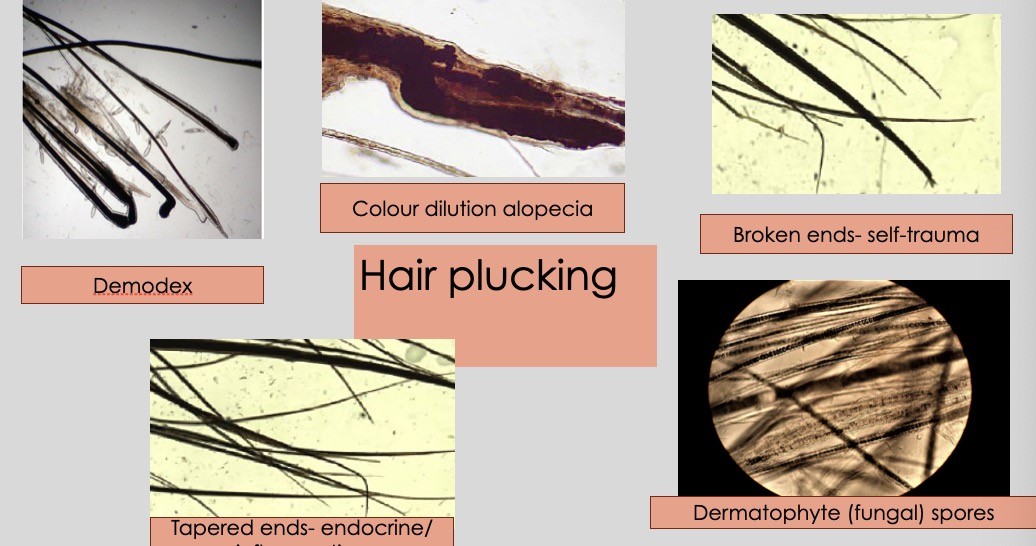
What are advantages of hair pluck
Quick, cheap and easy
Can detect demodex, mites and fungal infections
Good for hard to access areas
What are disadvantages hair pluck
Not good for surface parasites
More uncomfortable
Not good for cytology
Temperament needs to be considered
What equipment skin scrapes
Gloves
10 blade
Slides
Coverslips
Parafin
Microscope
What can you diagnose with skin scrape superficial
On every pruritic/scaly patient
May be able to diagnose demodex
Can diagnose
Cheyletiella
Sarcoptes scabei
Notoedres cati
What method deep skin scrape
Suspected demodex
Must scrape on 5 or more locations
Squeeze prior to scrapinf, scrape util capillary oozing
Diagnose demodex including juveniles and eggs
Where to do scraping
Head and neck-otodectes
Lateral elbow/lateral hock/pinnae -sarcoptes scabi, notoedres cati,
Dorsum/ areas of dandruff/scal- cheyeletiella
Alopecia margins- demodex
Comedones-demodex
What are skin scrape advantages
Quick, cheap and easy
Good for diagnosing demodex and burrowing parasites
Samples the epidermis
Only method to diagnose some deep parasites e.g. sarcoptes
What are skin scrape disadvantages
More uncomfortable
Some may need sedation
Invasive
Not good for surface parasites e.g. lice and fleas
Not good for cytology
Can cause secondary infection as have caused a wound
Patient interference
What equipment swabs
Gloves
Plain swabs/cotton buds
Slides
Cover slips
Diff quick
Microscope
What method swabs
Rub swab over skin/ gently around external ear
If dry area swab or location can be premoistened with saline/paraffin
Roll swab along slide
Can also suspend large blobs of earwax in paraffin
Add cover slip
Examine under microscope
What diagnose swabs x4/x10
Otodectes cynosis
What diagnose swabs x100
Fungi- Ringworm- moist swab
Yeast- Malassezia
Bacteria: In house cytology smear OR external culture and sensitivity
Inflammatory cells;
Initial inflammatory cells: neutrophils, eosinophils
Chronic inflammation: macrophages, lymphocytes
What are swab advantages
Quick and easy
Can detect bacteria and fungal infections
Good for hard to access areas e.g. ears
Good for moist/deep lesions
What are swab disadvantages
Not good for parasites
Can be uncomfortable
Risk of contamination
What is woods lamp
UV lamp to detect skin problems
A screening not a diagnostic test
Always requires follow up testing such as trichogram/culture/PCR
What are advantages of woods lamp
Easy
Non-invasive
Quick
Rapid diagnosis of dermatophyte infections, especially in felines
What are disadvantages woods lamp
False +ve and false –ve's
30%-70% sensitivity for microsporum canis-false negatives
Microscporum gypseum and trichophyton mentagrophytes do not fluoresce
Lint, dander and organic debris can fluoresce= false +ve
What do we label samples with
Site sample
Method used
Prior topical/systemic acaricide(s)/antiparasitic treatment or antifungal(s) used
When do we choose each method
Pruritis and scaling- skin scrape, tape impression
Suspected demodex-hair pluck or skin scrape
Exudative lesion- swab, direct impression
Suspected dermatophyte- Tape impression, direct impression
 Note
Note  Flashcards (60)