Jan 20: social theory
 Studied by 0 people
 Call with Kai
 Learn
Learn Practice Test
 Spaced Repetition
 Match
Match Flashcards
 Knowt Play
1/43

There's no tags or description
Looks like no tags are added yet.
Name | Mastery | Learn | Test | Matching | Spaced | Call with Kai |
|---|
No analytics yet
Send a link to your students to track their progress
44 Terms
review of past lects + social thoery and emotions (3)
conc of of “disciplinary views” and biological roots of human emotionality; our emotionality is linked to our sociability, suggesting that emotions are therefore vital to the study of social relations (aka sociology= study of social relations) *sociability
this conc suggests that emotions should be central to soci theories—BUT this is not the case:
—soci theories have downplayed the influcenes of emotions on social relations
emotions also have a role is social theories
theory def + example - 2
def: “a ‘supposition’ or a system of ideas intended to explain smth, especially one based on general principles”
ex. darwin’s theory of evolution can be seen as system of ideas; survival of the fittest as a general principle
social theory - 2
def; a theory that tries to explain patterns of social relations
there is a great variety of social theories about why social relations are the way they are
purpose of a theory - 3
helps us to make sense of the world by providing potential explanations to our questions
tool-box approach; apply diff theories to a question to see which seems to offer the most insight
*this allows us to come up with hypotheses (to test)
Prof: considers tool-box approach very imp and smth that he tries to instill in his students
types of social theory - 3
Barbalet: 2 general types of social theories
1)social systemic
2)social actor
in soci, social thoery generally focuses (most) on social systemic theories but pays (some) attention to how actors react to and perpetuate structures
*link btwn social actor & social system theory
1)social systemic (social theory) - 3
focuses on how social environment (systems) shapes/makes us who we are + determines our actions/behaviour
(systems) shapes our expectations, opportunities, interests;
—coerce us *systems can coerce us
commonly referred to as “structural” (theory?)*"structural" → social structures shape individuals
2)social actor (social theory) - 4
sees human interactions as based on self-conscious/reflective decision-making
— based on rational action
commonly reffered to as “agent” or “rational-choice” (theory?)
*Agentic/rational choice based explanations: idea that ppl behave using rational choice based on the options offered (to them)
founding figures - 3
in soci like in most other diciplines, the founding figures of the soci had long-term effects on the major theories *of sociology
founding figures: Marx, Durkheim + Weber
their analyses popularized certain understandings of the determinants of social relations *aka sociology; study of social relations
key periods for soci (for founding figures of soci) - 3
1)enlightenment
2)romantic movement (romanticism)
3)founding figures (re: Marx, Durkheim + Weber) influenced BOTH Elightenment and Romanticism;
— 1st sociology theorists considered rationality as well as emotions *they consider both rationality and emotions
1)enlightenment - 3
1)enlightenment: Harris noted that early soci was influenced by elightenment, which promoted focus on rationality
—*emotions seen as opposite of rationality)
(to say that founding figures/early sociology focused solely on rationality) considered overly simplistic, as founding figures DID consider emotions
Harris’ arugment: Early sociology was influenced by Enlightenment rationalism, but it is inaccurate to claim that founding figures ignored emotions.
BC founding figures incorporated emotions in sophisticated ways that go beyond the Enlightenment’s narrow rational/irrational (emotional) divide.
2)romantic movement (romanticism) - 4
2)romantic movement (romanticism): as reaction to Elightenment and influential at time soci was founded
downplayed reason;
—emphasizing emotionality and splendour/power of nature *emotion as important
*romantic → moving, emotional
*humans are complex beings yet role of nature is influential in humans
Barbelet: SOCI 2.0 vs SOCI 3.0 — 3 (enlightenment (rationality) → romanticism (emotion) → ?)
Barbelet: one-sidedness of the Enlightenment with its focus on rationality dominanted soci + removed emotions from soci
*one-sided focus of Enlightenment ignored emotions to focus on rationality; this shaped the dominant form of soci at time
By 2nd generation of sociologists, romanticism (with focus on emotion) lost its influence + was rejected
(rejection of Romanticism) didn’t happen on its own—Barbelet argues that Weber + Parsons play imp role in removing emotions from soci
*individual actors/1st generation sociologist (Weber + Parsons) also had role in removing emotions from soci
Max Weber - 4
German; known as one of world’s greatest geniuses *W → German
periods of severe mental illness; he struggled with his mental health
got degree in law but extensively studied econ, hist, classics, etc.
along with Marx + Durkheim (the 2 other major founding figures), Weber was one of most influential founding sociologists
the focus/characteristics of Weber’s work — 3
1)rationalization: some ppl claim Weber had a general social theory focused on rationalization
2)eclectic; most ppl argue that while Weber’s work focuses on rationality but that isn’t a grand over-riding theory of social relations
*no one clear theory applicable to all social life; social relations are too complicated for this
2)heuristic; instead Weber’s theory is conceptual and analytic *use heuristics to analyze a situation
—ideal types; can real world examples fit into one of those ideal types?
Rationality: was it the focus of Weber? Parsons’ interpretation - 4
Weber’s rationalization view popularized by Talcott Parsons *Weber’s view was basis of Parson’s theory
Parsons is right that rationalization is prominant element/common theme of Weber’s work *ex. Weber: social relations as becoming organized in a more rational way
Parsons was right that rationalization a major theme of Weber’s work—but wrong to treat it as the (only, over-arching) theme. Parsons overemphasized rationalization at the expense of Weber’s other major concerns.
Yet, most claim rationalization is only one of the many elements in Weber’s work
— Weber does NOT proprose a grandiose (rich) theory of rationalization *weber also had other concerns
Weberian rationality - 5
Weber’s rationalization; process by which individual behaviour + social relations become increasingly rational
types of (*rational-based) social action (aka ideal types): Weber focused most on instrumental & value-rational, least on affective-rational
science; weber saw superstition was declining, science strengthening *belief in science rising (science as rational)
weber saw major social institutions as increasingly based on rationality
Weber ultimately saw rationalization was very influential during his life
Weber: types of social actions (4) *aka ideal types
1)instrumental-rational, 2)value-rational, 3)habitual-rational, 4)affective-rational *A HIV
RE: Weber focused most on instrumental & value-rational, least on affective-rational
*ideal types can be applied to any actions and which one is the most influential will tell us a lot about the behaviour
social institutions & rationality for Weber - 4
Weber saw major social institutions as increasingly based on rationality *insitutions were being rationalized/rationalization of institutions; in 3 main ways;
1)bureaucracy as rational form of (social) organization that expanded
bureaucracy = rules dictating how ppl should act *e.g. hierarchy, division of labor
2)rule of law as rationalization of rules *rule of law=rationalizaiton of rules
3)capitalism; rational organization of markets *capitalism=rationality of markets
weberian rationality on emotions - 4
Prof: While Barbalet criticizes Weber for downplaying emotions, Weber did include emotions in his theory of social action
—specifically in theory of 4 types of social action; affective-rational or emotional included
*However, Weber never fully developed this category and tended to privilege rational forms of action (insturment, value), suggesting that emotions (affective) were secondary in his model.*RE: Weber focused most on instrumental & value-rational, least on affective-rational social action
Prof; Interestingly, even actions Weber considered “rational,” like value‑rational action, often involve emotional dimensions; positive + negative emotions (e.g., pride when acting according to values, shame when we violate them).
*This shows that Weber implicitly recognized the emotional basis of social action, even if he did not make emotions a central focus.
Weber: postive vs negative emotions in social action - 3
Prof; Interestingly, even actions Weber considered “rational,” like value‑rational action, often involve strong emotional dimensions
we have positive emotions; when acting in ways supporting our values (pride)
we have negative emotions; when not acting in support of our values (shame)
(e.g., pride when acting according to values, shame when we violate them).
Weber’s work: prostestant ethic and spirit of capitalism - 3
most famous work by weber
weber focuses on how Calvinist religion beliefs made working hard + reinvesting profits (seen) as rational *rationality based
Prof; but a close read (at work it) shows that emotions were key (*to these calvinist beliefs promoting work hard + revinest profits ethic)
*we find influence of value-rational action
weber’s main argument in work prostestant ethic and spirit of capitalism - 3
weber’s argument: combo of predestination + calling + aestheticism *as calvinist religious beliefs?
their combination (of these 3 elements) made it seem rational to work hard, save + reinvest profits for the sake of getting more and more money
— emphasizes value-rational action *sucess as ‘proof’ that you are going to heaven but emotions get downplayed in this argument
3 components: predestination + calling + aestheticism
Re: combo of these 3 elements pushes rational ethic of work hard + invest profits
1)predestination: humans have no ctrl, God predestines all; this causes ppl anxiety
2)calling: idea that everyone has a calling; ppl/everyone should strive to work (hard) toward this calling
3)aestheticism: need to lead a simple life to be a good Christian person
*CPA
*from Weber’s work; prostestant ethic and spirit of capitalism
Prof: emotions as pt of weber’s protestant ethnic - 3
but emotions get downplayed in Weber’s og argument: combo of predestination + calling + aestheticism (specific pt of calvinist beliefs) make it seem rational to work hard, save + reinvest profits for the sake of getting more and more money
— emphasizes value-rational action
YET when look closer at weber’s argument, emotions are there & vital for his argument *emotions have an imp role
imp emotions: anxiety + fear, and pride + shame
Prof: role of emotions in weber’s argument (2 groups + their purposes) — 2
anxiety and fear → pushed ppl to work hard, to be successful and reinvest their profits
*push ppl to act in certain ways (work hard) to “ensure” (make sure) they’re going to heaven
pride and shame → pride/shame of one’s standing in the religious comm also promoted drive for a sucessful calling
*push ppl to act in fear (worried about) being seen as “lazy” by others
Talcott Parsons - 4
greatest influence on american sociology betwn 1930s until his death
was very influenced by Weber (& Durkheim) and claimed modernization involved social rationalization
— translated weber’s work to English in what many considerd as a biased way + overemphasizing rationalization
Parsons as a functionalist
parson’s functionalist view - 3
as functionalist; parson’s viewed “societies” as social body—(of) pseudo living entities *viewed societies as a living organism
—argued that like a body, various functions need to be performed for the social body (society) to survive
*need to focus on the factors promoting survival (of society) so looked at the function of diff institutions
—political, economic, reproductive, educational, etc.
parsons’ core beliefs - 4
parsons accepted that “modern” society was based on rationality *similar to Weber’s rationalization of institutions
—all major social instutions were rationally organized, allowing them to function collectively allow social survival *survival of society (‘social body’)
parsons was brilliant + influential figure & dominated north american soci for nearly 50 yrs
—helped expunge (remove) emotions from sociology, which earlier US social paid considerable attention to *during romanticism more attention toward emotions
parsons’ core beliefs on emotions - 3
emotions: parsons view emotions as non-rational and thus, emotions disruptive to the functioning of social body (society) *so believed we needed to move away from emotions
—modern institutions (e.g. political, educational) therefore must supress emotions so society can function propertly
Barbelet: parsons, emotions + social theory - 3
barbelet: parsons played central role in removing emotions from social theory in 2 ways
1)popularizing view of Weberian theory *Parsons translated ot English /popularized Weber’s work in a particular way some consider biased
2)through parsons’ own work
Prof: should we blame Parsons (for removing emotion from soci)? - 3
*while Barbelet does attribute Parons to removing emotions from sociology, prof says:
not entirely (bc of parsons) — it was kind of the anti-emotional zeitgeist (spirit of the times)
instead of blaming parsons for removing emotions, one might simply view him as reflecting broader ideas in sociology and beyond (at the time)
similar process marginalized (downplayed, suppressed) emotions in favour of rationality across other dicilines; in hist, psyc, anth, etc.
prof’s question: what might explain the anti-emotional zeitgeist of this period?
*RE: zeitgeist = spirit of the times
hyper rational ideology — high modernism *belief in reason, science, and control
*Human progress depended on rationality, order, and control — and emotions were seen as threats to that project.
humans can conquer and engineer
humans could engineer better societies
*High modernism imagined a world where: humans could engineer society, science could solve social problems and rational planning could eliminate chaos
rational-actor model - 3
served as the apotheosis (high point) of this rationalization (movement) of the social sciences
suggested that if you want to understand human behaviour you simply have to consider rational decision-making
*looking at human behaviour based on rationalization; (RE) process by which individual & social relations become increasingly rational
—consider the costs/benfits of each option; choose the option that maximizes benefits and minimizes costs
influence of rational-actor model - 2
less influenitial in soci bc of soci’s focus on structural theories; focus on rationalization of structures like Weber and Parsons *These theorists focused on how structures shape behaviour, not on how individuals calculate costs and benefits.
rational-actor model most influential in Econ; commonly reffered to as rational-choice theory
while econ embraced rational-choice fully, soci leaned toward structural rationalization (rationalization of structures by Weber, Parsons) rather than individual rationality
bringing emotions back into soci (and other disciplines?) - 3
1970s: parson’s structural-functionalist theory was losing support
*criticized for being overly abstract, overly orderly, and blind to conflict, inequality, and lived experience + flattened human agency and treated people as passive role‑followers within a system
at the same time/simultaneously, scholars/academics in diff disciplines (including sociology) became increasingly interested in emotions *academics in soci, psyc, anth, etc. began to explore emotion more
Barbalet: suggests that major historical events weakened (influence of) rational-actor model + created more interest in emotions
why major historical events that weakened rationalism - 2
(RE) Barbalet: suggests that major historical events weakened rational-actor model + created more interest in emotions
*major historical events in the 1960s–70s (e.g. cold war, vietnam war) exposed the limits and dangers of the rational‑actor model and rationalist ideologies more broadly.
*rational‑actor model following cost/benfits as dehumanizing, inadequate for explaining real social movements + dangerous when tied to large‑scale rationalized systems (e.g., nuclear strategy)
bringing emotions back into soci: critiques of rationalism - 3
1)a variety of (social) movement opposed hyper-rationalism; hippie/counter-cultural, anti-nuclear, anti-vietnam, student movements, which emphasized emotion
2)broader social critques of modernity + rationalization *anti-nuclear; rationalization leads to nucelar war
*Intellectuals/activists increasingly questioned the idea that rationalization automatically leads to progress.
Ex. nuclear weapons as the “logical” outcome of rational military planning, bureaucratic systems producing alienation in workers
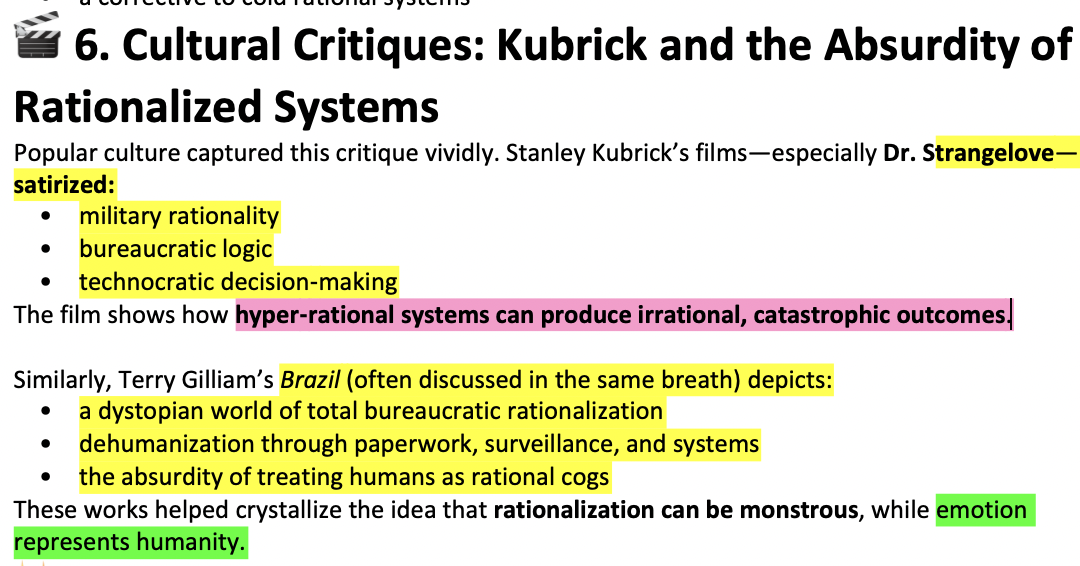
3)epitomized by Kubrik’s works; Dr Strangelove + Brazil
*Kubrik’s cultural work and then Brazil exposing the absurdity and danger of hyper‑rational systems—how they can produce irrational, catastrophic outcomes.
the soci of emotions - 4
this (critques of rationalism) created an opening for the study of emotions in sociology and other diciplines
(emotions) affected both Social Systemic + Social Actor theories/perspectives (described by Bartlet)
1)social systemic; social environment shapes our emotions in addition to our interests, opportunities and outlooks
2)social actor; focuses on how emotions shape human behaviour + social interactions
—both theories (recognize that) reason and emotions shape how we act
*both shape how we act
Randall Collins - 3
one of the most influential contemporary social theorists
at the uni of pennsylvania
Barbalet: presents Collins’ work Conflict as an early work that helped bring emotions back into sociology
This work helps to show why sociology needs to pay attention to emotions
Collins’ work Conflict: why sociology needs to pay attention to emotions - 4
shows how emotions are vital to understanding key issues that social theories focus on
without emotions, he argues that social theory is quite empty *without emotions, arugements → empty
argues that sociological theory is focused on 2 theories; conflict + consensus
emotionality is central to both theories
Collins on 1)conflict - 4
since Marx, sociolgists have focused on how conflict is a major determinant of social change *conflict as driver for social change
results in us focusing on racial, gender, class, sexual and other inequalities
ultilimately emotions are what push ppl to fight and contest
*emotions make us act on grievances
Collins on 1)conflict: social actor vs social systemic theory - 3
Collins: can see both social actor AND social systemic perspectives *relating to conflict
social actor: Collin’s argues that emotions play central role in pushing ppl to act on grievances over inequality
social systemic: yet notes that social structures shape these emotions and spread emotionality
Collins on 2)consensus - 4
since durkheim, sociologists have focused on the importance of consensus—the glue that holds society together, promotes peaceful relations
*consensus as social glue; what lands ppl together
collins notes that rituals promote collective emotionality and that shared emotions, in turn, promote collective unity
*rituals → collective emotionality; shared emotions → collective unity
also notes that emotions enforce norms that make consensus possible
*norms allow us to interact peacefully
significance of Collins’ claims - 4
conflict + consensus are dominant influences on social relations —all sociologists study both in some way or other
collins' argues that we can’t understand either (conflict or consensus) without considering emotions
—emotionality underlies social conflict AND social consensus
turner: not suprised by this—our emotions make possible our sociability *conflict and consensus are social
 Note
Note  Flashcards (102)