bio 3
 Call Kai
 Learn
Learn Practice Test
 Spaced Repetition
 Match
Match Flashcards
 Knowt Play
1/65

There's no tags or description
Looks like no tags are added yet.
Name | Mastery | Learn | Test | Matching | Spaced | Call with Kai |
|---|
No analytics yet
Send a link to your students to track their progress
66 Terms
Differentiate between the genetic information held on two homologous chromosomes, two nonhomologous chromosomes, sister chromatids, and two non-sister chromatids
Given a micrograph or drawing of a cell you've never seen before, label chromosomes, chromatids, sister chromatids, and homologous chromosomes, if present, and determine the haploid number and ploidy of the cell
Explain why chromosome replication has to occur before mitosis, in interphase.
Given a micrograph or drawing of a cell you've never seen before that is undergoing mitosis, explain what is currently happening to the chromosomes.
Predict the consequences of defects in mitosis on cellular division and their impacts on organismal function.
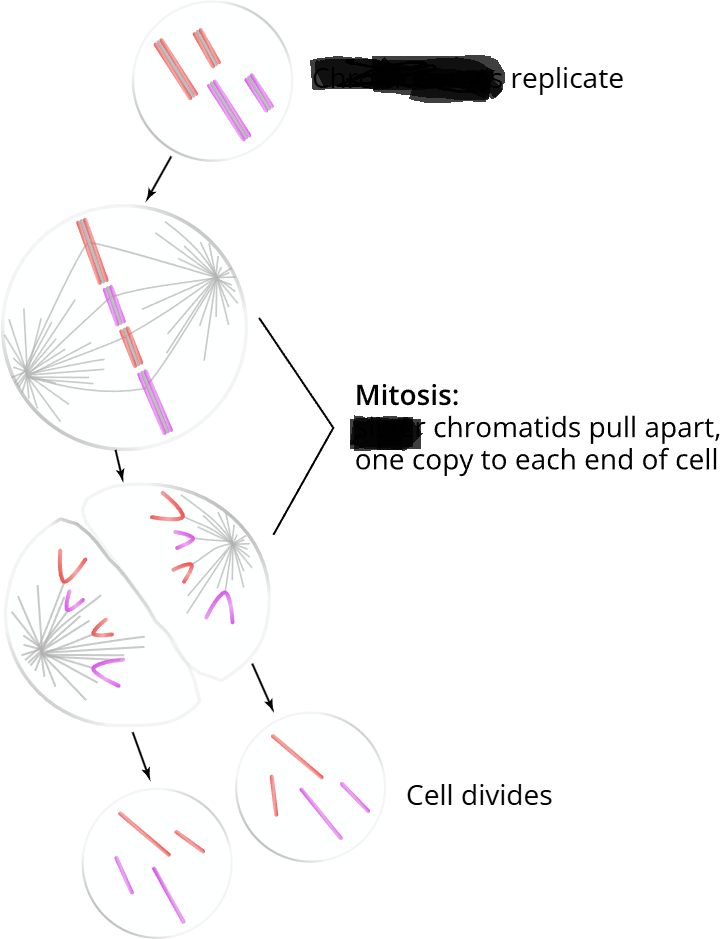
….. is the process responsible for distributing a copy of each ….. to each …..cell. It occurs after ….. have been replicated and prior to the physical division of the parent cell into two …… cells.
****….. is the movement and distribution of …… after DNA has already been replicated and prior to cell division.
Mitosis
chromosome
daughter cell.
chromosomes
daughter
mitosis
chromsones
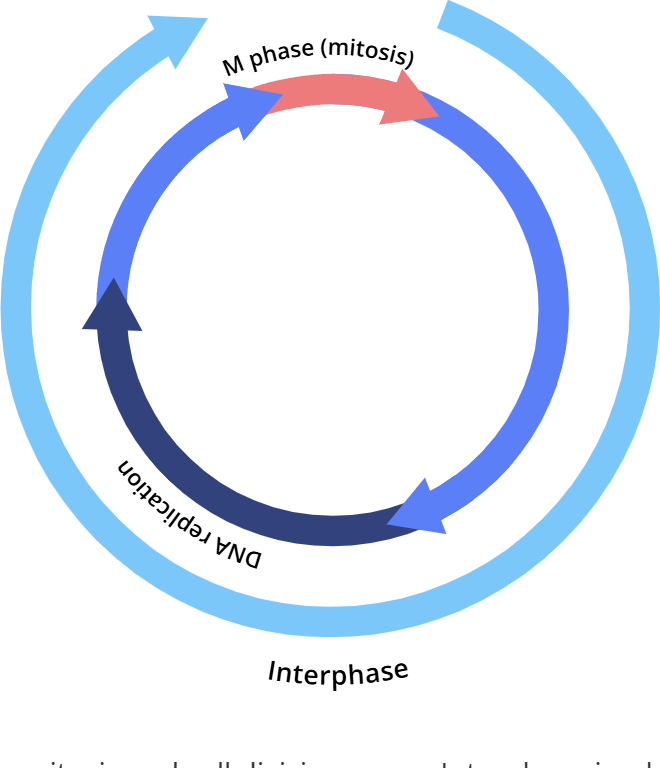
cell cycle - growing and dividing
….. phase - mitosis and cell division occur
…….phase - growth and DNA replication occur.
****The term cycle is appropriate because when cells are actively growing and dividing, the events cycle back and forth. …..phase is followed by an … phase, which is followed by an ….phase, followed by an … phase, and so on.
Why does DNA replication have to occur before mitosis, in ….phase?
Mitosis sends one copy of each ….. to each daughter cell, so it can't occur unless …. has already made the copies.
M
Inter
inter
M
inter
M
inter
chromosome
replication
…. molecules = one long double helix
….. = segments of a double helix that code for specific products.
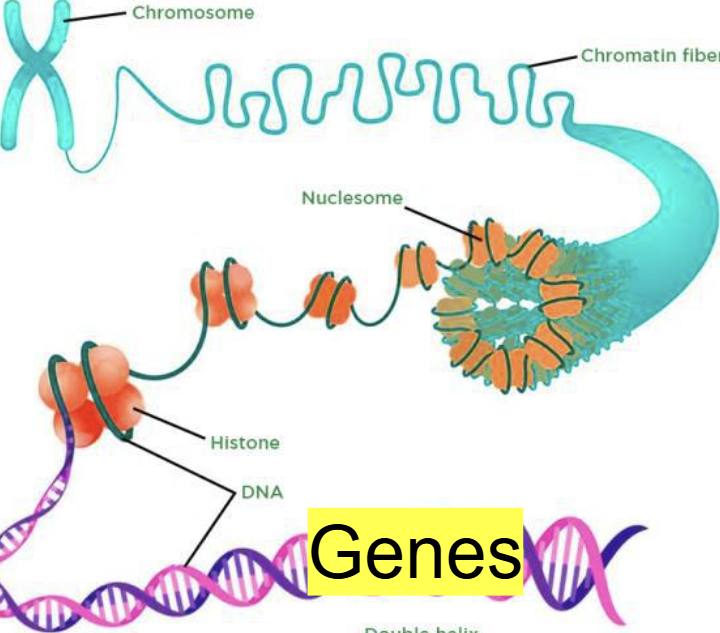
in cells, specialized proteins bind to the double helix, creating a DNA-protein complex called the …...
In euka, the proteins that bind to DNA and form the ….. are called …..
^^^circular in bac/archaea but linear in all euka
Histone proteins have amino acids w/ full positive charges in their primary sequences. Each phosphate group in DNA's sugar-phosphate backbone carries a full negative charge.
so this means that the …. and DNA in a nucleosome stick together via ….. attractions (+/-)
DNA
genes
chromosome
chromosome
histones
histones
electrostatic
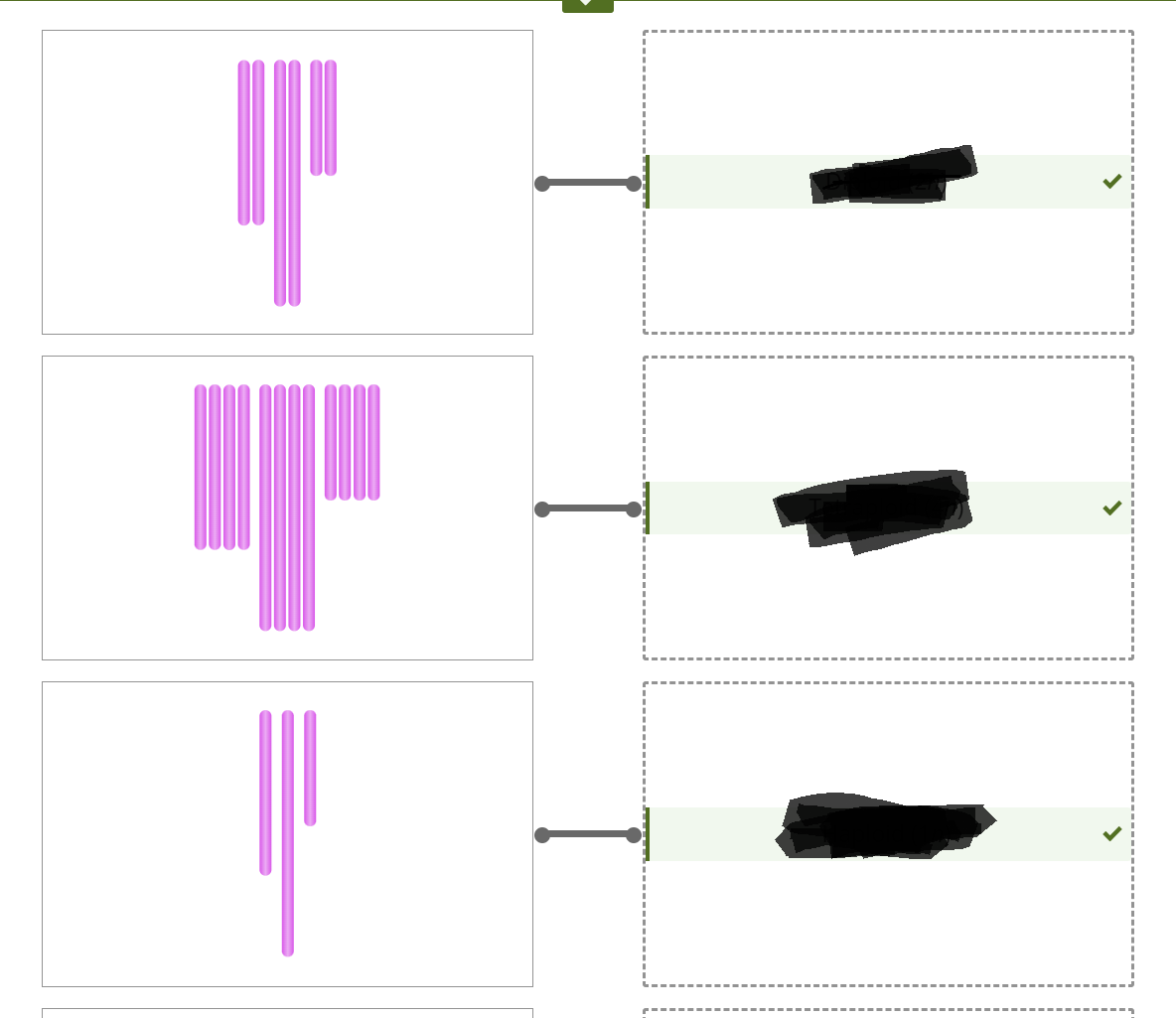
human cells have … different types of chromosomes
…… number refers to the number of different types of chromosomes (symbolized with an ….. = 23)
……. refers to the number of copies of each type of chromosome present. ….. is symbolized with a number before the …… (…. number)
Human cells have ….. of each type of chromosome, so each cell has a total of ….. chromosomes present
Humans are ……( write out expression)
Cells that only have one of each type of chromosome are said to be ……..
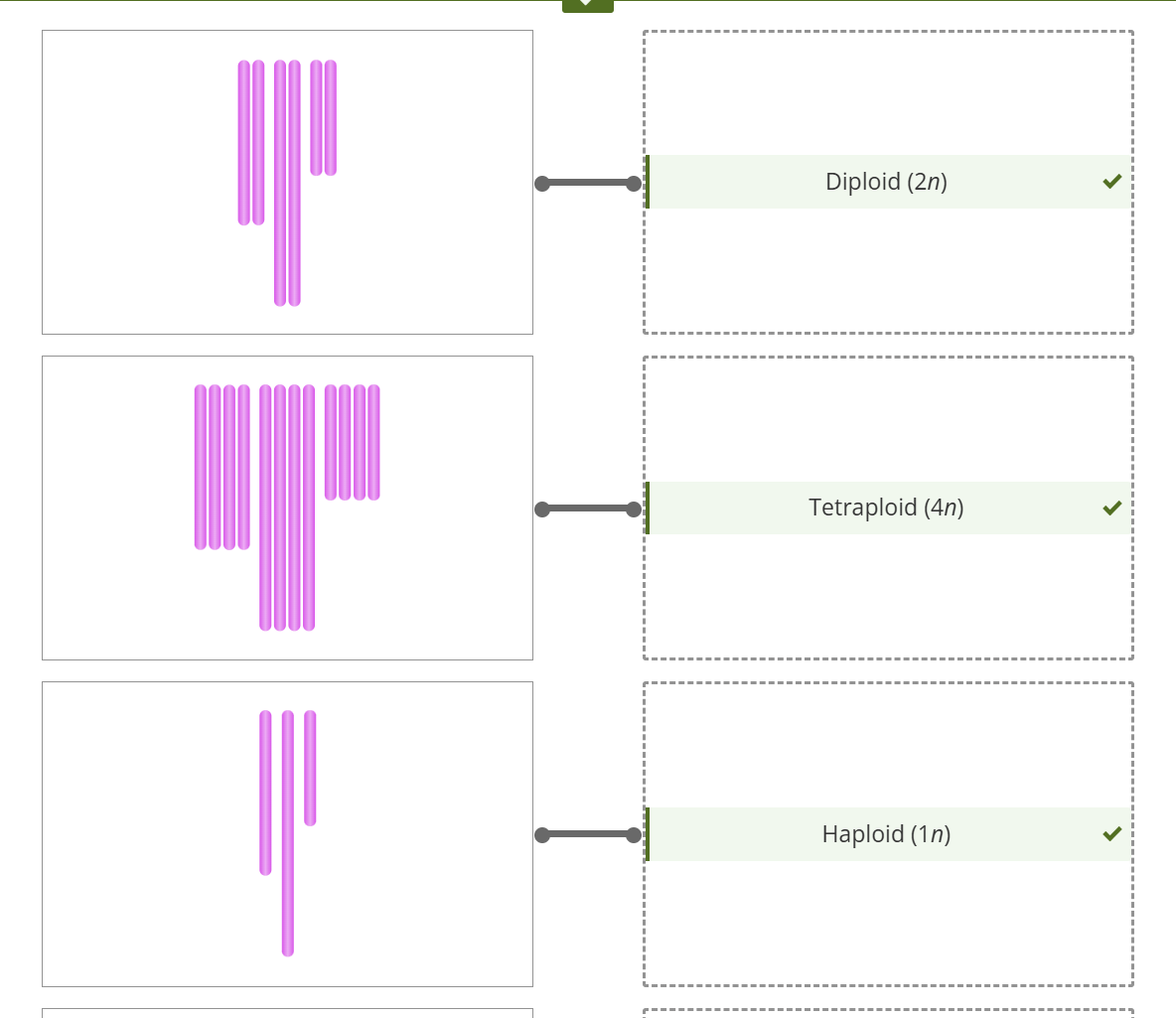
ex: strawberries have seven different types of chromosomes and eight of each type. write out expression. and what is total number of chromsomes
…… number is the number of different types (of chromosomes in a cell)
….. is the number of each type" (of chromosome in a cell)
for the image, they all have the same … number (which is what??)
but the …. varies. figure them out
The total number of chromosomes in a cell is the ….. number times the …...
23
Haploid, n
Ploidy, n, haploid
two, 46
diploid (2n = 46)
haploid
n = 7
8n
7 x 8 = 56 total
Haploid
Ploidy (number of each type of chromosome present)
n=3
dipolid 2n
treapoliod 4n
halpid 1n
Haploid x Ploidy
After DNA replication, a single chromosome consists of two identical copies of the same DNA molecule, complexed with proteins that hold the two double-helices together.
a ….. chromosome is still considered a single chromosome.
The two strands that make up a replicated chromosome are called ……. Note that each pair of ….. is identical ***each pair of DNA molecules contains the same genes and same alleles. ……. are identical copies of the same ……..
Strands on ……. chromosomes are referred to as …….. ****….. chromatids are physically joined to each other and comprise the same chromosome; …… chromatids are not joined to each other and are parts of different homologs.
replicated
sister chromatids 3x, chromosome
homologous, non-sister chromatids
Sister
non-sister
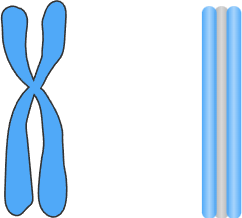
one on left is
one in right is
In reality, replicated chromosomes only look like ….. for an extremely short time. The …… shape occurs when cell division is occurring, and only just before ….. chromatids are pulled apart and sent to different ….. cells.
Before that, …. chromatids are joined all along their lengths by a specialized group of proteins.
replicated chromosome
Unreplicated chromosomes (line)
X 2x
sister
daughter
sister
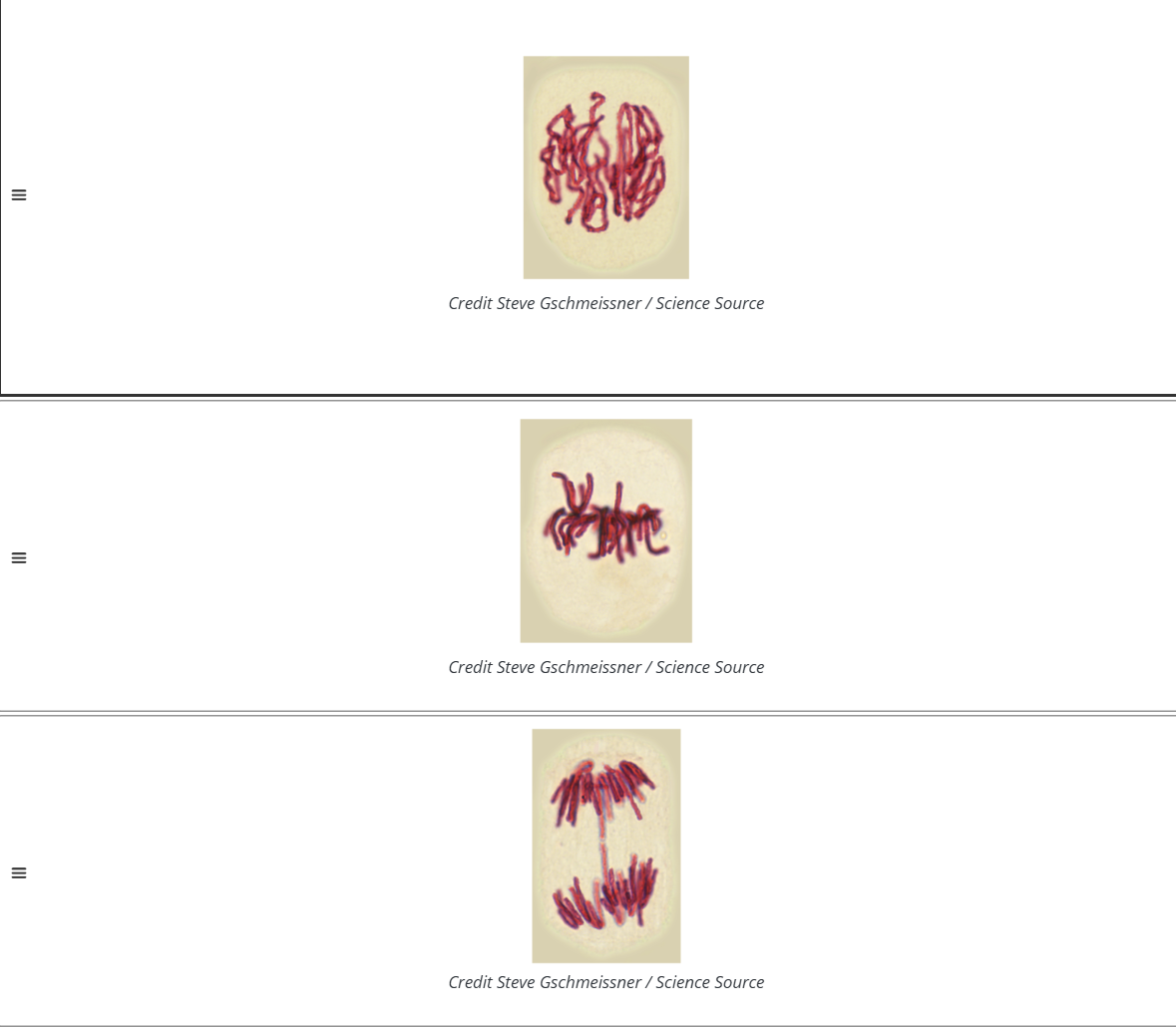
….. replication occurs during …..phase, creating replicated …….
…. starts: replicated ….. condense and the nuclear envelope breaks apart;
…. continues: replicated ….. are moved to the ….. of the cell;
….. finishes: the …. chromatids in replicated ….. are pulled apart and move to either end of the cell, then nuclear envelopes re-form around each set of chromosomes; and
Cell ….. splits the parent cell into two ….. cells, each with a complete set of ….. chromosomes.
^^^^^The starting events are called ….phase. The "…. continues" events in the middle are called ……phase. The ending events are called ….phase and ….phase. (….phase is when …. chromatids separate to become independent chromosomes and move to opposite ends of the cell. In …phase, nuclear envelopes re-form around each set of chromosomes)
so in summary (image)
Replicated chromosomes condense (….phase)
Replicated chromosomes are moved to the middle of the cell (….phase)
Replicated chromosomes are pulled apart until one copy is at either end of the cell (….phase)
dna,
inter,
chromosomes
Mitosis
chromosomes
Mitosis
chromosomes
middle
Mitosis
sister
chromosomes
division
daughter
identical
pro
mitosis
meta
ana
telo
ana
sister
telo
pro
meta
ana
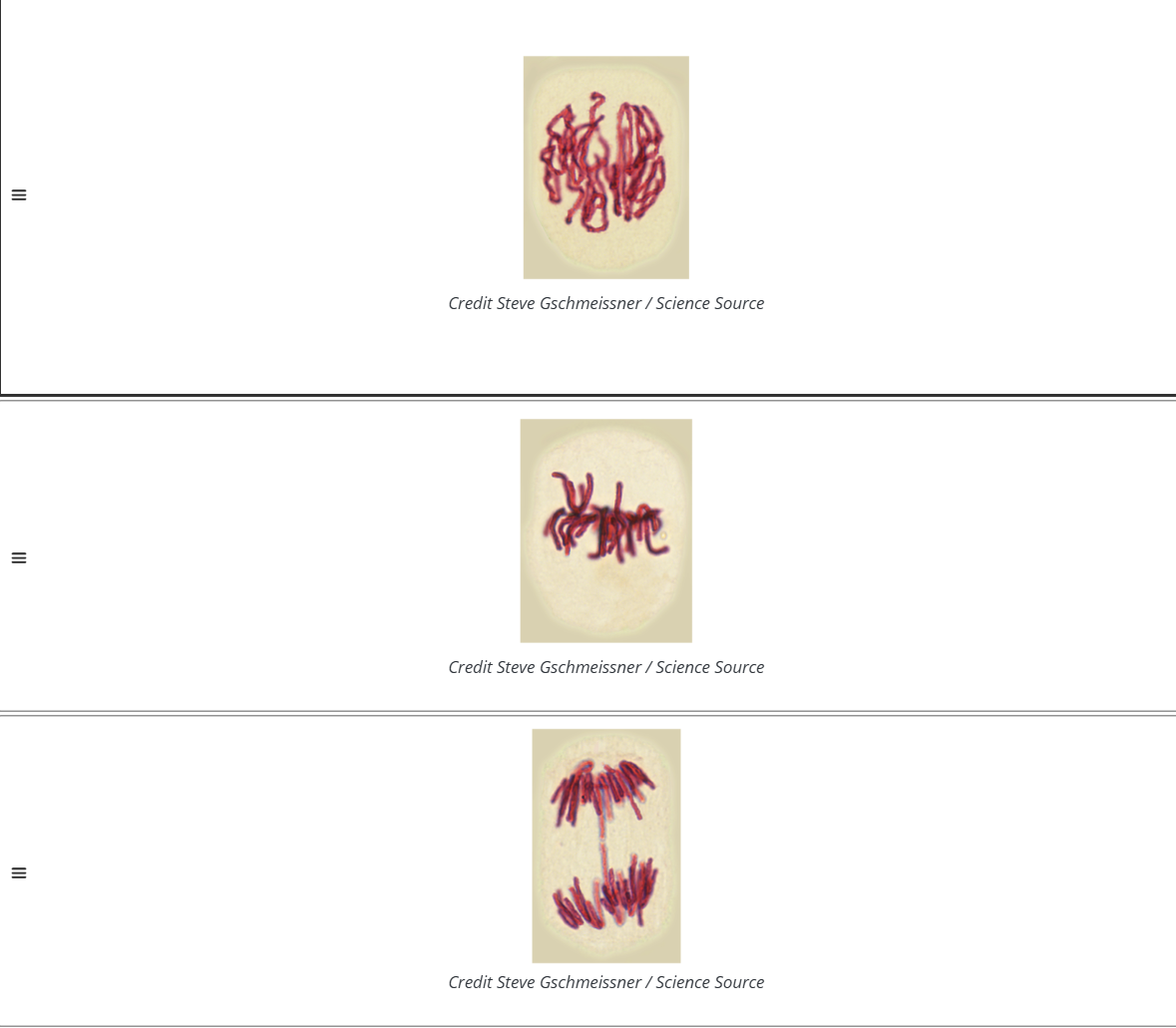
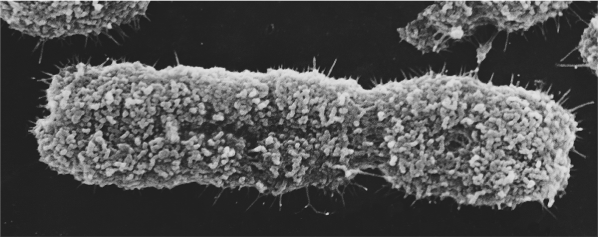
when chromosomes condense (Recall that euka chromosomes comprise a single, long DNA double helix bound to histone proteins), The double helix wraps around balls of 8 histone proteins, forming a structure called a …… and these are clustered into compact arrays called 30-nm fibers.
During …..phase, when genes are being transcribed and RNAs and proteins are being made, 30-nm fibers and nucleosomes may be broken apart to expose particular genes—leading to what life scientists call "open" DNA.
But when mitosis begins, …. stops. Instead, DNA compaction gets more ….. Specifically, 30-nm fibers are folded and packed together into extremely …. configurations. (image)
in the flic u can see that … chromatids are held tightly together, all along their length. Later, when each chromosome is moved to the center of the cell before being pulled apart, most of the proteins that hold the sister chromatids together start to break down, creating an … like shape
***….. position and …. activity are essential for mitosis to BECUSE if replicated chromosomes don't attach to microtubules and then pull sister chromatids apart correctly, daughter cells will not get one copy of each chromosome.
…… cells: Cells that directly give rise to sperm or eggs, or are sperm or eggs themselves. *****undergo meiosis to produce haploid daughter cell
…… cells: Cells that form the body, and that only undergo mitosis
…….. chromosomes (or simply homologs): …. versions of the same chromosome type.
nucleosome
inter
transcription
extreme
dense
sister
X
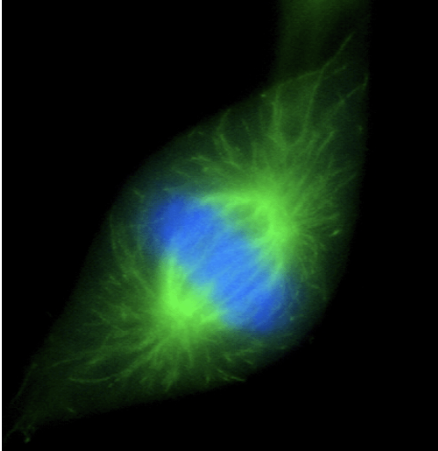
look at this flic, what phase is this??
middle of mitosis (METAphase bc middle)
Microtubule
kinesin
germ
somatic
homologus, different
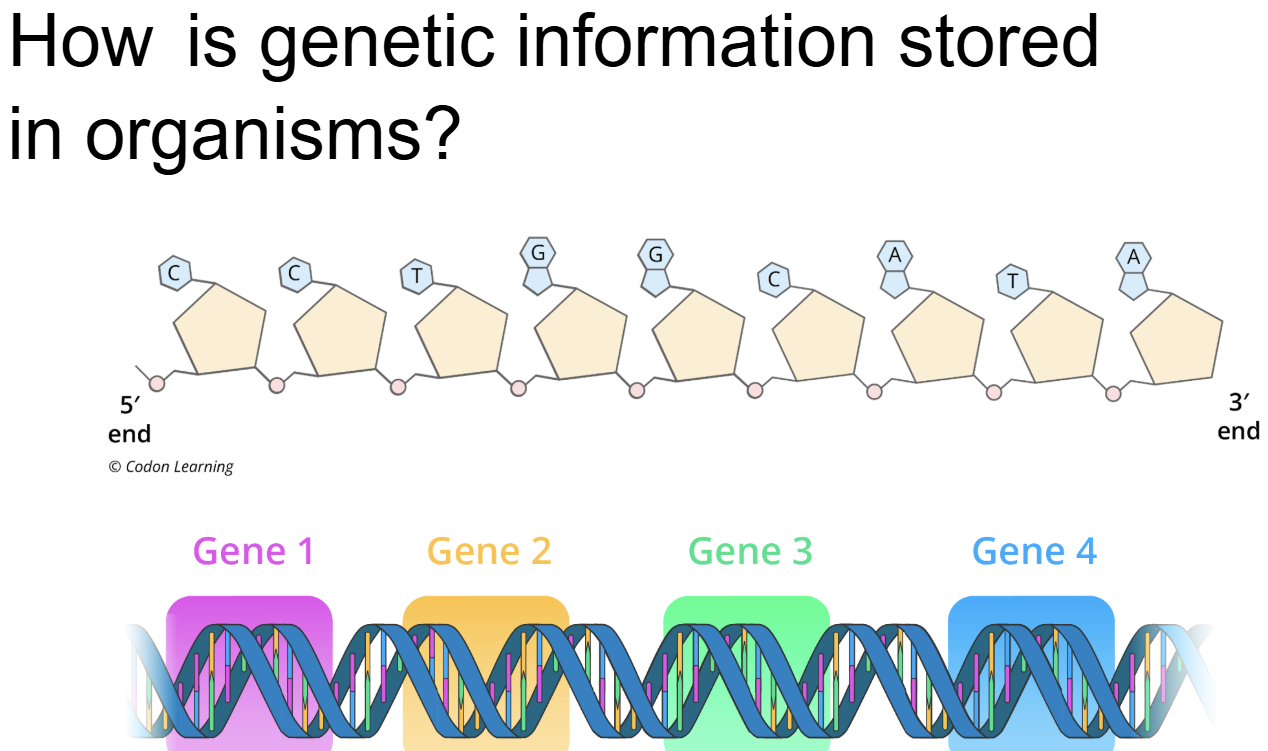
Primary structure (Read from ….)
Usually base paired and double stranded (…. structure)
Genes - lil areas among ….
Piece of …. can hold several genees
…. orgnaied into chromosones
5-3
secondary
dna
dna
Dna
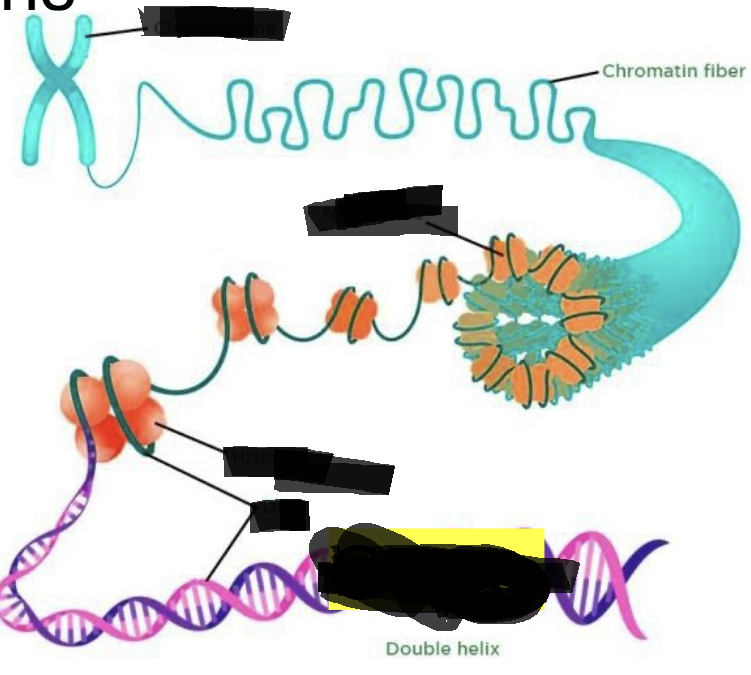
…… pack together to make chromosomes (wrapping on dna around proteins help compact so it can fit into ….)
All dna that contain genes are compacted into ……..
To (asexually) reproduce, organisms must copy their genetic information and divide it between 2 “daughters”
Bacteria: cell …..
- ….. fission (…. chromsome, replicated, partitioned to other end of bac, 2 new cells that are ……
somewhat sim to euka but chromsonmes are ….., dublpilcated, chromeosoems gotta be separated into new cells
so Eukar: chromosomes separate (…..), then cell …
REMEMBERRRR
Mitosis - division of ….. material
Cytokinses- division of ….
Nucleosomes
nucleus
Nucleosomes
divides
binary
ciruclar
identical
linear
mitosis, divides
genetic
cells
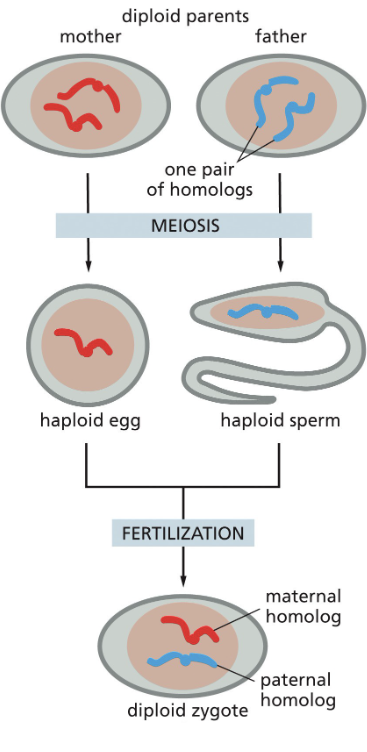
Sexually reproducing organisms have ……. chromosomes: 1 from each parent
……. chromosomes contain the same ….., but can have ….. versions
…… produces haploid games that fuse upon fertilization
asexual - gen indential ….
Sex - increase gen ….
***Typically … ( two copies of each of their chromosomes)
Homologus chromosomes = Two versions of the …. chromsone
*****Same genes but slight differences
…. parents (two copies for each)
…..- diploid to haploid state (2-1 copy)
….. fuse to haploid cells to make a …..
Dilpod zygoyte one copy from each ….
homologous
Homologous
genes
different
Meiosis
clones
diverty
dipolid
same
Diploid
Meiosis
Fertilizaiton
diploid
parent
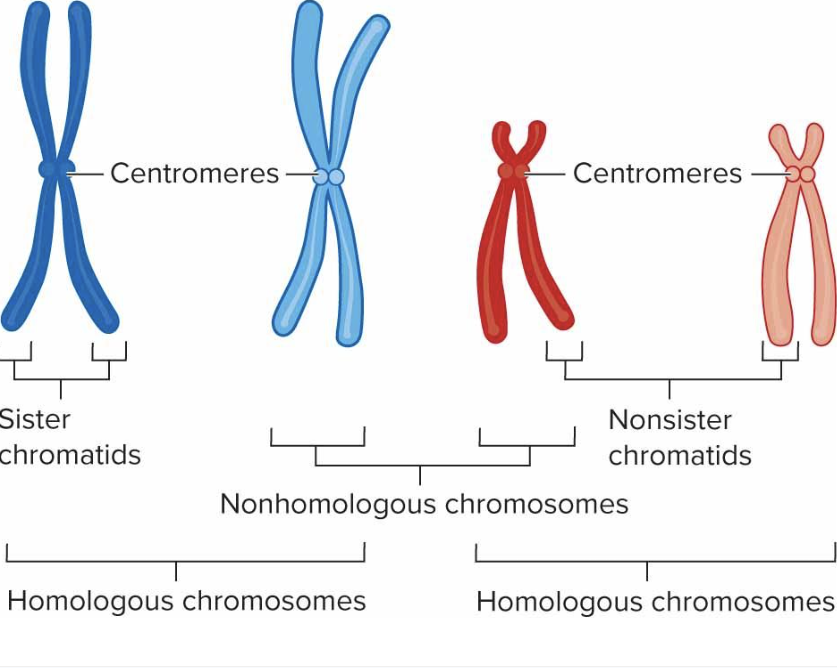
label
**remeber: …. chromatids, which are ….. copies of a chromosome produced during DNA …….
….. chromatids are chromatids belonging to …… chromosomes (one inherited from each parent) that are similar but …… genetically identica
sister
identical
replication
Non-sister
homologous
NOTTTTTTTTTTTTTTTT
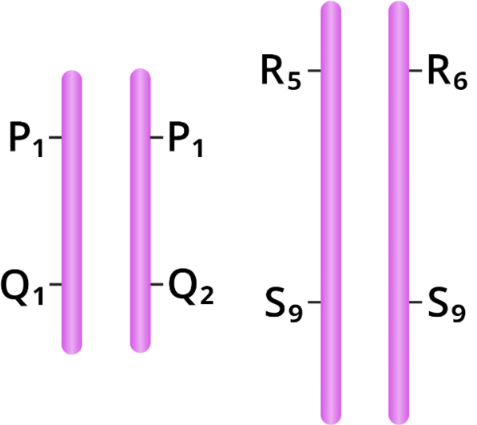
You examine chromosomes from an organism that is supposed to be 2n = 8.
It is missing two more pairs of homologous chromosomes.
It is missing two additional copies of the chromosomes it has.
It is missing four nonhomologous chromosomes.
***Multiple copies of the same type of chromosome are called homologous chromosomes, because they are the same length and have the same genes.
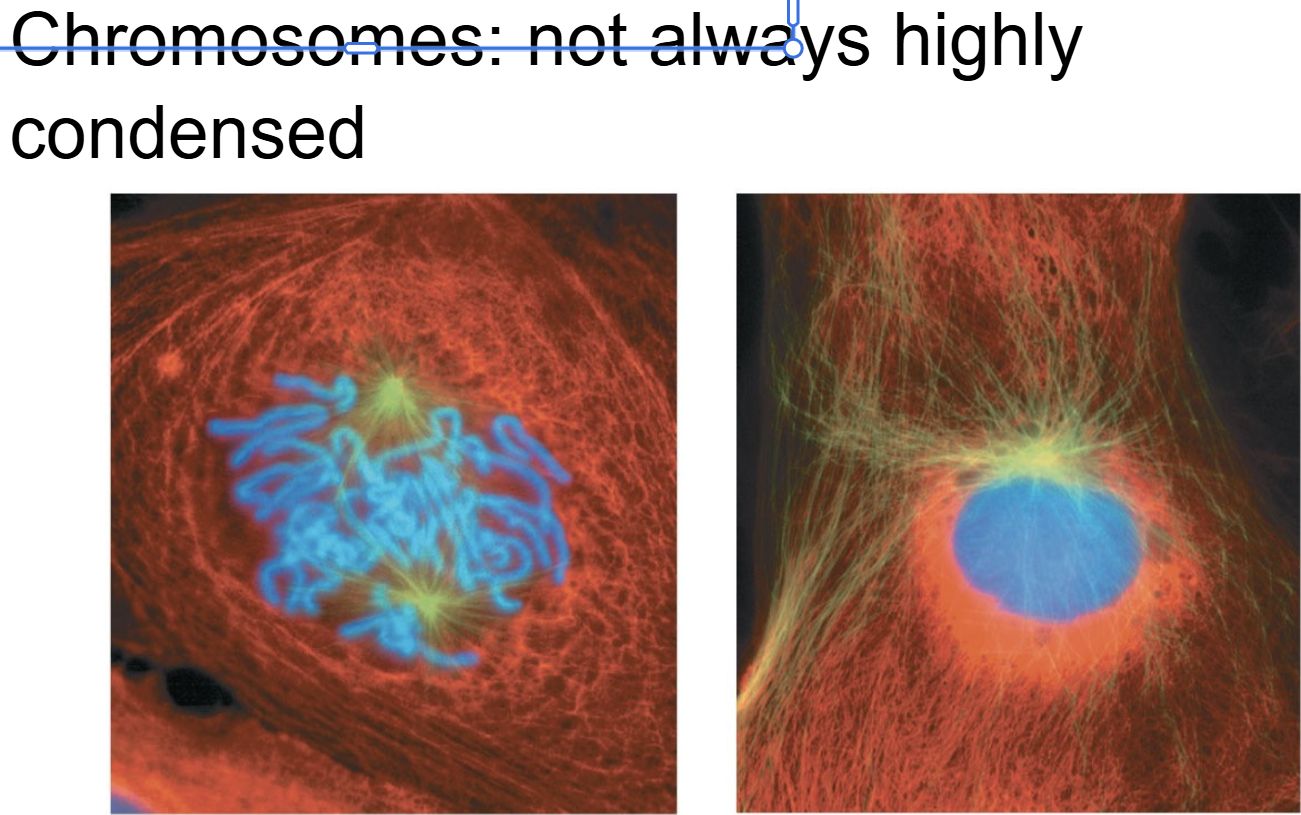
………. during mitosis
1st pic - rlly condensed u can see individual chromrones
2nd pic - cells growing ……phase they look like this
Highly condenses - mitosis
Chromosomes
inter
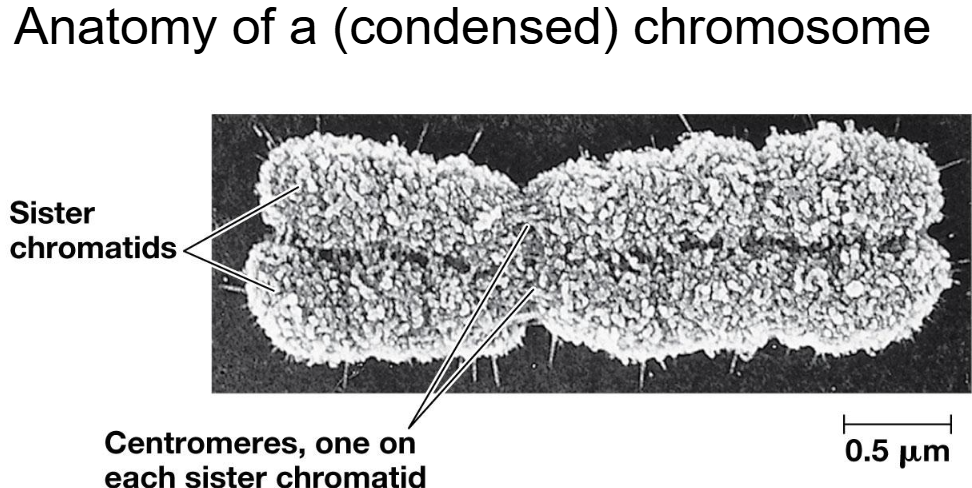
Dna replicated
Two sister chromatids (….. chromosome still)
Centromemere where sist chromtaids attached to eachother
Only sister chromatids …… dna replication
An organism has 92 chromosomes. After it replicates its DNA, how many chromatids and how many chromosomes does it have?
184 chromatids and 184 chromosomes
92 chromatids and 92 chromosomes
46 chromatids and 92 chromosomes
184 chromatids and 92 chromosomes
92 chromatids and 46 chromosomes
one
AFTERRRR
184 chromatids and 92 chromosome ***chromsones dont change after replication only chromatids
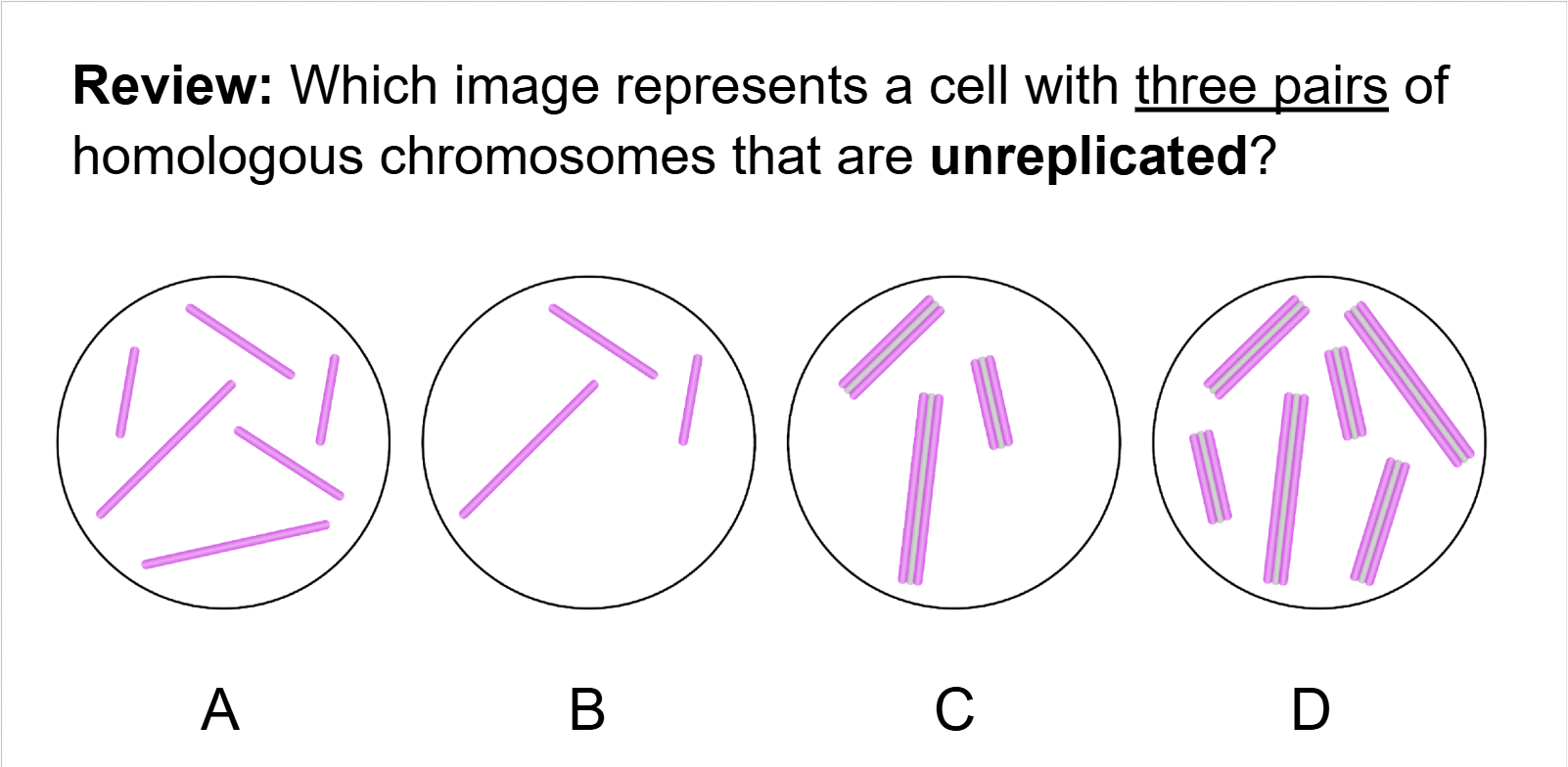
A cell with three pairs homologous chromosomes will have three different types of chromosomes, represented by different lengths, and two copies of each type.
what two options have three different types of chromosomes, but only one copy of each,= does not show pairs of homologous chromosomes.
what two options both have three pairs of homologous chromosomes, but the chromosomes in option ….. are replicated - this is indicated by the two sister chromatids tightly held together.
*** predict whether any of these cells are undergoing mitosis. Because these chromosomes represent condensed DNA, they are likely in some stage of cell division. Option …. is likely in prophase prior to lining up at the metaphase plate.
what are some reasons that a cell might divide?
….. reproduction
Growth and development
… renewal and repair
b, c
a, d
d
d
Asexual
Tissue
what would happen if DNA was not replicated before mitosis?
One of the ….. cells wouldnt have dna (The number of chromosomes sorted into …..” cells would be half of what’s in the parent cell
Unequal division
Cells would lose chromosomes (gottaa pass on …. info)
daughter 2x
gen
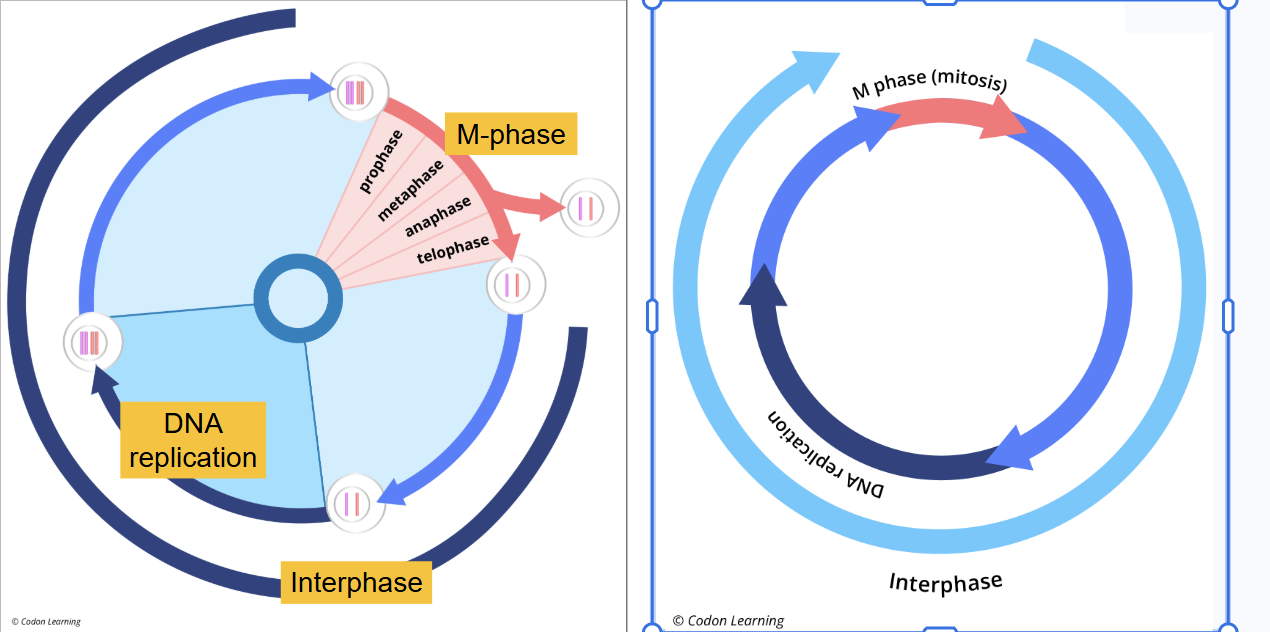
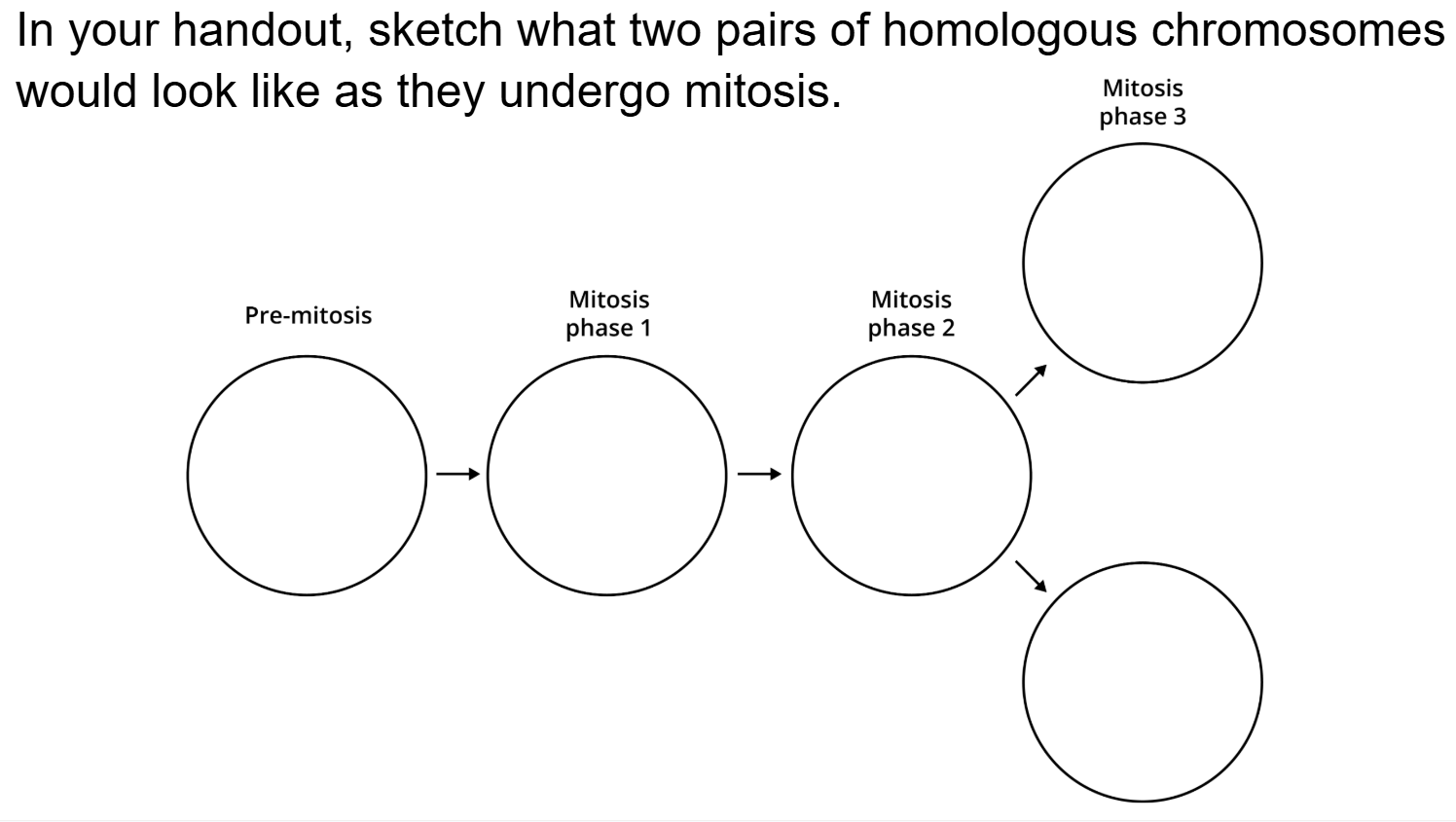
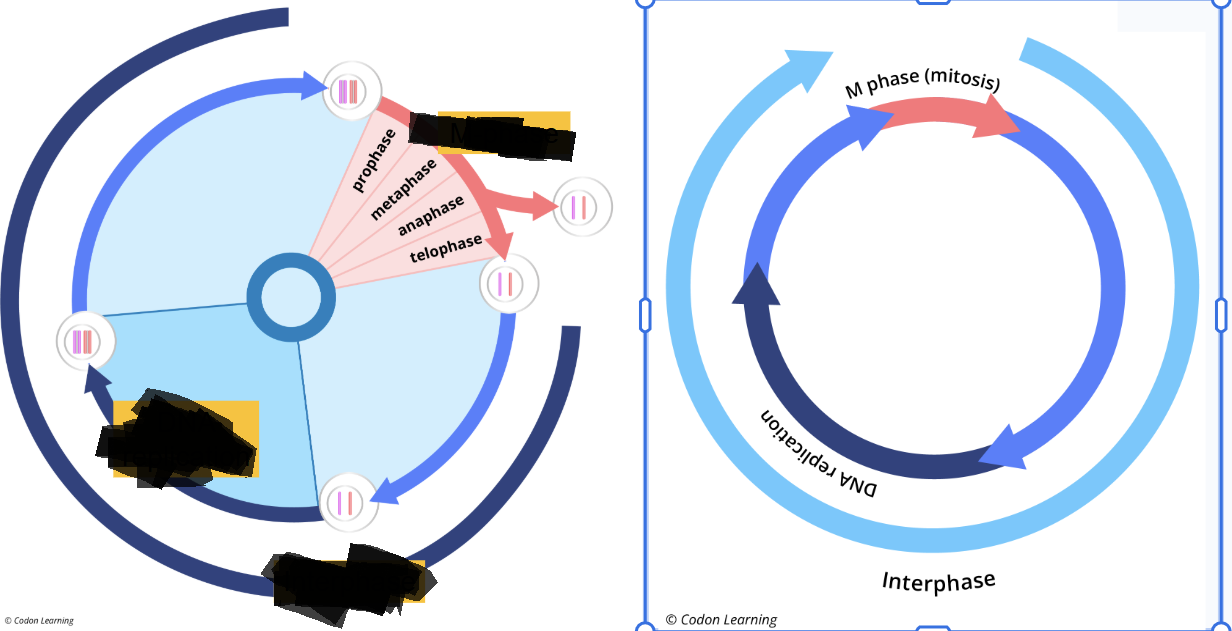
Pre-mitosis would be …..phase and could be interpreted as G0 or G1 phase (when the cell is …. actively replicating or dividing),
…. phase (when the chromosomes are being replication),
or …. phase (after replication).
Similarly, the model is aligned with the steps described in the readiness reading:
DNA replication → ….. → Middle (→ Apart) → two cells.
If you could observe the chromosomes in the pre-mitosis cell, what would they look like?
The two pairs of homologous chromosomes are lined up in the middle of the cell.
The two pairs of homologous chromosomes resemble a ball of yarn.
The two pairs of homologous chromosomes resemble grains of rice randomly positioned in the cell.
The two pairs of homologous chromosomes are separated on either end of the cell.
*** Cells in ….. could be before, during, or after replication. Regardless, in interphase, the DNA is not ….. and will look like a ball of yarn.
Which model do you think best represents the chromosomes in the mitosis phase 1 cell?
8 grains of rice randomly distributed in pairs throughout the cell
8 grains of rice randomly distributed individually throughout the cell
4 grains of rice randomly distributed in pairs throughout the cell
4 grains of rice randomly distributed individually throughout the cell
******Mitosis phase 1 represents ….., during which replicated chromosomes …...- In the model where a single grain of rice represents a single chromatid, option …. is the best answer.
- In the model where a single grain of rice represents a replicated chromosome, option … is the best answer.
What is happening to the chromosomes between mitosis phase 2 and mitosis phase 3? Select all that apply.
One DNA double-helix from each replicated chromosome is moving into each new cell.
One replicated chromosome from each homologous pair is moving into each new cell.
Two DNA double-helices from each replicated chromosome are moving into each new cell.
One chromatid from each replicated chromosome is moving into each new cell.
***Mitosis ends with two cells that each have the same number of chromosomes as the original parent cell. ….., chromatids, each of which is an DNA-double helix, are what separate at the end of mitosis.
inter
NOTTTTT
S
G2
Condense
The two pairs of homologous chromosomes resemble a ball of yarn.
interphase
condensed
prophase
condense
1
4
and 4.
one dna double,one chromatid
sister
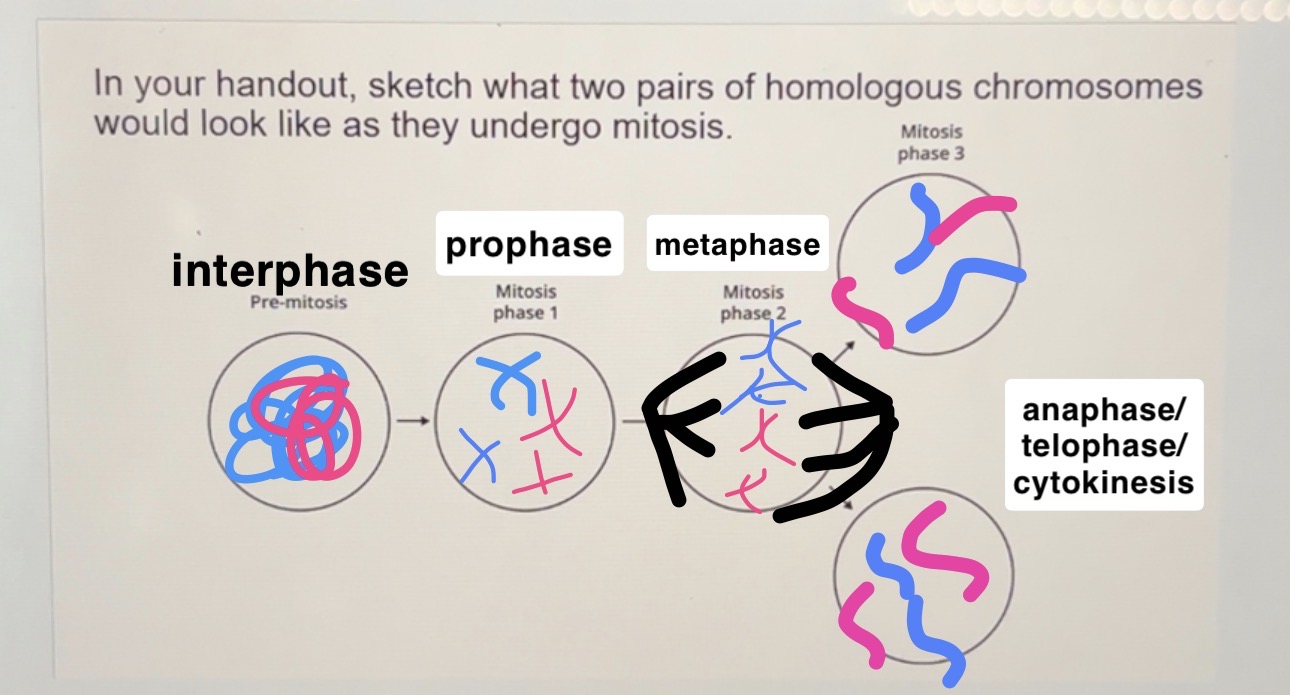
Diagram the sequence of stages in the eukaryotic cell cycle (M, G1, S, and G2) and label the major event or events that occur in each
Explain why cancer is 1) associated with mutations that regulate the cell cycle, and 2) more common in older than younger people
Predict the consequences of altering a given stage (M, G1, S, and G2) in the cell cycle in terms of the cell’s structure or fate
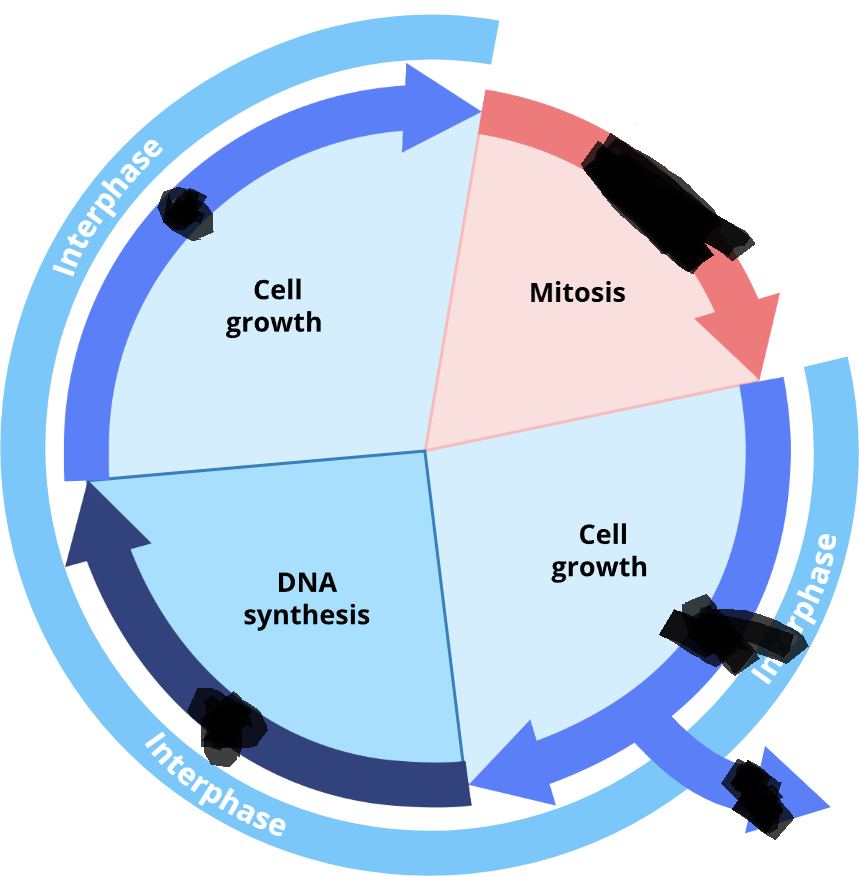
The cell cycle has four main phases.
G1: During the G1, or "first gap" phase, the cell ……., meaning that organelles are replicated and the cell increases in volume.
….. and …… occur at high rates during this phase. G1 is also when the cell receives signals that tell it either to keep ….. and dividing or to stop dividing. If the signals indicate that the cell should stop growth, the cell enters a long-term and non-dividing state called…..
For example, as a human embryo grows and eventually reaches adult size, more and more cells change structure, become specialized for their long-term function, and enter the…. phase. Your muscle cells and …. cells are classic examples of cells that are in…. and do not divide.
S: If cells in …. receive signals for continued growth, the cycle continues. Specifically, they enter S phase and …. their chromosomes, meaning that they synthesize DNA. (The S in S phase stands for "…….")
G2: Once the chromosomes are replicated, the cell continues to grow during G2, or "second gap" phase. A series of events in G2 lay the groundwork for mitosis and cell division.
M: The M phase, where M stands for ….., begins when the machinery that is required to …… chromosomes and begin moving them into position assembles. M phase ends when cell ….. results in two daughter cells. Both daughters then enter …..
which phases are included in interphase? Select all that apply.
grows
Transcription
translation
growing
G0
G0
nerve
G0
G1
replicate
synthesis
mitosis
condense
division
G1
S, G2, G1
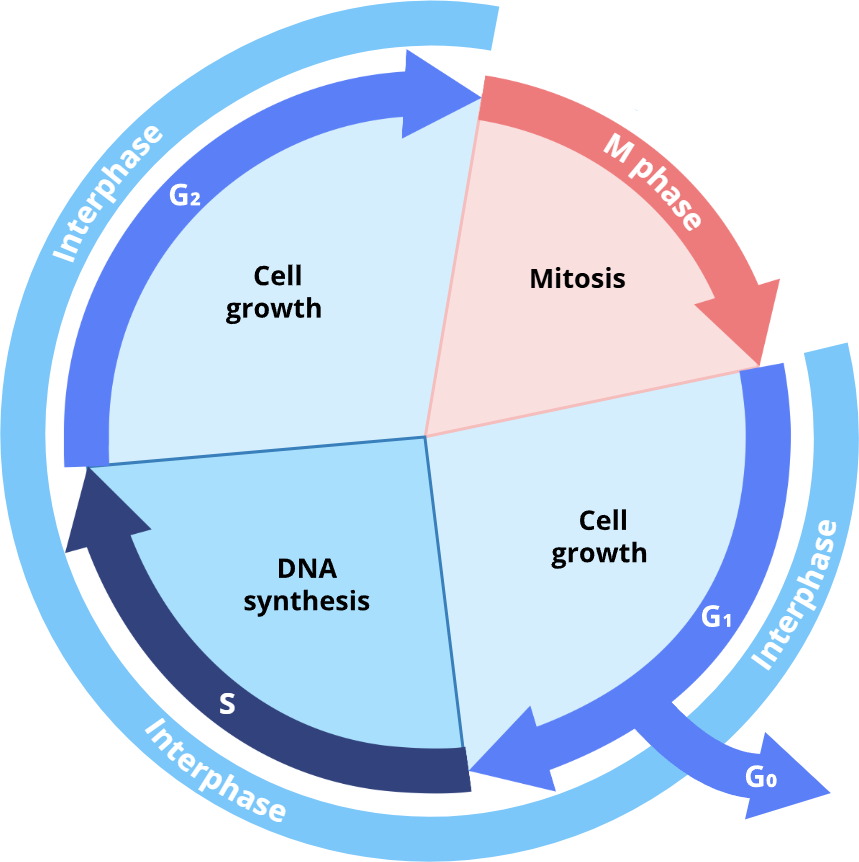
regulatory proteins control what came to be known as cell cycle checkpoints.
one function of cell cycle checkpoints is to ensure that damaged cells, especially cells with damage to their DNA, do not divide. If cells with DNA damage were allowed to divide, the mutations caused by that damage would be passed on to …. cells.
….. checkpoint: Cells can only pass this checkpoint if (1) they receive social signals keeping them in a dividing state (versus exiting to ….), (2) they are being supplied with adequate nutrients and have grown to adequate size to support division into two daughter cells, and most importantly, (3) their DNA is ….. damaged.
….. checkpoint: Regulatory proteins check to make sure that all chromosomes have been ….. properly and that the DNA is …. damaged.
….. checkpoint: As …. gets underway, regulatory proteins assess whether the microtubules that pull the ….. chromatids apart are attached properly, and later that the chromatids have separated so that each daughter cell gets one and only one of each chromosome.
****checkpoint failure leads to uncontrolled cell division, the most fundamental characteristic of cancer.
daughter
G1, G0, not
G2, replicated, not
M, mitosis, sister
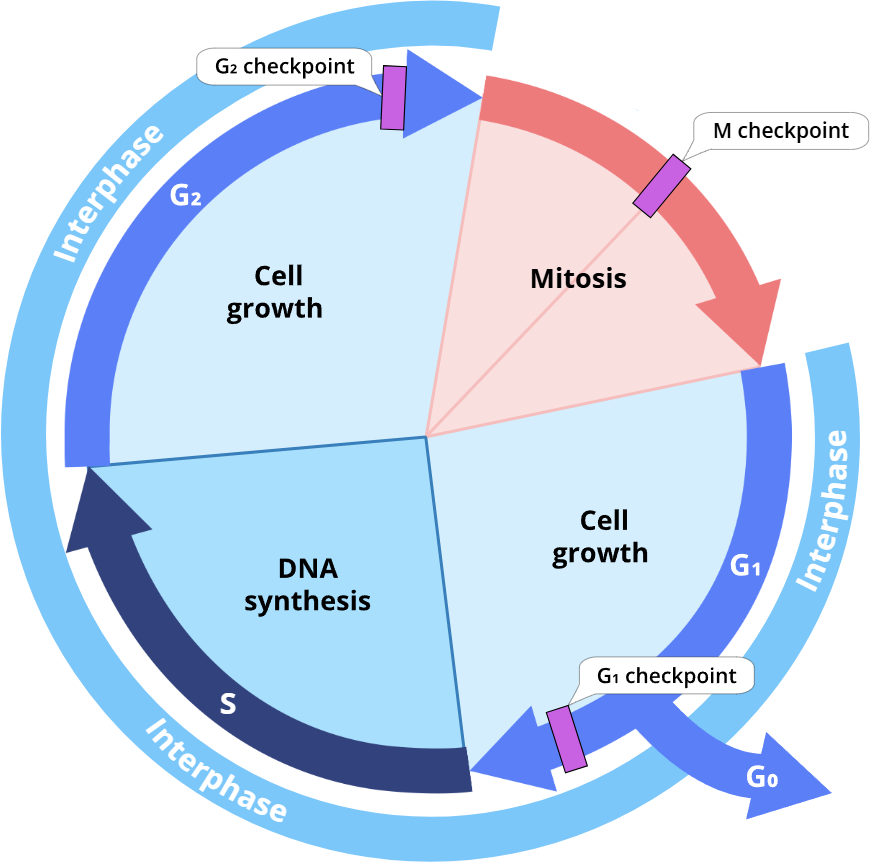
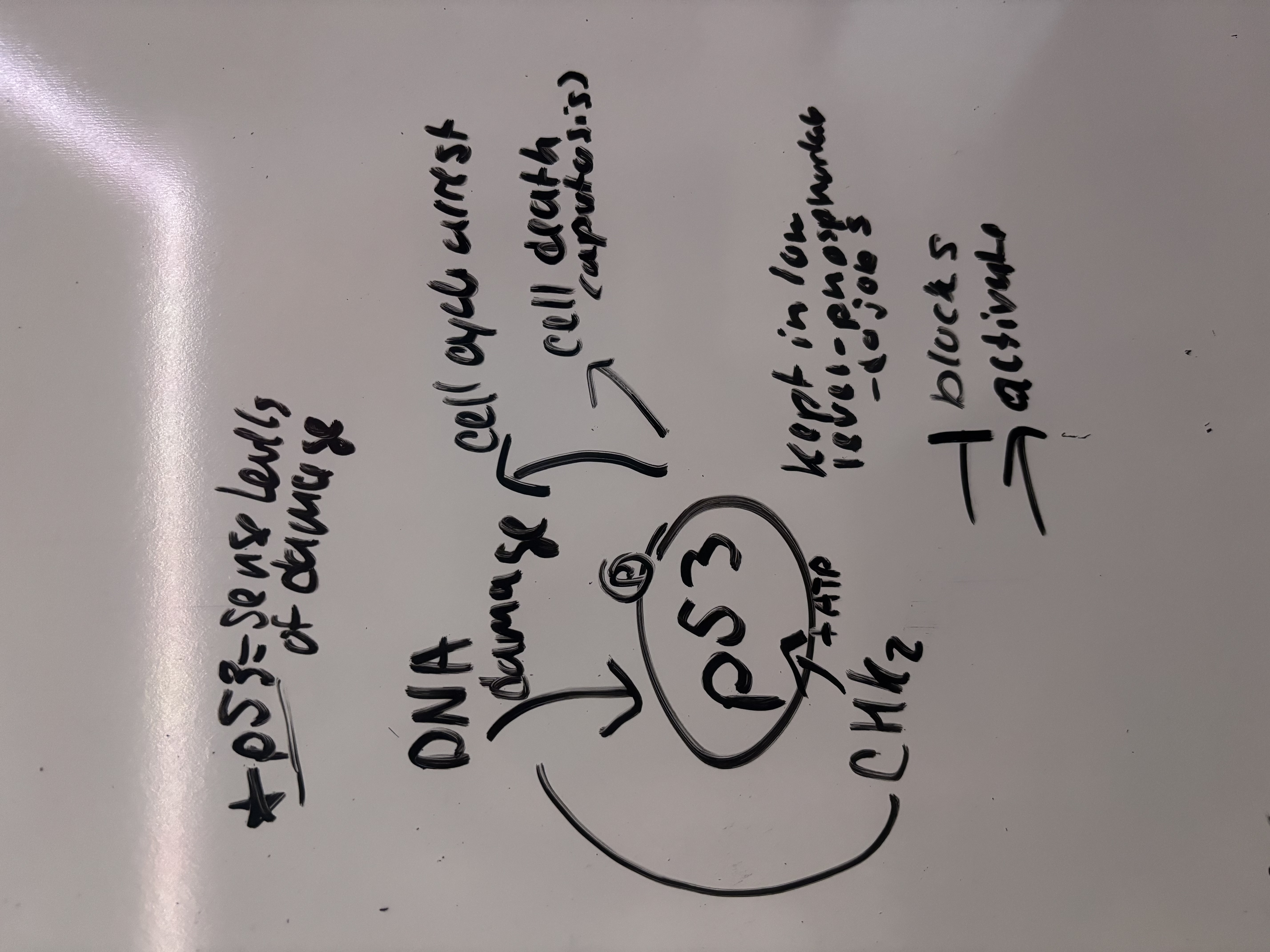
mutations in cell cycle regulatory genes and cancer, consider what may be the best studied of all cell cycle regulatory proteins: p53.
p53 is a ….. factor that is active at both the … and …. checkpoints.
If p53 receives signals that indicate DNA damage, p53 binds to …. and triggers the …. of genes that either (1) suspend the cell cycle until the damage is repaired or (2) induce the cell to self-destruct so the damage is not passed on to daughter cells. Thus, p53 is a …. signal in the cell cycle.
p53 plays such a crucial role in preventing …. due to DNA damage from being passed on to …. cells
When checkpoints function normally, these proteins suppress the ….. cell division that creates tumors.
Cell cycle checkpoint failure = essentially required for tumors to form.
common to find mutations that lead to over-expression of genes required for normal cell division. ("extra good" at growing and dividing). Other mutations are required for cells to detach from a tumor, move elsewhere in the body, establish secondary tumors in these new sites, and recruit a blood supply.
transcription, G1, G2
DNA, transcription
STOOPPP
mutations, daughter
uncontrolled
mutations in a specific somatic cell- genotype, the environment, and age.
…….- genetic predisposition to cancer; the …, they carry make them more likely to develop certain cancers (some people are heterozygous for alleles at the gene for p53 that result in loss of p53 function)
envir: …. are substances or processes that increase the mutation rate and ….. are substances or processes that increase the risk of developing cancer.
age: Cancer is a disease of many mutations. It takes time for DNA damage and replication errors to accumulate and cause the many mutations required for cancer to develop
Genotype, alleles
Mutagens, carcinogens
What are some major events that occur during G1 of the cell cycle? Select all that apply.
****In G1, cells prepare for ….. by growing, but they also do their normal cellular functions like making proteins (via …. and …..).
DNA replication
Cell growth
Transcription and translation
Chromosome condensation
since they dont do numbers … and …., in which cell cycle stage do they happen?
………. occurs in S phase (stands for synthesis)
………. occurs in mitosis (M phase - occurs make the chromosomes neat for accurate segregation in mitosis)
Interphase
….: cell growth
….: DNA synthesis
…..: cell growth
M phase
……: division of genetic material
division
transcription
translation
2 & 3
1 & 4
DNA replication
4. Chromosome condensation
G1
S
G2
Mitosis
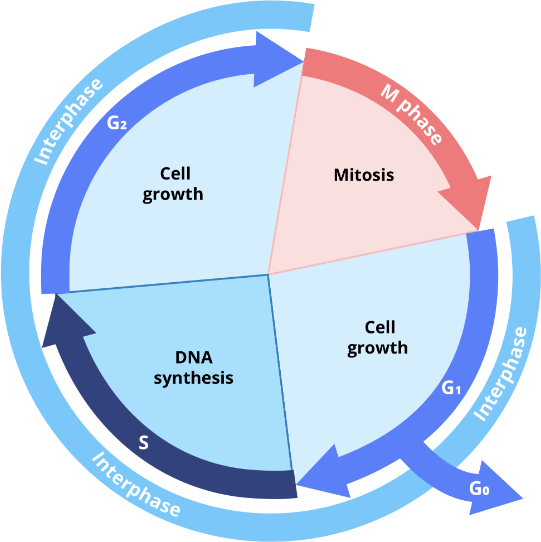
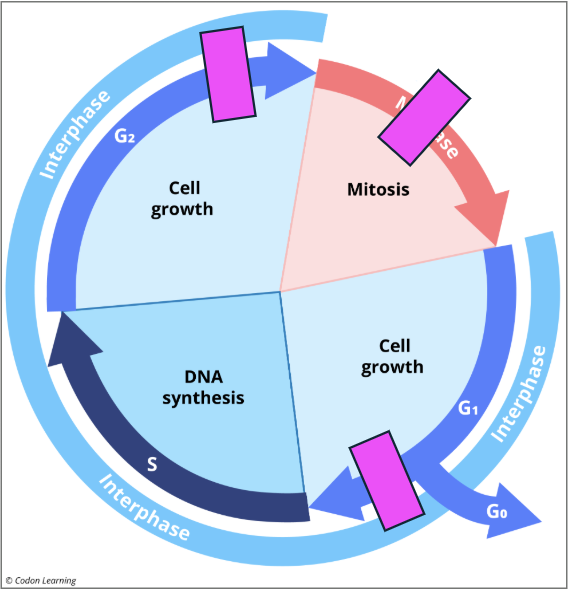
interphase (big window of time) - 90% and 10% mitosis)
….: cell growth - making proteins, rnas, receiving signals
***too divide or not too divide
has it received signals to divide or no
if yes i need more …..
i need atp
is there …. damage lets fix before replication
…..: cells exist cell cycle like neurons that dont divide
….: dna synthesis (dna doubles and orgnallees and histone protiens
…..: cell growth
cell signaling play large role in cell cycle
was dna ….. only one time any damage is it good
… phase: mitosis division of genetic material and cytokinese
make sure dna is gonna be seegrated faithfully
have …. chromatids separate every cell getting correct compliment of gen matieral
Are all …… attached?
g1
resources
dna
g0
s
g2
repilcated
m
sister
microtubules
If p53 functions to detect DNA damage before replication, in which cell cycle phase is it working?
1. G1
S
G2
M
G1 is the only phase that occurs before DNA replication, which happens in S phase.
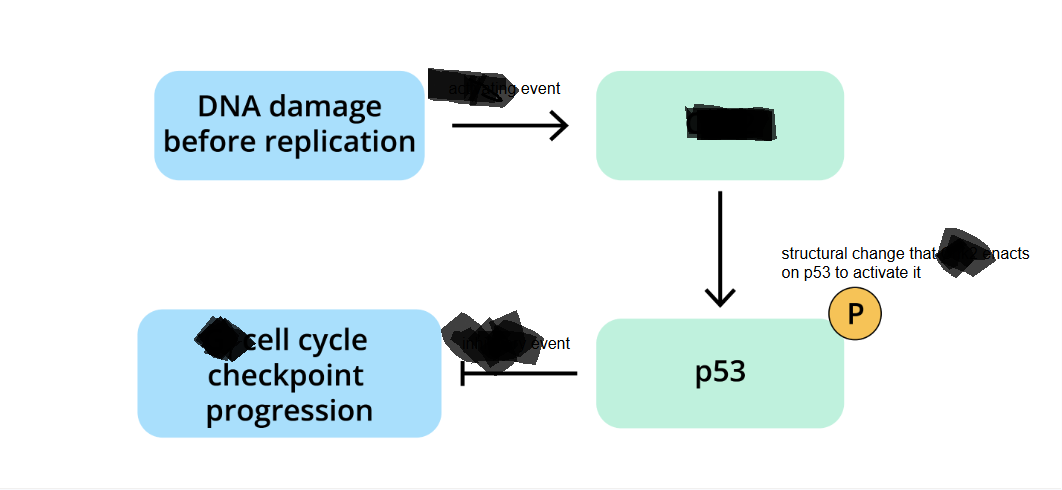
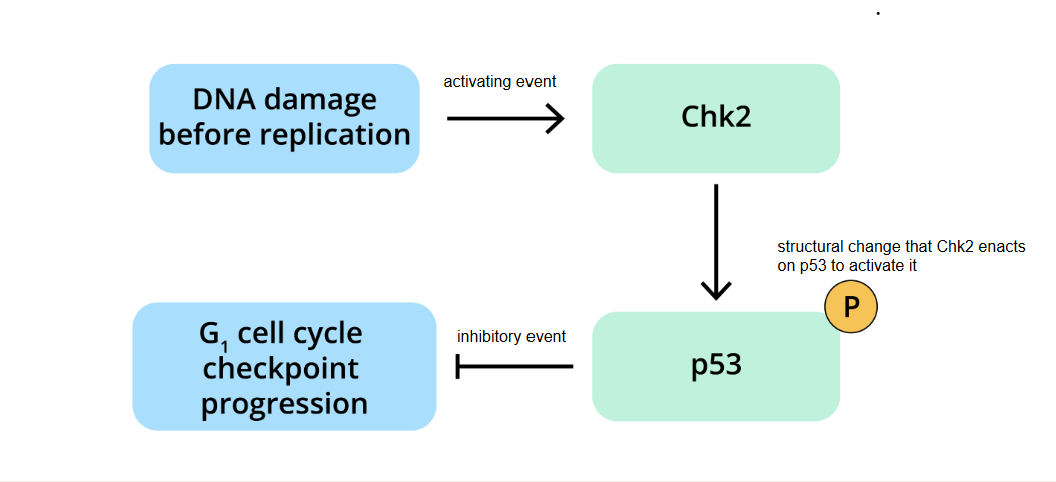
After further genetic analysis, you discover that the tumor cells have a mutation in the Chk2 protein. Which Chk2 mutation would most likely lead to cancer (uncontrolled cell division)?
The mutant Chk2 protein is overactive and phosphorylates p53 even when DNA damage is not detected.
The mutant Chk2 protein degrades damaged DNA.
The mutant Chk2 causes cells to arrest at the G1 checkpoint.
The mutant Chk2 protein can no longer phosphorylate p53.
***If p53 cannot be …… in response to DNA damage (via Chk2), then the cell is more likely to continue on in the cell cycle when it should …., thus increasing its likelihood of uncontrolled cell division.
If Chk2 was overactive, it would cause cell cycle ….. all the time, which would be the opposite of a cancer phenotype.
Option …. would also be unlikely to lead to cancer, since this function (which is not part of Chk2 function) would increase the likelihood of a healthy cell.
Option 3. describes Chk2’s typical function, which prevents uncontrolled cell division.
What are likely consequences of a Chk2 protein that can no longer function? In other words, why did this mutation likely cause a tumor in this patient?
Damaged DNA is …. during … phase.
….. accumulate and are passed to new cells.
More cell cycle checkpoint proteins become non-functional, eventually leading toward uncontrolled cell growth.
*** Note that if only the p53 pathway is disrupted, there are still other cell cycle checkpoints that can keep the cells from dividing uncontrollably. The more mutations that accumulate, the more likely that multiple cell cycle checkpoint regulatory proteins will stop functioning.
The mutant Chk2 protein can no longer phosphorylate p53.
phosphorylated
NOTTTTT
arrest
2.
3.
replicated, S
Mutations
wrd
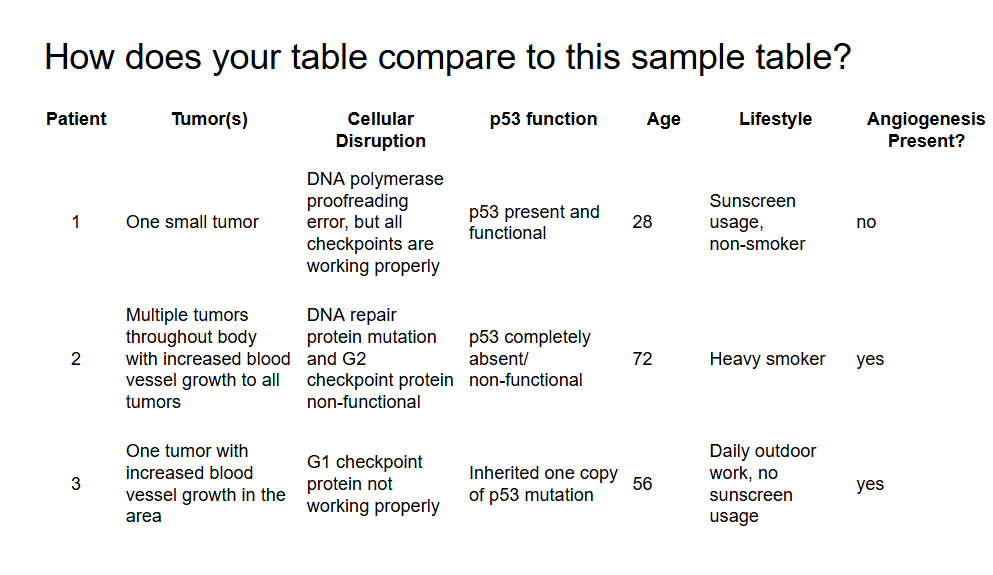
**** the older a patient is, or the more exposure they have to carcinogens, the more likely they will be to develop mutations that lead to cancer.(more time to accumulate mutations)
Blood vessel growth helps provide nutrients/oxygen to the cancer cell. The more ….., the more the tumor is provided resources to grow and spread, leading to more ….. cancer.
What events are likely occurring in the cells of Patient 1’s tumors? Select the two best answers.
1. DNA damage is detected in G1.
DNA damage is detected in G2.
Microtubules are not attaching to chromosomes
Mitosis is happening faster than it typically does.
DNA replication errors are arising during S phase.
*** this patient’s tumor cells have a DNA polymerase proofreading error, so every round of DNA replication will introduce new …… to DNA in the form of mismatches. Since this patient’s cell cycle checkpoints are still intact, this “DNA …..” should be caught in the …. checkpoint after …. phase.
angiogenesis, severe
2 & 5
mutations
damage
G2
S
Differentiate between the genetic information held on two homologous chromosomes, two non-homologous chromosomes, two sister chromatids, and two non-sister chromatids
Compare and contrast asexual and sexual reproduction with respect to inheritance of chromosomes by offspring
Explain why the segregation of homologous chromosomes in meiosis I leads to a reduction in ploidy
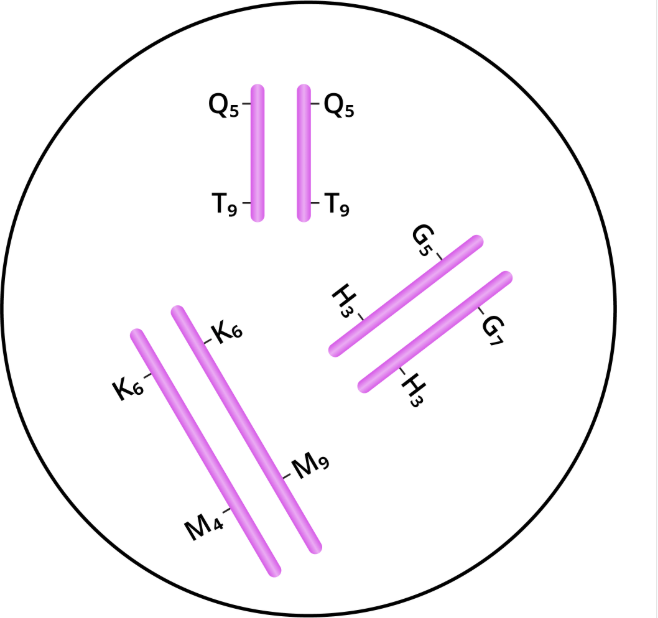
Which of the following components are present in this cell?
What is the ploidy and chromosome number of this cell?
Has this cell undergone DNA replication?
Which of the following components are present in this cell?
Homologous chromosomes
Sister chromatids
What is the ploidy and chromosome number of this cell?
2n = 6
2n
N = 3
Has this cell undergone DNA replication? Nooooo bc no sister chromatids
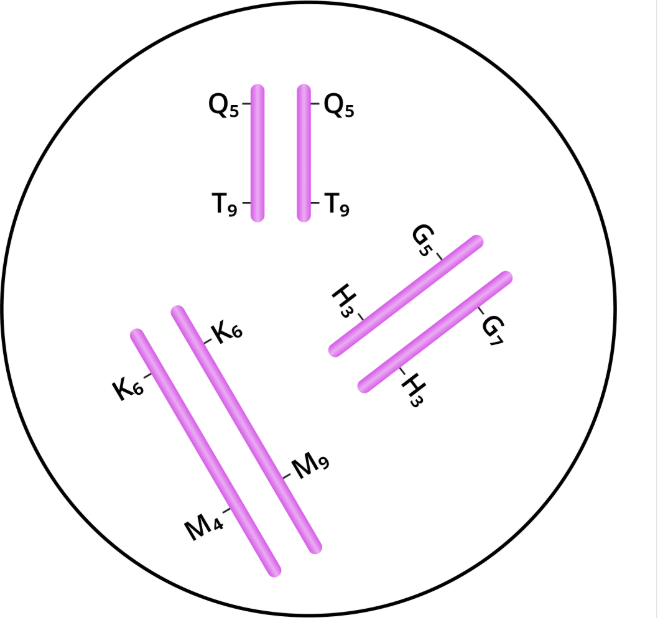
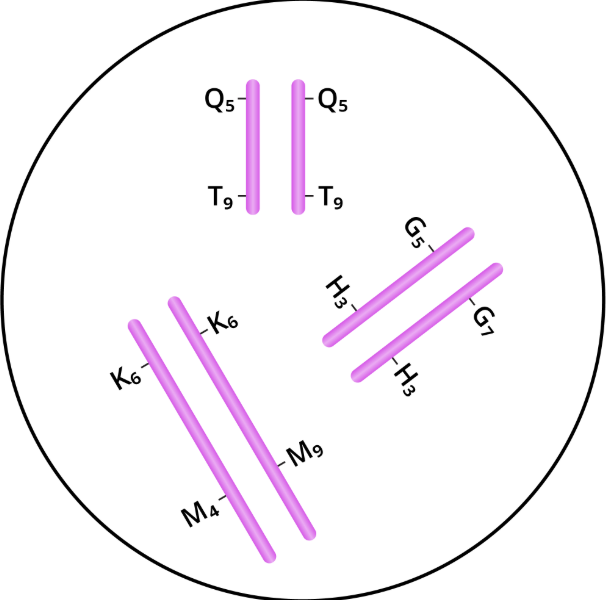
**like test
Which statements accurately describe the genetic material in this diagram? Select all that apply.
1. There is a total of six different genes shown on these chromosomes. Count numbers dash thingy
G5 and G7 are two different alleles of the same gene and are on two sister chromatids. No chromatids, on homo chromosomes (g5 g5 is homo)
T9 and M9 are two different genes and are on two non-homologous chromosomes
***what kind of chromosomes have different lengths and different genes.
6 differnt letter - 6 diff what??
for number 2, G5 and G7 are two different alleles: true/false
are they on sister chromatids? if not what are they on??
1. There is a total of six different genes shown on these chromosomes. Count numbers dash thingy
G5 and G7 are two different alleles of the same gene and are on two sister chromatids. No chromatids, on homo chromosomes (g5 g5 is homo)
T9 and M9 are two different genes and are on two non-homologous chromosomes
**set = homo
not set = nonhomo
Non-homologous
genes
true!! so g5 g5 would be homo
no!!! they are on homologous chromosomes,
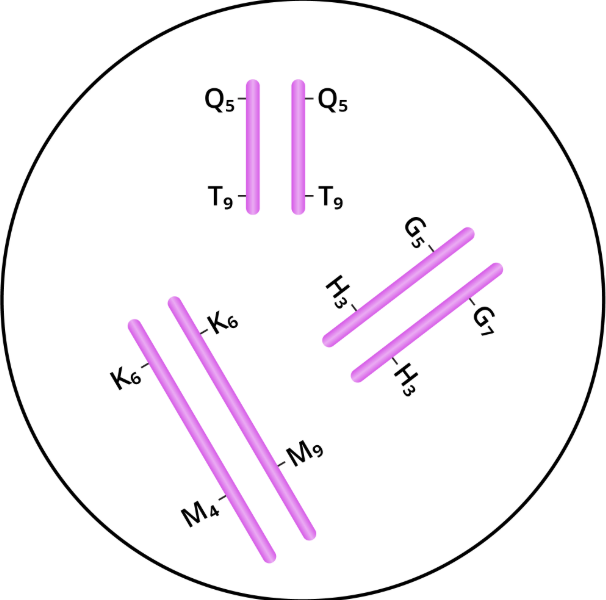
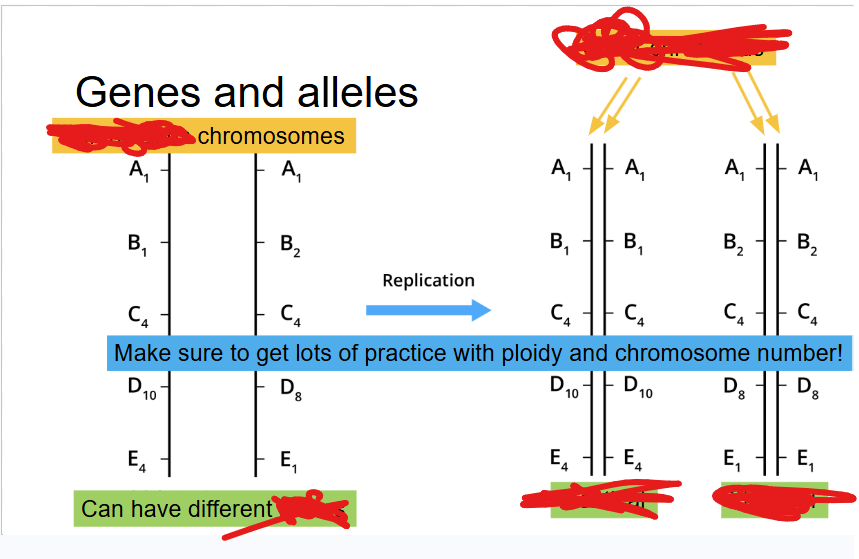
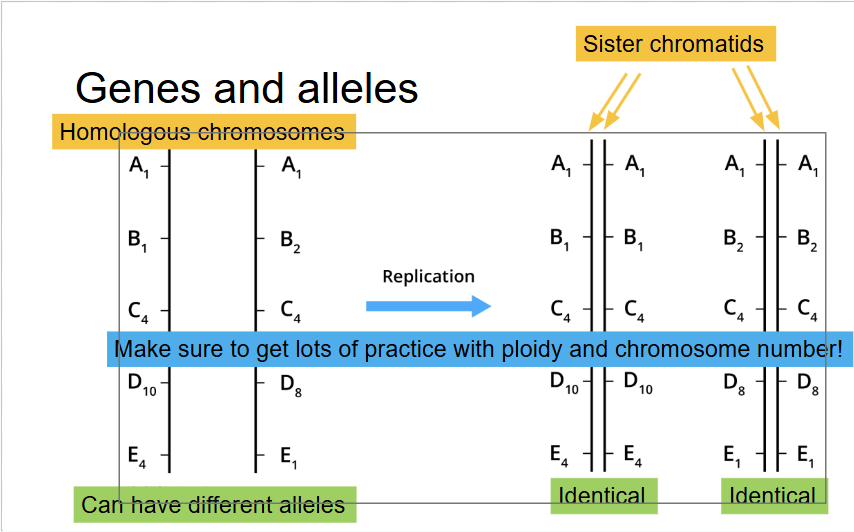
look at the left
they can have diff wuttt
After replication, sister chromatid (indentical) all alleles are identical
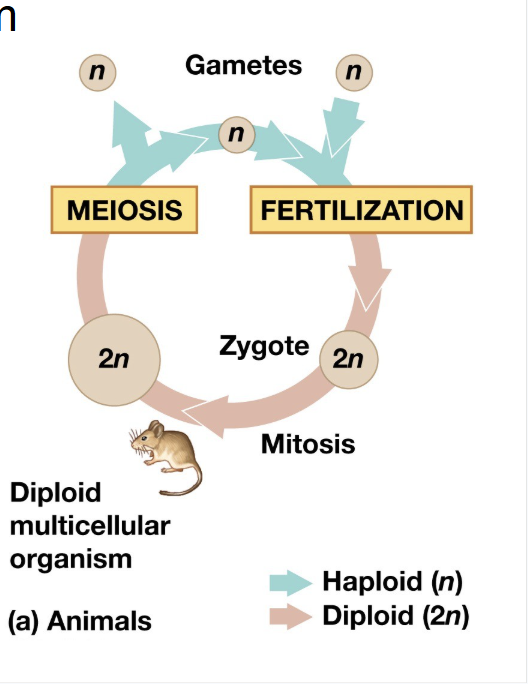
The diploid animal life cycle
Meiosis: Production of ….. gametes from ….. cells
Fertilization: Fusion of two …. gametes to form a …. organism
Zygote: …. organism resulting from the fusion of two …. gametes
haploid, diploid
haploid, diploid
Diploid, haploid
Which events occur only in meiosis? Select all that apply.
1. Homologous chromosomes separate into two different cells. ***in mitosis, what seperates???
DNA replication creates chromosomes with two identical sister chromatids. **whta phase is this??
Sister chromatids from a replicated chromosomes separate into two different cells.
***Chromosomes must be replicated before …. or …., and both types of cell division involve the replicated … chromatids separating into new cells. However, only in …. do homologous chromosomes separate from each other, reducing the …. of the new cells relative to the original cell.
1. Homologous chromosomes separate into two different cells.
sister chromatids
S phase
mitosis, meiosis
sister
meiosis
ploidy
Consider two siblings with the same biological parents. Which two cells would have the most different genetic information?
1. A heart cell and a skin cell, both from sibling 1.
A heart cell and a skin cell, both from sibling 2.
A skin cell from sibling 1 and a skin cell from sibling 2.
All of these cells would have about the same amount of genetic differences.
…. occurred in order for the two siblings to exist.
** creating haploid sperm and eggs via …., then … cell divisions of a zygote into a fully-formed adult.
bc Heart + skin = genetically identical for each sibling
Gamates produced are diff so between two sibling
meiosis
meiosis
mitotic
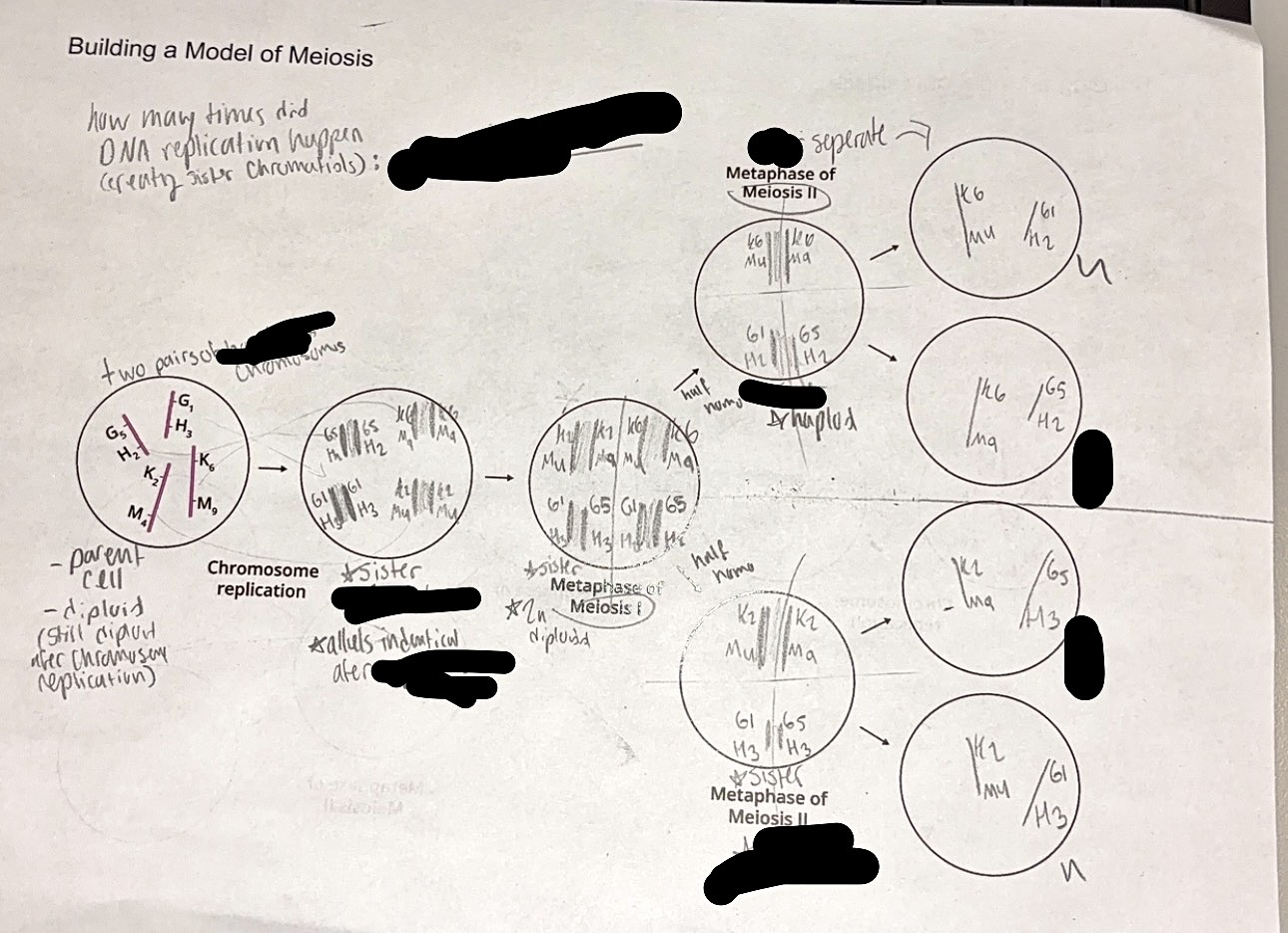
do it
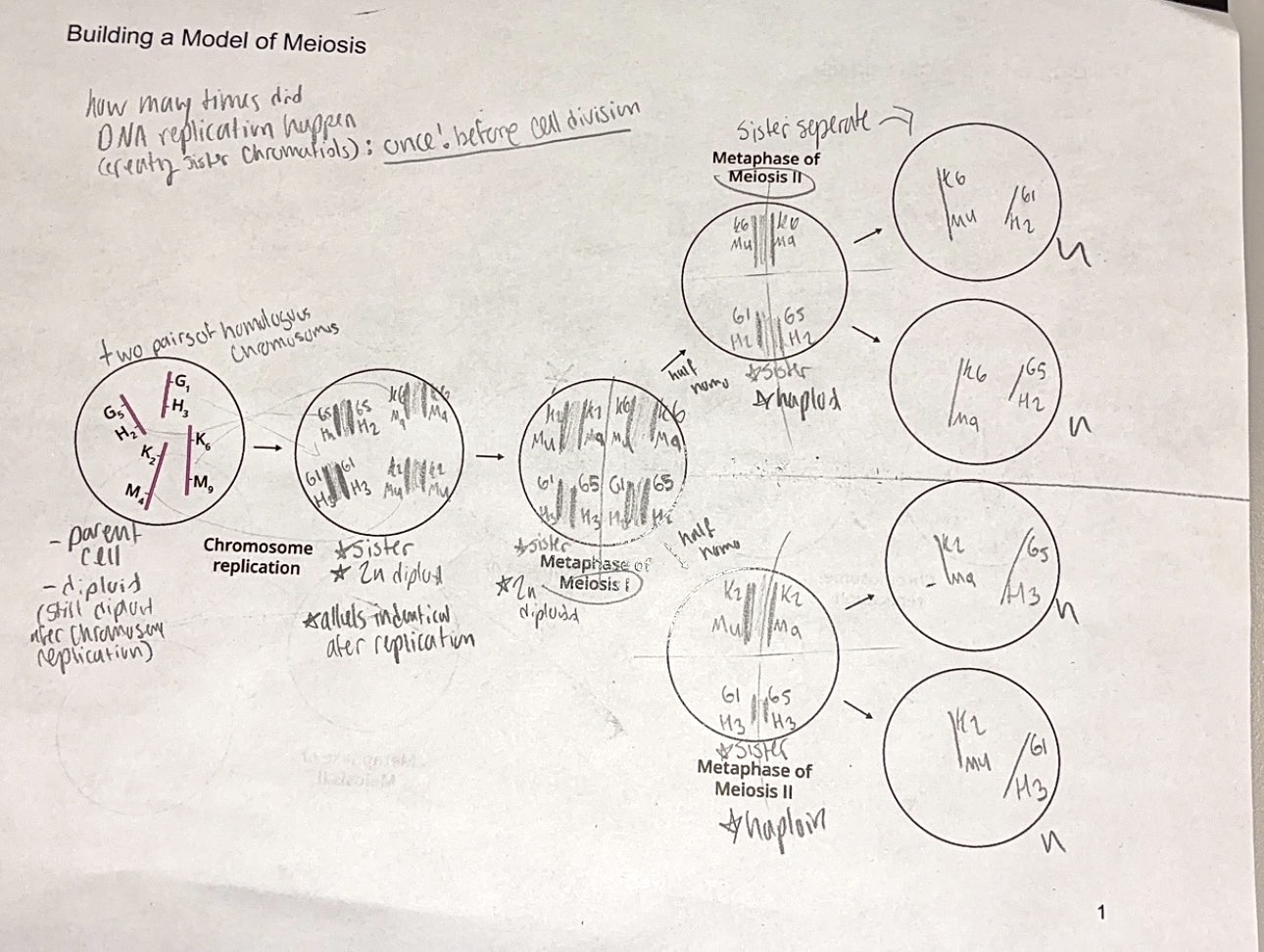
Modeling meiosis
Pick up two chromosomes that are homologous
Pick up two chromosomes that are sister chromatids
What is the difference?
Are all the pieces involved in both mitosis and meiosis?
gray and white
white white or grey grey
sister chromatids are indetical while homologs can have diff alleles
Yes – DNA is replicated in both processes. The number of divisions is differents
finger
mitosis
1 from dad
1 from mom
homo pair
g1 - nothing happens
only synthizne dna in s phase
in s phase, replicate each of these so
two fingers each ( 4 fingers total) - 2 sister chromatids
move metaphase (opp ends)
The crab-eating rat (Ichthyomys pittieri) has 92 chromosomes per diploid cell (2n=92). How many sister chromatids and how many chromosomes are there in a crab-eating rat cell that is in prophase of meiosis II?
184 sister chromatids and 184 chromosomes
92 sister chromatids and 92 chromosomes
46 sister chromatids and 92 chromosomes
184 sister chromatids and 92 chromosomes
92 sister chromatids and 46 chromosomes
**remver 2n - 92 i
s actyally 92/2 = 46
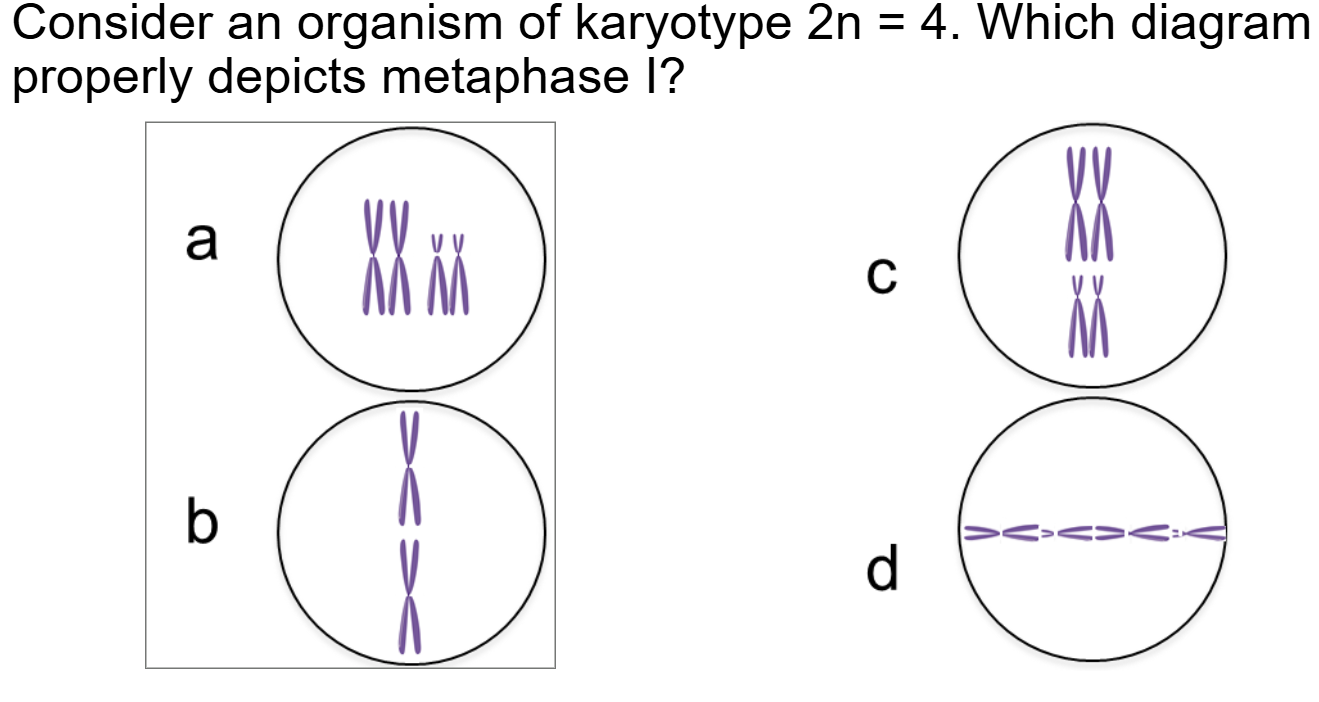
metaphase - gotta be in midd
meiosis 1 - still sister (x)
since 2n = 4
4/2 - 2 chromsomes each for a total of 4 chromsomes that are dipolid
any change in the …. sequence of a gene—not just those that cause measurable changes in the ……type—creates an …..
An … can be defined by any difference—even a tiny one—in either the structural or ….. segments of a gene.
…. that only differ in the base sequence of regulatory elements can be associated with different ….types.
If someone refers to "the gene for red hair," they really mean "the …. for red hair." The gene is for hair color; different … are associated with different colors of hair.
base, pheno, allele
allele, regulatory
Alleles, pheno
allele, alleles
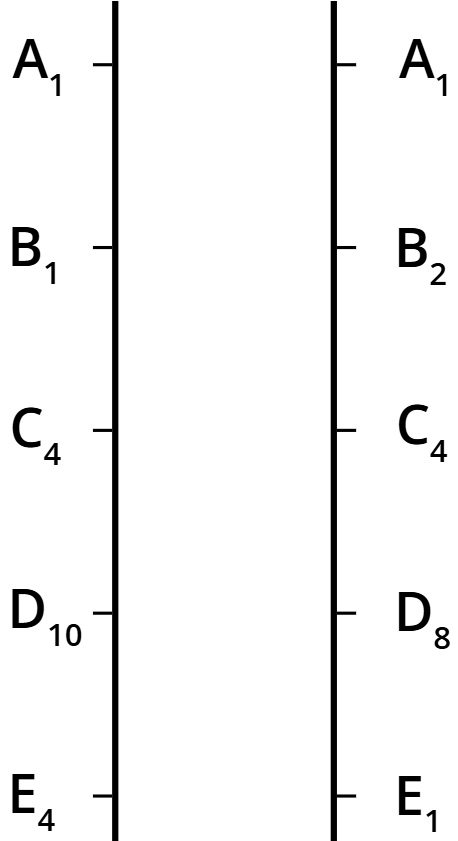
what kinda chromsome is this and why (they contain the same … but potentially diff ….)
how many diff genes?
how many alleles?
if we wanted to represent a 3n organism, what would need to add?
homologs: they contain the same , but potentially different alleles.
count letters - 5
count eveyr unique combo on letter + number but not doupilcated (a1 a1 doesnt count)
third vertical line
Why don't chromosome numbers keep increasing as sperm and eggs fuse, generation after generation?
……!!! The cells that undergo ….. in a human are …. and the daughter cells produced are ….. Instead of having two of each type of chromosome, the daughter cells of ….. have just one
… daughter cells of ….. develop into sperm and eggs, or what life scientists call gametes. When animal gametes fuse, they form a …. cell called a zygote—a fertilized egg. The zygote has two of each type of chromosome: one from the mother and one from the father.
meiosis
diploid
haploid
meiosis
haploid
meiosis
diploid
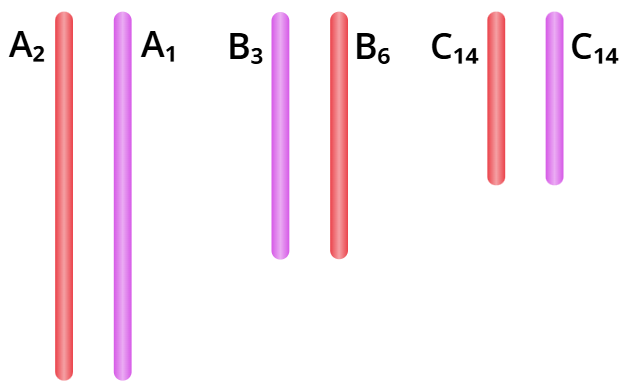
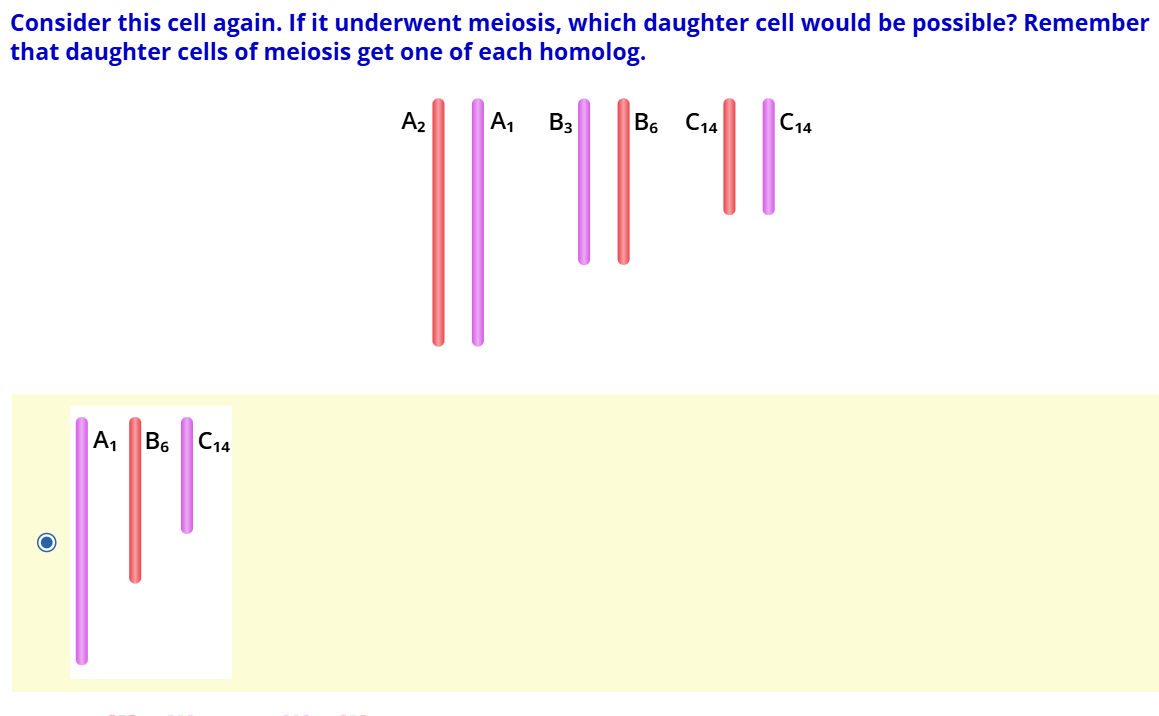
Colored bars indicate …….
letters indicate different …..
subscripted numbers identify different …….
Red bars represent chromosomes that came from this individual's mother (maternal); lavender bars represent chromosomes that came from this individual's father (paterna).
***…… chromosomes look the same and carry the same genes, though they may carry different alleles.
what is n = number? hapoloid number
are these replicated?
if the first cell was tretraploid (4), what would the duaghter cells be
chromosomes
genes
alleles
homologous
2n = 6 (pilodity)
so n = 3
nah bc no sister chromatids present
diploid
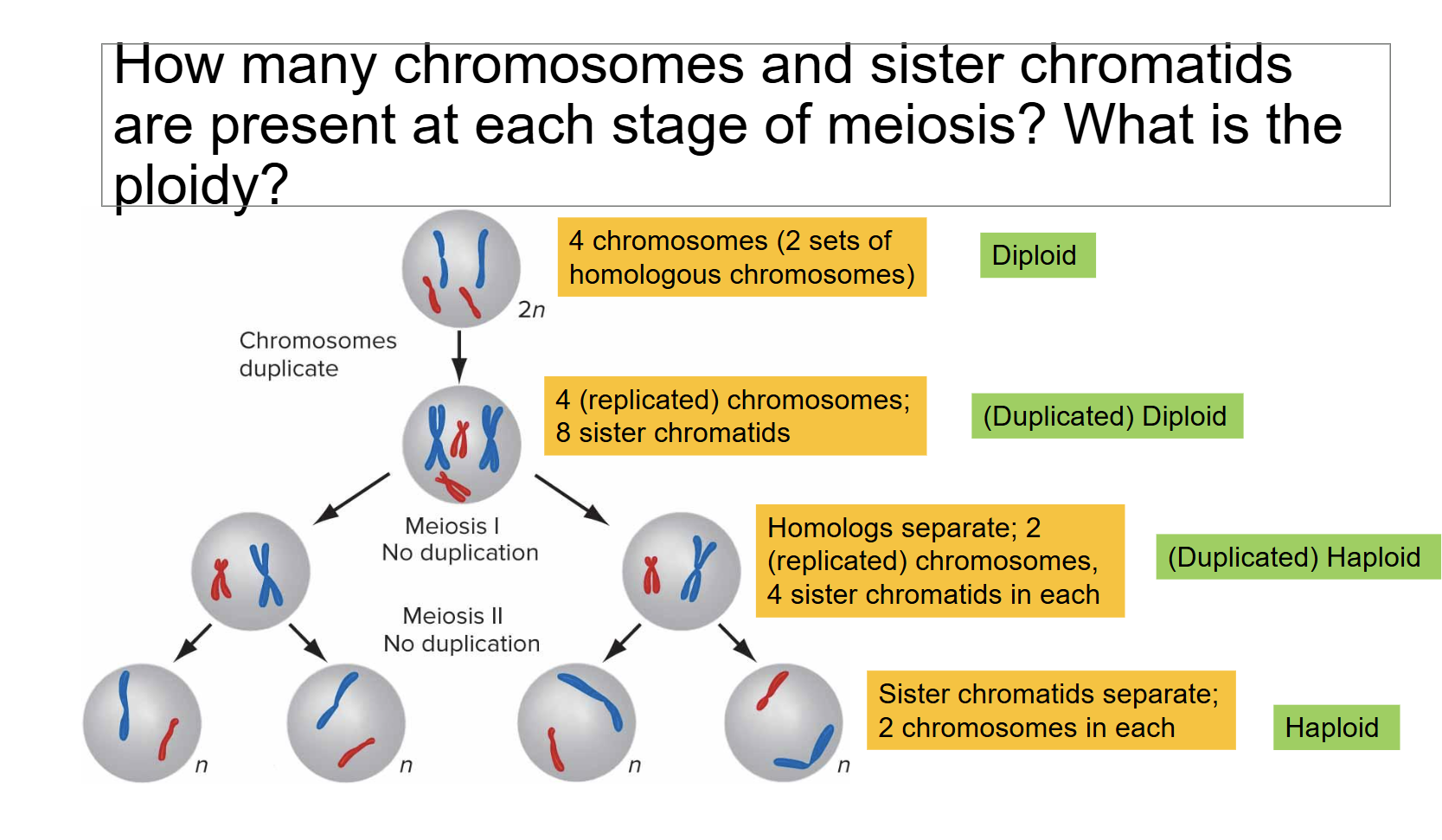
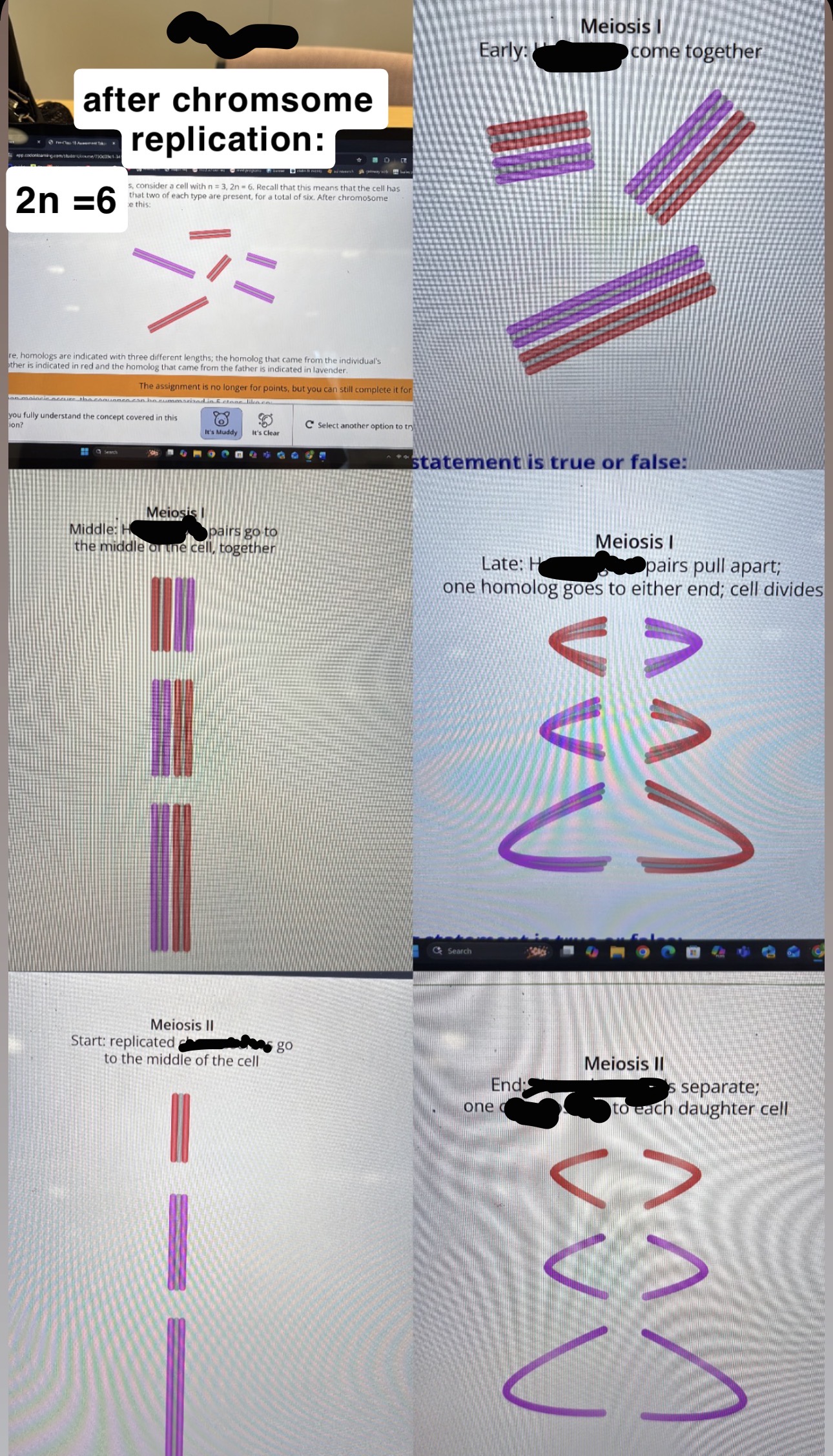
Cells undergo DNA replication prior to …., so the process starts with diploid cells that have replicated ……...
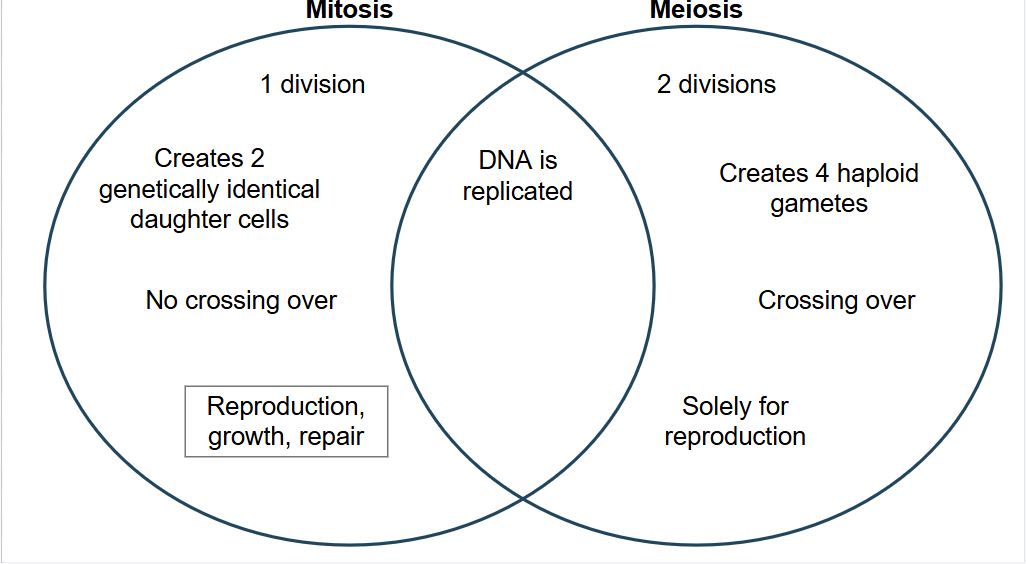
The process then involves two divisions, called Meiosis I and Meiosis II.
The reduction in …. occurs in Meiosis 1., when each daughter cell gets one replicated …. from each ….. pair.
In Meiosis II, each daughter cell gets one of the …. chromatids from each chromosome
BIGG DIFF: homologs act independently of each other at all times during …...
meiosis
chromosomes
ploidy
1
chromosome
homologous
sister
mitosis
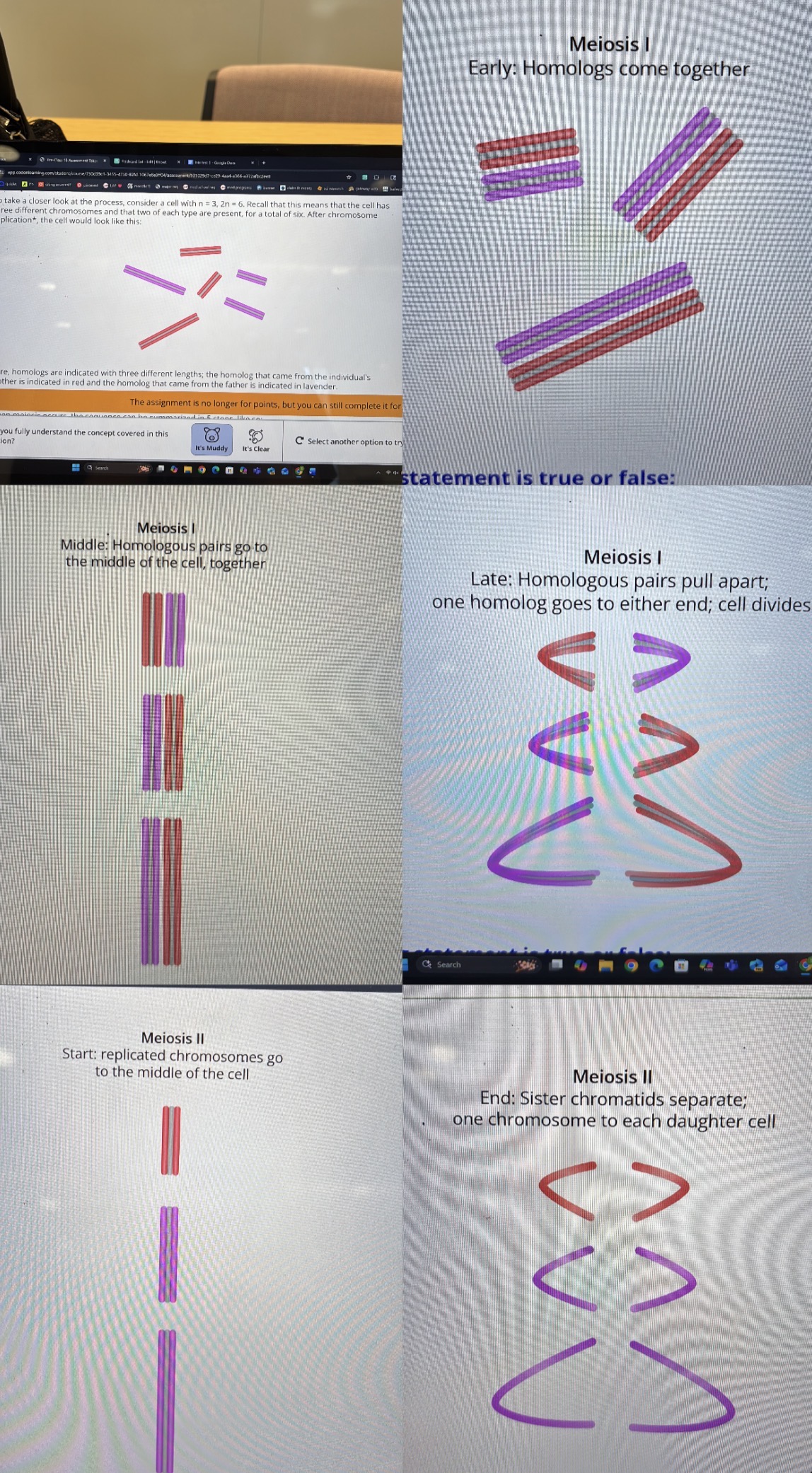
What happens in the middle phase of meiosis I is identical to what happens in the middle phase (metaphase) of mitosis. t/f
The events that happen in meiosis I explain why meiosis is a reduction division. At the start of meiosis I, the cell is diploid: it has two of each chromosome type and homologous pairs present. At the end, each daughter cell is haploid (only one of each type present). t/f
******The daughter cells of meiosis I are …..—each has one …. from each homologous pair.
Meiosis II occurs in each of the two daughter cells of meiosis I, meaning that a total of …. daughter cells are produced from the cell that started the process.
DNA replication, and thus chromosome replication, does …. occur prior to meiosis II—only prior to meiosis …...
What happens in the middle of meiosis II is just what happens in the middle phase (metaphase) of mitosis, except that the cell is haploid instead of diploid.t/f
What happens at the end of meiosis II is just what happens at the end of mitosis (anaphase and telophase), except that the cell is haploid instead of diploid.
f because in mitosis, homologs to the middle of the cell independently of each other--not together like this.
word up
haploid, chromosome
four
not!!!!!! 1
true bc In the middle of mitosis, replicated chromosomes go to the middle of the cell. That is just what is happening here (except there is just one of each type of chromosome).
true bc At the end of mitosis, sister chromatids pull apart and one goes to each daughter cell.
Explain the differences between somatic and germ cells. Describe the outcomes of cell division between these two categories of cells
Describe the process of crossing over that occurs in meiosis I
Explain why no two haploid cells that result from meiosis are alike in terms of genotype, and why this is important in terms of offspring fitness
Compare and contrast mitosis and meiosis
The crab-eating rat (Ichthyomys pittieri) has 92 chromosomes per diploid cell (2n=92). How many sister chromatids and how many chromosomes are there in a crab-eating rat cell that is in prophase of meiosis II?
184 sister chromatids and 184 chromosomes
92 sister chromatids and 92 chromosomes
46 sister chromatids and 92 chromosomes
184 sister chromatids and 92 chromosomes
92 sister chromatids and 46 chromosomes
92 sister chromatids and 46 chromosomes bc . Meiosis I reduces the pilody but each chromosome still consists of two sister chromatids.
Meiosis II is very similar to mitosis. It separates the sister chromatids (not homologous chromosomes)
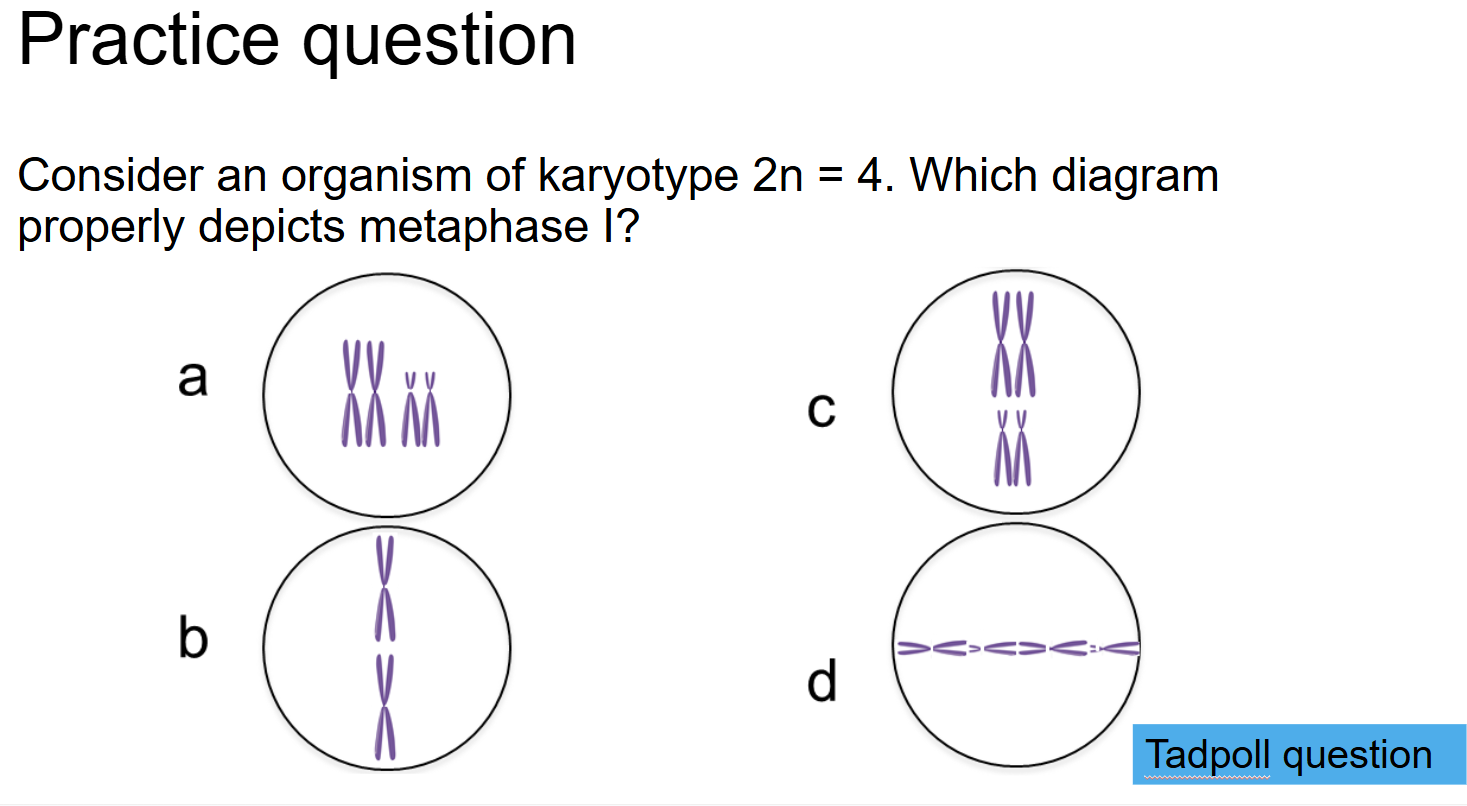
c. Homologs pairing up
Replicated (sister chromatids)
Sexual reproduction: Two parents give rise to offspring that have a unique combination of …. inherited from both parents
Offspring are genetically distinct from both parents and from any siblings
Asexual reproduction: A …. individual passes all of its genes to its offspring
Offspring are genetically ….. to parent and to each other – aka “clones”
Sexually reproducing organisms have different cell types
Germ cells: ….. cells; produce ….. gametes - ………
Somatic cells: Non-reproductive cells; produce ….. progeny - …..
How does meiosis contribute to genetic diversity?
genes
single
identical
Reproductive
haploid
Meiosis
diploid
Mitosis
Independent assortment
Crossing over
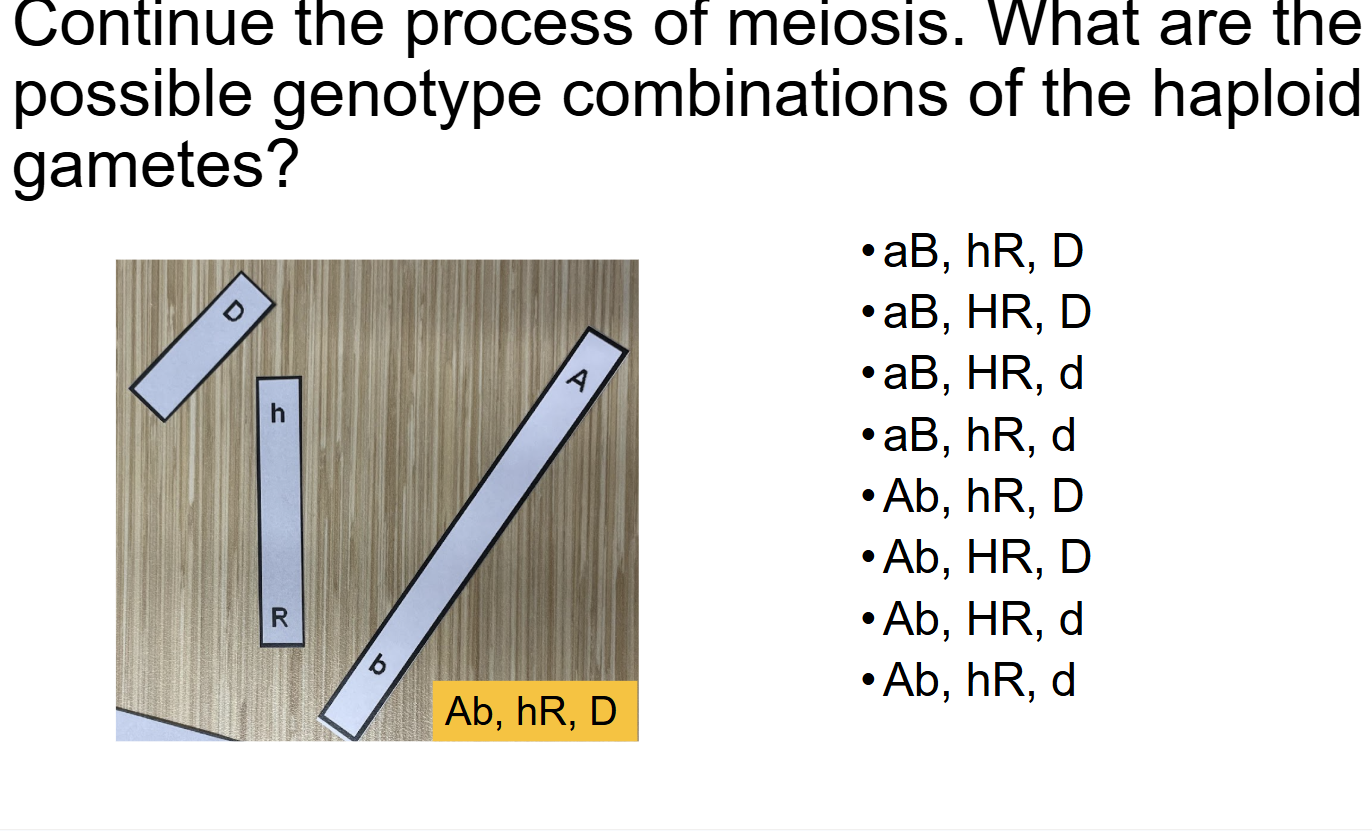
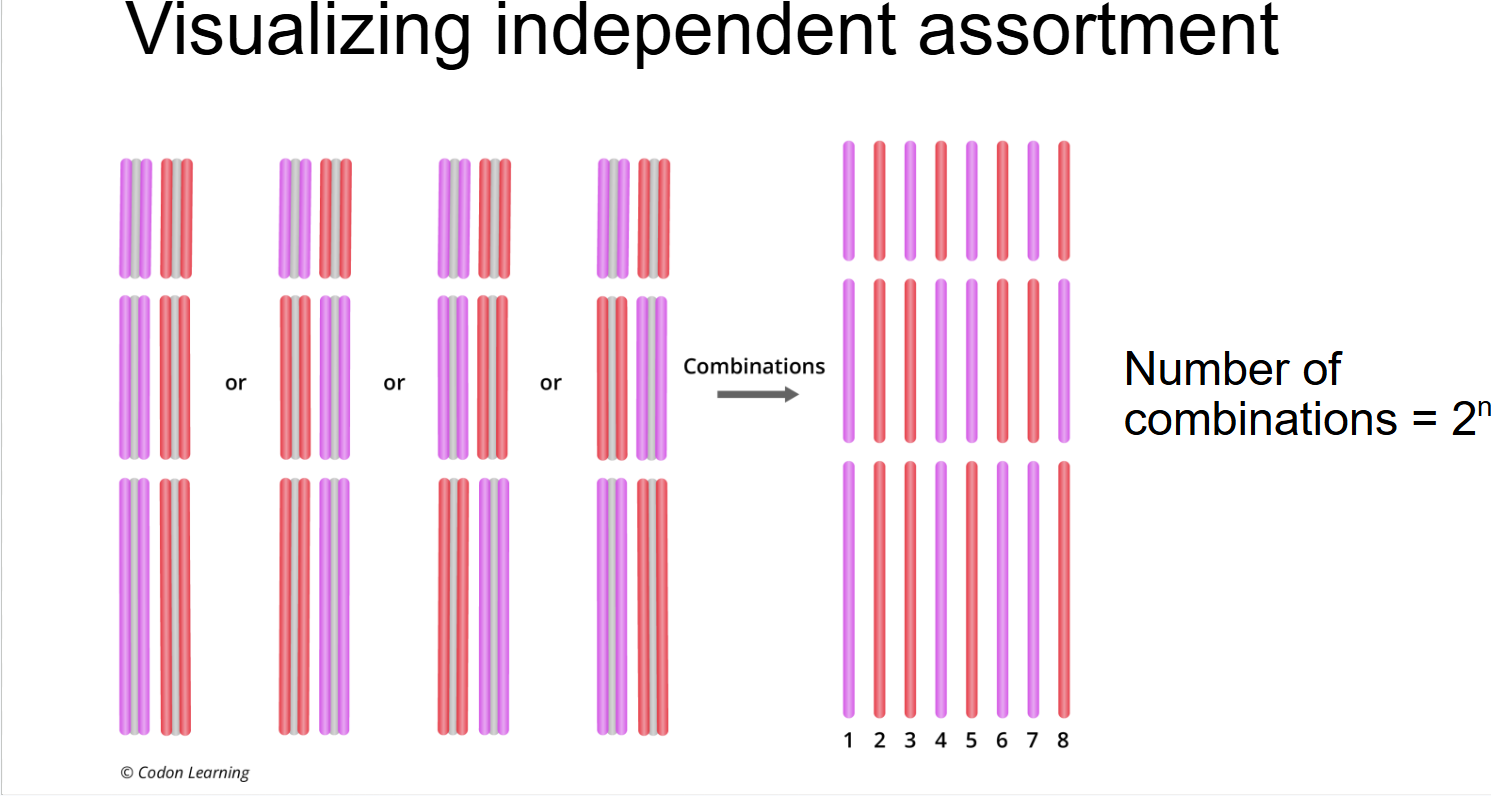
indepedent assortment
crossing over
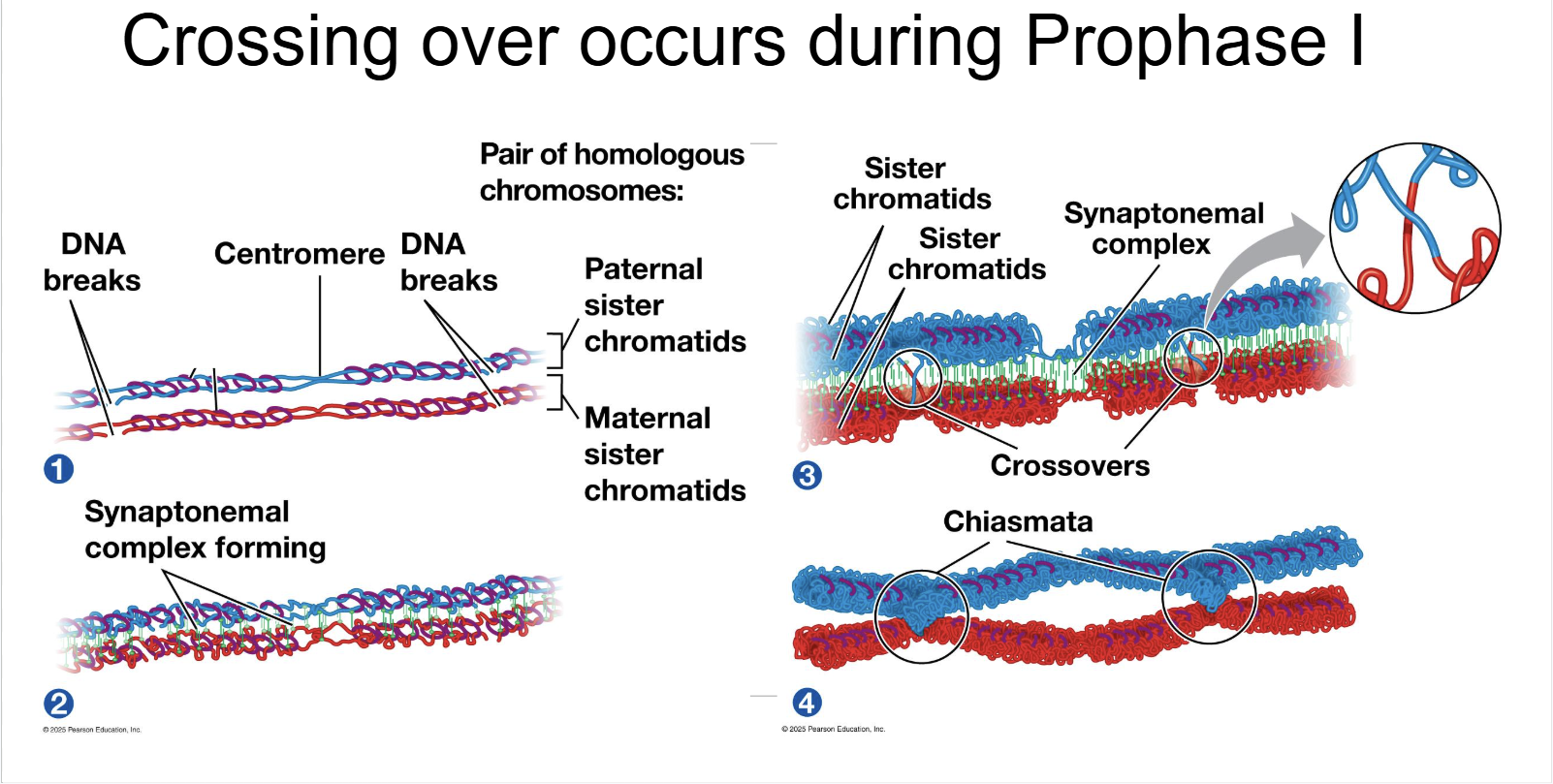
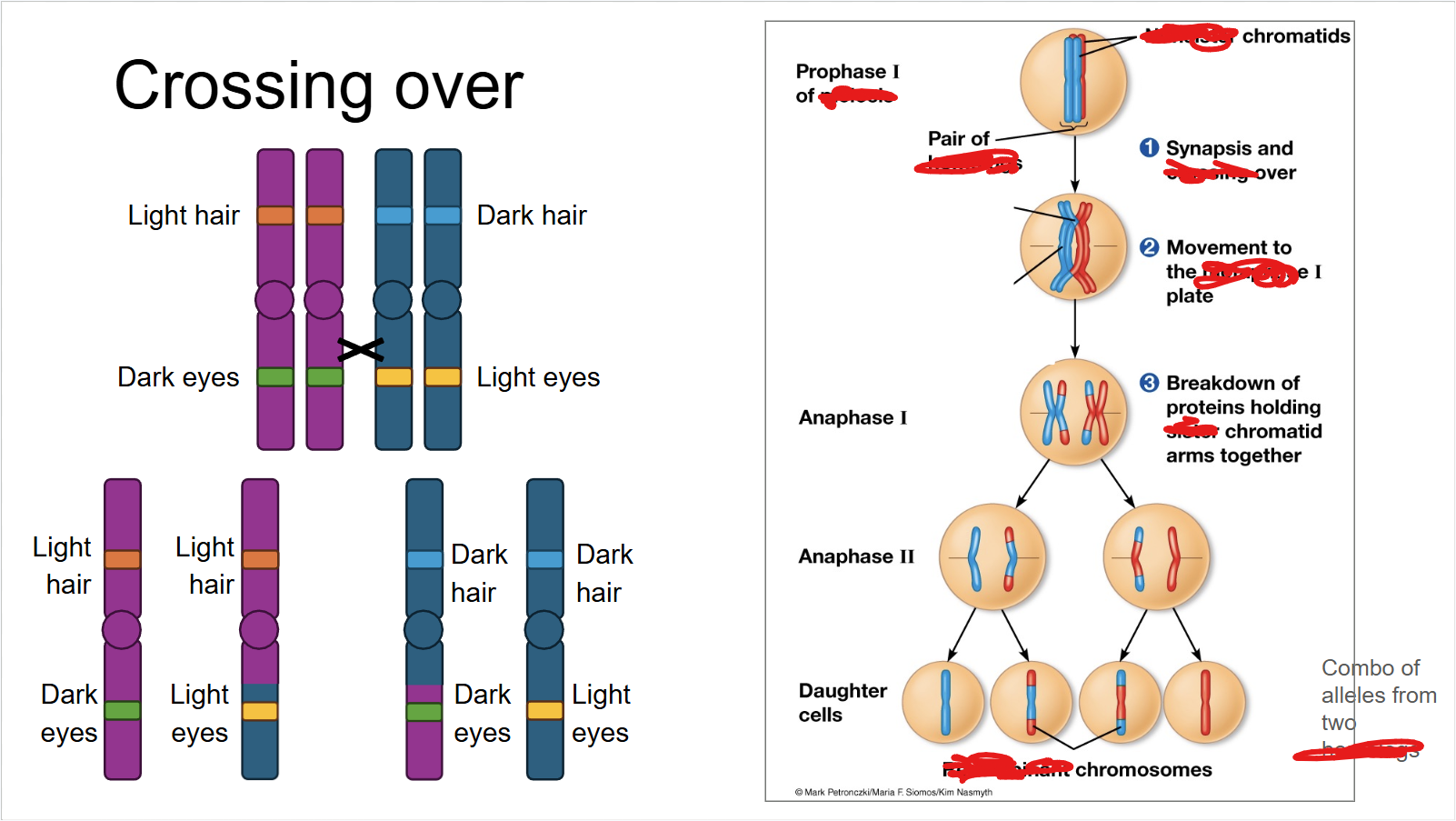
crossing over
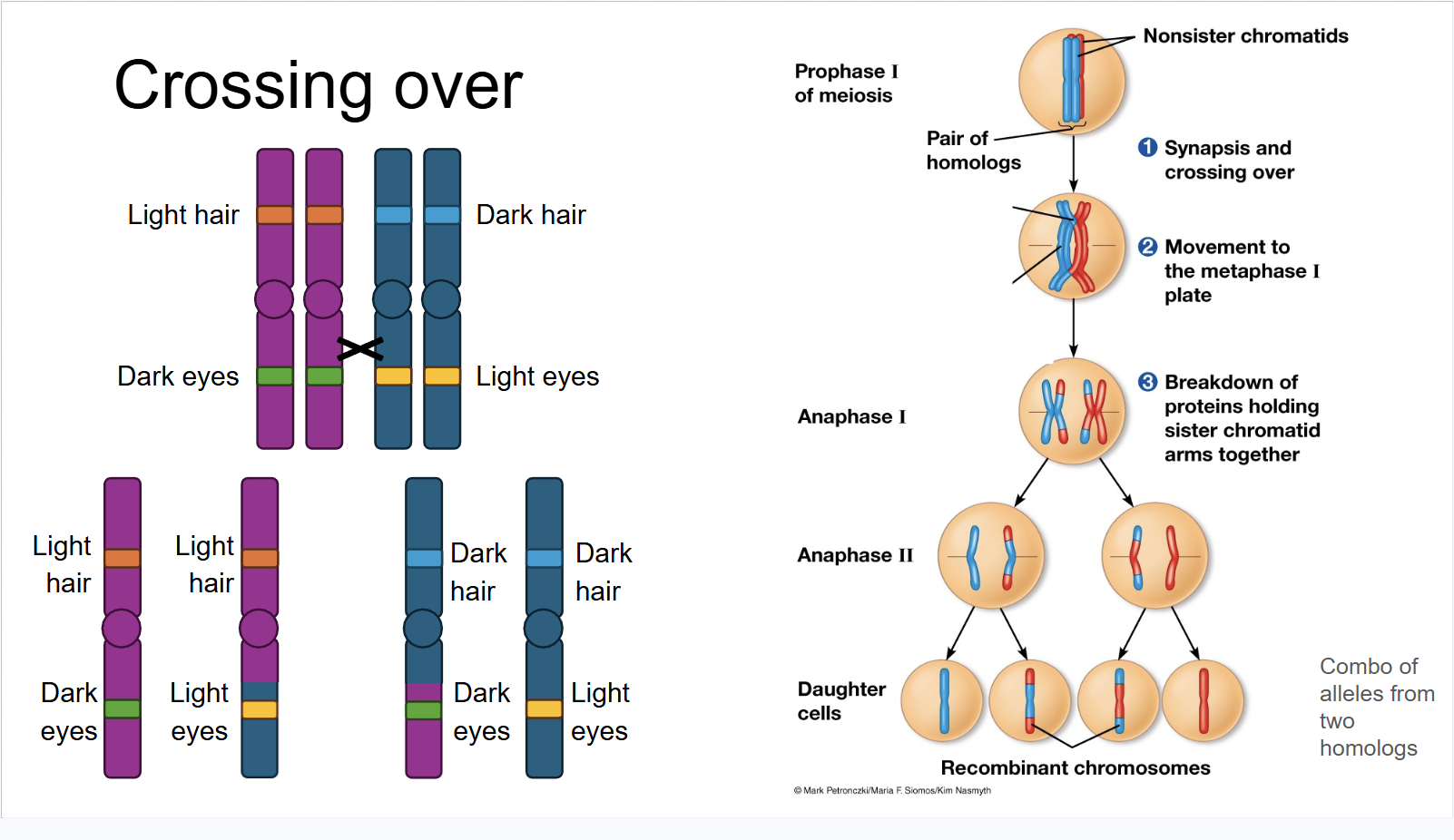
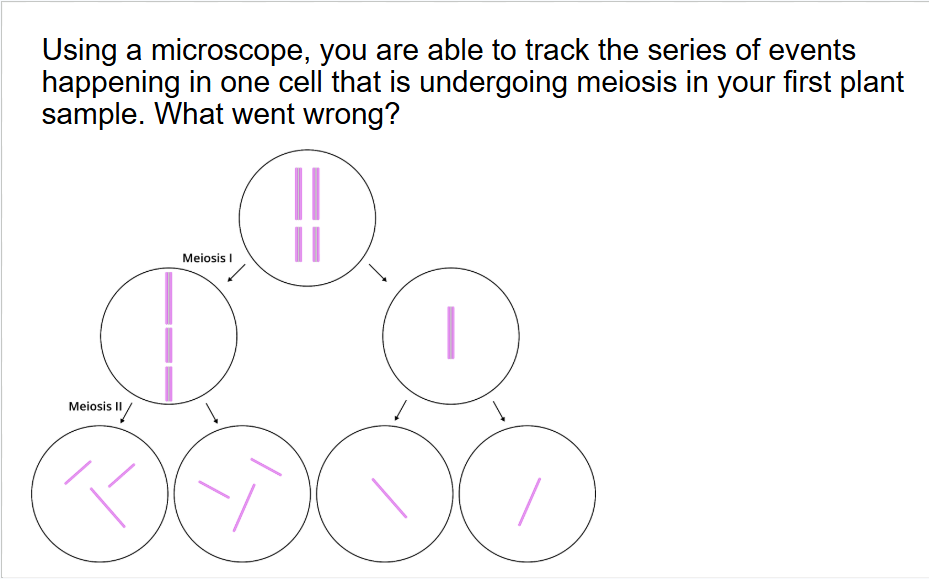
Mistakes in meiosis often lead to ….. offspring after fertilization
During ……. (what number), both chromosomes from one …… pair went into …. cell instead of separating.
Wrong number of …..
Every single …. affected (bottom row)
inviable
meiosis
homologous
one
chromosomes
progeny
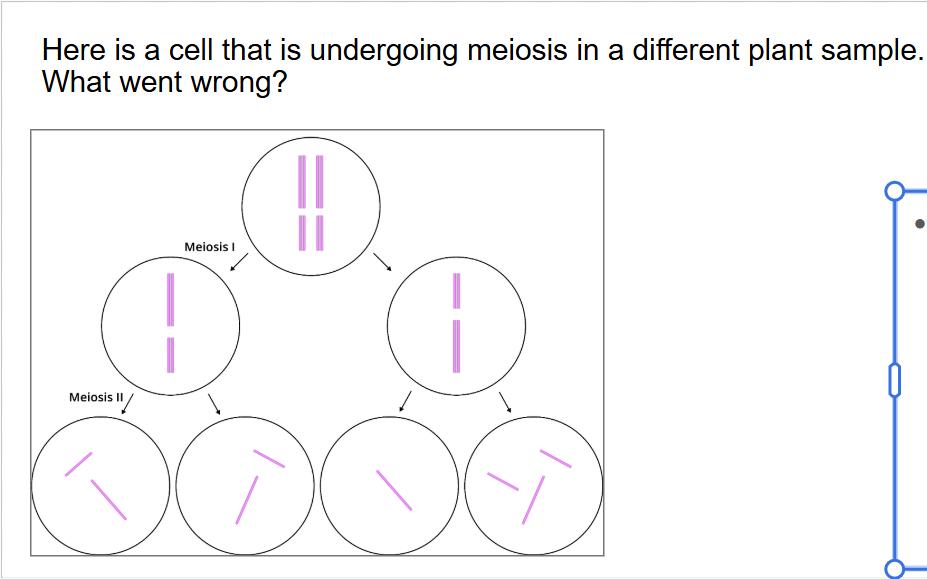
During ….(what number), the …. chromatids from one ….. chromosome failed to separate.
…. seperate properly
One cell not enough ….. other one too many
Half of …. affect
….. syndrome (third chromosome)
meiosis 2
sister
replicated
Homologs
chromsomes
progeny
Down
One sexually reproduces via flowering and pollination.
The second reproduces asexually via grafting.
One of your apple crops started with trees that all have large, juicy, red apples. However, after a few generations, many of the new trees are making apples of all types, including some that are sour, small, green. Which apple crop is likely this one?
its crop .. bc its reproducing via …., while the other corp is reproducing via …...
… introduces genetic variety because of ….. over and ….. assortment of the homologous chromosomes into …. cells.
…. produces new cells that are (essentially) identical to the first cells.
As new generations in this crop are being produced via ….., new combinations of genotypes leads to new …….
The next problem is that rodents living in a nearby forest recently introduced a fungus to your apple orchards. The fungus infects the leaves of the apple trees, making them shrivel up and die. A few trees in both of your apple crops show signs of infection. Which apple crop is most likely to survive this newly introduced pathogen?
The ….. information an organism has impacts its disease resistance. Because this crop is reproducing via ….., there is much more genetic diversity across individual trees. The individuals in the other crop are much more genetically similar, so if one is highly susceptible to disease, they likely all are.
How does meiosis contribute to evolution?
Meiosis creates genetic variation through …. over and ….. assortment
Genetic …. is the “raw material” for evolution
Without genetic variation, a stressor could wipe out a genetically …. population
Crop A, which reproduces by flowering and pollination.
meiosis
mitosis
Meiosis
crossing
independent
daughter
Mitosis
meiosis
phenotypes
Crop A, which reproduces by flowering and pollination.
genetic
meiosis
crossing
independent
variation
homogenous
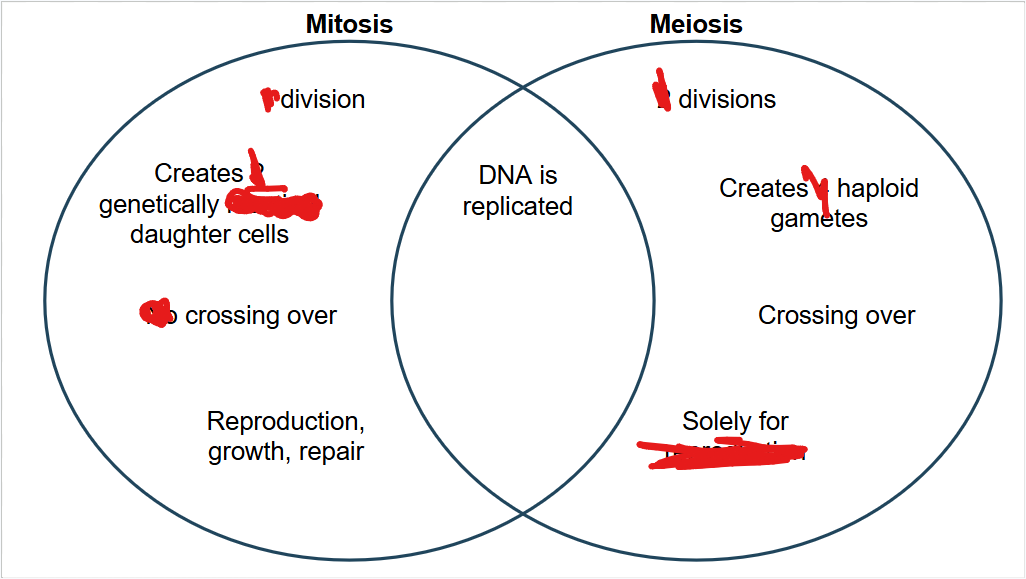
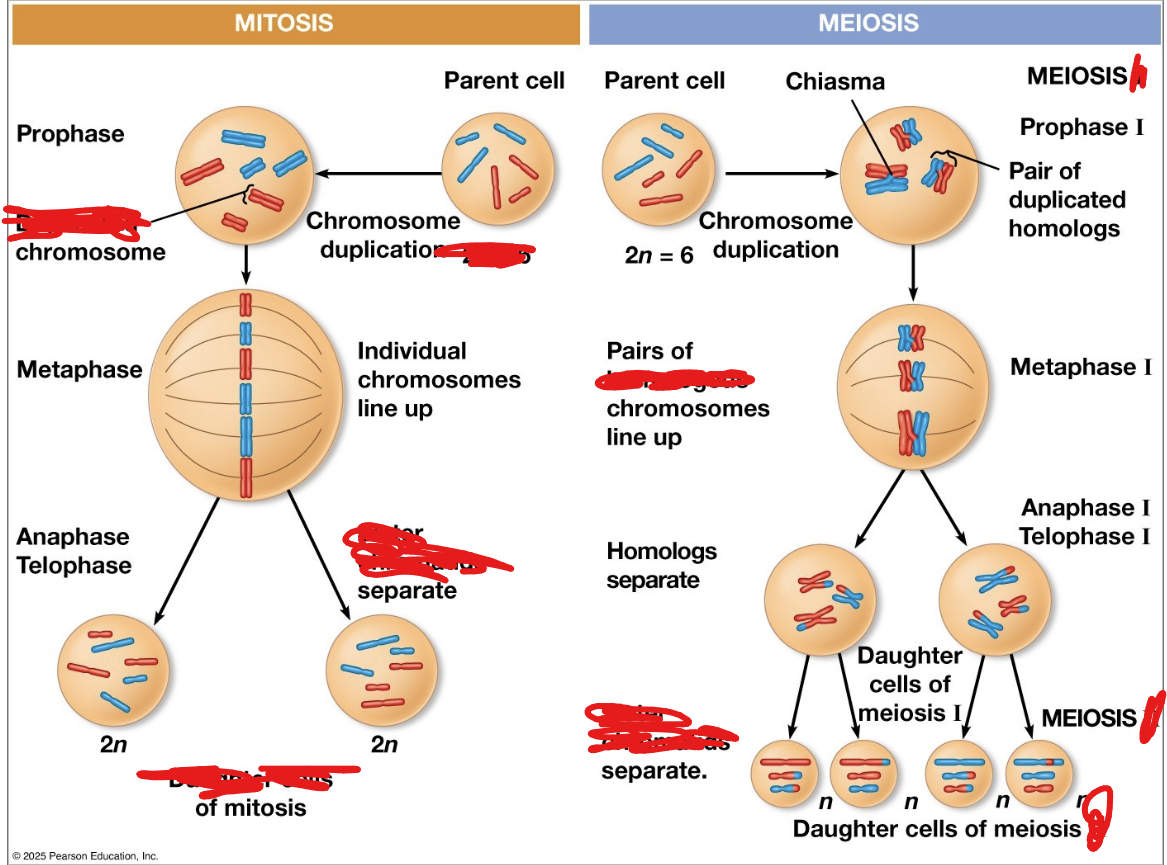
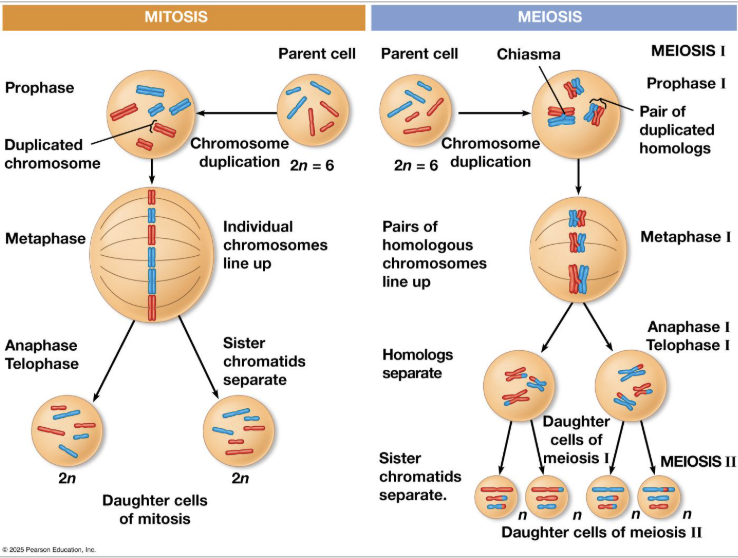
Using a drawing that shows the phases of meiosis, label the events that explain Mendel's principles of segregation and independent assortment. Add drawings to show how independent assortment can generate genetic variation in offspring. In each case, explain your reasoning.
Use the rules of probability to predict the outcomes of genetic crosses.
Label which elements in a Punnett square represent the genotypes of egg, sperm, and offspring. Explain how you can determine the frequency of each egg and sperm genotype and how you can use this information to calculate the frequencies of offspring genotypes and phenotypes.
mendel - …..-breeding strains
He grew the seeds and recorded the phenotypes of the offspring—what life scientists call the …. generation (for "first-filial").
He mated ^ individuals together, and recorded the phenotypes of the offspring. This was the … generation.
The traits that had …… in the F1s reappeared in the F2s
Genes don't blend. Instead, they act like ……. - they maintain their physical integrity and thus the integrity of the ….. they carry, generation after generation.
Those F1s had to have the ….. (two copies/alles) for white flowers, even though they themselves only made purple flowers.
half of the …. produced by the F1 generation carried the information (allele) for white flowers, while the other half of the … carried the information (allele) for purple flowers.
principle of ……- two versions of each …. separate when sperm and eggs form
two copies of the same allele at a gene = …..zygous.
two different alleles at a gene = ….zygous.
dominance = associated with a phenotype that appears in ……zygous individuals
*Sperm and eggs combine at random regardless of their …...
true
F1
F2
disappeared
particles
information
gen information
sperm
sperm
segregation
gene
homo
hetero
hetero
genotypes
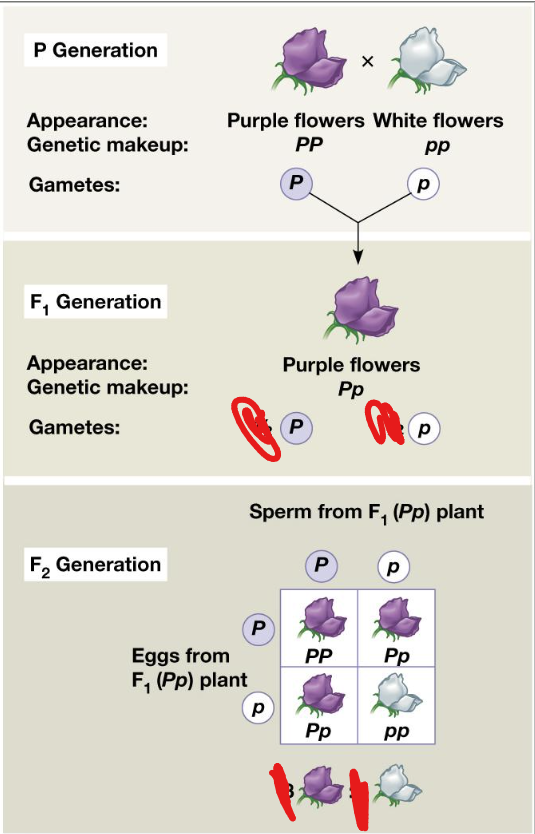
mendel Examined … characters in pea plants over 2 generations
F1 generation: all progeny were identical – displayed “…..” trait
F2 generation: progeny displayed ….. ratio of “dominant” to “recessive” trait
what are the observable traits?
Punnett squares
Determine …… that can be produced from an organism
Infer phenotype ratios from …… ratios
7
dominant
3:1
phenotype
gametes
genotype
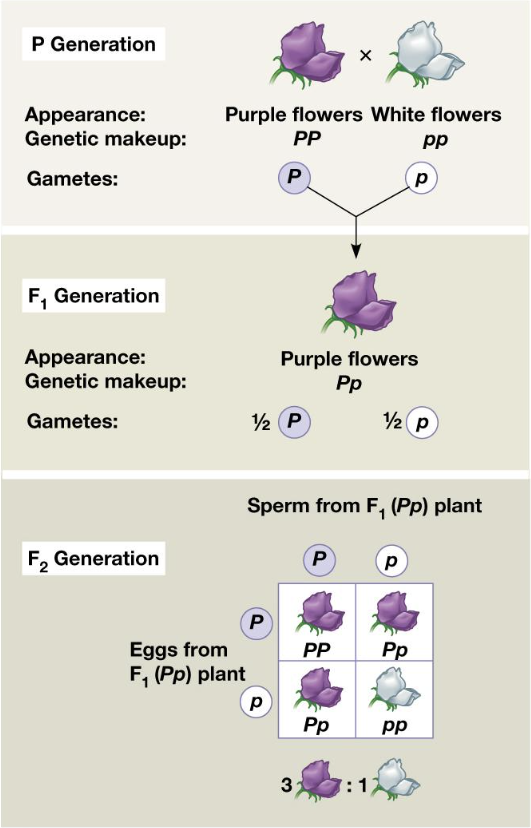
You cross a pea that is heterozygous for flower color (Pp) with a second pea that is homozygous recessive for flower color (pp). What genotypes of gametes will the first pea produce?
Two gamete types: pp and Pp
Two gamete types: p and P
One gamete type: Pp
One gamete type: P
One gamete type: p
Pea plant flowers can be purple (PP or Pp) or white.
Pea seeds can be yellow (YY or Yy) or green (yy).
Imagine crossing a pea plant that is heterozygous for both flower color (Pp) and seed color (Yy) with a plant that is homozygous for flower color (pp) and seed color (yy).
What gametes will each plant produce?
What are the genotypic and phenotypic ratios of the offspring?
First plant: 4 gametes – PY, Py, pY, py
Second plant: 1 gamete - py
1:1:1:1 – PpYy:Ppyy:ppYy:ppyy
1:1:1:1 – Purple & yellow : Purple & green : white & yellow : white & green
Consider a cross between parents with the genotypes RRYY and rryy.
What are the possible gamete genotypes from each parent? Choose the single best answer. (Hint: draw out a Punnett square!)
In this cross, which alleles end up in gametes depends on whether the genes are linked together or not linked together.
The RRYY parents will make all RY gametes. The rryy parents will make all ry gametes.
The RRYY parents will make 1/2 RR and 1/2 YY gametes. The rryy parents will make 1/2 rr and 1/2 yy gametes.
What are the predicted genotypes of the F1 offspring from this RRYY x rryy cross? Choose the single best answer. (Hint: draw out a Punnett square!)
1/2 RRYY, 1/2 rryy
All RrYy
1/2 Rr, 1/2 Yy
***foil first then set up punnet square
The RRYY parents will make all RY gametes. The rryy parents will make all ry gametes.
All RrYy
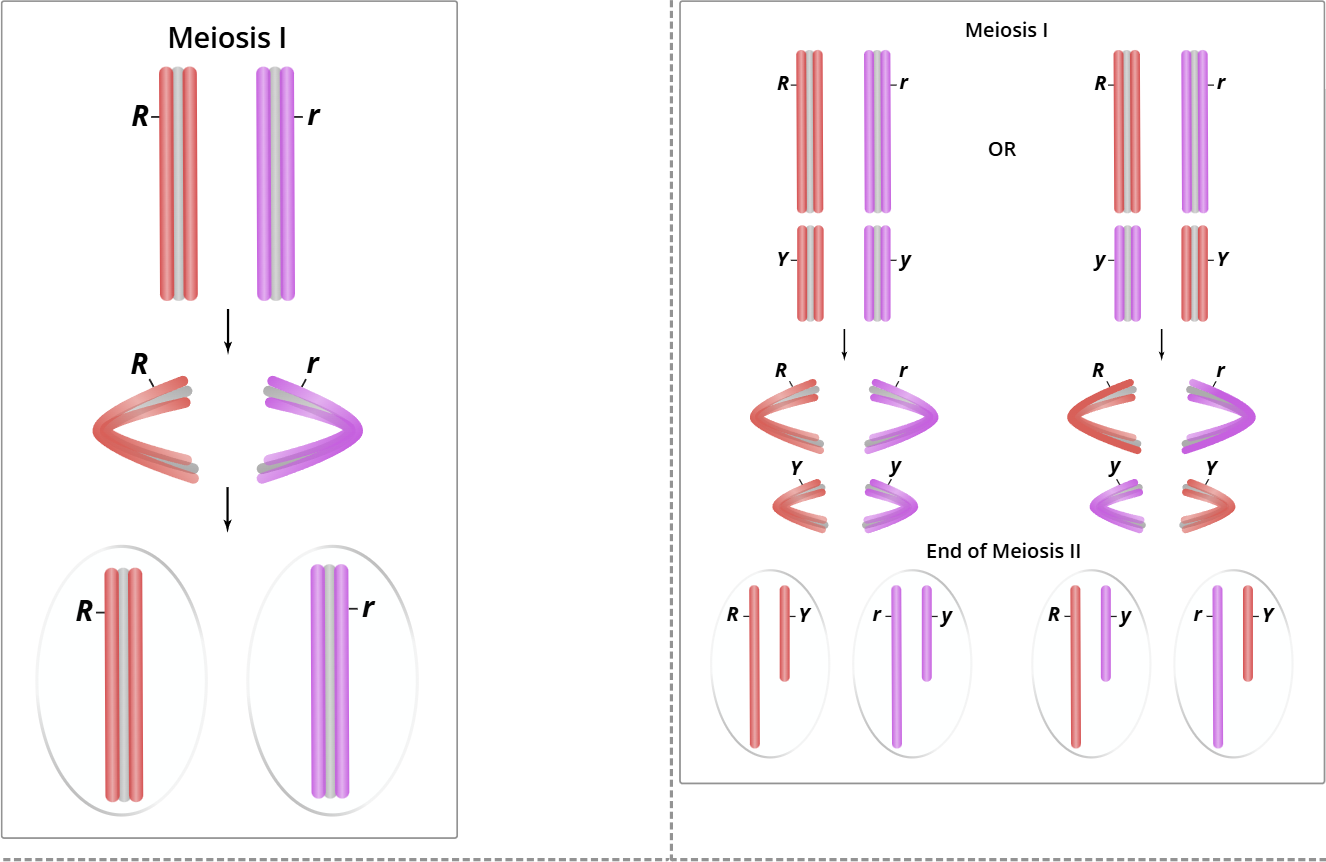
Under the hypothesis of "independent assortment," what are the predicted gamete genotypes produced by the RrYy F1 parents? (Note that since each parent has the same genotype, all the sperm and eggs will have the same genotypes.)
… gamete genotypes will be produced, in equal numbers. To predict the F2 offspring genotypes, the Punnett square will have …. rows, …. columns, and 16 cells.
picture on left is principle of whats (alleles of the same gene separate from each other ….. to gamete formation. Caused by the separation of ….. chromosomes at the end (anaphase and telophase) of Meiosis I.
equal numbers of RY, Ry, rY, and ry
four
four
four
segergation
prior
homologous
indepedent assortment

