Evolution Quiz 2
 Call Kai
 Learn
Learn Practice Test
 Spaced Repetition
 Match
Match Flashcards
 Knowt Play
1/170

There's no tags or description
Looks like no tags are added yet.
Name | Mastery | Learn | Test | Matching | Spaced | Call with Kai |
|---|
No analytics yet
Send a link to your students to track their progress
171 Terms
In order for evolution by natural selection to occur Darwin said there must be:
heritable variation
differential survival/ reproductive success
Quantitative genetics allows us to
measure heritable variation
measure differences in survival/ rep. success
Predict the response to selection
Which equation is used to determine the extent to which a trait is heritable
VP = VG + VE
VP=
total phenotypic variation in a trait
VG meaning
Genetic variation (variation among individuals due to genes)
VE=
environmental variation (variation among individuals due to variation in their environment)
Broad sense heritability
proportion of variation in the trait due to variation in genes
Broad Sense heritability equation
VG/VP
If variation among individuals is due to variation in genes then offspring should..
resemble parents
VG=
VA + VD
VA=
additive genetic variance (variation due to the individual effects of alleles)
VD=
dominance genetic variation (variation due to allelic interactions)
Since interactions are not inherited (VA or VD) causes resemblance between parents and offspring
VA
Narrow sense heritability equation (h2) =
VA/VP
Why do we use narrow sense heritability
to estimate the response to selection
If neither allele is dominant over the other (codominance) then
the line of best fit explains all genetic variation
VG=VA
If there is no line of best fit, use the equation
VG= VA+ VD
Selection differential (S) =
the difference between the trait mean of the selected individuals and the trait mean of the entire population
Selection gradient (B) =
more broadly applicable measure of selection
Selection gradient steps
take absolute fitness (ex. total # of offspring an individual has) and divide it by the total population’s mean fitness to calculate relative fitness
then plot the value of the phenotypic trait (x-axis) vs. relative fitness (y-axis)
the slope of the best-fit line through this plot is the selection gradient
Selection gradient (B) equation =
S/(var t)
var t =
variance in the trait
Selection differential equation =
mean of selected individuals - mean of all individuals
The slope of the line of best fit is the
selection gradient
The breeder’s equation predicts
the response to selection
The breeders equation
R=h²S
R defined=
response to selection
h²=
heritability
S =
selection differential
How to solve for R =
the difference between the mean trait value of offspring from selected parents and the population mean
The breeders equation can be used when
we know two variables
ex.) if we know heritability and selection differential we can predict the response to selection
Ex. Question that prompts use of breeders equation
Is the difference in flower size a result of natural selection on bumblebees
If h² is between 0.2 and 1.0 this suggest -% of the variation in flower size is due to additive genetic variance
20
axes for heritability (h²)
offspring flower petal distance (y)
maternal flower petal distance (x)
S = (equation rearranged)
B x (var t)
R is used to calculate
response to selection
If R is 0.01 this means
within a single generation, selection by bees should produce an increase in flower size by at least 1%
Given R what do you predict the beak depth for the next generation is
mean beak depth + r
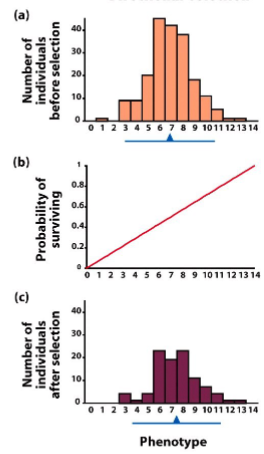
Direction selection defined
fitness consistently increases or decreases with trait fitness
In continuous traits directional selection changes the
means and lowers the variation
directional selection graphs
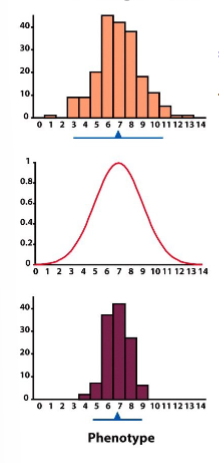
stabilizing selection definition
intermediate phenotypes have the highest fitness
In continuous traits, stabilizing selection does not alter the - but decreases - by “trimming the tails” of the distribution
mean, variation
stabilizing selection graphs
Disruptive selection defined =
extreme trait values have the highest fitness
In continuous traits disruptive selection does not alter the population - but “trims the tops” of the distribution to - variance.
mean, increase
Example of disruptive selection
small or large beaks lead to better bird survival than birds with medium beaks
Heritability is a ratio of VA and VP within a population under a particular set of environmental conditions. It is a -
within population measure
Heritability (does or does not) tell us anything about the causes of differences among populations living in different environments
does not
Differences among populations might be due to - (since heritability estimates depend on both)
very different environments
Low heritability (does or does not) necessarily mean a trait has little underlying genetic variation
does not
Can the heritability of a trait in a population change?
yes
- estimates are specific to a particular population in a specific environment.
Heritability
h² being low could mean
absolute value of VA is low
VP is large (due to large VE), relative to VA
A low h² means -. It doesn’t mean that the trait is -
a small response to selection from one generation to the next.
not capable of long-term evolution.
h² can change as the effect of - on the trait changes.
VE
Clausen, Keck, Hiesey’s study on Achillea, a perennial plant
two cuttings (one from top half one from bottom half) from 7 different plants and grew the cuttings in different environments (mather and stanford) same soil, sun, etc.
In the Clausen, Keck, Hiesey experiment since all cuttings were reared in the same environment - = 0 and any differences between plants in a garden was due to genetic variation. heritability =
VE, 1
Results of Garden plant experiment
plants raised at the stanford garden were taller
Interpretation of stanford garden results
since the cuttings were genetically the same even though heritability was high within each population this tells us nothing about differences between populations raised in different environments.
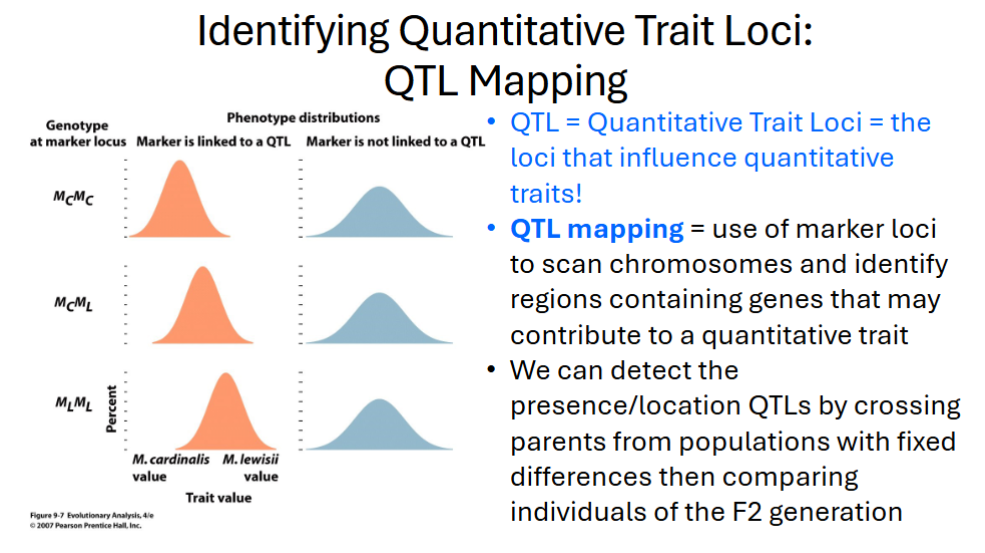
Quantitative Trait Loci (QTL) =
the loci that influence quantitative traits
QTL mapping =
use of marker loci to scan chromosomes and identify regions containing genes that may contribute to a quantitative trait
How can we detect the presence/location QTLs by
crossing parents from populations with fixed differences then comparing individuals of the F2 generation
If the distributions of phenotypes overlap then the marker (is or is not) linked to a QTL
is not
Genetic variation (is or is not) a requirement for evolution
is
_ and - reduce genetic variation
NS and genetic drift
_introduces variation slowly
mutation
Balancing selection =
selective processes by which multiple alleles are maintained in a population
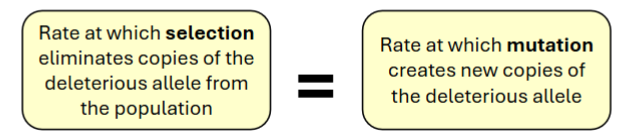
Mutation-selection balance
if the fitness differences between alleles are small (i.e. selection against a lower fitness allele is weak), then selection would remove the less fit allele very slowly
Mutation adds the allele back into the population at the - rate it is lost via selection
same
If selection is weak and similar to the rate of mutation
a less fit allele can be maintained at higher frequencies
equilibrium frequency
Heterozygote advantage
heterozygotes have a higher fitness than either homozygote
How does heterozygote advantage maintain genetic diversity at a locus
at equilibrium the advantage lethal/deleterious alleles in heterozygotes is balanced the obvious disadvantage experienced in homozygotes
Sickle cell anemia is an example of - since -
heterozygote advantage, heterozygotes are resistant to malaria.
_ selection selects for the intermediate phenotype regardless of underlying genotype
stabilizing
_ selection may not maintain multiple alleles at a locus
stabilizing
_ selects for heterozygous genotypes regardless of the phenotype they produce
heterozygote advantage
_ favors different alleles in different environments, or different alleles over time (if the environment changes over time)
selection
Selection can maintain - but requires fairly extreme amounts of variation or high migration
polymorphism
Frequency dependent selection
the relative fitness of a genotype is dependent on how common it is (its frequency) in the population
Negative Frequency dependent selection
rare genotypes have the selective advantage
Negative FDS example
rare clonal freshwater snails are attacked by parasites less
tradeoff
two different selective forces acting on phenotype (opposite ways)
Example of a tradeoff
being big means a better territory and more mates, but being big is also costly in terms of energy expenditure
Even if there is a tradeoff variation in the traits can only be maintained if different combinations have - fitness
equal
Example of tradeoffs in crickets
alternative male mating strategies
males get attacked by parasitoid flies. the flies are attracted to the male cricket call
male crickets employ two strategies for mating
some males call to females
other males use a “sneaker” strategy and don’t call
Tradeoff: mating, parasite load
variation is only maintained if the two strategies have equal fitness
all have different mating strategies but same fitness (same # offspring produced during lifetime)
If fitness is not exactly equal (one strategy has a slight advantage) selection will favor that strategy and it will -
reach fixation
example of tradeoffs reaching fixation
if calling 100% of the time gives males slightly more mates, this will be selected for
Trade-offs can interact with - selection
frequency-dependent selection
Trade-offs alone don’t maintain variation but trade-offs resulting in equal fitness can maintain -
variation
What is the smallest evolutionary independent unit
a species
evolutionary independence occurs when
mutation, selection, gene flow, and drift operate o populations separately
evolution (a change in allele frequencies) can occur
speciation
a lack of gene flow when populations are in contact with each other
Morphospecies concept
criterion for different species : unique morphological traits
Advantages to the morphospecies concept
widely applicable
can be applied to extinct or currently living organisms, asexual or sexual organisms.
Disadvantages to the morphospecies concept
× Species definitions may be arbitrary
× Different researchers may use different criteria
× May not accommodate polymorphism
× Difficult to identify important morphological traits the
fossil record
× Ignores strongly diverged non-morphological traits (e.g.
mating songs, drought tolerance, habitat preferences)
Biological species concept (BSC)
Criterion for different species: reproductive isolation. Different species do not hybridize in nature or fail to product fertile offspring if they do
Biological Species Concept Advantages
confirms lack of gene flow (the essence of speciation)
legal definition used by the endangered species act
Biological Species Concept Disadvantages
× Difficult to apply. What if two populations never meet? We can
hypothesize how they might reproduce but we don’t know for sure.
× Irrelevant for fossils, asexual organisms, and many plants (distinct
groups regularly hybridize)
Explore top notes

Explore top flashcards
