Behaviourism
 Studied by 0 people
 Call with Kai
 Learn
Learn Practice Test
 Spaced Repetition
 Match
Match Flashcards
 Knowt Play
1/16

There's no tags or description
Looks like no tags are added yet.
Name | Mastery | Learn | Test | Matching | Spaced | Call with Kai |
|---|
No study sessions yet.
17 Terms
Who started the behaviourist movement?
Behaviorism did not start from only one person. Even though John B. Watson is often credited, the ideas were already “in the air” (e.g., objective psychology existed earlier in Russia, and functionalists were moving away from introspection).
A major influence was the success of animal research (e.g., Thorndike), which increased conflict between animal researchers and introspectionists and helped prepare the ground for behaviorism.
Critique against behaviourism
Functionalists like James McKeen Cattell (1904) argued psychology should not be limited to consciousness and that many topics can be studied without introspection(e.g., perception, memory, learning, animal and child behaviour).
• Walter Pillsbury (1911) supported the idea that psychology can be defined as the science of human behaviour, treating humans as objectively as physical phenomena.
Ivan Sechenov - Russian objective psychology
• Founder of Russian objective psychology.
• Strongly argued that external stimulation causes behavior(thought is not the true cause of action).
• He introduced inhibition as a key brain mechanism.
• Believed psychology should be studied using the objective methods of physiology, not introspection.
Ivan Pavlov - Russian objective psychology
• Won the Nobel Prize (1904) for research on digestion.
• Discovered the conditioned reflex (conditioned response).
• Key concepts:
o Unconditioned stimulus (US) → unconditioned response (UR)
o Conditioned stimulus (CS) → conditioned response(CR)
• Explained learning with association principles (contiguity, frequency).
Important processes:
o extinction
o spontaneous recovery
o disinhibition
• Introduced:
o first-signal system (signals from real stimuli)
o second-signal system (language = “signals of signals”)
• Learning occurs through repeated association.
• A stimulus that was originally indifferent acquires the ability to elicit the same response as the unconditioned stimulus." (Pavlov, 1927).
Vladimir Bechterev
• Developed an objective psychology called reflexology.
• Focused on overt, observable behavior (motor reflexes).
• Criticized Pavlov’s “saliva method” as less practical for humans.
John B. Watson and the founding of behaviourism
• Watson formally launched behaviorism in 1913 with“Psychology as the Behaviorist Views It”.
• Core claim: psychology should be a purely objective experimental science.
• Main goal: prediction and control of behavior.
• Behaviorism rejects introspection as essential.
• Eliminates the concepts of consciousness, mind, or soul.
• Watson believed there is no “dividing line” between humans and animals in studying behavior.
Watson’s view of behaviour, langauge, and instincts
• Behavior can be described using stimulus–response (S–R).
• A stimulus can be external OR internal.
• A response can include everything from simple reflexes to complex actions (e.g., writing books).
Thinking and language
• Watson said thinking = subvocal speech (internal speech).
Instincts
• Watson’s view changed over time:
o Early: instincts mattered
o Later: instincts in humans were rejected → strong environmentalism
• Famous quote idea: “Give me a dozen healthy infants…” (extreme nurture claim)
Watson's Little Albert Experiment (1920)
• Objective: to demonstrate that emotions are learned.
• Association of a white rat with a loud noise → Albert develops conditioned fear.
• Conclusion: fear can be conditioned like any other behavior.
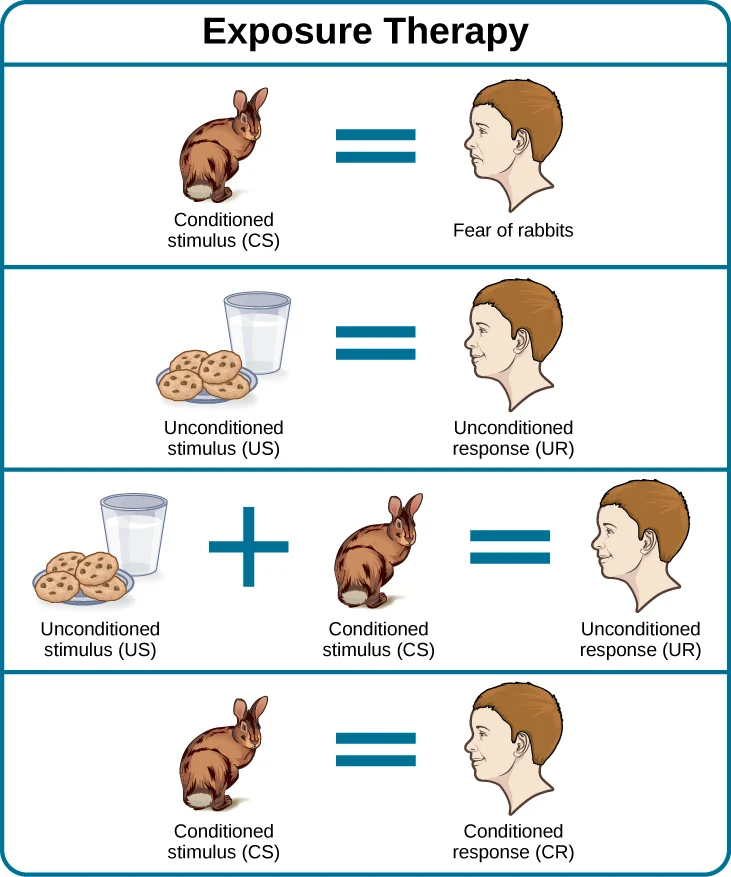
Mary Cover Jones (Peter and the Rabbit)
• Demonstrated fear reduction using:
o modeling (watching other children)
o counterconditioning (pairing rabbit with pleasant experience like food)
• Early example of behavior therapy and exposure therapy for counterconditioning
Behaviorism’s legacy
Watson changed psychology by:
1. shifting the goal toward prediction and control of behavior
2. making overt behavior the main subject of study
• Two types of behaviorism:
o radical behaviorism: rejects internal events as explanations
o methodological behaviorism: allows internal events, but they must be supported by observable evidence
William McDougall (a different kind of behaviorism)
• Also defined psychology as behavior science, BUT:
o emphasized purposive behavior (goal-directed)
o believed instincts motivate behavior (hormicpsychology)
• Supported internal mental events as real, studied through behavior → methodological behaviorist
Main contrast:
Watson = learning + environment + S–R focus
McDougall = instincts + goals + purposive action
B.F. Skinner and operant conditioning
American psychologist (1904–1990).
Radical behaviorism → experimental analysis of behavior.
Focuses on operant behavior (spontaneous, shaped by consequences).
Operant conditioning
Basic processes:
Positive reinforcement.
Negative reinforcement.
Punishment.
Extinction.
Reinforcement schedules: continuous, intermittent, ratio, interval.
"Operant behavior is modified by its consequences." (Skinner, 1953).
Applications of behaviorism
• Education: programmed learning, teaching machines (Skinner).
• Behavioral therapy: systematic desensitization, token economy.
• Experimental and animal psychology: basis of behavioral neuroscience.
• Advertising and marketing: stimulus association, reinforcement.
Criticisms of behaviorism
• Reductionism: ignores internal processes.
• Language, creativity, and motivation: cannot be explained solely by reinforcement.
• Ethics: concern about social manipulation.
• Cognitive reaction (1950s–1960s): return to the study of the mind.
Important terms
• Behaviorism transformed psychology into an experimental science of behavior.
• Watson: program → Pavlov: classical conditioning → Thorndike: law of effect → Skinner: operant conditioning.
• Contributions: education, clinical practice, research.
• Limitations: reductionism and neglect of internal processes.
• Current relevance: behavior analysis and evidence-based therapies.
• Behaviorism: the study of observable behavior.
• Classical conditioning: learning by association.
• Operant conditioning: learning by consequences.
• Reinforcement: increases the likelihood of behavior.
• Punishment: reduces the likelihood of behavior.
 Note
Note  Flashcards (22)