4.2.4.2 - Commercial banks & Investment banks
 Call Kai
 Learn
Learn Practice Test
 Spaced Repetition
 Match
Match Flashcards
 Knowt Play
1/21

There's no tags or description
Looks like no tags are added yet.
Name | Mastery | Learn | Test | Matching | Spaced | Call with Kai |
|---|
No analytics yet
Send a link to your students to track their progress
22 Terms
Functions of Commercial Banks
Primary Functions:
Accepting deposits
Lending
Providing efficient means of payment (facilitating transfer of funds)
Credit Creation - by using deposits to make new loans, commercial banks create credit and increase the money supply in the economy
Secondary Functions:
Providing financial advice
Providing foreign exchange
Functions of Investment Banks
Ensures the availability of capital for firms, governments & other entities
Prop Trading
Market Making
M&A
New Issues
UK Big Four Banks
HSBC
Barclays
Lloyds
NatWest
Balance Sheet =
Summary of assets & liabilites of a business
Asset =
What an individual/household/firm owns
Liability =
What an individual/household/firm owes
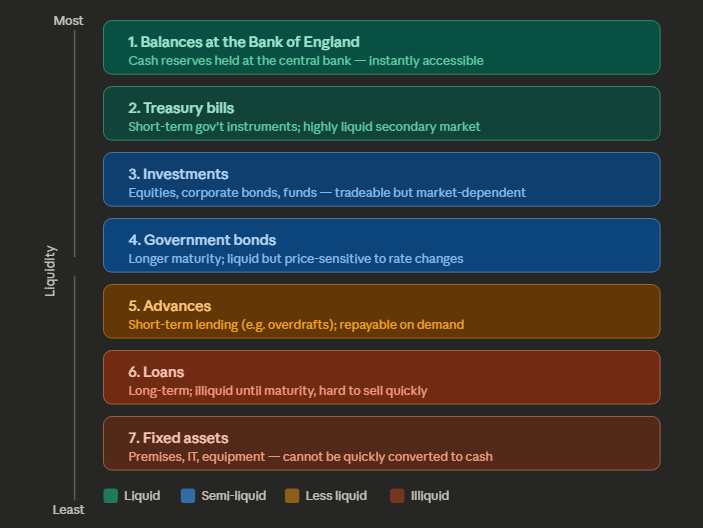
Commercial Bank’s Assets ranked by liquidity
Most Liquid
Cash
Balances at the Bank of England - cash reserves held at central bank - instantly accessible
Treasury Bills
Government Bonds
Investments
Advances - short-term lending (e.g. overdrafts) - repayable on demand, but can’t easily be sold on markets
Loans - long-term lending - repaid on fixed date, can’t easily be sold on markets
Fixed Assets
Least Liquid
Commercial Bank’s Liabilities
Customer Deposits (current accounts, savings accounts) - money owed back to customers
Borrowings from other banks
Share Capital - money raised by issuing shares
Capital Reserves (retained profit)
Bonds & debt securities Issued - owes interest & principal repayment
If a bank makes a new loan to a customer, what happens to the bank’s liabilities & assets?
Bank’s Liabilities INCREASE
Banks Assets INCREASE
Money Supply INCREASES
This is because transactions typically create both an asset & liability.
The loan acts as an asset because it is an agreement of repayment w/ interest by the borrower
Also a liability because the bank owes that money to the customer’s deposit account
Why is having more capital on a bank’s balance sheet safer?
Having more capital means the bank can absorb more losses on its assets
If the bank’s assets falls by more than its capital, it will be bankrupt.
Objectives of a Commercial Bank
Liquidity
Profitability
Security
Conflict between objectives of Profitability & Liquidity
Liquid assets generally yield a lower rate of return than more illiquid ones.
Banks therefore want to make profits by seeking investment opportunities & lending money out rather than holding cash that is not generating any returns.
However, banks have a need for liquidity as they must hold enough cash/liquid assets to meet the daily requirements of customers to make withdrawals.
Conflict between objectives of Profitability & Security
Banks may seek more risky investment opportunities & unsecured loans for higher returns, but this threatens the security & stability of the banks.
How do commercial banks make profit?
By charging higher interest rates on loans than what it pays on deposits
Vickers Rule
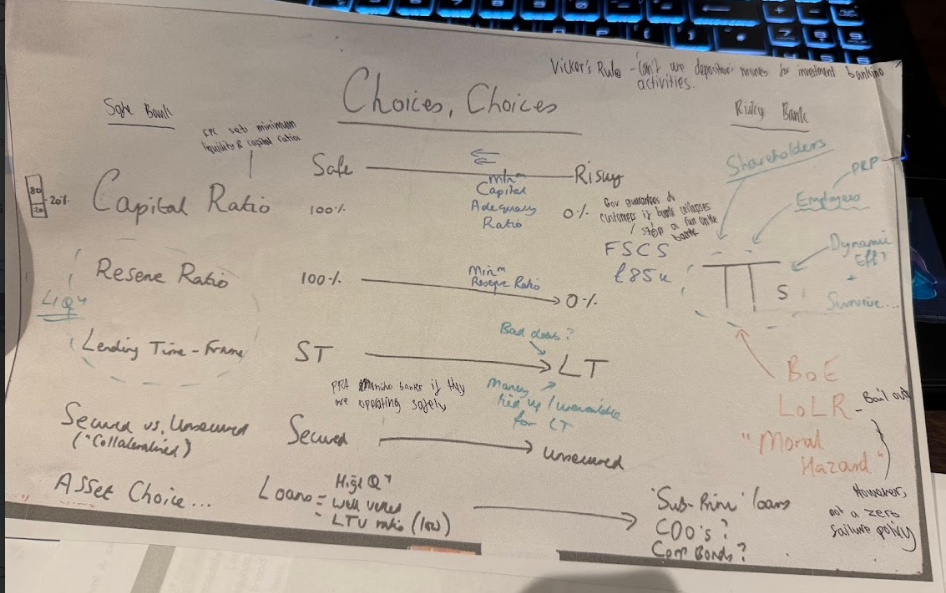
UK banks legally have to separate their retail deposit-taking businesses from investment banking operations.
i.e. can’t use depositors’ money for investment banking activities
Improves financial stability
‘Run on the Bank’ =
When a large number of customers simultaneously withdraw their deposits due to fears that the bank is, or is about to become, insolvent
Financial Services Compensation Scheme (FSCS)
Government guarantee to customers that if a bank fails, it covers up to £120,000 per person per firm.
Protects consumers’ deposits, maintaining confidence so reduces chance of a ‘run on the bank’
Bank of England ‘Lender of Last Resort’
BoE provides emergency liquidity to banks during crises, effectively bailing them out.
Prevents bank failures
However, moral hazard means banks may take advantage of this by taking risks knowing they will be bailed out if they fail.
Therefore, BoE employs a ‘not a zero failure’ policy, allowing some banks to fail if they do not affect the larger financial system.
Safe vs Risky Bank Summary Diagram
How banks create credit
*
Shadow Banking Sector =
= Financial intermediaries that provide credit (lend), but are not subject to regulatory oversight
Adds systemic risk as it is unregulated, so involves higher risk such as excessive leverage, inadequate liquidity.
Examples of Shadow Banking Entities
Hedge Funds
Private Equity Firms
Loan Sharks

