BIOL 1412 Nervous system IV
 Studied by 0 people
 Call with Kai
 Learn
Learn Practice Test
 Spaced Repetition
 Match
Match Flashcards
 Knowt Play
1/124

Earn XP
Description and Tags
LECTURE 6
Name | Mastery | Learn | Test | Matching | Spaced | Call with Kai |
|---|
No analytics yet
Send a link to your students to track their progress
125 Terms
What are the effectors of the ANS?
Smooth and cardiac muscles, glands
What 2 neurons are involved to the effector in the ANS?
Preganglionic + postganglionic
How can ANS neurons be distinguished by?
Type of nt released
What 2 types of nt distinguish ANS neurons?
Cholinergic + adrenergic
Cholinergic refers to which nt?
ACh (Acetylcholine)
Adrenergic refers to which nt?
Norepinephrine (NE)
What are the 2 subdivisions of the ANS?
Sympathetic + parasympathetic
What is the function of the sympathetic NS?
Prepares the body for activity
What is the “response” of the sympathetic NS?
Fight or flight
When is the sympathetic NS activated?
During exercise
In the SNS, axons exit the CNS via what?
Spinal nerves
At a ganglion involved with the SNS, which nt is involved?
ACh
At the effector involved with the SNS, which nt is involved?
NE
As an exception, what nt is present at the effector involved with the SNS if it is a gland?
ACh (instead of NE)
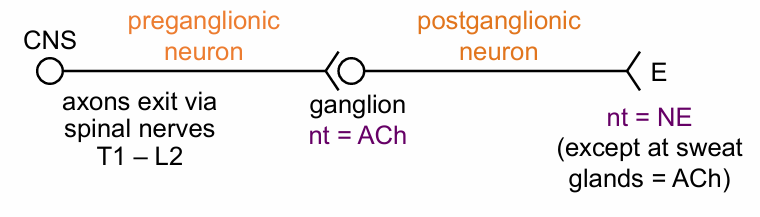
In the SNS, how must a chemical stimulation of a postsynaptic cell be stopped?
Nt must be broken down or removed
To stop chemical stimulation of a postsynaptic cell, ACh must be broken down by what enzyme?
Acetylcholinesterase (AChE)
On what surface must ACh be broken down by AChE?
Postsynaptic membrane
What IS a postsynaptic membrane made of?
Cell body/dendrites of postganglionic neuron (or effector cell)
Once ACh is broken down by AChE, where is there a NE reuptake?
At presynaptic membrane
Once there is an NE reuptake at the presynaptic membrane, it is then broken down by what enzyme?
Monoamine oxidase (MAO)
What is the function of the parasympathetic NS?
Rest & digest
What subdivision of the NS does “housekeeping” refer to?
Parasympathetic NS
Where are cell bodies involved with the parasympathetic NS located?
In brain stem or sacral spinal cord
In the parasympathetic NS, the nt at the ganglion cell AND effector is the same. This nt is?
ACh
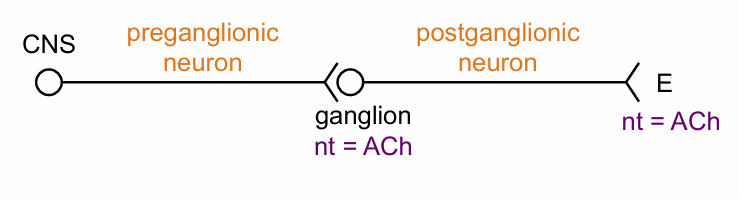
Where do most organs controlled by ANS receive input from?
Both SNS and PSNS
Most organs controlled by ANS, receiving input from both SNS and PSNS usually have _______ actions
“opposite”
ANS regulates internal processes continuously and ___________.
“automatically”
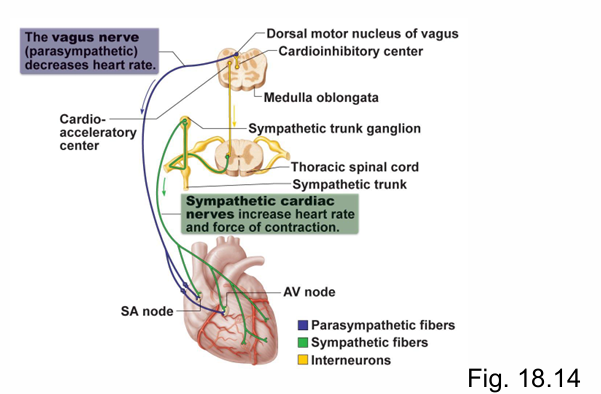
With the example of heart rate, which (SNS/PSNS) excites/inhibits?
SNS = excites
PSNS = inhibits
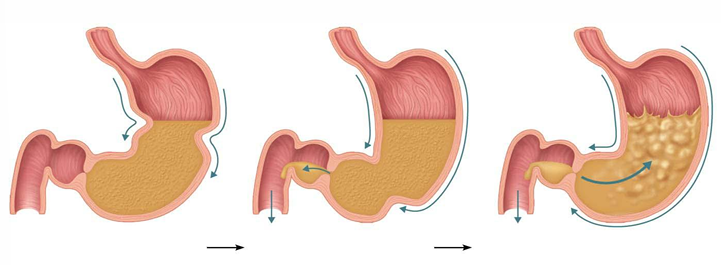
With the example of GI tract motility, which (SNS/PSNS) excites/inhibits?
SNS = inhibits
PSNS = excites
Which (SNS/PSNS) causes pupils of eyes to dilate/constrict?
SNS = dilate
PSNS = constrict
Which (SNS/PSNS) causes heart rate to increase + force of contraction?
SNS
If SNS increases heart rate (HR), what would PSNS do?
Decrease HR
As for the gastrointestinal tract (GI Tract), which (SNS/PSNS) increases/decreases motility?
SNS = decreases
PSNS = increases
Blood vessels are made of ______ muscle.
“smooth”
Which (SNS/PSNS) cause blood vessels to vasoconstrict (make it smaller so blood flows faster)?
SNS
The PSNS does not innervate blood vessels, except for what 2 places?
Erectile tissues
Which (SNS/PSNS) cause sweat gland secretion (hint: one of which has no innervation)?
SNS
Which (SNS/PSNS) causes digestive glands to increase/decrease secretion?
SNS = decrease
PSNS = increase
Which (SNS/PSNS) causes ejaculation?
SNS
Which (SNS/PSNS) causes erection and lubrication?
PSNS
SNS decrease secretion in the digestive glands, except for?
Saliva
T/F: Does the hypothalamus need cerebral input for its ANS functions?
No, but emotions can cause autonomic effects
What are 4 given examples of emotions that can cause autonomic effects?
Blushing, fainting, cold sweat, ⬆HR
What is the path of the higher control of ANS (cerebrum → ? → ? → ?)?
Cerebrum → hypothalamus → medulla oblongata → ANS
In the higher control path of the ANS, when the path reaches the ANS, it splits off into 2 paths towards what 2 subdivisions?
SNS + PSNS
The somatic NS transmits signals from CNS to the _______ system.
“skeletal”
In the somatic NS, to reach the effector/skeletal muscle, what neurons carry the signal from the “CNS (brain) → CNS (spinal cord),” and CNS (spinal cord) → E,” respectively?
“CNS (brain) → CNS (spinal cord)” = upper motor neuron
“CNS (spinal cord) → E” = lower motor neuron
What are the 3 types of movement in the somatic NS?
Reflexes, voluntary, rhythmic
What are the 2 types of reflexes in the somatic NS?
Spinal + postural
Which is least complex, spinal or postural reflexes?
Spinal
What do spinal reflexes require sensory input from (3)?
Sensory neurons like proprioceptors (e.g. muscle spindles) + pressure/pain receptors
Postural reflexes maintain what 2 things?
Balance + posture
What do postural reflexes require sensory input from (3)?
Like proprioceptors (e.g. muscle spindles), eyes, inner ear
Which type of movement in the somatic NS is most complex?
Voluntary movement
With voluntary movement, no ______(internal/external) stimuli is required
“external”
Walking and running are described in which of the 3 types of somatic NS movement?
Rhythmic movement
Rhythmic is a combination of what 2 movements?
Reflexive and voluntary movements
See the flip side
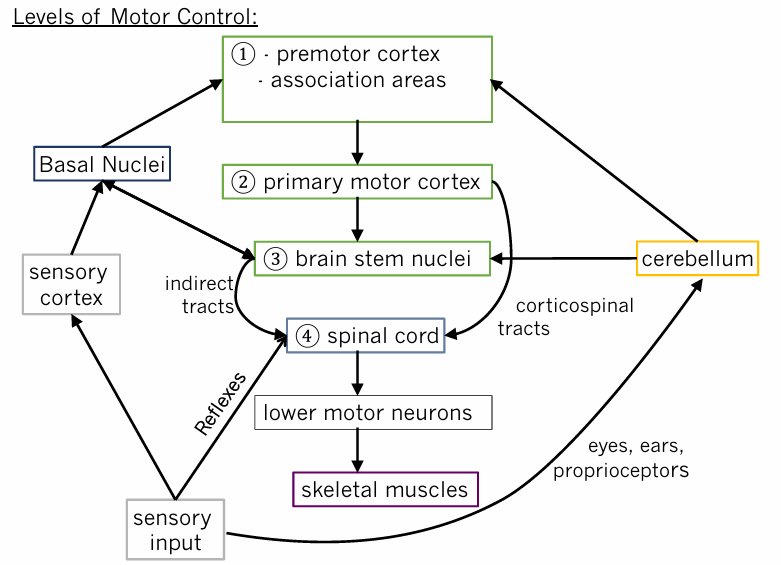
What are the 6 levels of motor control?
Planning (Level 1), Level 2, Level 3, Spinal Cord (Level 4), Cerebellum, Basal Nuclei
What does the (Level 1) planning level of motor control plan the sequence of?
Muscle contractions
What cortex in the brain does the (Level 1) planning level of motor control signal to?
Primary motor cortex
The (Level 1) planning level of motor control works with input from what brain region?
The cerebellum
What is unique about level 2 and 3 of motor control?
They involve descending tracts → lower motor neurons
In level 2 of motor control, signals are directly sent to lower motor neurons via what tract?
Corticospinal tract
For what purpose are signals sent directly to lower motor neurons via the corticospinal tract?
For fine skilled movements
In level 3 = ? → descending motor tracts → ?
Brainstem nuclei → descending motor tracts → lower motor neurons
In level 3, “brainstem nuclei → descending motor tracts → lower motor neurons” is a representation of ______ tracts
“indirect”
From what 3 brain parts/regions does the 3rd level of motor control receive input from?
Cortex, basal nuclei, cerebellum
The 3rd level of motor control is involved in coordination of large muscle groups for what 2 functions?
Maintenance of posture + locomotion
The 4th level of motor control is the spinal cord, which contains cell bodies of what kind of neuron?
Lower motor neurons
Level 4 (Spinal cord) of motor control contains central pattern generators (CPGs). What are these?
Network of neurons which set rhythmic, repeated movements
For central pattern generators (CPGs) to begin/stop movement, what do they require?
Cortical signals
The cerebellum has a role in planning + initiating movement by communicating with what areas?
Cortical areas
What does the cerebellum store?
Planned movement
The cerebellum stores planned movement and compares what?
Actual to plan
Where does the cerebellum use sensory input from, for example?
Proprioceptors
What 3 things does the cerebellum have a maintenance function for?
Balance, eye movements, muscle tone
What does low level of contraction mean for the cerebellum maintaining muscle tone?
There is a constant, slight contraction in your muscles even when you’re relaxed.
What 2 things does the cerebellum coordinate?
Skilled voluntary muscle movements
Timing of contractions involved >1 joint
Basal nuclei aid in _________ movement
“planning”
What does basal nuclei suppress?
Unwanted motions (e.g. at rest)
What does basal nuclei have a role in maintaining?
Muscle tone
The corticospinal (direct) pathway signals from ? → ?
Cortex → skeletal muscle
What are the 2 types of neurons involved with the corticospinal (direct) pathway?
Upper motors neurons + lower motor neurons
Where are the cell bodies of upper motor neurons located?
Primary motor cortex
Where are the axons of upper motor neurons?
Down spinal cord
Where are the cell bodies of lower motor neurons located?
Ventral horn of spinal cord
Where do the axons of lower motor neurons exit via?
Spinal nerves
What are the 2 clinical applications of the somatic NS?
Destruction of upper motor neurons
Destruction of lower motor neurons
Reflex arcs are still present in the destruction of upper motor neurons. What does this mean?
Reflex arcs between sensory and lower motor neurons are still present
What 2 results can the destruction of upper motor neurons lead to?
Spastic paralysis + exaggerated reflexes
In spastic paralysis, the presence of what increases muscle tone?
Reflex arcs
What is meant by “no muscle atrophy”, a feature of spastic paralysis?
The muscle doesn’t waste away/shrink (because constant reflexes keep it active)
What are 3 given examples of exaggerated reflexes?
Patellar, Achilles, Babinski sign
A loss of ________ signals to _____ motor neurons causes exaggerated reflexes.
“inhibitory,” “upper”
What is a strong example of a reflex that can test damage to upper motor neurons?
Plantar reflex
What does the plantar reflex entail?
Scratching the sole of ones foot
What is the Babinski sign when attempting to trigger the plantar reflex?
An extension of the big toe
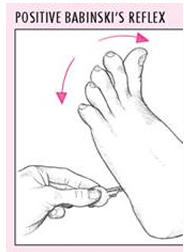
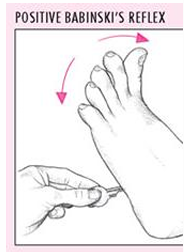
A positive Babinski sign indicates damage to upper motor neurons, except at what age where it is normal?
In babies
Why is a positive Babinski sign normal in babies?
Their corticospinal tract is not yet fully myelinated
 Note
Note  Flashcards (102)