plant physiology module 6
 Studied by 1 person
 Call Kai
 Learn
Learn Practice Test
 Spaced Repetition
 Match
Match Flashcards
 Knowt Play
1/16

Earn XP
Description and Tags
solute transport
Name | Mastery | Learn | Test | Matching | Spaced | Call with Kai |
|---|
No analytics yet
Send a link to your students to track their progress
17 Terms
active vs passive transport
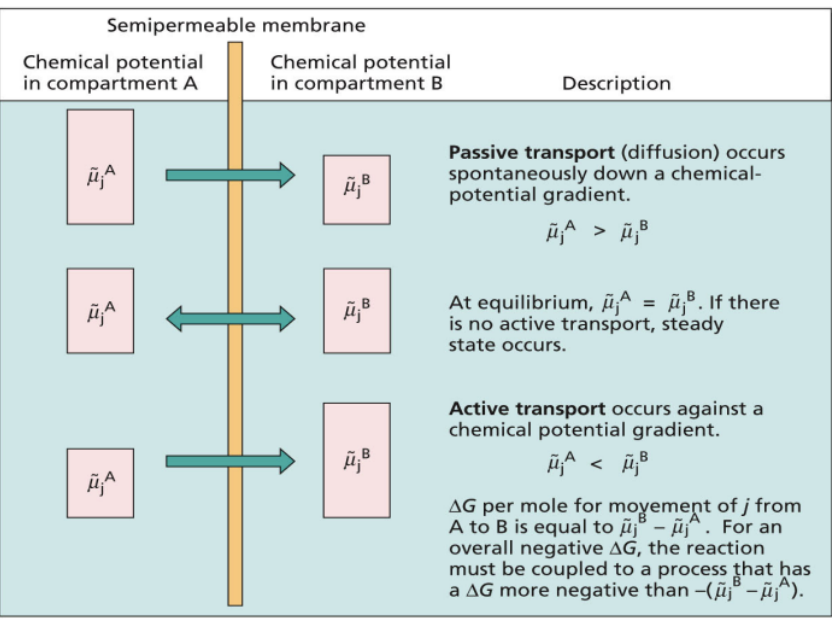
- Passive Transport: the movement of molecules occurs spontaneously, down a gradient of free energy or chemical potential (downhill)
- Active Transport: the movement of molecules against, or up a gradient of chemical potential. It is not spontaneous, and requires that work be done by using cellular energy
what is chemical potential?
- Is defined as the sum of the concentration, electrical, and hydrostatic potentials
- A sum of all the forces that may act on a molecule to drive net transport
Membrane permeability:
The extent to which a membrane permits the movement of a substance. It can be expressed in terms of a diffusion coefficient for the solute through the membrane
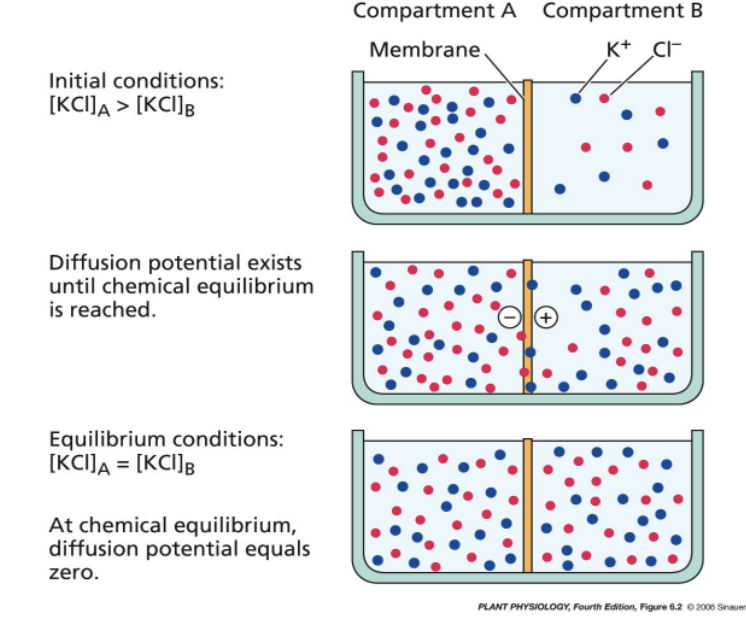
graphed out development of a diffusion potential and a charge separation between two compartments:
diffuse until equalib reached
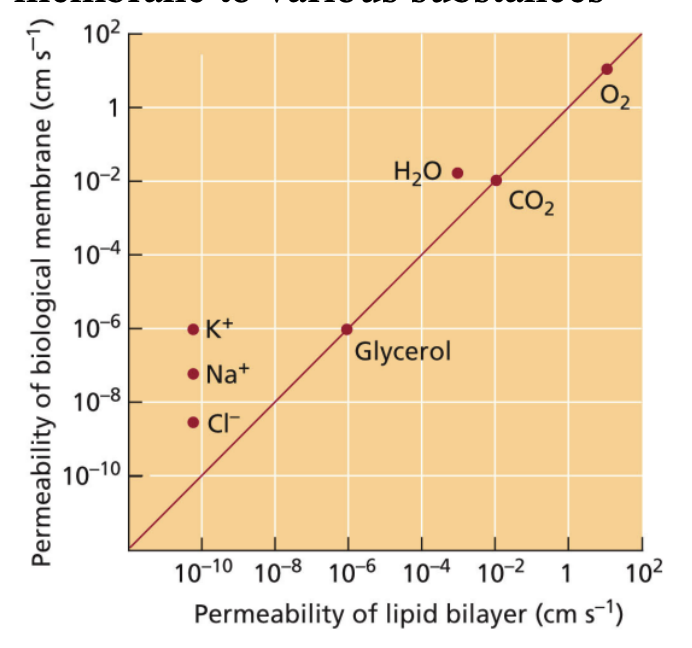
membrane permeability can impact what is able to diffuse
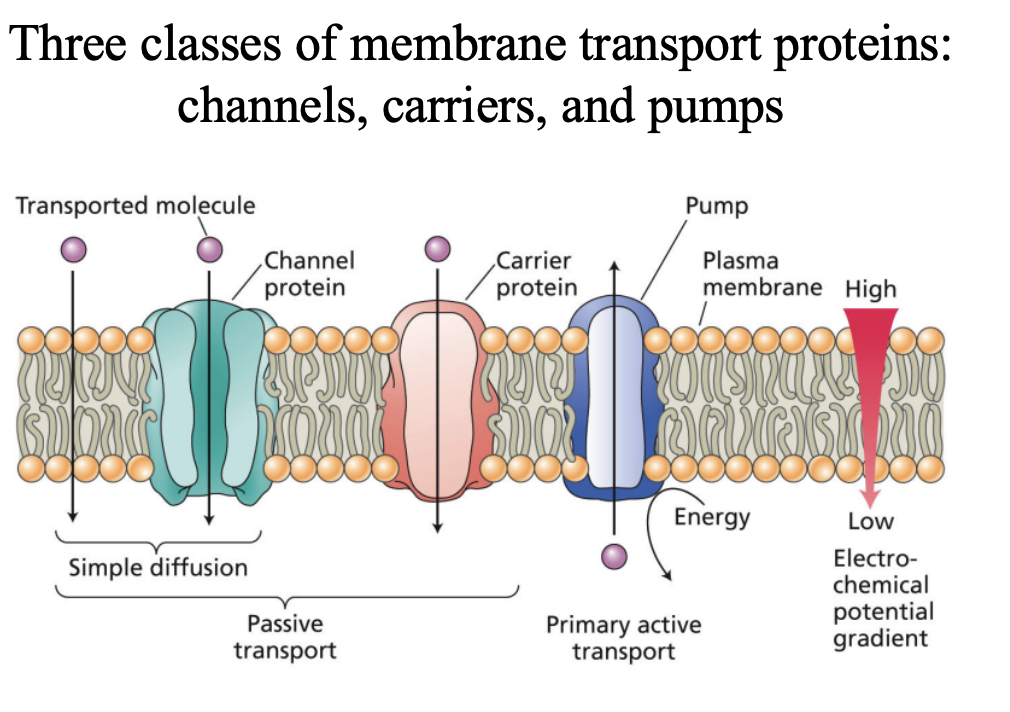
Membrane Transport Processes: transporter proteins (3)
which can go against electrochemical gradient?
Transport proteins on the biological membranes
- Channels
- Carriers
Passive transport
Active transport (Pumps - carriers that carry out primary active transport)
- Pumps
Typical values for the permeability, P, of a biological membrane to various substances
charged ions<non polar gasses
we need K+ more than Cl- thus, more perm
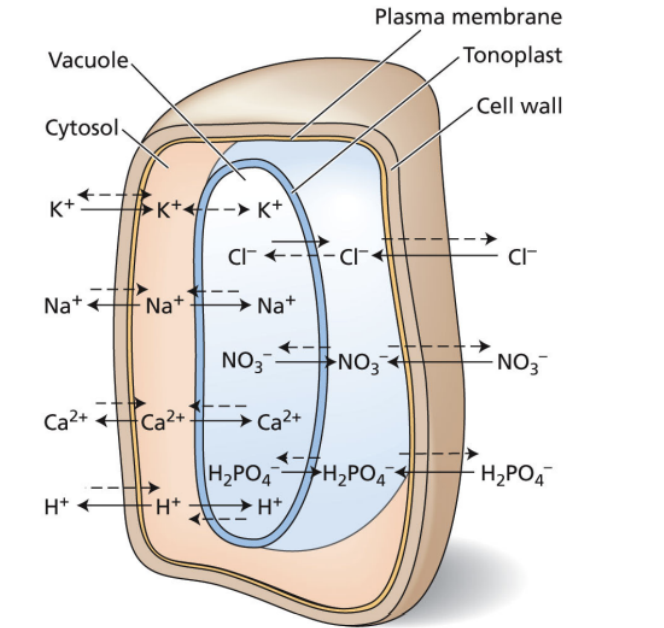
Ion concentrations in the cytosol and the vacuole
Controlled by both passive and active transport processes
solid arrow=active transport
dotted arrow=passive transport
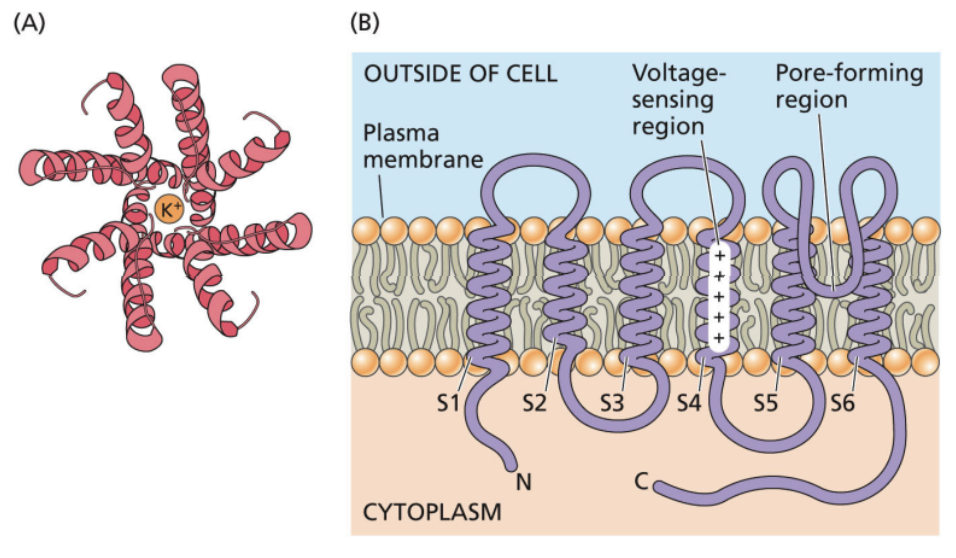
What are channel proteins?
- Transmembrane proteins that function as selective pores, through which molecules or ions can diffuse across the membrane
- Is passive
- The specificity of transport primarily depends on pore size and electric charge
- Is mainly limited to ions and water
- Channel transporters enhance diffusion across membranes
What are carrier proteins?
- It is not necessary to have pores that extend completely across the membrane
- The substance being transported by a carrier is bound to a specific site on the carrier protein
- Be highly specific due to binding requirement
- Specialize for specific ions or organic metabolites
- Binding causes a conformational change in the carrier, which exposes the substance to the solution on the other side.
- The rate of transport much slower than through a channel
primary active transport: definition, E, what is transported
- Is coupled directly to a source of energy, such as ATP hydrolysis, an oxidation-reduction reaction, or the absorption of light by the carrier protein
- Carry out by pumps (membrane proteins)
- H+, Ca2+, or large organic molecules
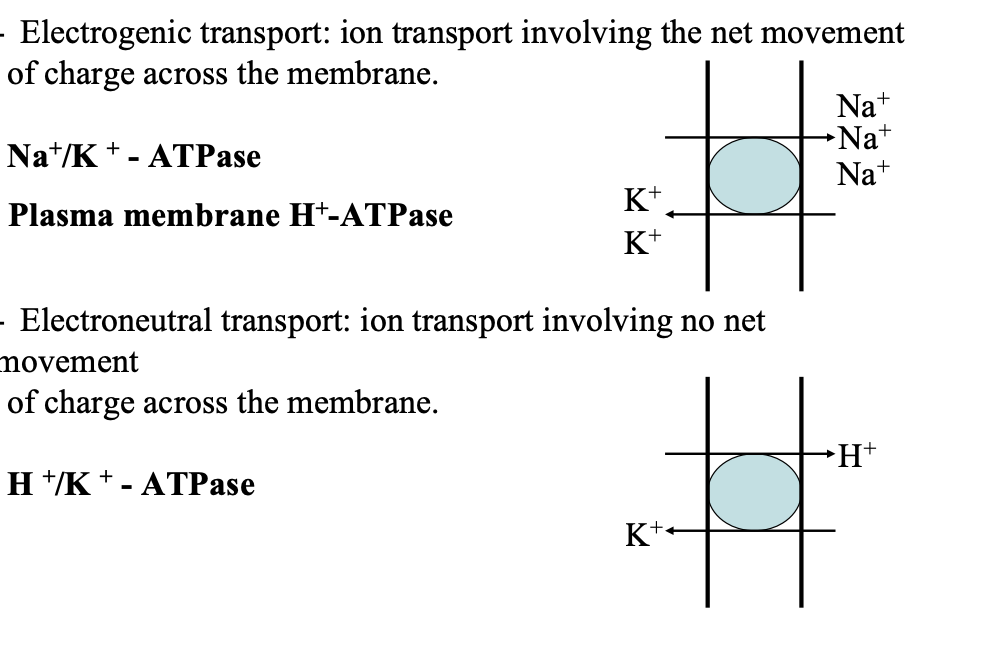
ion pumps: electrogenic transport and electroneutral transport
- Electrogenic transport: ion transport involving the net movement of charge across the membrane.
Na+/K + - ATPase
plasma memb H+-ATPase
- Electroneutral transport: ion transport involving no net movement of charge across the membrane.
H +/K + - ATPase
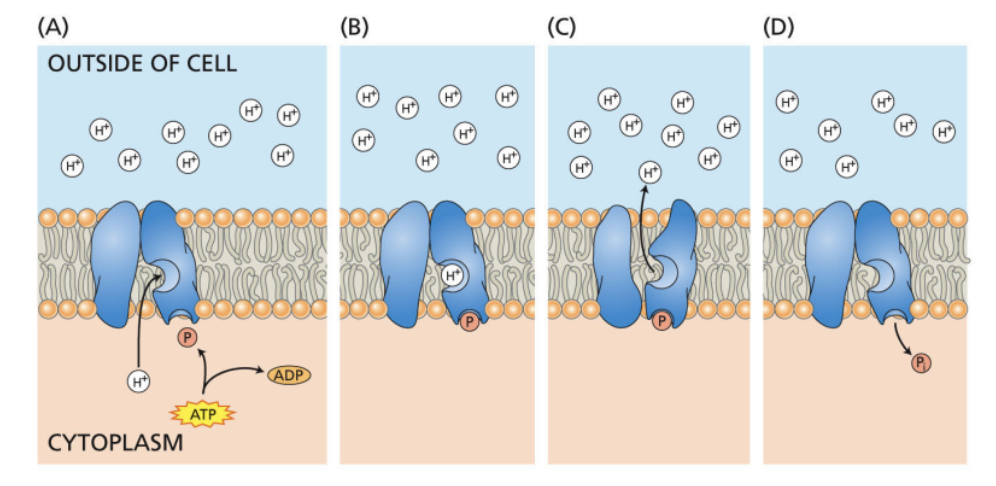
Hypothetical steps in the transport of a cation against its chemical gradient
able to pump against gradient bc of ATP hydrolysis providing E input
makes outside of cell more acidic, making its cell wall softer and allowing expansion
Secondary Active Transport
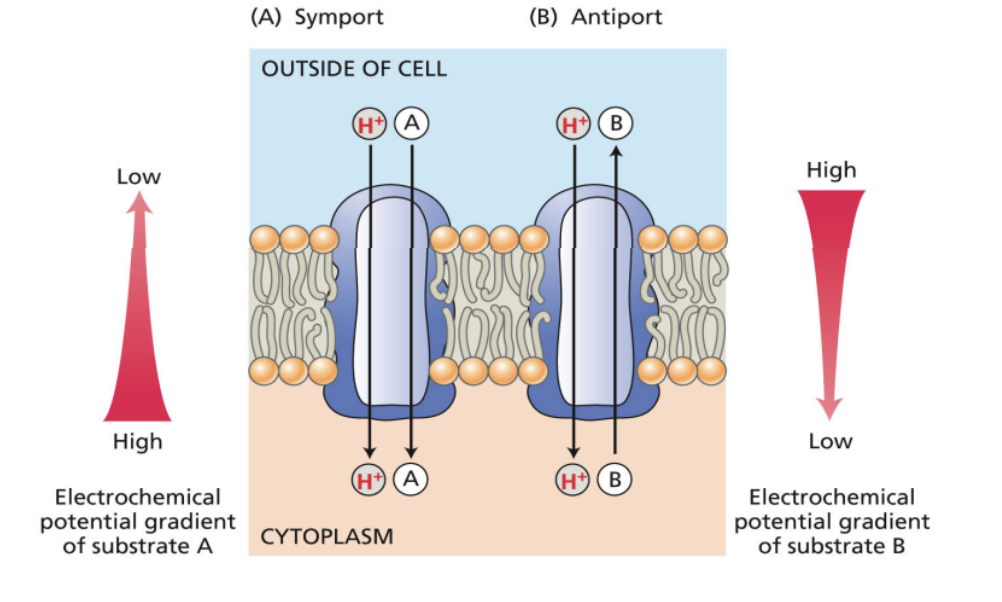
symport vs antiport
- Uses stored energy,
- The energy driving the transport is provided by the proton motive force rather than directly by ATP hydrolysis
- Symport (Symporter): the two substances move in the same direction through the membrane
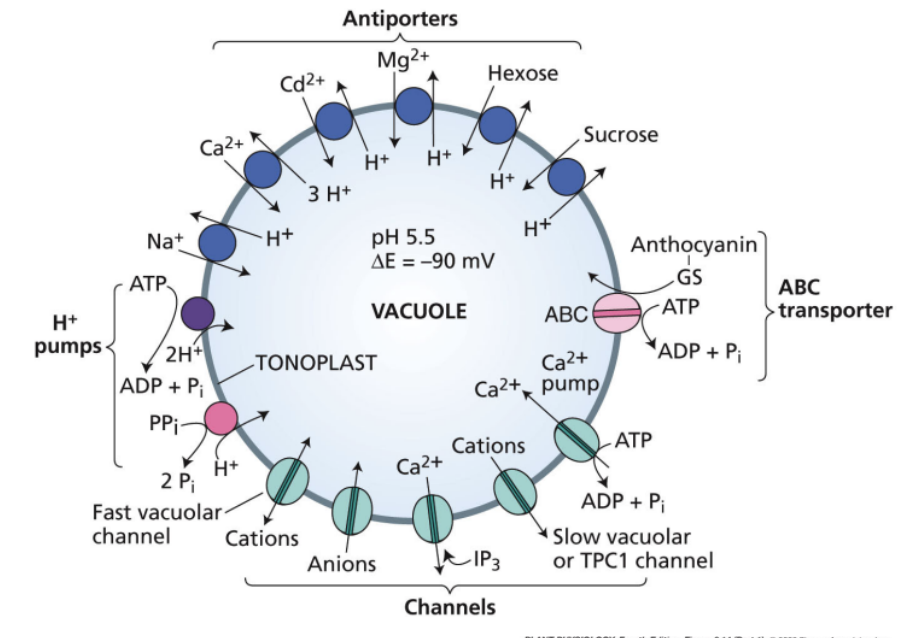
- Antiport (Antiporter): a coupled transport in which the energetically downhill movement of protons drives the active (energetically uphill) transport of a solute in the opposite direction.
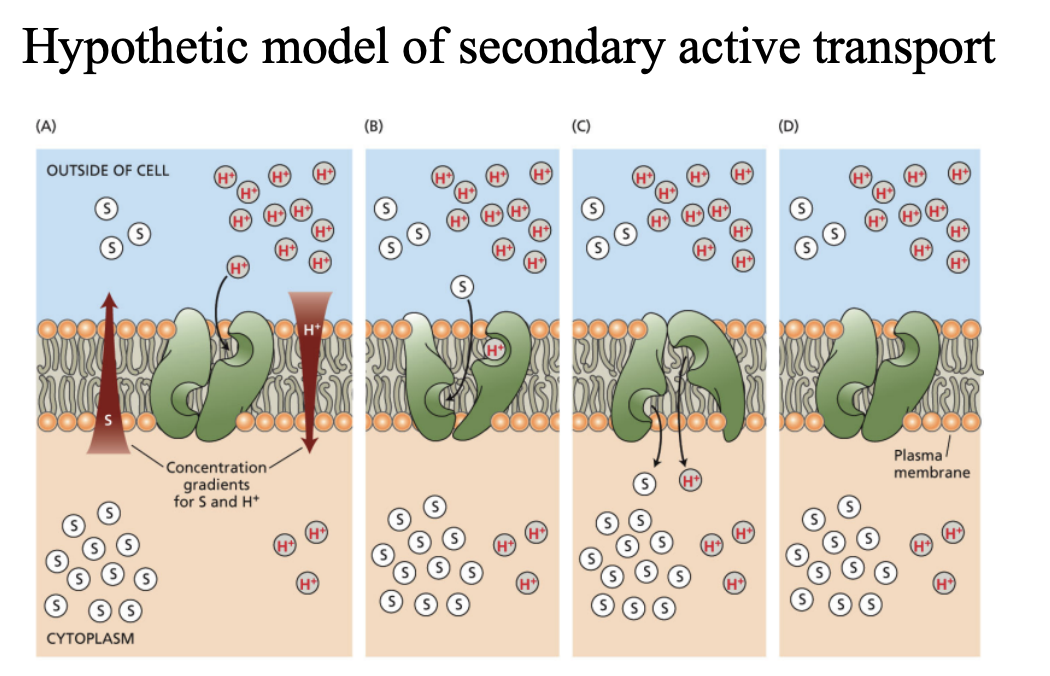
2 examples of secondary active transport coupled to a primary proton gradient
symport and antiport brings molec in against its gradient without use of ATP
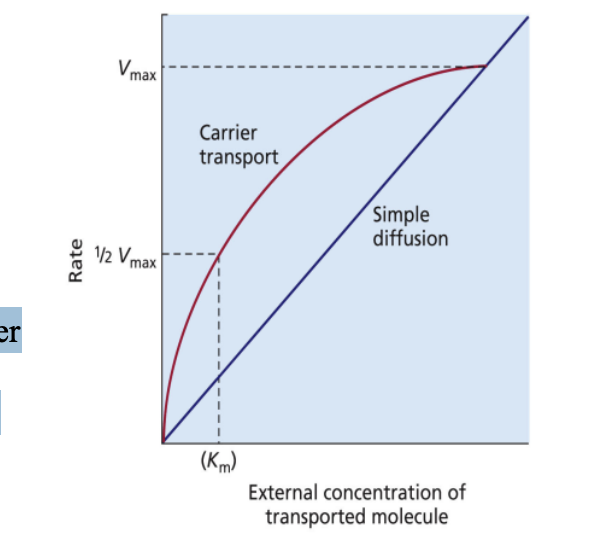
saturation kinetics (Vmax means what)
Carrier transport often shows saturation kinetics (Vmax)
Vmax cannot be exceeded
When the substrate-binding site on the carrier is all occupied, Vmax is approached
Vmax is an indicator of the number of molecules of the specific transport protein in the membrane
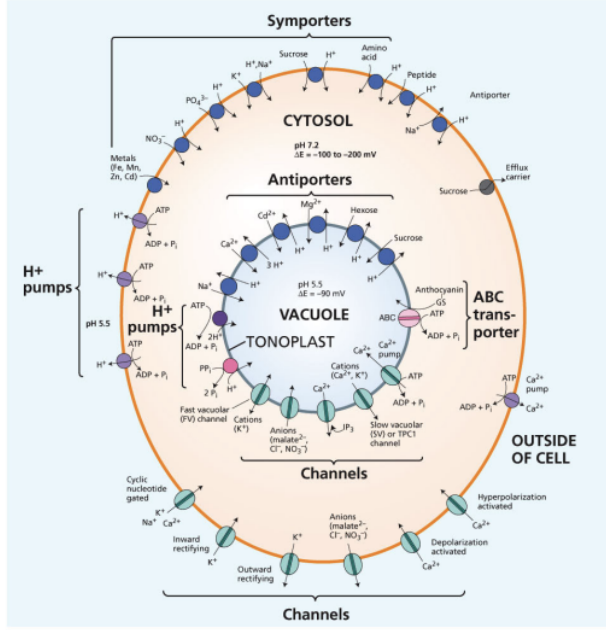
Overview of the various transport processes on the plasma membrane and tonoplast
aquaporins
cation transporters (2)
what compound is common for needing transporter in plants
- Genes encoding many transporters have been identified
- Transporters exist for diverse nitrogen-containing compounds
- Cation transporters are diverse
Cation channels: 56 genes in Arabidopsis
Cation carriers: a variety of ion carriers exist in plant cells
- Anion transporters have also been identified in plants
- Aquaporins might transport uncharged solutes
What Is Photosynthesis?
Means literally “synthesis using light”
- Organisms (Plants & some Bacteria) use solar energy to synthesize carbohydrates and generate oxygen from carbon dioxide and water

 Note
Note  Flashcards (25)